


INTRODUCTION TO THE GOSPEL OF JOHN
AUTHORSHIP AND DATE
The gospel itself is anonymous but the author is identified as “the disciple whom Jesus loved” (21:20). In spite of modern speculations to the effect that this “disciple” may have been Lazarus (11:3,36), an entire community or someone else, the consistent and reliable tradition of the early Fathers is that John of Zebedee was in fact the apostolic origin of the Gospel which now bears his name. There are indications that the author may have been a (Jewish) priest,920 a view which is not incompatible with John’s occupation as a fisherman and which harmonizes well with the focus of the Gospel (Jerusalem, Feasts, Temple). In the late second century, St. Polycrates of Ephesus evoked the not-so-distant memory of the Apostle John with these words:
There is also John, who leaned on the Lord’s breast who was a priest wearing the petalon (high-priestly miter or crown), a witness and a teacher, and he sleeps at Ephesus.921
Early Christians (including Theophilus of Antioch, Irenaeus of Lyons and Clement of Alexandria) have handed down a consistent tradition indicating that John would have written his gospel in Ephesus, around the year 96.922 Based on internal evidence (such as 5:2 “there is in Jerusalem”), some scholars also deem it possible that the fourth gospel was written before the year 70 AD and completed (or published, or released to other Churches) at a later time.
As we shall see in our mention of the parallelism between Jacob/Israel and Jesus, as well as the successive theme of Joseph (of Genesis) and the Beloved Disciple, there seems to be an intentional focus on a symbolic and anonymous authorship. This is of course consistent with the unnamed authorship of the other gospels and serves to draw the reader’s attention on the one who is seen in glory (Jesus) as opposed to the one who bears witness.
On the basic of linguistic data, a few scholars have suggested that the fourth gospel may have been originally written in Aramaic/Hebrew or directly in Greek but with an Aramaic/Hebrew mind. However, we shall also note important similarities between the Gospel of John and Jewish Hellenistic themes, notably those of Philo of Alexandria (20 BC – circa 50 AD).923
THEME(S)
The High Priestly Gospel
This gospel can be called “the High Priestly” Gospel, not only because of the famous prayer known by that name found in chapter 17, but also because this theme and approach runs throughout this unique gospel.
St. John reveals the truth about Christ by “drawing aside the curtain”924 on the person (hypostasis) of the Great High Priest who is the pre-eternal Word (logos925) of God. It is for this reason that the early Churches considered this gospel as reserved for those who are initiated or about to be initiated in the Holy Mysteries: to this day (in Orthodox practice,) it is only read during and after the baptismal season of Holy Pascha. This is consistent with the theme of mystery, initiation and intimate knowledge which is recurrent in the fourth gospel.926
The manifestation in this world of the High Priest consecrated as the Holy One of God is the fulfillment of God’s revelation: the invisible Most High God is made manifest and “explained” or “exegeted” (1:18) by his very Word who shares his divine and uncreated nature. Thus, the God who had no visible form on Mount Sinai (Deut. 4:12,15) is now seen with human eyes: “we have seen his glory” (1:12;12:41).
From the eternal and timeless holy of holies,927 one’s perspective is quite different. One comes to Christ if drawn by the Father by whom we are “fully known” or ‘foreknown’ (1Cor. 13:12). Hence, such passages as John 6:37–44 or 10:36 can only be rightly understood by those who live in the Church and who have experienced the fulfilled eschatology of the Kingdom in the Divine Liturgy (see Introduction to Revelation).

A representation of Jacob’s vision where the ladder is understood as the Temple
The high priestly theme is also connected with the gospel’s interest in the Temple or House of God, which is ultimately revealed as the Body of Christ (John 2:16–21).
Jesus and Jacob – Wisdom for the Journey
From this emphasis on the Temple or House of God (Bethel in Hebrew), we discover that this priestly theme of divine ascent (and descent) is echoed in the Gospel’s parallelism between Jacob-Israel and Jesus.
| Jacob – Israel | Jesus Christ |
| “He had a dream in which he saw a stairway resting on the earth, with its top reaching to heaven, and the angels of God were ascending and descending on it”. (Gen. 28:12) | “[Jesus] saith to [Nathaniel]: Amen, amen, I say to you, you shall see the heaven opened and the angels of God ascending and descending upon the Son of man.” (John 1:51) |
| Jacob and the well (Genesis 29). Note that wisdom is associated with water in many passages, e.g. Prov. 18:4; Sirach 15:1–3928; 24:21–34929 | “[Jesus] came to a town in Samaria called Sychar, near the plot of ground Jacob had given to his son Joseph… [The woman at the well asked:] Are you greater than our father Jacob?” (John 4:5,12) |
| Wisdom gives Jacob signs on the journey (Wisd. 10:9–12). | The ‘signs’ (σημεῖα) or divine acts on the Lord’s journey to Jerusalem |
| “I, [Jacob] may return to my father’s house in peace” (Gen. 28:20) | “In my Father's house there are many mansions.” (John 14:2) “Do not make my Father’s house a marketplace!” (John 2:16) |
| “[Jacob] was afraid, and said: “how fearful is this place! this is none other than the house of God, and this is the gate of heaven” (Gen. 28:17) | “I am the gate; if any one enters by me, he will be saved, and will go in and out and find pasture.” (John 10:9) |
| “Your name will no longer be Jacob, but Israel,930 because you have struggled with God and with men and have overcome… So Jacob called the name of the place Peniel, saying, «For I have seen God face to face, and yet my life is preserved.” (Gen. 32:28–30) | The theme of “seeing” in John’s gospel: John 1:18, 34, 51; 3:3; 6:46; 11:40; 14:7– 9 |
| “Twins” (Gen. 25:24) | John 11:16; 20:24 (references to “a twin,” the only instance in the Bible apart from Jacob’s family). |
| “If God will give me bread to eat” (Gen. 28:20) | Bread as the central theme of John 6 |
Another related theme may be that of a special beloved successor to Christ-Israel, as Joseph was Jacob’s beloved whose sevenfold blessing foreshadows the fullness of truth, intimacy and of the Holy Spirit manifested by the beloved disciple. Sonship is expressed by the “closeness to the bosom”931 as is the privilege of that disciple:
One of his disciples, whom Jesus loved, was lying close to the breast of Jesus. 24 So Simon Peter beckoned to him and said, “Tell us who it is of whom he speaks”. 25 So lying thus, close to the breast of Jesus, he said to him, «Lord, who is it?”
Hence, even Peter, the Rock who may perhaps be compared to Judah932 must ask this ‘Joseph-like’ disciple to obtain the great secret of the Lord’s betrayal. It is this same disciple who first believed that Jesus had risen from the dead (20:4–8) and who recognized the risen Lord on the lake side (21:7).
As Joseph Grassi suggests: “the gospel descriptions envisage a father-son relationship modeled on that between Jesus and his own Father… Putting it all together, we would have the succession: God the Father – beloved son Jesus – beloved disciple and son”.933
This is also a way to understand the entrusting of Mary to the disciple and of the disciple to the Lord’s mother. The sonship relationship is thus continued and the mother of the Lord is again the icon of Wisdom, as in Revelation 12.
Genesis and Creation recapitulated
As in Revelation, the patterns of the Old Testament are continued and fulfilled: John 1 is symmetrical to Genesis 1 and culminates in the Lord’s baptism which marks the beginning of the New Creation:
| Old Creation – Temporal | New Creation – Eternal |
| “In the beginning”934 (Gen. 1:1) | “In the beginning” (John 1:1) |
| “The Spirit of God moved over the water” (Gen. 1:1) | “I have seen the Spirit coming down, as a dove, out of heaven, and it remained on him” (John 1:32) |
| “And God said…” (Gen. 1:3) | “a voice came from heaven which said” (Luke 3:22) |
| “Let there be light, and there was light” (Gen. 1:3) | “that was the true Light which gives light to everyone coming into the world” + Luke 3:20–23 and notes |
| “God separated the light from the darkness” (Gen. 1:4) | “everyone practicing evil hates the light and does not come to the light, lest his deeds should be exposed” (John 3:19) |
| Day One (Gen. 1:5) | Day One935 and the Eighth Day |
| Old Adam | New Adam936 (1 Co. 15:22,45) |
| Sabbath, seal of the old creation (Exodus 20:11) | The Lord’s Day, seal of the new creation (2 Co. 5:17; Gal. 6:15) |
The gospel of John is in many ways ‘a different gospel.’ Certain themes emphasized in the synoptics (parables, exorcisms, and parousia) are absent. Instead, the evangelist focuses on miracles (“signs”) not previously included and lengthy theological discourses.
Many biblical scholars see a threefold structure in the book and a parallel between Jewish liturgical feasts and their fulfillment by the Lord of Glory:
– The prologue about the Word
– Book of Signs (Seven Signs)
– Book of Glory, Last Teachings, Death and Resurrection.
The Seven Signs
Our presentation of the seven signs937 does not include the Lord’s walk on the water and suggests that the last sign is in fact the piercing of his side, which results in this remarkable structure:
The Wedding Feast at Cana (2:1–12)
The raising of the dying son (4:56–54)
The Sabbath healing at Bethseda (5:1–16)
Multiplication of bread / Bread of Life (6:1–71)
The Sabbath healing of the blind man (9:1–41)
The raising of Lazarus (11:1–41)
Blood and Water from the side (19:25–38)

Resurrection of Lazarus (Feast: Lazarus Saturday)
Rome, Via Latina Catacomb, 4th century

The Hospitality of Abraham
Andrei Rublev: Old Testament Trinity (c. 1410 CE; originally at the Holy Trinity Cathedral at the St. Sergius Holy Trinity Monastery; presently held the Tretyakov Gallery, Moscow)


The Great High Priest
Contemporary – Greek Style

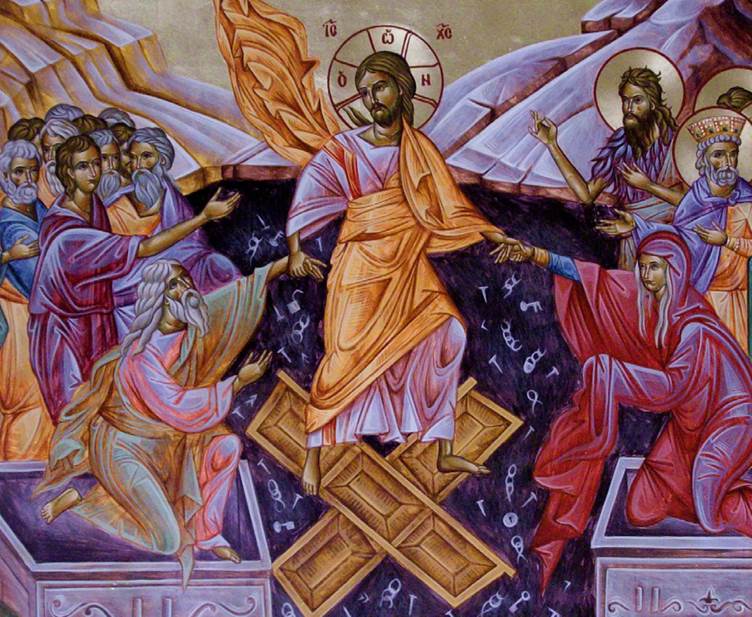
Χριστὸς ἀνέστη ἐκ νεκρῶν,
θανάτῳ θάνατον πατήσας
καὶ τοῖς ἐν τοῖς μνήμασι ζωὴν χαρισάμενος
The Resurrection of our Lord, God and Savior Jesus Christ (Pascha)
By the hand of Julia Hayes

* * *
Примечания
See Introduction to Revelation
Eusebius – Ecclesiastical History, 3.31.2–51
See also Introduction to Revelation for further discussion of the dating issue
The Gospel of John relies heavily of the LXX text of the Old Testament (92% LXX / 72% MT according to one study).
From the writing of St. Clement of Alexandria: “they do not enter in as we enter in, through the tradition of the LORD, by drawing aside the curtain” (Misc. 7.17) which is ‘temple imagery for access to the presence of God, the privilege of the high priest.’
Also meaning “Message”
Cf: Jerome H. Neyrey – The Sociology of Secrecy and the Fourth Gospel (electronic publication)
Cf: Margaret Barker – The Great High Priest (Continuum, New York, 2003), pp. 212–225
“The man who fears the Lord will do this, and he who holds to the law will obtain wisdom. She will come to meet him like a mother, and like the wife of his youth she will welcome him. She will feed him with the bread of understanding, and give him the water of wisdom to drink”.
“Those who eat me will hunger for more, and those who drink me will thirst for more”. Compare with the dialogue in John 4.
The view of Hellenistic Jews and of the Early Christians was that Israel meant “a human being who sees / has seen God” – see Traditions of the Bible by James Kugel
This theme starts with 1:18: “The unique Son who is in the bosom of the Father, he has explained him”
In the words of Joseph Grassi, “the holder of external authority”. Grassi is the author of the remarkable Secret Identity of the Beloved Disciple which provided important information for this section. See Appendix B.
Ibid., p. 52
There are good reasons to believe that Jesus was baptized right at the end of Sabbath on the first day, just as he also rose from the dead on the first day (the Lord’s Day).
Jesus triumphs over the old serpent in the desert immediately after his baptism to be revealed as the New Adam, which is why “immediately the Spirit drove Him into the wilderness” (Mark 1:12).
Based on Grassi, p. 68