


INTRODUCTION TO THE REVELATION OF JOHN
AUTHORSHIP AND DATE
Unlike the gospel, the book of Revelation or Apocalypse mentions the name of its author, “John” (1:1,4,9; 22:8). However, the exact identity of this ‘John’ was unspecified, leading to occasional speculations that the author was another John (i.e. “the presbyter John”) but not the apostle and beloved disciple. Already in the mid-third century, St. Dionysius of Alexandria could write:
Some before us have set aside and rejected the book altogether, criticizing it chapter by chapter, pronouncing it without sense or argument, and maintaining that the title is fraudulent. They say that it is not the work of John or a revelation, because it is covered thickly and densely by a veil of obscurity. [They affirm that its author is Cerinthus, who, desiring a reputable authority for his fiction, prefixed the name...] However, I could not venture to reject the book, as many brethren hold it in high esteem. But I suppose that it is beyond my comprehension, and that there is a certain concealed and more wonderful meaning in every part. Indeed, if I do not understand, I suspect that a deeper sense lies beneath the words. I do not measure and judge them by my own reason... I do not reject what I cannot comprehend, but rather wonder because I do not understand it.
Therefore that the author was called John, and that this book is the work of one John, I do not deny. And I agree also that it is the work of a holy and inspired man. But I cannot readily admit that he was the apostle, the son of Zebedee, the brother of James, by whom the Gospel of John and the Catholic Epistle were written. For I judge from the character of both and the forms of expression, as well as the entire execution of the book, that it is not his. For the evangelist nowhere gives his name, or proclaims himself, either in the Gospel or Epistle... In fact, he did not say, as often in the Gospel, that he was the beloved disciple of the Lord, or the one who lay on his breast, or the brother of James, or the eyewitness and hearer of the Lord. Certainly he would have spoken of these things if he had wished to reveal himself plainly. However, he says none of them; but speaks of himself as our brother and companion, and a witness of Jesus, and blessed because he had seen and heard the revelations. So, I am of the opinion that there were many with the same name as the apostle John, who, on account of their love for him, and because they admired and emulated him, and desired to be loved by the Lord as he was, took to themselves the same surname, as many of the children of the faithful are called Paul or Peter. For example, there is also another John, surnamed Mark, mentioned in the Acts of the Apostles... But that it is he who wrote this, I would not say... I think that he was some other one of those in Asia; as they say that there are two monuments in Ephesus, each bearing the name of John.2244
Citing Papias, Eusebius also expresses the possibility that Revelation may have been the work of a close disciple of the apostles, a man also called ‘John:’
The name John is twice enumerated by [Papias]. The first one he mentions in connection with Peter and James and Matthew and the rest of the apostles, clearly meaning the evangelist; but the other John he mentions after an interval, and places him among others outside of the number of the apostles, putting Aristion before him, and he distinctly calls him a presbyter. This shows that the statement of those is true, who say that there were two persons in Asia that bore the same name, and that there were two tombs in Ephesus, each of which, even to the present day is called John’s. It is important to notice this. For it is probable that it was the second, if one is not willing to admit that it was the first that saw the Revelation, which is ascribed by name to John.2245
This being said, the wider Orthodox tradition has consistently affirmed the direct connection between John of Zebedee and what is known today as the Johannine corpus. Indeed, the high priestly theme and paradigm discussed in relation to the gospel is also paramount in the book of Revelation, as its very name (apokalypsis means “lifting of the veil”) indicates. There are also unique expressions and concerns (Word of God, relationship with the Jews) that are unique to the Johannine corpus. Hence, it is probable that John worked with different secretaries or collaborators (tradition has St. Prochoros in the case of Revelation) and that the circumstances affecting the redaction of these works may have been drastically different. The book of Revelation may also have been written in Aramaic (or Hebrew) and later on translated in ‘rough Greek.’
Revelation itself is often dated to 96–98 AD, but is also possible that it is an earlier work or that it includes material going back as far as 50–70 AD, or even from the lifetime of Jesus Christ (1:1).
FURTHER DISCUSSION OF REVELATION’S DATE2246
Based on some statements by early writers such as Irenaeus, Victorinus and Eusebius, many commentators have concluded that there is a patristic consensus on a late dating (96–98) for the book of Revelation. In his well- received “A second Look at the Second Coming,” Orthodox author T. L. Frazier wrote that “tradition asserts that the Apostle John wrote Revelation while he was exiled to the island of Patmos during the reign of Emperor Domitian, between A.D. 91 and 96.” However, this statement, which is quite typical, only reflects the view of one stream of tradition on this matter. A more complete review of the data reveals four different opinions for the redaction of Revelation.
Saint Epiphanius of Salamis (
403) wrote that “John prophesied in the time of Claudius (41–54). This view saw adopted by two sixth century Western commentators (Apringius and Beatus of Liebana) who explain that this view was what “ancient ecclesiastical relatores have taught.” We should also mention the testimony of Philip Sidetes, a deacon ordained by St. John Chrysostom who wrote, citing Papias, that John of Zebedee had died quite early (in context before 58 AD) at the hands of the Jews.
The second position can be called “Early Date” and places the redaction of Revelation during the reign of Nero (54–68). This tradition is supported by ancient Syriac sources and adopted by St. Theophilact of Ochrid who wrote that John was on Patmos “thirty-two years after the Ascension of Christ into heaven.”
The third and most commonly adopted view is that Revelation was composed during the reign of Domitian (51–96). However, a closer examination of the sources reveals that Irenaeus’ writings are ambiguous and that Victorinus has in mind the publication (not necessarily the original writing) of Revelation under Domitian.
Finally, a few commentators such as St. Dorotheus of Antioch have suggested that John was exiled under Trajan (98–117) which would be considered the “Very Late” position.
The position taken in the EOB is that Revelation may have been written down in Hebrew or Aramaic at a very early date (41–60) and then widely published in Greek at a later time, close to the end of the first century. This approach has a significant impact on how one interprets the prophetic visions, notably the identity of Babylon the Great.
THEME(S)
Revelation is a fitting conclusion to the inspired Holy Scriptures. Genesis is recapitulated and fulfilled: it is a vision and celebration of the return to paradise and of the cosmic victory of true and heavenly wisdom manifested in the Word of God as Wisdom, Word and Power of God, but also in the Woman clothed with the sun or in the Tree of life that brings healing, not death.
The visions vividly illustrate the opposition between what is divine and true, and what is demonic and counterfeit: Christ vs. Satan or antichrist, the Bride of the Lamb vs. Babylon the Great (perhaps apostate Jerusalem), true vs. false Jews, etc.
The opening chapters of Revelation are reminiscent of the liturgical services of ancient Asia Minor and of the memory of St. John as “a priest wearing the miter.” It would seem that “on the Lord’s day,” John experienced an ascent or vision of the reality that underlies the liturgical symbols of the first Temple and of the early Christian basilicas: the high priest, the seven-branched lampstand, the synthronon of the presbyters, incense, etc. Indeed those very elements remain essential to the liturgical life of Eastern Orthodoxy. Hence, John’s visions are similar to those of Isaiah, Ezekiel and Daniel and reflect concern for pure and true worship, not man-made and oriented towards man but according to the heavenly pattern.

Inside the first temple.
Revelation is a timeless and encouraging vision of the restoration and victory of true worship, the bold hope that “to the one who overcomes, I will grant to sit down with me on my throne, as I also overcame, and sat down with my Father on his throne” (3:21).
Most commentators fall into one of four groups:
· Preterists interpret Revelation in relation to its first-century setting. In this view, most of the events it relates have already taken place (mainly in connection with the destruction of Jerusalem in 70 AD).
· Historicists interpret Revelation as presenting a sequence of events from the time of the apostle to the consummation of history.
· Futurists interpret the visions primarily as relevant to the end times and the second coming of Christ.
· Idealists view it as symbolic pictures of such timeless truths as the victory of good over evil.
Obviously, these approaches can also be complementary and help provide a polyvalent interpretation of the various symbols used in the book.
In the paradigm of high priestly temple worship which is essential to understand the book, the key is that:
Beyond the veil, the hidden place, was eternity in the midst of the creation, and the veil itself was believed to be a great screen on which history could be seen.2247

Another view of the Temple.
The great Jewish scholar Philo also understood this apocalyptic perspective. In his Questions on Exodus, he explained that ‘the veil was the boundary between the visible and invisible creation, that the world beyond the veil was unchanging and without transient events, but that the visible, material world outside the veil was a place of change.’ In that sense, Revelation is a quintessentially Eastern Orthodox book: the Divine Liturgy assumes the exact same paradigm, which is why we can pray even now:
Remembering, therefore, this command of the Savior, and all that came to pass for our sake, the cross, the tomb, the resurrection on the third day, the ascension into heaven, the enthronement at the right hand of the Father, and the second, glorious coming...

The Holy place in the First Temple.
For various reasons, the book of Revelation is not part of the cycle of readings in the Orthodox ecclesiastical lectionary. Certainly, excesses and heresies connected with erroneous interpretations of this complex book, especially the thousand-year kingdom, led to greater caution. The premillennial interpretation promoted by many early Fathers such as Papias, Justin and Irenaeus was eventually supplanted with an amillennial perspective. There are sound historical and biblical reasons for this decision. Historically, it seems obvious that Apostolic Tradition, for instance the preaching of Peter and Paul, did not include a teaching in an earthly one-thousand year long reign of Christ. Millenarism was never embraced in Rome and Alexandria. On biblical grounds, the binding of Satan is connected with the ministry of Christ (Luke 10:18; 11:21–22) and Matthew 12:28 associates the Lord’s exorcisms as evidence that the kingdom of God had “come upon them.” Also, Luke 17:20–21 indicates that the coming of the kingdom of God can not be observed, and that it is “among you” (cf. Colossians 1:13, John 18:38–39). In 381, the Council of Constantinople relied on Luke 1:33 to affirm that the Lord’s kingdom would not be limited in time but that it would have “no end.”
Taking into the fact that Revelation is highly symbolic, especially in its use of numbers, Orthodox interpreters take into account such texts as 1Chronicles 16:15 and Psalm 50:10 to see in the image of a thousand years a metaphor of fullness. Hence, the first resurrection can be connected with our spiritual death and resurrection in Christ (Romans 6:3–6; Ephesians 2:1, 4–7) which is our entrance into the Kingdom by “water and spirit” (John 3:5). Likewise, the theme of a New Creation and ‘God’s dwelling with his people’ (Revelation 20–21) can be connected with the incarnation of the Word and the new life brought about by baptism (2Corinthians 5:17; Galatians 6:15; comparison between Genesis 1 and the accounts of the Lord’s baptism).
BABYLON THE GREAT
Unlike most annotated versions, the EOB footnotes lean toward the view that Babylon of Great is in fact apostate Jerusalem, not Rome. One reason for the traditional identification Babylon = Rome may be the adoption of a post-70 date for Revelation’s redaction together with the influence of Tertullian and Irenaeus. Irenaeus does not give an explicit identification but his disciple Hippolytus certainly did.
On the other hand, there is substantial Scriptural data that points to the identification Babylon = Jerusalem, and this view has been supported by a large number of scholars and commentators, from Scott Hahn to Margaret Barker.
Among the elements being considered is the fact that in Revelation 11:8, the “great city” is the place where the Lord was crucified, i.e. Jerusalem. The same expression is applied to Babylon in 17:18 and throughout chapter 18. In 18:24, the description “in her was found the blood of prophets and of saints” applies much better to Jerusalem than to Rome, echoing Luke 13:34.
It should also be noted that Babylon “rules over the kings of the earth,” an expression which seems to fulfill Deuteronomy 15:6; “you shall lend to many nations, but you shall not borrow; you shall reign over many nations, but they shall not reign over you.” Considering the importance of economic themes throughout Scriptures including Revelation (Jubilees, loans), it is interesting to note that the Hebrew word for “interest” is Nashak which has the following entry in a typical lexicon:
Mark = mark left by the bite of a snake (Nashak (h5391) naw-shak'; a prim. root; to strike with a sting (as a serpent); fig., to oppress with interest on a loan).
Finally, Revelation is consistent with the Johannine contrast between the true Jews (or Israelites) and the false Jews who claim that “they are Jews and are not, but are a synagogue of Satan.”2248
Hence, the contrast between the fallen earthly Jerusalem and heavenly Zion is best explained by an opposition between the city where the Lord was crucified and the true and heavenly Zion who is Mother of the Living.
SIGNS BEFORE 70 AD
If it is the destruction of Jerusalem that is envisioned in Revelation, the following primary sources are of interest to be aware of the events that took place before the fall of the city in 70 AD.
According the Roman historian Tacitus (
117):
[Before 70,] Prodigies had occurred... In the sky appeared a vision of armies in conflict, of glittering armor. A sudden lightening flash from the clouds lit up the Temple. The doors of the holy place abruptly opened, a superhuman voice was heard to declare that the gods were leaving it, and in the same instant came the rushing tumult of their departure. Yet, few people placed a sinister interpretation upon this.2249
The Jewish historian Josephus also kept a record of these unusual events:
Thus there was a star resembling a sword, which stood over the city, and a comet, that continued a whole year. ...and at the ninth hour of the night, so great a light shone round the altar and the holy house, that it appeared to be bright day time; which lasted for half an hour. This light seemed to be a good sign to the unskillful, but was so interpreted by the sacred scribes, as to portend those events that followed immediately upon it...
Moreover, the eastern gate of the inner [court of the] temple, which was of brass, and vastly heavy, and had been with difficulty shut by twenty men, and rested upon a basis armed with iron, and had bolts fastened very deep into the firm floor, which was there made of one entire stone, was seen to be opened of its own accord about the sixth hour of the night... This also appeared to the vulgar to be a very happy prodigy, as if God did thereby open them the gate of happiness. But the men of learning understood it... So these publicly declared that the signal foreshowed the desolation that was coming upon them.
Besides these, a few days after that feast, a certain prodigious and incredible phenomenon appeared: I suppose the account would seem to be a fable, were it not related by those that saw it; for, before sun-setting, chariots and troops of soldiers in their armor were seen running about among the clouds, and surrounding of cities.
Moreover, at that feast which we call Pentecost, as the priests were going by night into the inner court of the temple, as their custom was, to perform their sacred ministrations, they said that, in the first place, they felt a quaking, and heard a great noise, and after that they heard a sound as of a great multitude, saying, “Let us leave this place!”
Finally, the Jewish Talmud also witnesses to the remarkable phenomena that occurred in the Temple during the Yom Kippur service... There was a strip of scarlet-dyed wool tied to the head of the scapegoat which would turn white in the presence of the large crowd gathered at the Temple on the Day of Atonement. The Jewish people perceived this miraculous transformation as a heavenly sign that their sins were forgiven. The Talmud relates, however, that 40 years before the destruction of the second Temple the scarlet colored strip of wool did not turn white:
The Rabbis taught that forty years prior to the destruction of the Temple the lot did not come up in the [high priest’s] right hand nor did the tongue of scarlet wool become white.2250
These little known records are also useful to approach the visions of Revelation – which may be visions of Christ himself subsequently revealed to John – with the right balance of symbolism and historicity.
MYSTICAL PATTERNS
In Revelation as in the Gospel of John, the patterns of the Old Testament are continued and fulfilled. As in the days of Moses, God’s people is called out from Egypt,2251 a place of false worship and spiritual deception. Revelation makes this parallelism unmistakable but using the symbolism of the plagues (which closely resemble the Ten Plagues) and with this clue:
The great city which spiritually is called Sodom and Egypt, where also our Lord was crucified. (11:8)
God’s people are called to a tragic departure (literally “exodus”) just as the Lord himself,2252 but also like Lot and the great crowd2253 (7:9) who were baptized in Moses2254 and became God’s covenant people.
The ancient and recurring call to “get out”2255 is a matter of salvation:
And I heard another voice from heaven saying, «Come out of her, my people, lest you share in her sins, and lest you receive of her plagues. (18:4)
This warning geographical but also spiritual – Jerusalem is abandoned as a desolate house2256 and the Lord’s voice is remembered; “let those who are in Judea flee to the mountains... For false christs and false prophets will rise and show great signs and wonders to deceive, if possible, even the elect.”2257
However, this “calling out” – the very meaning of ekklesia – applies also to all the spiritual, political and even economic patterns that threaten the holiness of God’s people in every generation, until this eon comes to an end2258 at the voice of the Word of God:
Behold, I am coming quickly, and my reward is with me, to give to every one according to his work (18:19).

Dormition of the Theotokos (Feast: August 15) By Theophan the Greek, 1392

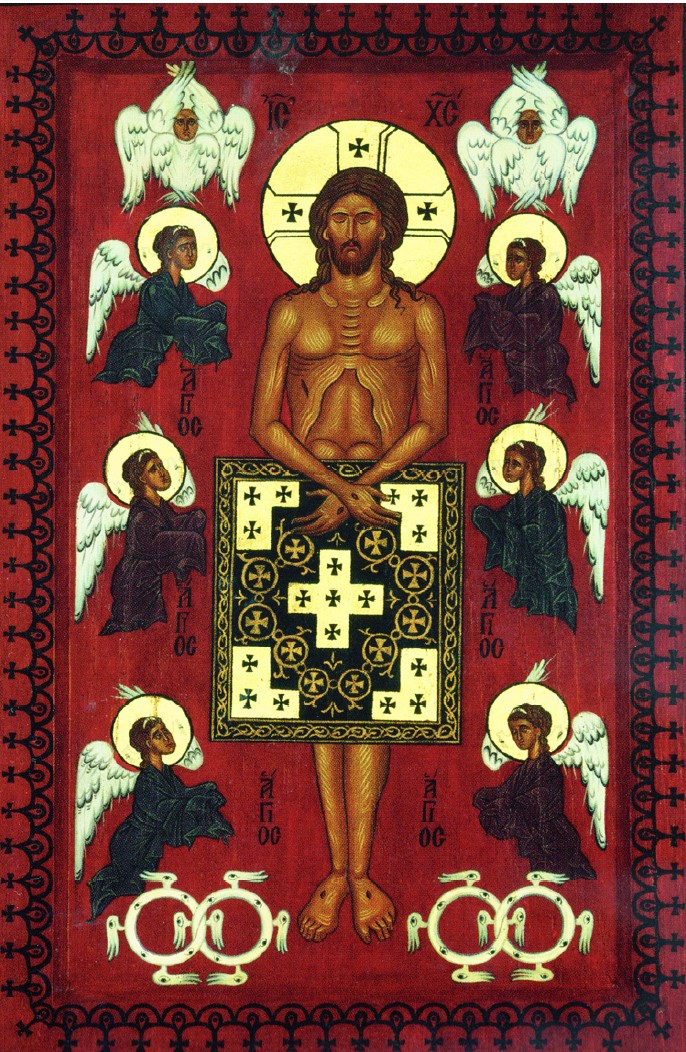
Epitaphios (Tomb / Shroud) Greek, origin unknown

* * *
Примечания
Eusebius, Ecclesiastical History, 7.25.1–16
Eusebius, Ecclesiastical History, 3.39.1–7
Based on The Early Church and the End of the World, G.DeMar and F. Gumerlock, pp. 129–135
Margaret Barker – The Great High Priest, pp. 212–213
Revelation 2:9; 3:9; see also John 8:39–59
Histories, 5.13
Tractate Yoma, 39b
Hosea 11:1
Luke 9:31 (see note)
“A mixed multitude went up with them also” (Exodus 12:38)
1Corinthians 10:2
See for instance Genesis 12:1; 19:14; 31:13; Exodus 11:8
Matthew 23:38; Luke 13:35 – is is the same root as Revelation 17:16; 18:19
Matthew 24:16, 24
Hebrews 1:10–12