


PART IV. Theophany and art
Human and Divine Luminaries
Ekphraseis and epigrams that we examined in the previous chapter show a fascination with the luminous qualities of icons and with the presence in them of lively or vivid form. Color was also an important element, as we recall from Damascene and from the Philes ekphrasis where its use in encaustic painting becomes an intricate theological metaphor. In theology, the poetry of St. Symeon the New Theologian recorded his visions of uncreated light and encounters with Christ in unprecedented detail. In the next two centuries, luminosity, color and liveliness became dominant themes in Byzantine secular poetry and literature.
This aesthetic, as we shall see next, had its origins in classical painting while its theoretical aspects were entertained by Plato, Aristotle and their philosophical heirs. As we look at this remarkable convergence of aesthetic and spiritual experience, it is important to remember the topos of Lycomedes and Plotinus. Aesthetic form pales in front of the vision of God. But when form has all the qualities that are intimated in Philes' poem and light permeates it as we saw in the Chrysotriklinos icon, it is possible to find in art not just a semblance of theophany but a being capable of illuminating its nature by its own existence: the plastic luminary that we have associated with enargeia in Maximian ontology.
Naturalism and impressionism characterize Greek painting in the classical period, even though Cretan-style frescos, like the eighteenth-century B.C. painting of flying fish from Phylakopi, Melos, show an impressive mastery of lively form and composition.816 In classical art, impressionistic and illusionistic effects rely principally on composition, abstraction, color and tonality. Placement and distance of objects and motifs in the picture frame and adjustments in color, tonality and clarity, are ways of simulating form and vitality in natural perception. High contrast, saturation and detail convey proximity while their opposites may be used to suggest an object's distant and elusive presence. A striking early fifth-century B.C. Greek fresco of a diver jumping from a tower into the sea (Color Plate 1; Figure 12.1), shows the use of abstraction, space and placement in composition to define movement and capture psychological, natural and spiritual realities, and in this particular case to draw a subtle analogy between diving and death, or perhaps diving and the soul's flight.
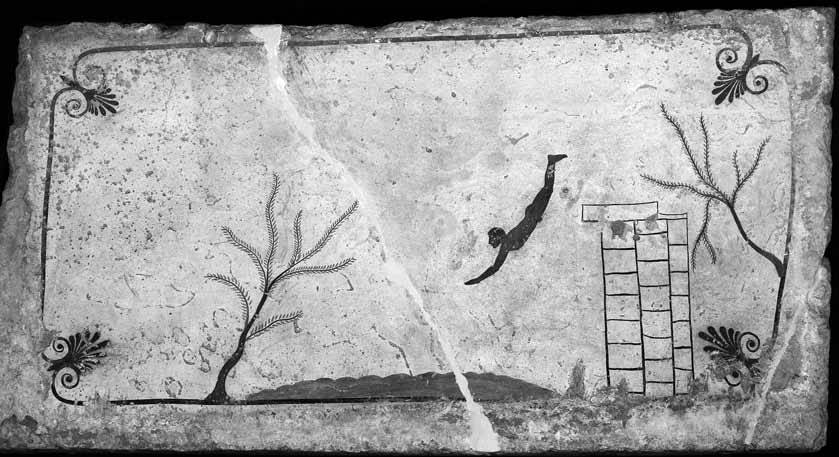
12.1 Diver Jumping from a Tower into the Sea, “Tomb of the diver,” early 5th century B.C., Museo Archeologico Nazionale, Paestum, Italy
The diver's isolation and elegance, the graceful lightness of his body, the motioning trees painted also in red, and the swelling emerald sea below, create a world of serenity, simplicity and emptiness that suggests nothing of the somber and dark realities of death. Here, an air of transcending stillness and joy permeates everything, while a sense of harmony and communion between human and natural forms speaks of a world that is at once ideal and real. Caught in the air, as if in a snap shot, trees and diver are frozen in a moment of lasting liveliness while the diving act itself, left unfinished and in possession of its own time, continues forever, as long as the image endures. It is good to keep paintings like this in mind as we consider what Greek philosophers wrote about art.Starting in the fifth century (particularly by Apollodorus and his pupil Zeuxis, b. c. 464 B.C.), color became more sophisticated as painters gradually refined the application of warm and cold colors, light and shadow and sought to convey expressive qualities and mood. This is evident, for instance, in paintings like the Abduction of Persephone c. 330–320 B.C. by Nichomachus (fresco, Vergina Archaeological Museum, Greece) and the Funerary Stele of Hedyste (3rd-2nd century B.C., Volos Archaeological Museum, Greece).817 By the middle of the fourth century B.C., the atmospheric use of color prevailed and diffused light was used to enhance the plasticity of figures. Toward the end of the century, we begin to see the masterful use of directed light in composition (e.g., the Pompeii mosaic depicting Alexander and Darius in Battle, based on a copy of a painting by Philoxenus).818
Accounts of works by famous painters such as Polygnotus, Parrhasius, Apelles, Protogenes and Zeuxis, among others, make it clear that the ability of a painting to convey emotion, character (ethos), physiognomy, presence and animated form was highly valued in Greek antiquity. Paintings won praise when they rendered nature and the human figure with compelling accuracy and liveliness and could in this sense be mistaken for real or surpass their originals in the concentration of physical, psychological and moral qualities.819
Interest in physiognomic portraiture of this type is shown by Socrates. In a purportedly actual conversation with the fifth-century painter Parrhasius, a master of the realistic style, Socrates tries to convince the painter that it is possible for moral qualities (psyches ethos) to be depicted in painting, since they are invariably depicted on people's faces.820 Parrhasius' position that painting cannot convey psychological realities, a notion echoed by Damascene, is epideictically refuted by Socrates. He brings as evidence the concentration of moral qualities on the human face and the variety of expressions that form there. Painting in this view can depict anything that can be observed in nature: the more careful the observation, the more penetrating the form.
In the same spirit, Plato singles out the work of Parrhasius and Polygnotus for its ability to intimate the essential forms pursued by philosophy and criticizes the work of Apollodorus and Zeuxis, which he calls «skiagraphia» or painting in light and shade, for simulating the transient presence of objects in human experience.821 The impressionistic use of light and shadow involved the laying on and fading out of shades of color to render an object's proximity, distance, atmospheric qualities and texture. The effect was at odds with Platonism's emphasis on painting as a means of representing the basic forms of reality and registering ideal types and behaviors. Polygnotus' paintings, exemplified by his panels in Delphi, with their precise and austere depictions of heroes from Greek myth and history, had an obvious didactic and edifying function that Plato approved.822
Aristotle took a similar position in favor of the realistic style, arguing that it can render character better than its rival. Thus, he complimented Polygnotus as a genuine «ethographos,» a painter of character, and criticized a work by Zeuxis for failing in that regard: «... but the painting of Zeuxis contains no character at all.»823 Comparing the work of Zeuxis with certain plays, he applied the same critical principles to pictorial and literary works, and criticized paintings and plays with strong expressive and atmospheric qualities for their failure to describe tersely the actions that defined the ethos and personality of characters.824
Plato rejected vivid images as a form of illusionism or magic (thaumatopoiia).825 Art was an instrument of metaphysical gnosis and a corrective device for fallible human perception, committed to the service of philosophy. It had no license to create its own beings or generate a rival reality to that of the philosopher's art. As the use of the term thauma suggests in this context, Plato did not oppose images which were life-like in the sense of replicating nature. What he opposed, rather, was images which have a life of their own and may be said in this sense to «impersonate» (mimeitai) their subject (be it animate or inanimate) that is, to bring it to life or present it in a dynamic state of being.826
The Byzantines insisted on art's mnemonic and anagogical function, but they did not consistently embrace the Platonic view. Plato rejected the impressionistic use of color in skiagraphia for its detrimental effect on the soul's equilibrium. By contrast, ekphraseis, as we have seen and shall see in more detail below, associated color, shading and illumination with a painting's ability to convey the presence and experience of transcendent realities in Christian life, particularly the presence of holy persons. Thus in Byzantine sources the term «charakter» is consistently used with reference to depictions of holy figures–particularly their facial expression and posture–that create the impression of a living being.827
St. Eupraxia, for example, has a vision of Christ's «despotic figure» (despotikos charakter) in which he appears in his reigning, hieratic attributes as a commanding and sublime presence.828 We read in the vita of St. John Chrysostom, that he owned an icon of St. Paul in which the apostle's presence was so compelling that it caused him to engage it in conversation. When his disciple, Proclus, looks at the image and brings to mind a vision of Paul that he had earlier, he finds the same «charakter" in both.829 To dream Paul and see Paul in art is to encounter the same living reality. What art achieves in such instances is replicated in one's sleep by the work of divine grace. A painting that can accomplish this exists in the world but also in eternity.
Skiagraphia is used in a similar context in stories of miraculous paintings that have been inspired by holy visions. In one such example, the painter first dreams of the monastery in which a miraculous Saint (St. Theodora of Thessaloniki, d. 892) lived. He then goes to the actual location. In a second dream, he «has the impression of sketching» her figure (skiagraphounta).830 The artist paints in his sleep what he paints when he is awake. The image forms as an aesthetic object in a dream act and is part art, part revelation. The picture will be true to its subject because it has already been painted. Actually, it will capture it in its ideal form: «Assisted by God's guidance and the Saint's prayers, he depicted her in such a form that those who had know her well asserted that she looked like that when she was young.»831
The picture's theophanic nature is established when fragrant oil begins to bleed from the palm of the Saint's hand. Thus, the picture goes through three stages. It is first miraculously painted in a dream where it exists as mental object, or vision. Then, it becomes art. In the third stage, it acquires an organic, somatic reality and function. Although the story emphasizes the accuracy of the painting, the central point is its increasingly vivid, lifelike character, defined successively by its miraculous inception, masterful execution and miraculous life. As in the Philes story, theophany enters the substance and process of art.
Byzantine painting used the «Graeco-Roman koine,» a blend of classical and Hellenistic styles that Roman artists adapted to their own needs.832 Impressionism and realism were part of its repertory. Impressionism was ideal for the iconography of theophanic realities. The realism favored by Parrhasius (and Plato and Aristotle), on the other hand, was ideal for the countless feast cycle and narrative icons which defined the identities and dramatized the lives of Christ, the Virgin Mary, apostles and saints. The clusters of interacting, idealized heroes in the scenographic paintings of Polygnotus, caught in succinct actions and gestures that define their personality and character, had a stylized, timeless and contemplative quality that was appropriate for a hieratic art.833 By contrast, the impressionistic use of color and light in skiagraphia that made the fruit Zeuxis painted the prey of birds, was appropriate for expressing visually the type of religious experience that placed human encounters with holy figures in an actual and present time.834 Like Zeuxis' irresistible grapes, the visions and icons of Eupraxia, Proclus and others were sights of presence rather than representation. Mental and physical imagery, holy vision and art were, at least at first appearance, indistinguishable.
We turn next to the role that color and light played in the experience of images in Byzantium. A sixth-century ekphrasis by Agathias praises a Constantinopolitan icon of the Archangel Michael in encaustic. It attributes the strong response it elicits in the viewer to its colors. The Archangel, described as «the invisible chief of the angels,» is said to exist in the image despite «the incorporeal essence of his form,» a remarkable feat called «greatly daring.»835 Tension between the sensuousness of the painted figure and its intangible original–between aesthetic and theophanic form–intensifies the viewer's experience. But the incredible serves to establish the credible. The aesthetic takes over and the tension is resolved: «engraving within himself (en eauto ton typon eggrapsas) the [archangel's] form, he trembles as if he were present (hos pareonta)."836 Art has channeled the holy being into the viewer's mind. Its emotional impact is especially intense, as one would expect of a real encounter.
Vision engenders contemplation («the eyes encourage deep thoughts») as color helps transform the aesthetic experience (techne chromasi porthmeusai) into prayer (ikesien) and «higher contemplation (kressoni phantasie)."837 Glowing, shimmering colors can suggest affective and intellective states. They can also recreate the kind of abstract and fluid imagery that is the dominant quality of dreams and holy visions. What Agathias finds amazing about the icon is the fact that it can transcend its own material conditions (i.e., the physical nature of the panel and pigments that constitute it) and exist in the same disembodied form as its holy subject. The object that he is identifying here is aesthetic. It is that part of the icon that escapes the panel and takes on the appearance of something living and real. As with enargeia, it is something that the image delivers by means of its inherent qualities and structure. Color is its predominant element, that which most conveys the experience of an apparition. But what Agathias describes is not possible without the contribution of other qualities.
The fact that the icon is in encaustic and comes from the same period as the Sinai Pantocrator (discussed earlier) may give us some clues as to the kind of image that Agathias is describing. In the best of Fayum portraits, we see the ground painted progressively from dark to light, a luminous rendering of the face, modeling achieved by highlights, nuanced rendering of shadows, an evident plasticity and dynamism, a rich palette of colors and an overall impressionistic and painterly quality. Warm and cold colors are used to show objects advancing and receding relative to the viewer, creating proximity and distance respectively. The overall effect is one of animated expression and intimacy, with faces marked by larger than usual eyes projecting their presence beyond the painted surface in a manner that invites conversation and contact.838 In some cases, color is rendered with intense dynamism and energy that allows it to solidify form, even as the overall effect is impressionistic. In others, strongly highlighted areas in the flesh, often reflected in the pensive brightness of the figure's eyes, give color surfaces a lively and transient quality that nearly eliminates volume and depth.839 It is highly plausible that Agathias' icon had some if not most of these qualities.
The description by the Patriarch Photius (858–867, 877–886) of a ninth-century mosaic of the Theotokos with the Christ child on the apse of the Hagia Sophia (Figure 12.2) reflects a similar sensibility. The homily was delivered at the mosaic's official unveiling on March 29, 867, in the presence of Emperors Michael III and Basil I and the charged atmosphere of post-Iconoclastic restoration. Flanked by two standing Archangels each 5m tall, the 4m tall Theotokos rises 30m from the ground and is surrounded by a field of gold tesserae that covers the entire semi-dome.840 Only fragments of the Archangel Michael remain, but the delicate face and part of the highly textured wings of the Archangel Gabriel are still visible. Light falls on the mosaic from a row of five windows set immediately below it and from windows above it on the dome.
Photius' homily is considered by many to have little aesthetic significance. Maguire points out that the topos of contrary emotions, affection and detachment is assigned to the Virgin despite the fact that her expression is impassive.841 This and similar observations lead others to conclude that Photius was only using the image to bring attention to the role of Mary in the Incarnation, and remind his audience that images are justified by the Incarnation.842 I believe that Photius is accurately describing the mosaic's aesthetic qualities and expressive form.843 Maguire compares post-Iconoclastic paintings to black and white photographs which are more abstract than color photographs and argues that Byzantine viewers compensated for an empty visual field by exaggerating physiognomic details.844 It is a wrong analogy. Based on their own tonal scale, black and white photographs can be as rich as color prints, or on occasion even richer. Likewise, a painting deemed abstract by naturalistic standards may be highly expressive based on color tone, shading, texture, rhythm, use of voids, tension etc. (as we shall see in discussing Modernist and Zen art in Chapters 14 and 15). The Hagia Sophia mosaic musters a significant degree of expressive complexity behind its apparent (and distant) simplicity. It is difficult to convey in a few photographs the icon's continuous interaction with ambient light and the effect that dynamic illumination has on composition and expression. Photius writes:

12.2 Theotokos and Child, Mosaic from the Apse, 834, Hagia Sophia, Istanbul, Turkey
to such an extent have the lips been made flesh by the colors (diesarkothe ta xeile tes chromasin), that they appear merely to be pressed together and stilled as in the mysteries, yet their silence is not at all inert neither is the fairness of her form derivatory, but rather is it the real archetype.845
The description is accurate. A pensive and eloquent quality is indeed present in the face of the main figure of the mosaic. It arises from the expression of her mouth and eyes and the overall vividness of her face. Her physiognomy actually conveys her hieratic character which is why it makes sense in this context to mention the picture's realization of the holy person it portrays. The opposites of motherhood (meter) and virginity (parthenos), childhood (tokos) and divinity (hyperphuei), tenderness (storge) and detachment (apathei) that Photius attributes to the mosaic are not just rhetoric.846 They actually convey visual facts. The description «a virgin's and mother's gaze (omma)» is corroborated visually. So is the attribution of a «detached and imperturbable mood (diatheseos)» to her face and posture.847
The rosy blush on the cheeks and chin, and the brighter red on the lower lip define the lower part of the woman's face. Her large, boldly outlined eyes and eyebrows dominate the upper part that is framed by the closely drawn line of the head covering. Shading defines the chin, lips, the fine classical nose, the area near the tear ducts, and over the brighter lower part of the eyelids. When illuminated, the reds become more dominant, the flesh tones more even, and the shading above the eyes darker and more prominent. This makes the eyelids appear heavier and adds an attentive and pensive expression to her intense gaze. The slight downward motion and large irises of the eyes convey a sense of awe and guarded melancholy.
A substantial, monumental maphorion drapes the figure with dynamic, imposing angular shades of blue, purple and black. It gives to the youthful face that emerges from underneath, an air of gravity and somberness, qualities that are also reflected in its gaze. The left hand that embraces and holds the child is freely modeled, while the wrist and fingers of her right hand convey a delicate and graceful gesture that is both light and reverent. Majesty and humility, youthfulness and gravity, tenderness and thoughtful detachment, alertness and tranquility, are readily visible. Christ's crown-like golden locks, round face, large forehead, blushing cheeks and serene but alert gaze convey both docility and authority.
Mango's detailed description of the materials used for the composition of Christ's head proves the mosaic's technical and aesthetic sophistication:
Fine- grained white marble is used for the projecting or highlighted parts, viz. the center of the forehead, above the eyebrows, one vertical row down the ridge of the nose and one transverse row across the top of the bridge, the tip of the nose, the top of the chin, and a few lines under the eyes. The grey vein of Proconnesian marble provides light shadows on the ridge of the nose (vertically, on either side of the white line), between the eyebrows, on the right side of the forehead (inside the green shadow line), under the eyes, and in a small patch to the left of the mouth. Three tones of pink marble are used, the palest mostly in the forehead, the two more intense tones in the cheeks and chin. Cream marble outlines the nose and nostrils ... The eyebrows, eyelids, nostrils, and corners of the mouth are in slightly purplish black glass. The parting of the mouth is in deep red glass. Vermilion glass is used in the lips, small spots on the cheeks, a spot on the bottom part of the chin, and others on the right ear. The whites of the eyes are in white limestone.848
When illuminated by the light that comes from the windows above and below, the maphorion displays tones of blue, green, purple and black– reflecting the rich palette of glass used in its construction. As colors shift and transform, motifs acquire and lose solidity. Facial features become more colorful and translucent. Light and distance eliminate details and enhance abstraction. The image begins to float and fluctuate. Christ's face in particular gives the impression of emerging and taking shape out of sheer light. His brilliant white and gold halo, blond hair with golden highlights, gold and silver tunic and himation compliment and enhance his glowing face which appears ethereal and angelic, but also tenderly youthful and delicately carnal. His figure glows, at times giving the impression that it stands apart from the wall that hosts it, suspended between stretches of light and gold. Color is an aesthetic and theophanic reality. The illusion is not directed at nature but at the reality of divine presence and holiness. In 1347, the future Patriarch Isidore had a dream of the mosaic. The Theotokos came out of her seat, descended from the wall, pointed at the patriarchal throne, and after a few words of counsel resumed her original position on the wall.849
Another example is a poem on an icon by the celebrated twelfth-century painter Eulalius. It was composed by his contemporary novelist, philosopher and poet Theodorus Prodromus (c. 1100-c. 1158). It attributes to color the ability to render not just liveliness and expressiveness in a figure but also the immateriality of physical form necessary to portray angelic figures. The subject of the icon was the Annunciation (possibly in the Monastery of Christ Euergetes). The image is described as being exceedingly vivid. To underscore this quality, the painting is attributed to the miraculous intervention of its central character. Like Christ who is portrayed as a painter of souls in the Acts of John, Mary takes over the painting act. She gives a speech-like liveliness to colors: «[not] the art of painting ... but the Maiden who is celebrated among men has directed the brush of Eulalius and made his colors so expressive (eulalon ... to chroma deiknyei)»; «You [O Virgin] ... have let fall upon his brush a drop of breath.»850 Painter and painting are now integral members of Mary's own life–very much like the poem by Manuel Philes.
The image is refined and appropriately abstract in its depiction of the Archangel: «The colors have been altered in relation to the subject . the brush, as if it were made of some fine substance, delineates the incorporeal (aylian)."851 The figure of the diaphanous angel contrasts with that of the young woman who is so sensuous and lively that she appears to stand next to her image as would a posing model. The painter's palette is sophisticated and evocative: «the colors are those of flesh (sarkinos) for they represent a live Maiden (zoses kores) ... so great is the art of Eulalius as ... to mix colors that are endowed with speech (lalounta chromata).» The distinction between image and original disappears. «The image is animated (empsychos eikon), for indeed you are being painted alive»; «it is a live painting, for verily you live O Virgin.»852 Realization replaces representation. Painting participates in a divine reality; it does not replicate it.
The language of Prodromus suggests an eye sensitive to aesthetic qualities. The emphasis on the eloquent liveliness of form, the idea of capturing an object in its act or moment of conscious existence, recalls the Ch'an concept of chi'yun or «spirit resonance,» discussed earlier (see also Chapter 15). If the figure is being painted alive, its liveliness comes from the painter's ability to envision his subjects (Mary and the Archangel) in conversation and capture that moment with his brush. The picture realizes its objects in a space and time that belongs indistinguishably to art and divinity.
Prodromus' verse is the inspiration for a number of fourteenth-century epigrams by Nicephorus Callistus that also celebrate the work of Eulalius. We referred to this epigram earlier. Its subject is the Archangel Michael. The painter's brush is «dipped ... in immateriality (skaryphon eis aylian evapsen)» – variants of this expression can be found in Prodromus (vapsas to graphydion eis aylian)–while the angel's figure is «hiding in colors his incorporeal nature (chromasi ten aylon egkrypton)."853 The painting is said to «encompass the immaterial by means of colors (synexei chromasi ten aylian)".854
When combined, the last two phrases place the anagogical power of the image within the aesthetic object that it puts forth. The angel exists aesthetically. All one needs to do is to go where the image is. The angel is present there. Callistus recognizes the difference between the physical and aesthetic aspects of painting («how is that matter can drag the spirit down?»).855 Through color, the image is said to convey corporeality at the same time that it annuls or conceals it («else the spirit remains unobserved in his picture»). The tension adds to its vividness and presence and is consistent with the topos of contradictory conditions.
The Archangel materializes in front of the viewer as an unmistakably aesthetic-heavenly being. The visual object at hand does not differ from a vision. It is both life and art. In another epigram, Nicephorus praises a despotic icon of Christ in the Church of the Holy Apostles. A work of art, the painting is also a moment of theophany. The artist has seen Christ's face (thea).856 In two other epigrams that echo Prodromus, an icon of the Hodegetria type is addressed directly with the phrase «you are alive (zes), pure maiden» and is described as standing before the viewer full of breath and life (empneousa kai zosa chroais).857
Literary classicism dominated Byzantine intellectual culture in the twelfth century. It explains Prodromus' extensive use of Homeric and classical language and poetry in his writing.858 A passage in Pliny describes how Apollodorus of Athens (fl. 408 B.C.) first introduced light and shadow-based curvatures and «bestowed glory on the brush» by giving his figures «the appearance of reality.»859 Praising as celebrated a painter as Eulalius, Prodromus, who according to some scholars was also an illustrator, would naturally look to the topoi of antiquity for language that would best express his appreciation for the master's work.860 A dedicatory epigram that he composed for an illustrated copy of his romantic novel, Rhodanthe and Dosikles, uses a topos popular among other writers of the period. The writer is compared to a colorist who fails the standards set by the great masters of classical painting (i.e., Apelles, Praxiteles, or Polygnotus) but has no problem meeting those of contemporary artists.861 A poem of his describes a candle spreading in thousands of rays its burning light (myriaktinon selas) next to an icon of the Virgin Mary while another celebrates the face (prosopou) of Maria Comnena and compares it to a radiant mirror (katoptron) sparkling with clarity and grace (katharan kai peristilpnon charin).862
Religious art was not the only area where luminous images came alive. In this passage from the eleventh-century romantic epic of Digenes Akrites, Digenes' wife is described as if she were a living painting:
The noble Girl her beauty overgleaming (hyperastrapton)
Brighter than peacock shone (elampe) and all the plants.
Her face had copied the narcissus hue (chroian),
And like a rose in bloom her cheeks were dawning (exanetellon),
Her lips showed forth a rose-flower (anthos rodon) just opening
What time begins the dawning of its cup (anatellein).
Curls that were riding just above her brows
Scattered about fair-flashing (chrysoprepeis) gleams (aktinovolous) of gold,
And joy unspeakable (arretos) was over all.863
A discriminating vocabulary is used to convey the liveliness of the woman's face at the moment that it impresses itself on the viewer and is captured, almost photographically, in words. Blooming, soft and rosy cheeks, a complexion white like the fresh petals of a flower in the morning light (the dramatic time in which this sight is recorded), a sensuous mouth (gently breathing or even on the verge of speech) and shiny hair (reflecting the ambient light), paint an image that is at once idealized and natural, detached and intimate. The association of these qualities with joy gives to the scene a paradisiacal character but it also resonates with the captivated gaze of the viewer who is thoroughly absorbed by the spectacle (and by his own proximity to it). But the image is real. Its subject is on the verge of breathing, speaking and moving even as it is being painted in so many colors and words.864 In this sense, it is a spectacle only momentarily, as long as it has not yet risen or spoken or perhaps opened its eyes. A picture never rests because it has life in it.
Impressionistic and transcendent qualities in physical appearance are important in Anna Comnena's (c. 1083-c. 1148) Alexiad as is her mastery of color and light terminology:
... he (the child Constantine Ducas) was fair-haired with a milk-white complexion, suffused in the right places with a delicate pink (erythrematos meston), like that of a rose just bursting (exastraptonta) its sheath; his eyes were not light, but gleamed (lampontes) from under his eyebrows like those of a hawk's under a golden hood.
... her (Maria Ducas) skin was white as snow ... her complexion (chroma) was exactly like a spring flower (anthos) or a rose. And what mortal could describe the radiance (augas) of her eyes? Her eyebrows were well-marked and red-gold (pyres) ... this queen's beauty, the radiance (epilampousa) of her grace and the charm and sweetness of her manners surpassed all description and all art.
... her (Irene Comnena) face too shone with the soft glamour of the moon (selenes apestilve feggos) ...the bloom of her cheeks was such that their rosy hue (rodonian) was visible even to those who stood afar off. Her eyes were blue, yet in spite of their gaiety (charopon) they were somewhat awe-inspiring... if in those olden days a man had said that this Empress was Athena in mortal guise or that she had glided down from heaven in heavenly brilliance and unapproachable splendour (ouranias aigles kai aprositou marmaryges) he would not have been far from the truth... The pupils of her eyes resembled a calm sea shining with the intense blue (exaugazousa) of quiet deep water; the white surrounding the pupils was extraordinarily bright (antestilven), thus giving the eyes an indescribable dazzling (charin apelampon amachon) and exquisite beauty.865
The portrait of the Empress Irene describes a being that is both celestial and human. She sparkles in those moments of her finite existence in which the unique person in her comes alive. She retreats into her own body and reality only to transcend them again and reach a tenuous ideality. Through it all, she remains alive–which is what her literary iconographer in this instance also aspires to do. This is an aesthetic of existence rather than representation. Rhetoric provides the framework but art provides the content. Like the icons of Mary and Gabriel, Irene inhabits two worlds at the same time but belongs to neither. Her portrait could be compared to an icon of the Virgin–or as Anna actually suggests, to the likeness of the goddess Athena.866
The heroines and heroes of Digenes and the Alexiad have fair, gleaming and delicate complexions, bright and lively eyes, fine eyebrows, tender and evocative mouths, gracefulness, kindness and restraint. With their intense and arresting gaze, they seem to exist in a state of openness and self-possession that makes them at once vulnerable and impenetrable. These exemplary persons emerge out of sparkling and glimmering surfaces, which at times reflect a moon-like light, an enveloping sunshine, or the warmth and energy of fire.867 They are portrayed in a detached manner, as if the author is painting them alive in words and images, unaffected by their presence. Vivid and animated, they are either suffused in a delicate light like Digenes' wife, or sparkle with physical and moral brilliance, like Comnena's imperial family. They are as close to theophany as mortal beings can be.
The same aesthetic informs the experience of nature and architecture as we can see in this description of Digenes' palace.868 «The ceilings with mosaics he all adorned,/Of precious marbles flashing with their gleam (te aigle astraptonton)/The pavement he made bright (efaidrynen) inlaid with pebbles.»869 The glassy, glittering texture of marble in the rooms and pavilions of the palace recalls a mirror: «shining marbles throwing gleams of light (faeinon lian astrapovolon)."870 Constructed of precious onyx, its floors are described as having the diaphanous, crystalline texture of frozen water: «so firmly polished those who saw might think/Water was there congealed in icy nature (hydor ... pepegos eis krystallinon physin)."871
Let us now turn to the poetry of Symeon the New Theologian.872 Symeon has been described as «the best known of all the Byzantine ascetics of the middle and later periods,» «the greatest of the Byzantine mystical writers,» and «a kind of virtuoso of experiences of light.»873 His visions of divine light continue a tradition that dates back to Evagrius of Pontos and Macarius of Egypt. It became official for the Orthodox Church, following the Hesychastic controversies, in the fourteenth century in the writings of Gregory Palamas and his older contemporary St. Gregory of Sinai (c. 1265–1346). It builds on the experience of theophany in Christ's Transfiguration. When Christ appeared to his disciples on Mount Tabor immersed in divine light, there was no «addition» or «transformation» to his nature; he simply showed to the disciples «what He really was.»874 The light seen then was divine and uncreated light made visible by grace. Palamas explains: «when saintly people become the happy possessors of spiritual and supranatural grace and power, they see both with the sense of sight and with the intellect that which surpasses both sense and intellect.»875
There is a subjective aspect in the visio dei which as Symeon tells us in the Ethical Discourses depends on one's spiritual state. A harsh, blinding light characterizes ecstatic illumination (en ekstasei) and appears to those who are new to the spiritual life – «eisagogikon te eusebeia,» or at the early stages of reverence.876 A marvelous, resplendent light permeates and envelops those steeped in a life of holiness. This light is substantive (synesti) and illuminates the recipient «symmetrically» (photizon symmetros) and «according to the measure that nature allows (chorei)."877 It leads to a lucid and comprehensive vision (kathora, theoria) of temporal and eschatological realities. In contrast to ecstatic illumination that is experienced as harsh and unrelenting and causes one awe, the light which envelops those accustomed (dianoigetai) to divine union is measured and soft, and causes «delight and an inexpressible joy of heart (anekfrasto thumedia kai agalliasei)."878
Symeon's hymnography is the most detailed and poetic account we have of theophany in the Orthodox experience. It allows us to literally see what the Saint saw and appreciate its aesthetic, iconographic potential. As with ekphraseis, rhetoric and reality converge. And like Anna Comnena, his mastery of color and light terminology and visual discrimination are extraordinary. There is, of course, repetition and stylization. But, as with iconographic types, it is important to consider this aspect as a matrix for the outline of what is at times an exceptional imagery.
In Hymn XVI, uncreated light «sparkles (apastrapton)» in the saint's heart, but also surrounds him with «immortal splendor (athanato aigle)» and irradiates his body with «shimmering rays (aktisi kataugazon)."879 His "face shines (lampon prosopon)» and every part of him turns «luminescent (photoforon)."880 Warmth is implied in the light's «all-embracing (kataphilein)» quality which he describes as one of «delight and sweetness (hedones, glykasmou)."881 In Hymn XVII, he sits at night in his cell, and describes its presence as «fiery (pyr)» and a «luminous cloud (photos nephele)» that turns into a «superlative sun (helios apoteleitai)."882 It enters and «warms [his] soul and inflames [his] heart (psychen thermainei, kardian ekkaei)."883 Then, it «hovers like a brilliant star over (aigle photophoros perieptatai)» him and «irradiates [his] intellect (noun lamprynousa)» which likewise takes flight, seeking in vain a match for its «sublime vision (theorias hypsos)» in the created world below.884 He describes a landscape spread in all directions, with vertical abysses and horizontal expanses (ouranou, abyssous, eschata).885 The divine light eludes him, being «uncreated and ungraspable (aktistou kai aleptou)."886
At first, light is contained within Symeon's dark cell. Slowly it takes over his heart, expands into his intellect and spreads out beyond and above it to envelop and illuminate all things. Transported beyond the confines of his physical and mental existence, the Saint is led to a majestic contemplation of the created world that magnifies the transcendent nature of divine illumination. This is not a mere mental, imaginary reality. The senses continue to perceive a world that now appears different, a difference that is ontological and aesthetic. The predominant modality is positive: a theology of light and plenitude (and therefore revelation) rather than darkness and depletion.887 Thus, everywhere light must come; everywhere it must be seen and felt and contemplated; everywhere things must become visible, if not transparent. Symeon had a following among Byzantine intellectuals, patricians and laymen and women who read his poetry, attended his sermons and sought his spiritual counsel.888 It is unlikely that they left unimpressed with his vision of light and illumination as instances of theophany. Anna Comnena would have known about him and so, perhaps, would the monk who compiled the epic of Digenes Akrites.889
Variations of the same imagery appear in Hymn XXII. The divine light enters Symeon's soiled (rypon) and corruptible body and soul, and consumes them in flames (flegeis hylen). Even though it is immaterial (aylos), it mingles with matter. Merciful and loving, it turns from a blazing fire (pyr) into a cooling dew (drosizeis) and washes him clean.890 Distant as a faraway and unreachable star, it is also within reach, intimately tucked in his heart where it is rekindled by divine grace. Its paradoxical nature is repeatedly made clear: «Believe me then to be perfectly formless light (phos aschematiston)/all simple (haploun), not composed, in nature undivided/in all ways inscrutable, within reach unreachable.»891
Reminding the Saint of his ineffable and uncreated energies, God counsels him not to search for its causes in his own nature (physin) but instead to accept illumination as a supreme act of divine philanthropy (philanthropos).892 Transfigured (metaschematizomenos) in his mercy, God appears to those who have purified their intellect (noun kekathermenon) as luminous as the sun; but to those who live in the dark night (gnofon, nychta) of the flesh, he is nothing more than a distant star.893
In Hymn XXIV, the divine presence is described in terms that suggest motion and activity: a «simple» and «sweet (glyky)» light, «self-revealing» and «self-uniting,» «spiritually visible,» «distant» and «intimate,» resembling «springing water (hydor vryon)," "burning fire (pyr flegon)," etc.894 In Hymn XXXV, the imagery recalls the radiant stillness of the glistening, crystalline floors and ceilings of Digenes' palace. Here, it is Christ who speaks of the divine light, the only visible aspect of the Godhead: «it takes a ray of my glory/ and a glimmer of my light/and at once, they're made divine/for like a mirror (esoptron) filled/with sun rays/or a crystal rock (krystallinos lithos) illumined / when midday sheds its light (ellamptheis mesembrian)/my divinity irradiant/ is received by everybody.»895 Theophany simulates the light of the midday sun which casts no shadows and envelops things in an even illumination. This is the light that makes Digenes' wife such an idyllic and ideal landscape of desire and appears intermittently in Comnena's iconography to turn her loved ones into ideal beings.
In Hymn XLV, the Holy Trinity speaks of its mysterious indivisibility and reveals the forms under which it is experienced:
light, peace (eirene) and joy (chara), life (zoe), nourishment and drink; sunrise (anatole) and resurrection (anastasis), rest and ablution, fire and water, river, spring of life (pege zoes) and streaming water, bread and wine; true sun that never sets (helios ontos adytos), ever-shining star (astron aeilampes), an oil lamp shining (lampas eklampousa) inside the soul's abode.896
Participation in the divine light is as real as the consumption and taste of bread and wine in Holy Communion. Symeon actually uses this analogy to describe those who partake of the divine light (metalavontes, koinonoi, symmetochoi).897 The experience is tangible and real. It is the entire person that participates in the life of God.898
In Symeon's poetry, faces radiate, stars sparkle, water and dew glitter, oil lamps and candles shine, and springing water glistens. When illumined, bodies become transparent and light, space expands, shadows are eliminated, beings emerge from obscurity, vision is enhanced, the intellect is limpid like a mirror, and the senses experience delight and warmth. Though mystical, this world is not vastly different from the one that allows Anna Comnena to perceive her mother like a goddess and speak of her dazzling gaze and the splendor of her countenance, or has Digenes discover in his wife an abundance of grace that brings all nature to a consummate stillness and joy. Like the fire that warms the heart of the ascetic, the blushing cheeks of figures lingering on the verge of life–breathing their colors in front of a captivated viewer (as do the icons of the Hodegetria and the Annunciation discussed earlier) or quietly exuding a playful and innocent charm (as in Comnena's recollection of the Ducas boy)–are part of a reality in which theophany embraces humanity.
In closing this chapter we would be amiss not to mention church architecture. As Louth has argued, any discussion of light in Byzantine religious experience must take into account the liturgical function of Byzantine architecture.899 Here again we can see the coherence of the Byzantine vision. The same aesthetic that informs Byzantine poems, hymns and literature shapes the architecture of church space. Digenes' palace was a mirror turned to nature. Byzantine churches were designed to reflect the divine life and bring persons and nature to a state of holiness. This architecture of immanent and transcendent light was not accidental. It resulted from an impressive alignment of geometry, theology and aesthetics.
Classical and Hellenistic antiquity influenced the training and curriculum of architects in Byzantium. Optical contrivances, the manipulation of the space surrounding a mosaic or fresco, and the need to adjust composition and construction to the needs of the perceiver, were commonplace. Anthemios, one of the architects of the Hagia Sophia, entertained elaborate optical and geometrical problems.900 The historian and scientist Nicephorus Gregoras (c. 1290–1360) described the mosaic icon of Christ Pantocrator at the center of the Hagia Sophia dome (c. 1355) in highly technical terms: «... when one looks up [at the image] from below, one is unable [to apprehend] by sight its true proportions and transmit them to the mind, since sight is usually deceived by the interposition of distance between the spectator and the object seen ...»901 He then proceeded to give the exact dimensions of the mosaic and point out that on the basis of those values, «accomplished painters» will be able to calculate «using proportional analogy,» the other measurements of the figure.902
Byzantine churches were oriented toward the point on the horizon in which the sun rises on the feast date of their dedication. As Iakovos Potamianos has shown, particular attention was given to the position of the sun at midday, on the third hour (9 a.m.) of the liturgical day, as well as on the illumination of the dome and the gradual descent of light on the illustrated walls.903 Sills on dome windows were designed to direct sunlight from their lower position toward the icon of Christ Pantocrator which was looking down from the highest point. Since direct illumination was avoided, the incoming light was diffused and gave the impression that it was descending from its divine origin in the Pantocrator icon.904 The entrance door was positioned toward the west, so that the setting sun could illuminate the iconostasis and holy doors as the priest carried the Gospel book back to the sanctuary at vespers.905
From the great church of the Hagia Sophia to the churches and chapels of Mount Athos, Byzantine architecture follows the «dynamic movement» of light throughout the day.906 Beams of sunlight form transitional zones of illumination which direct perception upward, toward the dome and beyond it. They connect the interior of the church with the encompassing sky outside. Analogies to the divine presence are inevitable. Light descends from the dome during daytime and fades at dusk. Or, it enters from lower windows at noon when its flooding effect highlights some forms and throws others into obscurity. In those parts of the church that are not reached by sunlight, burning candles bring the holy figures they illuminate to life. As light travels from the windows at the base and sides of the dome, to reach painted and living faces, it stretches out into a luminous ladder.907 For a few minutes, this thread of light unites art, life, nature and God.
Light models and paints. It brings stationary objects to movement and forms to liquidity. The sight of incense blending with the rays of the sun, or with the delicate scent of lit candles and oil lamps, the glittering icons and translucent marbles of the columns, iconostases and floors where natural and artificial designs surround and capture the eye, are all elements of a theology in which the divinization of beings is an act of ontological revelation. Theological and aesthetic realities become indistinguishable. But this is not aestheticism or religious spectacle. It is, rather, an ontophany. Everything is called upon to rise from obscurity and show itself in its full reality. As holy persons and the faithful standing next to them become visible to each other, they move from the tomb to a charismatic resurrection.
There are similar images in Symeon's poetry. In Hymn XXIII, he climbs a ray all the way to the blinding sun, only to lose grip of it and fall. As he sits weeping at night, the ray returns. «Like a rope descending from heavenly heights (schoinion apo hypsous ouranious katavainei)," it "traverses (diaschisasa)» the physical and spiritual «darkness (zophon)» in which he is immersed, and lifts him up again.908 The swirling beam that cuts like a knife through the thickness of the night is here a metaphor. But it finds a natural analog in Orthodox churches when the morning or evening sun enters through doors and windows, to awaken illustrated (and living) saints. What the saint experienced spiritually in his cell, is reenacted in church space (see Figure 12.3).
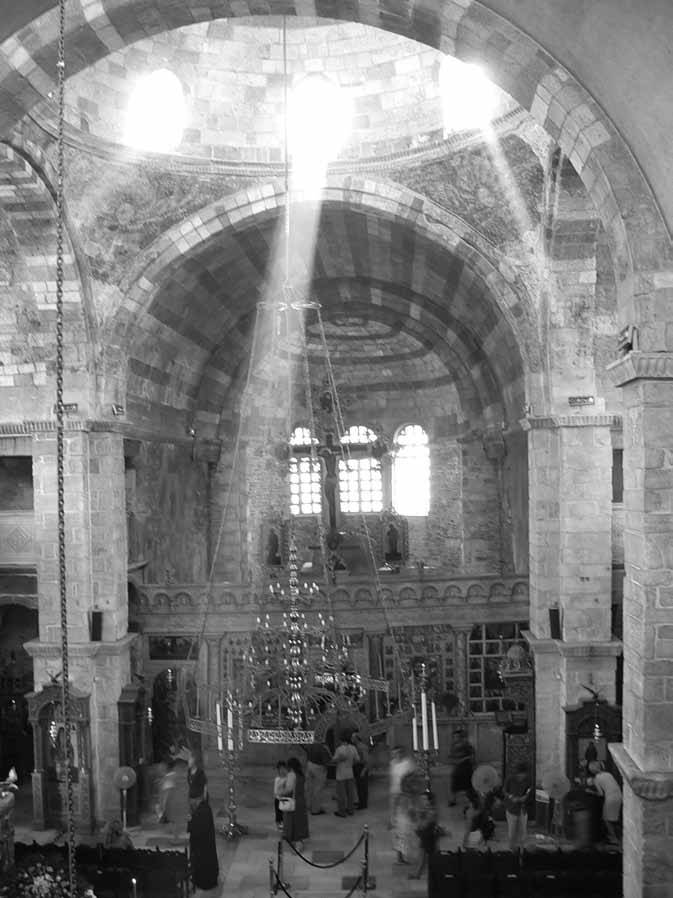
12.3 Cathedral of the Ekatontapyliane,4th century, Paros, Greece
When sunlight enters the church, it is hard to see in detail many of the frescos and mosaics placed on its apse, dome or upper walls. At night, the most visible areas are those closer to reflective surfaces, particularly if gilded in gold leaf or silver. Icons too are not fully visible. Difficulties in perceiving clearly color, line, texture, shape and other aesthetic properties under such conditions, make the experience of paintings quite similar to that of visions and dreams. This perhaps is the reason why the authenticating model of a painting would first appear in the painter's or patron's dream.909
It is conditions like these that most likely encouraged the creation of images that had their own ambient luminosity. They shone with an interior light and needed only the minimum presence of external illumination to become fully visible. In mosaics, a rich palette of colors (shades of yellow, amber, green, blue, brown, black etc.) applied on glass tesserae, and the use of cubes of select marble, gold and silver leaf glass, created lustrous, gleaning surfaces. The overall effect was one of depth and motion. Overlapping hues created a chromatic recession. The image formed by the mosaic moved from the surface to a deeper ground from where it would emerge time and again, as if it were actually forming its own appearance (see our discussion of a similar movement in the paintings of Rothko in Chapter 13).910
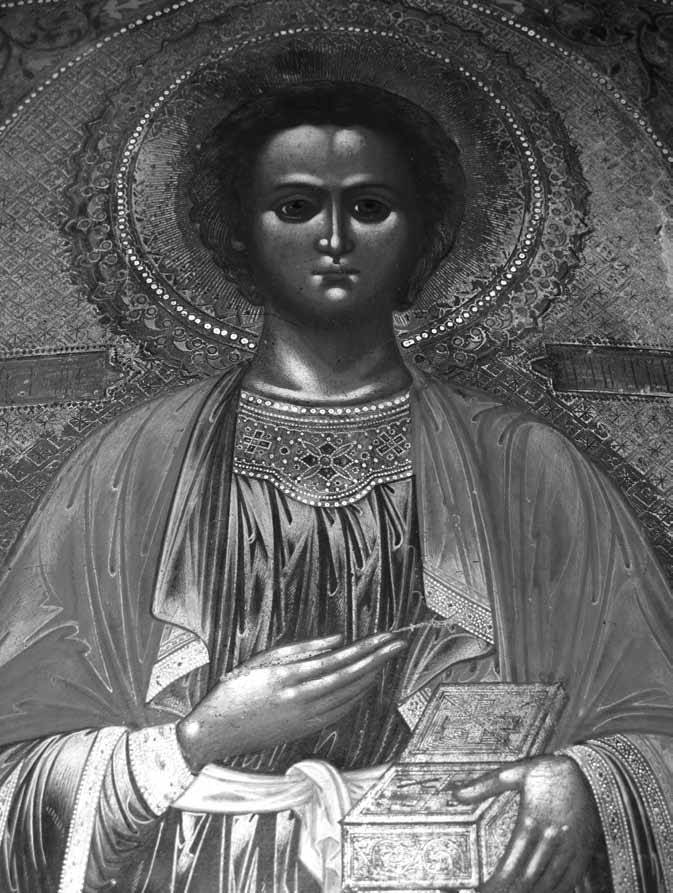
12.4 St. Panteleimon, early 19th century, St.Anthony’s Greek Orthodox Monastery ,Florence, Ariz., U.S.A.
The undated Athonite icon of St. Panteleimon in Figure 12.4 is painted on a curved panel. Its most prevalent features are the vivid, contrasting colors and the luminous motifs in areas most associated with the saint's spiritual identity and miraculous attributes. These appear lit from inside, glowing with an integral, corporeal light. The icon's elaborate background surrounds the figure. Reminiscent of a field of flowers or jewels, it contrasts with its concentrated and pensive gaze. It resembles embroidery or a mosaic. Symeon's theophanies come to mind. The divine light irradiates Symeon's body with its «shimmering rays (aktisi kataugazon).» Here it shapes and permeates the Saint's face. When he is united with God, Symeon is filled with light (photophoron). He resembles an «oil lamp shining (lampas eklampousa).» So does the youthful face of the icon. It is the same aesthetic that led Digenes and Comnena to see in the sensuous existence of their loved ones the presence of an ideal and timeless life. The icon is alive. It exists in a world steeped in color and light. Delightful and solemn, it brings theophany and holiness to the senses. It is an example in art of the synergy of natural and divine light. The Saint is present as an inextricably aesthetic and spiritual being.
The Theophanic Icon
Theophany is the natural and supernatural fruition of the ascetic life. The ascetics who strive to see God live simultaneously on the margins and center of the Church. They are often at odds with monastic and ecclesiastical authorities only to emerge in later years as exemplary persons or saints (e.g., the Holy Fools of Russia).911 Exemplary icons have a similar relationship to artistic conventions. They reflect and transcend them at the same time. Like the ascetic, they speak from a deeper ground and beyond the confines of what at their time is understood as traditional or normative. They embody ascetic modalities like humility, austerity and silence. They hide their art in profound simplicity. Symeon's charismatic spirituality challenged Church authorities for two centuries after his death.912 His idiosyncratic, daring and deeply personal poetry remains unmatched in Orthodox hymnography. The icons of Theophanes (Feofan) the Greek (c. 1330-c. 1410) are to this day unique and mysterious. They seem projected and incorporated on walls and panels from an invisible source. They appear to form spontaneously in light and pigment, a quality that the work of his student St. Andrei Rublev (c. 1360/70-c. 1430) simulates but never captures with the same spontaneity and simplicity.
The purification of the passions that precedes the divine vision implies for the image a similar emptying, a simultaneously kenotic and plerotic aesthetic. Implicit is a movement toward the dissolution and augmentation of form, toward contraction and expansion consistent with the inexhaustible plenitude and withdrawal of the divine presence. I have selected four icons which display these qualities and engage the aesthetic object in acts of self-realization, bringing it to a state of enargic subsistence–what ascesis and divine grace bring to beings in Maximian ontology. They include a fresco, The Holy Trinity (Hospitality of Abraham) in the Cathedral of Transfiguration on Ilyina Street, Novgorod (c. 1374) by Theophanes the Greek (Color Plate 1; Figure 13.1), and three panel icons: Christ Pantocrator (Athens Byzantine Museum, fourteenth century) (Color Plate 6; Figure 13.2), The Savior (c. 1394, Tretyakov Gallery, Moscow) by Andrei Rublev (Color Plate 4; Figure 13.3), and The Apostle Thomas (mid. fourteenth century, Holy Metropolis of Thessaloniki, Greece) (Color Plate 7; Figure 13.4).
But before we turn to these works, it is necessary to clarify further the relationship between theophany and art. The visio dei in Orthodoxy is a discernible, empirical reality.913 As we saw in Maximus, the divine light inhabits beings; it is in that regard incarnate. In deification, the senses open to creation and beings emerge as perfected participants in an unfolding theophany, actively and charismatically immersed (photistiken charin) in the life of the divine word.914 Christ dwells in glory and holiness, «in the fullness of the deity (pleroma theotetos),» inside the ascetic who consumes him every day and moment of his life.915 But what is consumed consumes and envelops. Theosis is at once Eucharist and Baptism, Transfiguration and Passion. To explain this plenitude, Maximus uses the image of subterranean waters, springing from an everliving Christ who is «the source of life» (pegen zoes) in order to underscore this interior plenitude.916 Symeon's ideas of the body as a full participant in deification and of divine illumination as an intimate encounter with Christ have a Maximian basis.917 According to Alfeyev, Symeon brings Maximus' view of the deification of the entire person to its natural, anthropological conclusion.918
Theophany is ontophany and anthropophany. What the ascetic sees can be seen by others whose senses have been restored–those who like the disciples on Mount Tabor have witnessed her deification. Symeon made poetry of his encounters with uncreated light.919 His hymns show a life consumed by the desire to see the divine light. His inability to explain (eipein) everything that he experiences only intensifies the need to put it in words, a task that is never completely mastered. His verse bears witness to truths that he cannot explain. The uncreated light is known directly and through its redemptive interventions (ergo). But it is never fully objectified. Language cannot contain it. It exists in words and beyond them. The poet discovers his verse (and voice) as he searches for God but he also loses it the moment that the right words are found. Theophany is a cause for silence and for new forms of speech. Parallels with the iconography of holy (and in secular literature ideal) persons are hard to miss. Pairs like visible invisibility, formless form, immeasurable measure etc. are everywhere in Symeon's verse.920 They are not only rhetorical tropes. They are also the liminal forms of a reality that language cannot contain.
This is an aesthetic in which paradox defines and transcends form. We have seen it in the flushing pinks and reds of human faces animated and yet asleep, tangible and yet ideal (e.g., Digenes' wife), or of divine and holy persons coming alive on the surface of motionless walls (e.g., the Theotokos of the Hagia Sophia apse). To capture and express life, painting and poetry must break the forms that make them possible. By establishing dissonances through recognizable patterns and forms, they can bring to their silent subjects the semblance of life. Paintings that have enargeia set themselves in a motion that they contain but which at the same time contains them and defines their being. We may think of them as particulars that embody and realize the lives of universals.
In the twelfth-century mosaic of the Great Deesis (Hagia Sophia) that we discussed earlier (Chapter 3), Christ appears detached and tender, austere and gentle, subtle in his divinity and robust in his humanity. Tensions created by this type of juxtaposition point beyond an art of representation and toward an art of living presence. In Symeon's verse, the reader encounters a reality that is unfolding in the very act of reading and listening. She reads and hears the ineffable–the theme is present in all of Symeon's hymns. Words reveal and conceal. Elliptical phrases and opposites come together, as if to suspend and affirm logic. The voice that speaks in Symeon's hymns craves for communication and expression. But its silence is also unmistakably there.
These observations help frame our inquiry, but they are not specific enough. To speak of a theophanic icon in the fullest sense of the word, we must know what theophany looks like. Orthodox tradition tells us that in deification the body is visibly transfigured. The penultimate Eucharist, theophany sanctifies the full person, spiritual and physical. In the fourteenth century, this understanding of divine Presence was the subject of a bitter controversy that pitted Byzantine humanists against Palamas and other theologians who were concerned about the incursions of reason and philosophy in religion and the increasing sympathy with which Thomism and scholastic thought were viewed in official circles.921 Theophany and the doctrine of the Divine Energies on which it was based is still not a settled issue between Orthodox and Catholic theologians.922 We can only consider the matter briefly as our topic dictates.
In The Triads (In Defense of the Holy Hesychasts), Palamas answered his critics by arguing for the hypostatic character of the divine vision and the deification of the body.923 He knew Symeon's work well: «In his Christocentrism, his Eucharistic spirituality and his theology concerning the light, Palamas certainly owes much to that great mystic of the eleventh century, to whom however he scarcely refers.»924 The two were also connected through an eleventh-century tract on the Jesus Prayer.925 The ancient prayer now included the inhaling and exhaling invocation of the name of Jesus. The aim was to concentrate the intellect in the heart, the seat of spiritual life. The tract was initially attributed to Symeon, because of similarities to his writings on the same subject. Its influence is evident in The Triads.
For Palamas, theophany is the consummate Christian experience and the justification of the ascetic life. The divine light is hypostatic. It is an object or reality of some kind: «one sees, not in a negative way–for one sees something (ora gar ti)–but in a manner superior to negation (apophasis)."926 By «negation» Palamas means the removal from the intellect of any cognitive form or figure and the cessation of all mental activities (noeras energeias).927 This «something» is indeed some thing. God is a reality, a living actuality (as energeia). The divine light is his presence. It operates internally, affecting the senses, and externally, affecting sensory objects: «contemplation (theoria) ... is not simply abstraction (aphairesis) and negation (apophasis).928 It is a union (enosis) and a divinization (ektheosis) which occurs by the grace of God, after the stripping away of everything from here below which imprints itself on the mind, or rather after the cessation (apopausis) of all intellectual activity.»929 It is a known unknown.
In divinization, senses and intellect coincide. This is evident in the claim that those who see the divine light do not pretend to «know ... what it is (ti de estin ouk eidenai)» that they are seeing, but know only that they are «seeing (orosin)» an «immaterial brilliance» (aylon ellampsin).930 The distinction between «knowing» and «seeing» indicates that in this experience the senses perceive without reflection and ratiocination. Perception does not trigger thought. It contains it. Thought saturates perception. Objects do not stand out as such in the particularity assigned to them by cognition even though they remain distinct in their forms. Luminosity permeates one's field of vision but is not accompanied by an attachment to objects. Light exists in and through things. It does not stand outside to illuminate them. The two co-inhere in a state of ontic rest and plenitude.
Like Symeon, Palamas insists on the immanence of the divine vision. At the same time, the encounter with God defies explanation. Thought lapses into paradox: the light is «invisibly visible,» «unknowingly knowable» (oromenen aoratos, nooumenen agnostos), the radiance of «an invisible (aphanous) glory» which is nevertheless «observed (epopteuontes)» by the saints–this last quotation is from Maximus who is frequently quoted in the Triads.931 Yet theophany brings immediate certainty. The divine light is called a «sight (thea)" that is "true (alethe)» and not a «semblance or analogy (eikotos)."932 It is not a «symbol (sumbolon)" or "illusion (phasma)."933 To see it, is to see God's active presence in the world. In theophany the mediating activity of the intellect ceases. This is not a space for dialectic.
His opponents had argued otherwise, contending that the light seen by the three disciples in the Transfiguration was «sensible, visible through the medium of the air, appearing to the amazement of all and then at once disappearing. One calls it divinity because it is a symbol of divinity.»934 For Palamas it was beneath God to appear through something other than his own energies. Theophany cannot hide behind a creature, «a sensible light. whose nature is entirely foreign (physin allotriotaten) to God.» His reasoning was simple: «a drawing of a man (gegrammenos) is not humanity, nor is the symbol of an angel the nature of an angel.»935 God is present as he is, in his unlimited actuality, not through a sign or semblance. He is the Taboric light; he does not appear through it: «the light was not a simulacrum of divinity, but truly the light of the true divinity, not only the divinity of the Son but that of the Father and the Spirit too.»936 Theophany is exactly what the word means: the appearance or revelation of God in the world.
For Palamas, nature is open to divine activity because that activity is the logos present in all creatures. By contrast a theology that claims God's withdrawal into similitude empties beings of their inherent divinity and leads them to an existence without grace. Theophany is therefore a reality to which all beings are attuned. Their very being anticipates it. When the divine light enters the atmosphere, it is fully received by it because it is in its nature to do so. Thus, it is not to an intrinsically alien world that God appears but to a world that has alienated itself from him and has therefore violated its own nature. To be truly one's nature is to participate in divine being. To explain this idea, Palamas borrows the Areopagite notion of «spiritual sensation (pneumatiken aisthesin)» that is, sensation infused with the Holy Spirit. He describes it in terms of «participation (methexis)," "reception (lepsis)» and «divinization (ektheosis)."937
"Methexis» is dynamic. Those who sense spiritually do so because their senses have come alive in grace and are looking at the world with new eyes. «Ektheosis» implies divinization from within: one becomes a God by reaching out for God. True theology begins from that movement. In the beginning one cannot see: «that light is not sensible (aistheton), even though the Apostles were deemed worthy to see it with their very own eyes, but through another, not sensible (aesthetike) power."938 Later, one sees but cannot describe the sight «as it was seen (ouk hos horomenon)."939 The senses now open to the very ground of their existence and so does the intellect: «he does not know by what organ he sees this light"–thus Paul «did not know whether it was his intellect or his body which saw» (2Cor. 12:2).940 There are no originating causes or agents because discursive thought has ceased to operate: «the Spirit through whom he sees is untraceable (anexichniaston)."941 In theophany, nothing moves because everything is in motion. A thing's act of being itself becomes evident.
With stillness comes clarity: «Such a one does not see by sense perception (aisthesei), but his vision is as clear as or clearer than that by which the sight clearly perceives sensibilia (aistheta)."942 Brilliance is not confined to objects or their enframing space but seems to expand beyond them (peras lamprotetos).943 Palamas compares it to sunshine (en hemera lamponti phosphoro) that shows no degree of fluctuation or change: «What then shall we say of that light which admits neither movement (parallage) nor shadow of change (tropes aposkiasma) which is the splendor (apagausma) of deified flesh, flesh which enriches and communicates the glory of the divinity?»944
As in Symeon, illumination takes two forms. In the first, it precedes union and appears suddenly in the form of a flash of light (epilampsin). In the second, it coincides with union and appears as a «perpetual vision of light (diarkes photos thea)."945 How Palamas explains this notion is of particular interest. Objects are typically positioned in our visual field according to proximity, distance, sequence and succession. The further away they stand, the less visible they are and the more abstract. In theophany this order is inverted: “even things far off are accessible to the eyes, and the future is shown as already existing (os onta deiknytai).”946
The most tangible instance of theophany is in the saint. The «deified (theourgesan)» bodies of the saints can be seen with «bodily eyes (somatikois opthalmois)" transformed (metharmosamenon) and filled with a «radiant light (lamprotetos)."947 They show no evidence of aging, suffering or rigor mortis (a phenomenon still reported on Mount Athos). Luminous in their appearance, they often emit a fragrant scent.948 Like icons, their bodies when deceased may bleed myrrh. The sanctified body participates in the divine energies–even in death. Palamas cites St. Gregory the Theologian according to whom the divine splendor is contained within created nature (physei choreithei).949 In theophany, nature cooperates with God, in a joint act of creation. He also quotes St. John Climacus (c. 525–606): «One is a hesychast who hastens to confine the incorporeal in the corporeal (asomaton en somati)."950 Asceticism is the struggle to return the body to this condition, as Climacus does not tire of repeating in The Ladder. In a beautiful passage, he calls his body: «my friend,» «the one that by nature I have grown to love ... to whom I am eternally bound ... the one who will rise with me (syn emoi anistamenon)."951 The body is to be rediscovered and loved according to its sanctity. Its mystery and that of the soul are inextricably bound: «What is the mystery that surrounds me? How am I to explain the blending of my body and soul?»952
Faithful to the Patristic tradition and especially Maximus, Palamas ties theosis to the Incarnation. Asceticism (hesychasm) is the gratuitous conformation of matter to Christ. In Christ, matter finds its true form and life (zoes eidos). The ascetic participates in the mystery of the Incarnation through the transformation of his own body: «For if the hesychast does not circumscribe the mind in his body, how can he make to enter himself the One who has clothed himself in the body, and who thus penetrates all organized matter, insofar as He is its natural form?»953 Thus the body is rediscovered and reintegrated in divine life. Deification is actually the restoration of the ascetic's full humanity. The change is perceptible. It affects all aspects of one's existence.
What we can conclude from this brief examination is tentative and by no means precise. In the divine vision, light appears diffused rather than concentrated. According to Palamas, theophany de-materializes objects and makes them transparent. When in this condition things do not cast shadows. The permeating light creates an open and dynamic visual field. Objects are seen through each other and on an equal scale–perhaps without the usual divisions of foreground and background that order our perception of things. Vision becomes panoramic, and perspectives multiply. Tensions that usually result from the arrangement of objects in space are eliminated. The relationships between solids and voids that define space and help orientate perception are suspended. Simple, ethereal and evanescent forms appear as integral expressions of the luminous field that envelops them. They exist in a stasis that intensifies their presence and being and takes its intensity from an ambient and pervasive light. Lossky's «margin of silence,» the mystical ground from where tradition generates new forms and realities and in which it envelops (obscures) their origins, comes to mind.954
In theophany all mental activity ceases. Thought is totally absorbed in the act of seeing. It is thoroughly visualized. Rather than posit objects, vision now exists in total synergy with them. Even illumination eliminates contrasts. Things have an inner luminance or brilliance that makes them appear at once physical and immaterial, opaque and yet diaphanous, solid and still ethereal. But light also materializes in form or as form, making its energic nature visible. Thus things exist dynamically, as phenomena of their own subsistence, immersed in a light that they possess and which possesses them. Illumination is a state of being. Digenes' glassy palace and the luminous, mirror-like wings of Theophanes' angels, in which their stillness and flight are caught forever, are an example. Things seen in their basic structures or geometry, transparent like illuminated transparencies, are not just that. They are also fully themselves, free of their reified existence. We cannot know exactly what happens to color under these conditions. But we know that it cannot be a superficial veneer or a mere quality of things. It must exist in an ontophanic modality. We shall see later how Modernism's experiments with color and form become relevant to the experience of color suggested by theophany.
What happens to light and beings in theophany recalls the movement that gives us enargeia. In enargeia an interior (internalized) motion is present in the image that accounts for its vividness. All instances of enargeia are epiphanic but not all are theophanic. In the encaustic painting of Eutyches, illumination is essential to form but it is not where form as such materializes (or arises). By contrast, the icons examined in this chapter, bring light to a state of corporeal existence (or expression) while imparting on it the deep expressivity of personhood, the hypostatic expression present in the incarnating and incarnate Logos.
If we consider two of these images in their historical context, Rublev's The Savior and Theophanes' The Holy Trinity, it will become apparent that they have hesychasm as their spiritual and aesthetic basis. The influence of Palamite theology on fourteenth-century iconography in Russia is indisputable. The key figure linking Symeon, Palamas and Rublev is St. Sergius of Radonezh (1314–1392), a mystic and monastic reformer. Rublev took his vows under the Abbot and founder of Troitsky (presently St. Sergius-Trinity) Monastery, St. Nikon of Radonezh (1355–1427), successor and disciple of Sergius.955 Sergius was active in the beginning of a period of great monastic revival which coincided with the translation of Symeon's writings in Slavonic and the beginning of his remarkable influence on Russian monastic and lay spirituality.956 Sergius' familiarity with Byzantine hesychastic circles is confirmed by his contacts with one of hesychasm's leading figures, the Patriarch of Constantinople Philotheos Kokkinos (c. 1300–1379) who was a friend and disciple of Palamas and the compiler of the Haghioritic Tome, an Athonite tract on hesychasm.957
Sergius' experiences of uncreated light and fire resemble Symeon's. Epiphanius the Wise, his first biographer (who is also the source for the little information we have for Theophanes), reports a vision of light which Sergius had during one of his vigils. Responding to a voice calling him by name, Sergius opened the window of his cell whereupon «a great light appeared from heaven and drove away all darkness of the night, and the night was illuminated by this light which excelled by its brightness the light of day.»958 The description could be taken from any number of Symeon's hymns. In another vision, as Sergius was officiating, a disciple known for his purity «saw a fire moving over the Table of Oblation, illuminating the altar and encircling the Holy Gifts. And when the saint was about to partake of Holy Communion, the divine fire rolled itself up like a shroud and entered the holy chalice.»959
Symeon was especially popular among Sergius' disciples at Troitsky, where some of the earliest manuscripts of his hymns have been preserved. He was revered by later monastic groups, like the Non-Possessors led by Nil of Sora (c. 1433–1508), who also emphasized the importance of poverty, asceticism and unceasing prayer in Christian life.960 Known mainly through his hymns, he remained one of the most popular Byzantine authors in Russia, equal in status to Palamas and the early Fathers of the Church. The intimate nature of his verse, its lyrical intensity, and love of imagery and paradox, led Russian iconography to reciprocate with stunning visual equivalents. The great icon of The Holy Trinity (consistently attributed to Rublev) was commissioned by Nikon to commemorate his spiritual father.961 Rublev painted the Church of the Holy Trinity at St. Sergius-Trinity that was damaged by the Tatar invaders and rebuilt by Nikon in 1422.962
Rublev is believed to have studied and worked with Theophanes, the painter who dominated Russian iconography in the latter part of the fourteenth century. Large numbers of Greek artists from Constantinople and other parts of the empire had come to Russia as early as the first half of the eleventh century.963 The Cathedral of St. Sophia in Kiev is one place where their work survives. But the catalyst was Palamite theology. According to Olga Popova, the triumph of hesychasm in 1351 had the most profound effect on Russian art, one that lasted well into the end of the sixteenth century: «Art could now absorb the intellectual currents of the age, its fascination with the vision of God and the operation of divine energies as light. Painting could be spiritualized to an even greater degree.»964
Popova identifies Sergius (and thus Symeon) as the seminal figure in the iconographic developments of that period and lists numerous icons which reflect the hesychastic spirituality that he and his disciples embraced.965 Characterized by «flowing silhouettes, soft tones, simplified linear structures, smooth blending of color on the faces, and an overall harmony,» these icons are «a direct and literal response to the example of his life and teaching.»966 She singles out Rublev as only second to Theophanes and calls his art «the embodiment of the hesychast prayer of the heart . this imagery is accessible only to a few seers of the Divine Light, the hesychasts, among whom his biography suggests St. Sergei should be numbered.»967 Extant church icons, painted throughout the fifteenth century, from Moscow, Dmitrov, Suzdal and other locations are characterized «by a festive solemnity . style has become delicate and fragile, and all forms are incorporeal . the smooth modeling of the faces is refined and almost transparent, which removes the pictorial surface from any sensual association.»968
Recollections of Rublev and his fellow monk and iconographer Daniil by Trinity-Sergei's abbot Spiridon (1478), recorded in a chronicle of the period, have an obvious hagiographic character as they impart on the painters the discarnate contemplation of angels. But they also function as a mirror to his iconography where Spiridon can now envisage the painter coming alive and gazing at beings that are at once aesthetic and divine:
... they had such virtues and were so eager for fasting and the monastic way of life, and participated so much in divine grace and were so advanced in divine love, that they never had any care for things earthly, but always raised their minds and their thoughts on high to the immaterial and divine light, while their physical eyes were continually raised to pictures of the Lord, and his all-pure Mother and all the Saints, painted with material colours. So even on the Feast Day of the radiant Resurrection of Christ, they sat on chairs before the divine and all-pure icons and looked continually at them, whence they were filled with divine joy and radiance.969
The reference to color in a context that emphasizes purity, radiance and immateriality is consistent with the descriptions of exemplary Byzantine icons and mosaics in ekphraseis and epigrams. The painters' contemplation of icons and their divine subjects is intense and is presented here as theophany in art. The painted figures radiate a joyful light that suggests the delicacy and fragility of their form and the presence of divine grace. It is as if art has absorbed theophany and stands now in lieu of the visio dei. The aesthetic object is present but its materiality is transcended the moment it is perceived. Art brings theophany to the senses and is itself transfigured in the process. The image of the two iconographers lost in contemplation on the day of the Feast of the Resurrection suggests continuities between liturgy, iconography and theophany which this Russian ekphrasis assumes.
Epiphanius, a disciple of Sergius and his biographer, presents a similar account of his friend Theophanes at work, in a letter written in 1415.970 The Greek painter has no use for «existing models» and paints instead from «his inner spirit» which «encompassed distant and intellectual realities while his spiritual eyes contemplated spiritual beauty.»971 Theophanes here paints spiritual realities without the mediation of art–which is why no models need to be placed before him. The intimation of an acheiropoietos moment where the image is received in the artist's inner vision–like an apparition–instead of materializing slowly on a panel, is an intriguing notion. It is also a testament to (or perhaps a justification for) his daring originality. On the other hand, we must admit that Theophanes' iconography, in particular his frescos, corroborate Epiphanius' account.
The Holy Trinity is part of a cycle of frescos that established Theophanes' reputation in Russia as an eccentric artist-philosopher who painted traditional iconographic themes with an uncharacteristic fluency and novelty.972 Figure 13.1 (see also Color Plate 2) is a detail from this work that does not include the figure of Sarah in the lower right sight of the composition.973 The figure of Abraham and other parts of the fresco have been destroyed.

13.1Theophanesthe Greek, The Holy Trinity (Hospitality of Abraham), c. 1374, Cathedral of Transfiguration, Ilyina Street, Novgorod, Russia
The two-tone composition, in shades of white and brown, recalls a photographic negative. The three main figures are positioned in an isosceles triangle and framed by their open wings and energetic haloes. They sit comfortably around a table fully aware of what is placed in front of them and eager to share it. Tonality is intense in those areas where red washes are most visible. Highlights are in white outlined over brown, orange and red and seem drawn in rapid strokes as if painted in a hurry in order to catch rapidly flashing light or an unfolding action. They help model the figures' arms, hands, faces, staffs and wings and the contents of the hemicyclic plane at the center that resembles a table or built structure. The white tunics and himatia (of the angels in the center and left) blend and fade in the white background against which wings, haloes and the figures' red, brown, white and orange garments are taking shape. The effect is impressionistic.
With reserved gestures and expressions of keen awareness and anticipation, the angels appear as if they have just settled around the table. Like everything else in the icon, they are formed out of a combination of lighter and darker tones. There is a transparent quality and weightlessness to the entire composition that contrasts with the solid and robust bodies outlined by the voluminous, flowing hymatia (especially of the angel seated on the right). One gets the impression that the scene is unfolding before her very eyes, passing over the wall like a shadow or reflected likeness. Outlined in brown, with very fine white striations on the cheeks, chin, nose, neck and forehead, the angels' heads rest against brown haloes which have their own physical presence, suspended over them like shielding disks set in a circular motion or like straw hats in the summer sun. There is tension in their alert and intense gazes. The central figure's enveloping wings circle the table around its curved side creating a rhythmic movement of enclosure and openness. There is a sense of stillness or tentative rest that contrasts with the highly curved shape and dynamic contouring of his wings which give the impression of restlessness and impending flight.
The limited range of colors gives objects and structures a geometric and abstract quality. Their bodies are light, translucent and ethereal. Their postures and gestures are delicate and have an air of uncertainty. The image is warm and earthy, but also cold and distant. It has a high degree of abstraction as highlights define everything in sight. This imparts on the table (particularly the white blade of the knife lightly touched by the angel), on the figures' wings, hair and garments, and on their facial expressions and gestures, a stark, geometric simplicity. The icon and its subjects seem to materialize in light as they are being painted and the impression is created that figures and image can at any moment disappear or shift into another form and color. Theophanes may have painted the quintessential icon that so many Byzantine ekphraseis made their ideal. For us this means that an image can enter the realm of theophany aesthetically without the need of representation or symbolism by simply being itself. Two other icons allow us to think in the same direction (see Figures 13.2 [and Color Plate 6] and 13.3 [and Color Plate 4]).
The two images are quite similar. In both, Christ has a radiant, expressive and eloquent face with refined and delicate features, and a quiet, reserved majesty. 974 In the Athens icon, his face is more articulated and robust and its contours suggest a fullness and depth that is absent from the Russian icon. Yet, light is an inimical, substantive aspect of figuration in both icons that defines the two figures and brings them to a state of vivid and conscious presence. The Greek Christ has a physical intensity and pensiveness in his expression that is absent from Rublev's translucent and ethereal Savior. The Russian icon is rendered in soft tones whose sonorous quality and shimmering density bring a motioning, lyrical quality to his expression that is not evident in the Athens painting. In the forehead, cheeks and neck of the Pantocrator light is thoroughly corporealized and appears to swell from within, bringing to his face a sense of warmth and proximity if not intimacy to the viewer. By contrast, Rublev's Christ looks toward and beyond his viewers with a hushing and distancing silence.

13.2 Christ Pantocrator, 14th century, Byzantine Museum, Athens, Greece
The pronounced highlights in the Pantocrator's forehead and eyebrows recall the icon of St. Panteleimon that we discussed in the previous chapter in which the Saint's body is shown glowing like an oil lamp. But there is much less concentration of light here as if plastic unity matters less and what is important is to bring every plastic element to a state of transfigured subsistence. The Savior is modeled in soft, diffused highlights which reduce depth and bring to color an atmospheric, ethereal and irradiated quality that imparts on the figure an emanating presence.975 Fine and precise lines outline the face, eyes, eyebrows and delicate mustache as if inscribing a face on the irradiated flesh. Here painting itself participates in theophany.976 The tender slightly motioning mouth, the blushing hues of the cheeks, and the figure's open, distant and encompassing gaze, create an expression of calm gentleness and quiet bliss.

13.3 Andrei Rublev, The Savior, c. 1394, Tretyakov Gallery, Moscow, Russia
When seen side by side, the two figures appear to motion in opposite directions. The Athens icon occupies and dominates space while The Savior gives the impression of pausing or even restraining its own appearance. The Pantocrator's expression is engaging, his gaze is arresting and firm. His is not a state of contemplative repose but one of penetrating and yet warm and tangible austerity. Contoured highlights in the neck, cheeks, nose and forehead saturate the figure with physical and mental (noetic) energy most visible perhaps in its distended neck. The asymmetrical positioning of the eyes makes vision a dominant quality of the face and lends the resonance of interior life to its physical features. By contrast, The Savior is all light, all color as if nothing is kept inside and what forms on the surface of the image is the full being present in one singular and inexhaustible apparition. His flushed cheeks carry a sense of intangible warmth and animation. The nearly transparent beard is consistent with an atmosphere of diffused but contained illumination. Light is faintly corporealized and emitted softly from the face, eyes, hair and skin. The overall effect is one of lightness and tranquil silence, presence and ineffability.

13.4 The Apostle Thomas, mid. 14th century, Holy Metropolis of Thessaloniki, Greece
In the icon of St. Thomas (Figure 13.4; Color Plate 7), the youthful figure resonates with the gold field that surrounds it and their co-existence has a sonorous and yet quiet quality. Its complexion recalls the warm, lustrous and polished appearance of hammered copper. The refined highlights, the terse but expressive lines that outline the eyebrows, nose and lips and the pensive, mature and resolute gaze impart personal life on a being that seems to form out of a fusion of light, flesh and gold–part reality, part apparition and part incarnated color. The tones of red that are diffused in the cheeks, forehead, hair and neck, and concentrate in the delicate lips and tip of the nose, create an incandescent surface that appears lit from inside but also open to its surrounding light. Here pigment simulates and absorbs the layered gold which flickers at points with an inner intensity but also with a noetic presence that emanates from the eyes, the slightly raised eyebrows, tight lips and unevenly exposed forehead. Silent and withdrawn, as if lost in thought or recollection, the figure has a past and present and is in full possession of its physical and noetic life. It is fragile and yet astute, youthful but solemn, with tender features but a cutting glance. Slender and austere when viewed from the perspective of its tall and lean body, it seems to rest more on its inner reality than on its physical form.What we have seen in these four icons are admittedly only glimmers of the theophanic world that we deduced from the theologies of Maximus, Symeon and Palamas. Of the four, those of Theophanes and Rublev come closest to suspending our ordinary perception of space, time and corporeal form and positing their own realities in a way that is both tangible and visibly transcendent. The distinction of background and foreground is simultaneously retained and suspended creating perspectives within the two compositions that suggest motion and stillness, engagement and withdrawal. These oppositions are reminiscent of the qualities that Photius saw in the apse mosaic of Hagia Sophia. In The Holy Trinity, voids and solids materialize in a fluid, luminous equilibrium that creates the impression of an expanding and yet integral reality. In this geometry of flesh and matter, light is ubiquitous and yet contained, corporeal and yet noetic. The icon has the resonance of an acheiropoietos that forms spontaneously out of its own space and readily in front of our very eyes, commanding present and eternal time–the nun kai aei that we mentioned earlier. When in the beginning of this study we suggested that the exemplary image is the equivalent in art of an acheiropoietos, this is what we meant.
How close can art come to theophany? This is a question that we can only answer by pointing at individual works. Like the saint, the theophanic image is rare and solitary. It is conspicuous in its hiddeness and vocal in its silence and requires a type of perception that is formed in eusebeia and in what we might call an aesthetic vigilance (nepsis). Here, seeing theologically and theologizing visually is what we must strive for. In theophany, there are no limits to what one can see of a God who at once conceals and reveals his being and allows creation to be known in its full goodness. When art comes under the light of theophany, we can expect a similar openness. Thus, within the Orthodox tradition, there is room for what in the spiritual life we might call «new saints.» An art steeped in this spirit remains open to new possibilities. While never abandoning its ground, it brings its mystical vitality to bear on new forms. In the next chapter, we keep this ground in mind as we take a final look at Modernism.
Theophany and Modernism
Our discussion of Modernism in this chapter is indebted to Maritain's efforts to elucidate the relationship between Christian and secular art and explore the reasons for their occasional convergence. Even though we cannot agree with him that this convergence is a matter of spiritual ordination and find the impact of its psychological justification on the ontology of the art object problematic, the question itself remains essential. A Christian aesthetics that wishes to avoid the insularity of traditionalism on the one hand, and the facile syncretism of contemporary art criticism on the other, must follow Maritain's call for constructive dialogue with contemporary art.
Earlier we discussed how Russian Modernists appropriated the Byzantine icon and largely misconstrued its aesthetics and theology. We now take a positive look at Post-Impressionist and Modernist paintings which experiment with figuration, abstraction and the transformation of light, color and form and do so in ways that help us investigate a theophanic aesthetic outside the framework of the icon. We look at works by Camille Pissarro (1830–1903), Vincent Van Gogh (1853–1890), Robert Delaunay (1885–1941), Kandinsky, Pablo Picasso (1881–1973), Chagall and Rothko (1903–1970), we consider relevant excerpts from their writings, and identify similarities with paintings, icons and ekphraseis discussed in earlier chapters. We conclude by comparing The Holy Trinity and The Savior with two Rothko paintings.
The sensation of light in things and the transference of this experience to painting were central to the emergence of Modernist art. At first an Impressionist, Pissaro became interested in Georges Seurat's (1859–1891) pointillism, the application of small and tight units of color in order to achieve greater luminosity and precision in tone and color.977 He used this method in a number of works in the mid and late 1880s. In Ploughing at Eragny (1886) the dotted surface mutes light and texturizes form. By contrast, in Apple Harvest (1888) (Figure 14.1) light permeates and de-materializes form.
Baskets and bodies, trees and grass lose their solidity. It is not difficult to transpose these luminous dots to the icon of St. Thomas and imagine his portrait dissolve in light. The author of Digenes and the admirer of Eulalius' icons would have been fascinated.

14.1 Camille Pissarro, Apple Harvest, 1888, Dallas Museumof Art, Dallas, Tex., U.S.A.
Pissaro eventually abandoned pointillism because its «systematic division» of color brought about a «deadly leveling» to the work.978 «I think continually,» Pissaro wrote, «of some way of painting without the dot. I hope to achieve this but I have not been able to solve the problem of dividing the pure tone without harshness ... How can one combine the purity and simplicity of the dot with the fullness, suppleness, liberty, spontaneity and freshness of sensation postulated by our impressionist art?»979 In Seurat's paintings the world is viewed through a technique and that mediates form. Pisarro, by contrast, wanted to transfer the richness and subtlety of aesthetic perception to art. A painting should be an extension of the perceptual act and itself a reality rather than a construct. This notion recalls Greek and Byzantine views of enargeia in painting where the image is so vibrant that it moves out of the picture plane and enters life.980
Apple Harvest forms out of the intensity and vibrancy of light. The image seems to register (and exist in) the moment that light actually permeates matter and transforms it into color. By bringing a temporal dimension to form, it gives the impression of a phenomenal, unfolding reality–to which the frame is an artificial boundary. Thus, as in the theophanic vision, what the image presents is not contained in its given time (as would the object of a picture and the picture itself) and space. In Apple Harvest it is the energy that illumination imparts on things that takes the image beyond the artifice of a «picture» (i.e., an image made to represent the world). Everything in sight, trees, people, soil, fruit seem absorbed in an act of appearance. They are neither nature nor art.
Van Gogh saw nature as filled with mystical energies.981 Painting could tap into these forces to become a form of religion, an aesthetic liturgy. In color, there was mystagogy (but of an affective, psychical type):
And in a picture I want to say something comforting, as music is comforting. I want to paint men and women with that something of the eternal which the halo used to symbolize, and which we seek to convey by the actual radiance and vibration of our coloring ... portraiture with the thoughts, the soul of the model in it, that is what I think must come.982
Painting should impart on things an inner luminosity; it should replace artistic conventions designed to signify holiness with images of a sanctified nature.
The Sower (1888) (Figure 14.2) shows an iridescent landscape dominated by an explosive sun and a soil swelling with energy. Colors (especially purple and yellow) are radiant and vital. The searing sun melts everything in sight: man, house, soil, bird and horizon are splashed with color and light. Nature shines by virtue of its own majesty. The image is an aesthetic miracle: the man, the house in the distance, and the sowing field resonate with something transcendent.983 The intensity and energy are impressive. But unlike Pisarro's Apple Harvest, color in The Sower becomes the dominant physical element: an alternative form of material subsistence. Saturated with color, soil and wheat become chromatic beings. Yellow is pigment turned to sky and sun. Purple is pigment turned to soil. A different order of materiality sets in that ties the image to art. Color is open to illumination, but it is not transformed by it. Things are open to color but color does not live in them. The blinding effect of theophany on the novice in spiritual life comes to mind. The diaphanous and ethereal face of Rublev's The Savior and the incandescent flesh of the St. Thomas icon are a point of contrast.
A distinction is due here. An image may show beings engaged in acts of being red, bronze or marble. Or, it may show them as simply having these qualities. Acts of redness and the quality red are two different things. I can paint a thing yellow but that does not make it a yellow thing. The idea is fundamentally Aristotelian but Etienne Gilson put it nicely: «whiteness is not what it is, it does not even exist, save that there exists a being which exercises the act of being white.»984 To make color formal is to de-hypostasize it. The redness of a rose and that of velvet may be similar but they are hypostatically different. Unless identical, two red roses are red in different ways. We can look at a flower and bring velvet to mind, because the velvet that we saw was not only red in the same way but it also had a particular kind of texture that matched that of the flower.

14.2 Vincent van Gogh, The Sower, 1888, Rijksmuseum Kroeller-Mueller, Otterlo, the Netherlands
To turn to more relevant examples, a red square that is red hypostatically must have redness by virtue of its being the particular square that it is. It must be this particular red square rather than any square in red. A red square without this dimension is a plastic concept. In The Sower, for example, we do not have plastic concepts. Yellow belongs to the wheatfield substantively or hypostatically and in that modality extends to the sky and sun (which bear the same texture). Color assumes the existence of soil and crop (in the painting they have the same consistency). It is in that sense a material as well as a plastic being, existing in the ambiguity of its two hypostases.
Artists who wrote on theoretical and aesthetic matters, often painted on the basis of a programmatic vision. Approaching abstraction on the basis of mostly conceptual (ideological) priorities, they had no interest in seeing form as tied to particular individuals and persons or forms of existence. Or, to put it differently, they rejected any kind of connection between existents and forms. Plastic concepts abound in Modernist painting and sculpture where they are supposed to assume an existence of their own and in this sense create a new ontology and canon for art.
In 1915, for example, Malevich explained the «new painterly realism» in this way:
I have destroyed the ring of the horizon and got out of the circle of objects, the horizon ring that has imprisoned the artist and the forms of nature ... Objects have vanished like smoke; to attain the new artistic culture, art advances toward creations as an end in itself and toward domination over the forms of nature.985
The plan was to replace things with free (non-objective) forms so that art would cease to be bound to nature and representation. This idea is of interest to us because the theophanic image also needs a significant distance from both. But the problem with Malevich's plan is that it creates a different objectivity: that of ideas and ultimately of the artist (subject) that paints them. The purported autonomy of the aesthetic object is, in other words, deceptive.
In Suprematist Painting (1917–18) (Figure 14.3), the yellow rectangle gives the impression of a theoretical object or a compositional and chromatic experiment. The subject is yellowness and rectangularity. What happens when a rectangle is positioned on a diagonal axis and its color begins to dissolve (at the upper edge)? It is set in motion. It becomes a dynamic form. Rectangles as such are conceptual objects. Something may exist in nature that resembles Malevich's open rectangle but one cannot mistake the object in the painting with a natural object or phenomenon. It is rather an aesthetic puzzle; one that can be answered not by the way that the object is or exists aesthetically but by the ideas that preceded it–by the programmatic vision of which it is an illustration or expression.

14.3 Kazimir Malevich, Suprematist Painting, 1917–1918, Stedelijk Museum, Amsterdam, the Netherlands
Thirty-four years later, Rothko created the painting in Figure 14.4. As in the Malevich image, color is the dominant element. But in this case it does not stand out as the detached object of an aesthetic proposition. Rather, it is part of a movement that permeates the image. Green, orange, yellow, white, purple, magenta and gray are present with different levels of intensity. Wherever color is, something is in motion. But it is not a mere chromatic, plastic event. Rather, colors fuse and coexist with light to create sheets of orange, magenta and green. But light has its own domain, which these color zones like sheets of clouds veil. There is a forward movement in the image as if this distant luminous horizon is breaking through and setting in motion the layers of color as they materialize in the vibrant surface. The animated rectangles recall clouds that precede thunderstorms in their thickness and vaporous texture or the surging and yet placid surface of a sea or lake. This is especially evident when the painting is seen in black and white. The entire image is in motion. But there is also a tension that keeps it still.Color participates in its own being, a being set in its own time and space and existing in a perpetual state of presence and animation. It belongs to the image in an inherent, organic sense. It cannot be formal. It has no geometry because it is engaged in a certain form of life. It brings itself forth but not entirely. Restrained (measured) and yet open, the image seems to exist on the verge of self-disclosure, catching realities which are not yet objectified or may never be, enhypostasizing color which is here not a plastic entity but a being in its own right. In Untitled representation becomes irrelevant, as Malevich had dreamed. Art indeed has no object (not even itself). This, I think, is because it is not «art» anymore. It has become a living reality. Here we have no need to posit an original–i.e., something that the work imitates. Like Theophanes' angels, the image of luminous fields and nebular volumes passes through the painting and leaves it unperturbed–and it does not have to be that particular object (i.e., a «field») at all.
Rothko said about his art that it is «not abstract, it lives and breathes.»986 «I am not an abstractionist,» he explained in an interview with art critic Selden Rodman, «I am not interested in the relationship of form to color or anything else. I am interested in expressing basic human emotions–tragedy, ecstasy, doom and so on.»987 Untitled is consistent with this idea. It presents a world in which the forms of art and life converge to create not mere analogs to feelings (or plastic similes) but tangible realities in which feelings subsist. Shapes, Rothko said, are «unique elements in a unique situation; they are organisms with volition and a passion for self-assertion; they move with internal freedom, and without need to conform with or to violate what is probable in the familiar world.»988 «They have no direct association with any particular visible experience, but in them one recognizes the principle and passion of organisms.»989 Untitled is one such organism.

14.4 Mark Rothko, Untitled, c. 1951–1952, Tate Gallery, London, U.K.
Many avant-gardes were interested in optics and were fascinated with the idea of bringing art and science together, believing that the latter would be the ground of a new spirituality. We have already discussed this subject in Chapter 4. Interest in spiritual matters combined metaphysical and anthropological ideas (to recall Russian Modernists and the theosophical character of Florensky's theology). Disembodied essences floated in space like bundles of reflected light. To catch them in art and conceptualize them in metaphysics was a spiritual feat.
The work of Delaunay is a good example. Color and light show a world in motion. Nothing stays the same long enough to become an object in its own right. Painting that shows only solid things is at odds with «the vital movement of the world,» Delaunay wrote.990 It is "descriptive, divisive" and "literary."991 It is descriptive because it puts things on display without understanding (and showing) the forces that define them. It is divisive because it separates what light unites, and literary because it undermines the sensuous nature of things in favor of some idea or concept. Delaunay rejected that aspect of painting that has traditionally reified the world and thus lied about it.992 Like Van Gogh, he thought that painting becomes vital only when it paints like nature does: «Light in Nature creates movement of colors»; «Art in Nature is rhythmic and abhors constraint»; «nature . engenders the science of painting.»993 The new art is part science and part mysticism. It is also primitive (and thus authentic). The first human images or «effigies» used the casting shadows of the sun to model their objects.994
As with pointillism, we know right away that the picture in Figure 14.5 has the perception of color as its subject (see page 278). But unlike Delaunay's later paintings, color here is still part of the world picture which appears indeed as if seen through a broken window or lens. The overlapping patches and their contrasting and fusing tonalities have a geometric quality that recalls the work of Malevich.
For Delaunay, color has a psychic consistency that makes painting spiritual and eliminates the need to imitate reality. Painting captures light and transcribes it in colors. A variegated, fluid picture emerges, like a transparency. Colors of any kind or shape of form are everywhere: «The simultaneity of colors through simultaneous contrasts and through all the (uneven) quantities that emanate from the colors, in accordance with the way they are expressed in the movement represented–that is the only reality one can construct through painting.»995 In this new kind of painting
... our soul finds its most perfect sensation of life in harmony, and this harmony results only from the simultaneity with which the quantities and the conditions of light reach the soul (the supreme sense) by the intermediary of the eyes. And the soul judges the forms of the image of nature by comparison with the artifice of painting.996
As the Byzantines also intuited, color is the language of the soul. It is where psychic and physical realities meet.
Delaunay considered Seurat a pioneer in this field: «one of the first theoreticians of light.»997 More important was the influence of the French art critic Charles Blanc (1813–1882) who saw color in terms of harmonies. Blanc wrote that color, like music, has a scale and principles, and its own science. He admired Asian art for the precision of its chromatic compositions: «oriental artists are infallible colorists since we never find a false note in the web of their colors.»998 This view was reflected later by Van Gogh who said of Japanese painters that «their work is as simple as breathing.»999 Motion and immateriality link music with color. For Blanc, translating things into vibrations and vibrations into colors, makes painting a form of musical composition (the reverse also holds): «As each sound echoes in modulating itself upon itself and passes, by vibrations of equal length, from fullness to a murmur to silence, so each color seen in the solar spectrum has its maximum and its minimum of intensity; it begins with its lightest shade and ends with its darkest.»1000 Color is «a mobile, vague, intangible element, while form on the contrary is precise, limited, palpable and constant.»1001 Like our emotions and thoughts, color is dynamic and changeable.

14.5 Robert Delaunay ,Simultaneous Windows (2nd Motif, 1st Part), 1912, Solomon R. Guggenheim Museum, New York, N.Y., U.S.A.
Painting becomes a form of metaphysics and theosophy in Kandinsky. The artist feels the absolute. Once its «emotional vibration» reaches him, he strives to find «a material form capable of being perceived.»1002 The «new painting,» he wrote in 1910 about his work «must guide the spiritual evolution by adapting its forms for greater refinement and lead the way prophetically.»1003 Refinement here means discarnation and de-objectification. Once the connection of things to the physical world is severed, what remains of them can enter psychical space and find its path to the spirit. Rather than paint a thing on the canvas, one paints an interior image, a concept-picture. To make the invisible visible, the visible needs to be dematerialized. «Everlasting and eternal» realities cannot be circumscribed.1004 They can only pass through form and disappear in the same spiritual realm from where they came.
Kandinsky was a practicing Orthodox. According to Andrew Spyra, he «read some Orthodox imagery as superficially Christianized representations of a far deeper psychic and preconceptual dynamic that was rooted in the shamanistic cultures of northern Russia and Siberia.»1005 A «Creative» and «Abstract» Spirit is at work in the universe, Kandinsky wrote in the Blau Reiter Almanac in 1912.1006 Spirits create spiritual realities which in the physical world have only a transient existence.1007 As in an Areopagite universe, we see them and know right away that they are semblances or divine symbols or allegories. Form is «nothing more than the necessary medium through which today's revelation can be heard.»1008 Its sole purpose is to capture the echo or «inner sound» of the absolute.1009 «It is only as a step towards this spiritual vibration that the physical impression is of importance.»1010
This is a spirituality of sensations and spectacles. The image is like a mirror behind which a transcendent reality remains invisible. Color becomes energy. Like music, it has a tonality; it is susceptible to motion (or to the impression of motion). Color stimulates the soul and the ensuing energy opens the door to the transcendent:
the eye is strongly attracted by light, clear colors, and still more strongly by colors that are warm as well as clear; vermillion stimulates like flame, which has always fascinated human beings. Keen lemon-yellow hurts the eye as does a prolonged and shrill bugle note the ear, and one turns away for relief to blue or green.1011
Like a shaman, the artist awakens the soul by recreating its music:
Generally speaking, color directly influences the soul. Color is the keyboard, the eyes are the hammers, the soul is the piano with many strings. The artist is the hand that plays, touching one key or another purposively, to cause vibrations in the soul.1012
For Kandinsky, spiritual beings are aesthetic phenomena of an extraordinary intensity. If a saint were to materialize in front of us, for example, his appearance would be one of striking and brilliant colors, sharp contrasts and clashing planes. In Figure 14.6 the blue has the transparent quality of stained glass, the lemon-yellow the harshness of a flood light.1013 Contrasting and luminous motifs gravitate toward the elongated, diagonal, spearlike band of lighter and darker yellows. Once there, they flash out in all directions, suggesting speed, noise and violence. The figure of the rider in Composition recalls an earlier painting, St. George (Version II) (1911), and repeats one of Kandinsky's favorite themes, that of St. George slaying the dragon. Composition resembles a photograph of an explosion that has caught things in the initial seconds of their disintegration. It may seem that we have here an instance of enargeia as the aesthetic object bursts out of the picture plane. But its dynamism is exactly the opposite. Rather than sustain the integral presence of what it puts forth, it perpetuates its dispersion and destruction. Absent is the quiet and still motion of theophany, where action is so deeply engrained in form that distinctions between rest and motion disappear. Light is plastic but it does not participate in the hypostatic presence of things. On the contrary, it is an inimical part of their rupture, fragmentation and dissolution.
We enter a different world with Picasso. «Colors, like features,» the artist told Christian Zervos in 1935, «follow the changes of the emotions.»1014 In his paintings, colors never leave the objects they create. The boundaries between picture, painter and viewer are fluid. Colors, like feelings, travel between the painter's mind and the forming image. But in the end, the image is an independent entity, a being in its own right. A painting «changes as one's thoughts change ... when finished, it still goes on changing according to the state of mind of whoever is looking at it ... [it] lives a life like a living creature, undergoing the changes imposed on us by our life from day to day.»1015 Picasso discovers colors. He does not invent them or make them the subject of speculation. There is no metaphysics here, at least, not outside his works. A painting posits its own reality, from within its own space. If metaphysics happens, it happens in terms that the image itself defines. Powerful chromatic sensations get hold of the artist unannounced. As in Kandinsky, color is filled with sensations. It can be tasted, even swallowed: «I go for a walk in the forest of Fontainebleau. I get 'green' indigestion. I must get rid of this sensation into a picture. Green rules it.»1016 One follows the color to where it wants to go. It is the things of this world that take over.

14.6 Wassily Kandinsky, Composition, 1926, Russian State Museum, St. Petersburg, Russia
The artist is not a master of the picture. There are no keys to hit or strings to pull. One becomes «a receptacle for emotions that come from all over the place: from the sky, from the earth, from a scrap of paper, from a passing shape, from a spider's web.»1017 But painting is not there to record mental states and become a part of a personal or collective sphere of emotions and sensations. Picasso mocked those who tried to find either ideas or feelings in his paintings: «When I paint my object is to show what I have found and not what I am looking for . what one does is what counts and not what one had the intention of doing.»1018 Just as colors suddenly appear and take over the artist's mind and body, so too a picture enters the artist's life. Its origin and destination are unknown: «A picture comes to me from miles away: who is to say from how far away I sensed it, saw it, painted it; and yet the next day I can't see what I've done myself.»1019 Here the image precedes intention. When the intention becomes clear, the image is already formed. It never ceases to dominate. Nothing can (and should) stand in the way of its reality. Art springs from «what the instinct and the brain can conceive beyond any canon.»1020
Psychic realities exist deep in the aesthetic object like a mystical ground. They cannot be extricated from it: «ideas and emotions... form an integral part of it [the object], even when their presence is no longer discernible.»1021 Once in the image, they have no independent, purely psychic, existence. This is why «they can't escape from the picture» and be attributed to the artist or to any other intentional entity (e.g., an ideology, a Zeitgeist etc.).1022 Even the «indelible mark» that the image leaves on the mind of the artist when it first appears belongs to the aesthetic object. The painting is not a mirror in which the artist can see his own face or mind. The work only shows its own being.1023 It thinks its own thoughts.
Picasso often sounds like Van Gogh, Pisarro and Delaunay. But there is one fundamental difference. The artist always defers to the work which has its own, independent reality:
Though these two people once existed for me, they exist no longer. The 'vision' of them gave me a preliminary emotion; then little by little their actual presences became blurred; they developed into a fiction and then disappeared altogether, or rather they were transformed into all kinds of problems. They are no longer two people you see, but forms and colors: forms and colors that have taken on, meanwhile, the idea of two people and preserve the vibration of their life.1024
Art has also its own time and history which exempt it from the categories of consciousness:
I also often hear the word evolution. Repeatedly, I am asked to explain how my painting evolved. To me there is no past or future in art. If a work of art cannot live always in the present it must not be considered at all. The art of the Greeks, of the Egyptians, of the great painters who lived in other times, is not an art of the past; perhaps it is more alive today than it ever was (emphasis added).1025
This view of the art object suggests the enargic image both in its internal composition and dynamics and in its incorporation of intentional and temporal realities. Painting paints beings: «you always start with something ... everything appears in the guise of a 'figure'.»1026
Seated Bather (Figure 14.7) is one such being. The painting is often discussed in terms of symbolic qualities (for surrealist leanings).1027 But this is not what the aesthetic being that we encounter there suggests. The woman's displaced openness to space, and the tranquil integrity with which she rests there, bring to the blue and white tonalities a sense of gleeful lightness and transient stillness. The white areas are consonant with the color of morning sky and sea; the blue with that of sand and whitewashed wall. Present at multiple planes, the body reverts upon itself as would a structure resting on the edge of a shoreline. The shape, texture and arrangement of its parts recall the dispersed, once mobile panels of a stranded boat. This extends to the figure's head which seems imposed and artificially attached to its body. A gaping, part machine, part insect-like face blends with the sky and appears oblivious to its own form. Its wooden texture suggests solidity and stillness.
A being is present and presents its own world. One may wonder what it is but not that it is: «when a form is realized it is there to live its own life.»1028 A form is realized when it reaches a degree of self-subsistence: when it exists as an integral being rather than as a picture of something that exists in another reality or space. Picasso returns to this idea when he discusses Guernica (1937), in a 1945 interview with Jerome Seckler. The work, he says, is not surrealist. It does not fit a label or a concept because it is not a representation: «They don't represent anything in particular. The bull is a bull, the palette a palette, and the lamp is a lamp. That's all.»1029 The bull is a bull because it exists simultaneously as animal and image–in painting (and for the painter), it always has: «I just want to reproduce the objects for what they are and not for what they mean... I make a painting for the painting. I paint the objects as they are.”1030 This is why one can touch the bull or swallow green or open a painted window: “I deal with painting as I deal with things. I paint a window just as I look out of a window. If an open window looks wrong in a picture, I draw a curtain and shut it, just as I would in my own room.”1031
Where there is art (in the true sense of the word), there is ontophany. Things come to being and life. Intentions are the residue they leave behind. One may try to trace them there but she will find only shadows. Like Chagall (whom we met earlier in Chapter 4), Picasso considers conceptual art at odds with painting: «The idea of research has often made painting go astray, and made the artist lose himself in mental lucubrations. Perhaps this has been the principal fault of modern art.»1032 Those who paint after ideas «paint the invisible and, therefore, the unpaintable.»1033 On cubism in particular he said: «Mathematics, trigonometry, chemistry, psychoanalysis, music and whatnot have been related to cubism to give it an easier interpretation. All this has been pure literature, not to say nonsense, which brought bad results, blinding people with theories.»1034

14.7 Pablo Picasso, Seated Bather, early 1930s, The Museum of Modern Art, New York, N.Y., U.S.A.
Chagall had the same idea: «There are painters and that's it. Movements– they are theoretical conceptions. And the great painters have always been above movements . In order to speak of art you must talk in concrete terms and not clutter your thoughts with abstract concepts.»1035 Between 1911 and 1913 Delaunay had criticized Chagall's work for being too literary and anecdotal to be considered avant-garde. Chagall countered that his paintings were actually more «abstract» than Kandinsky's.1036 He distinguished two types of abstraction. In the first type, the picture lacks any evident resemblance to actual things and is as a result «ornamental and decorative, and always restricted in its range.»1037 In the second type, the picture is abstract in that it has never existed before. Rather than being an inadequate picture of the world, it is actually an altogether new reality: «something which comes to life spontaneously through a gamut of contrasts, plastic at the same time as psychic, and pervades both the picture and the eye of the spectator with conceptions of new and unfamiliar elements.»1038
Like Picasso, Chagall redefines abstraction. A figure is not abstract in relation to what it represents. It is abstract in that it makes something new which commands its own place in the world. It automatically sets up its own reality. Abstraction is the absence of «representationality» in the aesthetic object. Defined negatively, in the conventional sense, a figure is abstract which subtracts from the real and in so doing alludes to its absence. Defined positively, in the sense preferred by Chagall and Picasso, a figure is abstract which puts forth a new plastic reality that is physically and psychically vital. Applied to the aesthetic object as a whole, abstraction is the emergence of a plastic being or reality that lacks a reference to a particular original as its source. It therefore posits its own independent existence as a being (or reality) present for itself. This type of abstraction disposes a composition toward enargeia.
Chagall explains that his canvases are filled with «objects and figures employed as forms–sonorous forms like noises–passion-forms which should give a supplementary dimension impossible to achieve through the bare geometry of the cubists' lines or with the spots of the impressionists.»1039 This sonority is not part of an analytic of color. It comes when things become impassioned and assume a plastic life of their own. Color is not a plastic concept. It is, rather, an aesthetic reality, one that has its own plastic and emotive life (its «passion-forms» as Rothko put it). In other contexts, Chagall calls this quality «chemical» or «chemistry.»1040 Chemistry is what makes color organic. When color is chemical it is not a pigment, a concept or a quality objects have. It is a life-form.
In a lecture that he gave in Chicago in February 1958, Chagall said:
Colour and all its distinctions are the pulses of the organism. Colour is the pulse of a work of Art ... No speculation, no skeleton-like scheme can change the disposition and the flow of the born colours ... I am often asked: what do you call colour and its chemistry? The same can be said of colour as is said about music: 'The depth of colour goes through the eyes and remains within the soul, in the same way that music enters the ear and stays in the soul.'1041
Color resembles music because of its immateriality, energy and rhythm. Like music, it can reconstitute dynamic physical and psychical realities. The comparison to the human pulse emphasizes its vitality and dynamism but also its inherence in form.1042 When in 1973 the Russian critic and art historian Aleksandr Kamensky asked Chagall to define color, he explained that he understood the word beyond its usual aesthetic or technical sense: «Colour is purity. Colour is art. Pure art. Or its fundamental intonation… ».1043 Thus color acquires a transcendent quality. Those can see it who like ascetics can tell the difference between a living image (apparition) and one that is nothing but temptation (delusion):
In recent years, I have often spoken about the chemistry, about authentic color, and about painterly matter as a barometer of authenticity. A particularly sharp eye can see that authentic color and authentic matter contain in themselves every technical possibility as well as moral and philosophical content. If there is a moral crisis, there is also a crisis of color, of the moral material, the blood, and of the elements of the word, of sound, of all the components of art and life as well.1044
For Chagall and Picasso, paintings are life-forms. In the Bather and other works objects dominate the space that envelops and shapes them through their plastic integrity and dynamism. They absorb space and at the same time fill it with their presence. Apparent distortions are harmonized in a world whose logic is set by the image. In Chagall, it is color that shapes reality. Expansive, vibrant, intense and evocative, it permeates everything in sight. Objects emerge in its midst as if they had always existed there. Nothing is transferred to the image from outside (or beyond). At the same time, nothing in it is exactly of the world as we know it. We can see this in one of the four backdrops Chagall painted for Leonide Massine's ballet Aleko (Color Plate 8; Figure 14.8).

14.8 Marc Chagall, A Wheatfield on a Summer’s Afternoon, Study for backdrop fo rScene III of the ballet Aleko, 1942,The Museum of Modern Art, New York, N.Y., U.S.A.
Warm gold, fiery red and orange yellow, some of it sky, some of it water, soil and mist, dominate the image. Saturated with light, they envelop and permeate everything in sight. We see a field of light-speckled wheat and flowers, a slender sickle, a small boat in fluid blue with a solitary (distant) figure, a vertically suspended poplar branch with olive green leaves, and two suns. One is spinning around, inside a white moon; the other is hazy and humid and its rays are spilling as if blood or paint. Everything shimmers in heat and light. The silhouette of boat and rider, oars at rest, seems to linger in a small patch of isolated blue, overtaken by light and heat. The body of warm yellow water is swelling underneath. Right where the poplar's green edge barely touches the water, next to the sparkling flowers and wheat, the lake's surface is gleaming. A solitary sickle stands alone in mid-air with no hand in sight. Washed in hues of red and dark orange with a bleeding sun, this is a plastic and physical (somatic) landscape (moist in paint and blood). Remnants of spring are still visible in a pervasive summer. The scene gives off a sense of fragile but lasting stillness and brightness, as if fusing an incinerating noon with a radiant sunset.A comparison between the Bather, A Wheatfield and Untitled reveals a similar type of movement in the aesthetic object. In the Bather, the figure's integrity is enhanced by the manner in which its fragmented body embraces and articulates its blue, beige and white environment. Dispersed but complete in its own reality, the body is as shallow and open as it is solid (similar to an exposed wooden structure) and closed. In A Wheatfield, light and color turn simple forms into enunciating beings that break the silence of the world they inhabit and create. Without them, the sickle, the poplar branch, the boat and its occupant would be nothing more than signs in need of a narrative or a disambiguating code to justify their existence. Those familiar with the storyline of the ballet, will see in the painting not an illustration but a parallel reality.
When Chagall spoke of chemistry and blood, he spoke as he painted. In A Wheatfield color actually (visually) breathes and takes on the consistency of water, air, heat and sunlight. Similar movements can be observed in the Rothko painting. A refulgent, dazzling light pierces through a schism formed by two (rectangular) fields of iridescent red and orange, only to disappear behind them as through a veil. Ubiquitous and yet concealed, it lends a sonorous and tense balance to their pulsating, shimmering surfaces. On the upper side, a beam of yellow recedes into orange and red, drawing the entire form (or body) toward a distant, nebulous depth.
Paradoxical shifts occur within the three images: openness and closure in Bather, enunciation and silence in A Wheatfield, ubiquity and concealment, frontality and recession in Untitled. They recall the tensions that characterize theophanic experience as described by Symeon and Palamas–e.g., Palamas' «we see invisibly» (oromen aoratos).1045 The Palamite description of the divine vision as a «sight» (thea)–it is not a «symbol» (symbolon), a «semblance or analogy» (eikotos), or an «illusion» (plasma)–finds a near pictorial analog in A Wheatfield and Untitled.1046 Color signifies by an act of inherent significance and consummate presence. There is no room for semblance and artifice.
Rothko's distrust of illusion (and perspective) is well-documented. Painting should follow the «proper development of the subject in the spirit of utmost integrity to its own materials.»1047 «Flat forms ... destroy illusion and reveal truth» because, as in Untitled, the image pulsates with an inner motion that evokes a deeper, subsisting reality.1048 In 1943, before he started painting his classic abstract paintings (and stopped putting titles on his works), Rothko said that his pictures «depart from natural representation only to intensify the expression of the subject implied in the title, not to dilute or efface it.»1049 Abstraction here, as in Chagall, is seen as an act of animation: «any picture which does not provide the environment in which the breath of life can be drawn does not interest me» (emphasis added).1050 In order to show the world, art must first make it disappear by introducing its own beings.
Like Untitled, A Wheatfield and Bather are tangible examples of enargic movement in the art object. In A Wheatfield, light and color reach a level of enhypostasizing energy that animates everything in sight and brings it to a state of perspicuous existence. We can see this in the singular poplar branch beaming with life and motion or in the sickle that is suspended in a reaping moment over the field of wheat and flowers. In the Bather, the faceted body and asymmetrical ground of the seated figure cut right into the passive atmospheric blue. Figure and horizon merge but their tension remains. Through the quiet intensity of its shape, the figure brings its surrounding space to a state of contained motion. Ready to move at any moment, it seems to linger in its own reality, contained and at rest within its faceted and yet coherent being.
Symeon wrote that the divine light illuminates all things in sight symmetrically (photizon symmetros). A Wheatfield can help us visualize how in theophany objects are transformed without losing their identity.1051 The nearly diaphanous sickle sparkles. The poplar branch seems to belong to an invisible tree from where it bends into the water and light. The boundaries between sky, earth and water are open. In Symeon and Palamas, the ascetic partakes of (methexis, ektheosis) the divine and human life all at once.1052 God's energies and those of beings (their logoi) are perfectly aligned. Whatever transpires in A Wheatfield happens in a world that is ready to receive it, as if its moment has finally come. To paint a lake and a boat realistically in this case would be a dead picture. This is what Christianity has all along opposed in the idol (the dead image made alive in cult).
Palamas' (and Symeon's) distinction between the flashing, incidental illumination (epilampsin) experienced by the novice and the «perpetual vision of light» (diarkes photos thea) that marks theophany has an aesthetic parallel in Untitled and A Wheatfield. In the former, it is the pervasive light that saturates the converging triangles and brings them to a searing proximity. In the latter, it is the vivid constancy with which light animates water, air and soil and the luminous existence of everything in sight.1053 There are even some interesting parallels between the language of Symeon's Hymn XVII and the iconography of A Wheatfield. Symeon describes the divine light as a «fiery» (pyr) and «luminous cloud» (photos nephele) and witnesses its transformation into a «superlative sun» (helios apoteleitai) that «hovers [over him] like a brilliant star» (aigle photophoros perieptatai).1054
Writing of Rothko's work in 1978, the critic William Packer compared them to Byzantine icons and described his impression of them in these words: «The paintings sat quietly on the walls, calm, simple, glowing objects of contemplation possessed of the emotional power and impassive authority of the authentic icon.»1055 In her in-depth study of Rothko's art, Anna Chave mentions the painter's interest in the Greek Fathers, especially Origen and possibly John Climacus–Rothko, according to Dore Ashton, liked «the 'ballet' of their thoughts, and the way everything went toward ladders.»1056 Generalized comparisons and statements of interest or intention by the artist should be treated with caution, but there is reason in this case to pay attention.
Rothko's paintings challenge the norms of Christian iconography more than the work of Chagall and Picasso (or even Delaunay and Kandinsky) but they also help us take the theophanic image beyond the confines of the icon as we know it. Descriptions of the divine light do not suggest a highly saturated yellow or gold tone, as we typically associate with icons. They speak instead of a «soft Light» that «embraces from without» and can, by virtue of these qualities and its intense and constant luminance, be distinguished in appearance from ordinary, natural light.1057 Symeon's «luminous cloud,» mentioned earlier, points to the direction of white as does his reference to «springing water» (hydor vryon) or a luminant «crystal rock» (krystallinos lithos).1058 Comparisons to sunlight, moonlight and the flame of an oil lamp in his hymnography suggest tones of orange, yellow, white and blue.
We should be careful, of course, not to use Symeon's poetry or the accounts of contemporary hesychasts as manuals for a theophanic iconography. This, as we have shown, would be contrary to how Orthodox theology understands theosis, being and art. We can, however, allow individual works to speak for themselves. Thus in closing I would like to put two exemplary icons and two Rothko paintings side by side and to identify areas where they converge and where the Modernist image becomes relevant to a theophanic aesthetic. The first pair is No. 9 (1958) (Color Plate 3; Figure 14.9) and Theophanes' The Holy Trinity (Color Plate 2; Figure 14.10). The second is Rothko's No. 15 (1951) (Color Plate 5; Figure 14.11, see page 292) and Rublev's The Savior (Color Plate 4; Figure 14.12, see page 294).

14.9 Mark Rothko, No. 9, 1958, Collection of the Fukuoka City Bank Ltd.,Fukuoka, Fukuoka Prefecture, Japan
Despite clear differences in composition, the two images have a noticeable chromatic and expressive resemblance. The vaporous white rectangle that hovers over its maroon counterpart is vivid, energetic, luminous and soft in a tactile sense. So is the field of white that envelops and illuminates the faces, bodies and wings of the three angels seated around the table, and forms their himatia and tunics. With a palpable and yet elusive energy, white underlies the maroon and brown areas of the two paintings and motions forward, creating depth and volume and in the case of the angels the appearance of corporeality. In both paintings, illumination is subtle, textured and contained and exists as an indistinguishably chromatic and ontic reality. The manner in which they simultaneously posit and negate form is also strikingly similar. In No. 9, the white rectangle seems to surge inside and outside its frame, as if emerging from another dimension or reality hidden behind the layers of red, maroon and black. In The Holy Trinity, the white that forms the background, highlights and part of the angels garments brings the brown portions of the image to a state of tentative existence, as if at any moment they could be absorbed in a fusion of light and matter and disappear from sight.

14.10 Theophanes the Greek, The Holy Trinity (Hospitality of Abraham), c. 1374, Cathedral of Transfiguration, Ilyina Street, Novgorod, Russia
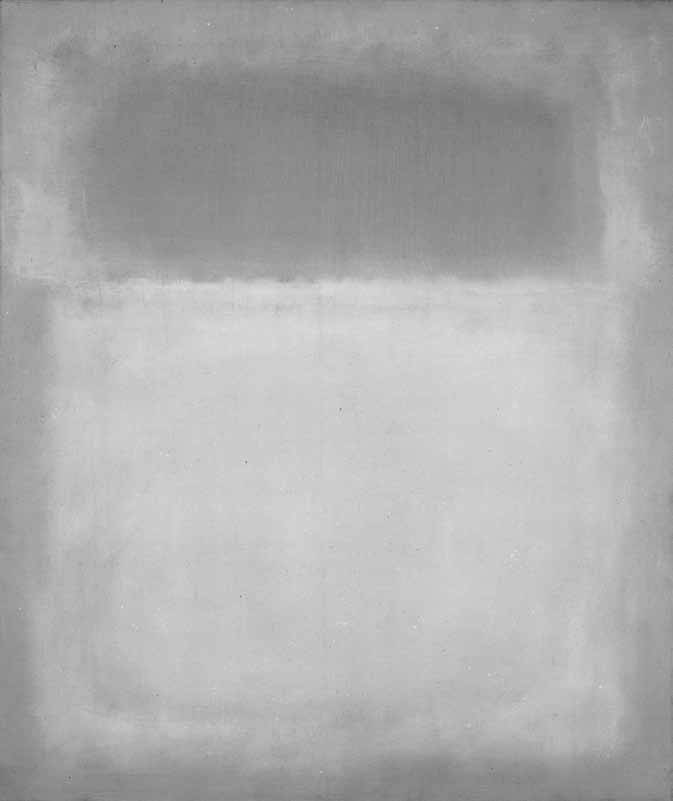
14.11 Mark Rothko, Untitled, 1951,The Nationa lGallery of Art,Washington D.C., U.S.A.
Resilient and yet on the verge of dissolution, the rectangles persist as if to affirm the substantiality and volatility of the realities that the image creates. A similar tension is evident in the Theophanes icon. Aided by the central figure's framing wings, which lift the entire composition out of its physical space on the wall, the white areas and highlights bring everything in sight to a state of imminent flight and resolute presence. There are also differences. The intensity and depth of Rothko's chromatic beings are absent from the Theophanes fresco. And the rapidly drawn highlights which bring to the wings, faces and bodies of the icon's angels and to everything in sight a weightless luster are almost inconceivable in the dense and saturated world of No. 9. Exemplary images are not confined to a certain era or movement. Nothing prevents Theophanes' fresco from being fully integrated in the Modernist cosmos. And nothing excludes No. 9 from the world that theophany opens to the senses and to all aspects of experience.
In the exemplary icon, layers of paint gradually make light shine out of what in the portraits and images of saints takes the being of flesh–as we have seen in the St. Thomas and St. Panteleimon icons. The same effect can happen where flesh or a discernible being is absent and the movement simply exists as a hypostatic modality expressed in color. Thus, in Rothko certain realities emerge that are not objectified (as in figurative painting) but are still, to recall Picasso, figures in their own right because of the reality that the image creates and perpetuates by its own existence. In The Savior, Christ's face comes to life out of a fusion of light and color where color gradually creates the being that we see, a being that belongs to the world possessed by the image. It is thus iconic and apparitional because it is forming right as one sees it and as long as the image exists both on the panel and in the viewer's mind–as Picasso suggested about the lives of images.
In Untitled, a diaphanous layer of evaporating white forms over the orange and pink rectangle, but also inside it where orange that was once brighter–and has left a visible trace of that existence–is now being subdued or softened. The light that is diffused in the animated, energy-filled field of yellow, but is more intense at the edges of what seems to open like a window inside its frame, has already entered matter and imparted on it the first resonances of movement, expression and life. Thus we may have here a proto-epiphany of being, a simultaneous rupture of art and world where both open to the new realities that theophany brings about. Rothko's rectangles have their own lives. Their shapes are as tentative and open as the depth that they create by radiating their presence from within their own space. Here, light and color reach beyond their own realities and toward the formation of yet unknown or unencountered forms. Inversions are possible as are shifts within the image from one rectangle to another, from one shape to another, the key to the movement remaining uncertain.1059

14.12 Andrei Rublev, The Savior, c. 1394, Tretyakov Gallery, Moscow, Russia
There is energy and contained motion, rest and fluidity, concentration and dispersion. Nothing is solid or confined to its own singular existence. The image exists in a delicate and quiet equilibrium. It is not a flat and placid tableau but an unspecified and yet tangible portion of world.In The Savior, we encounter lightness and quiet, transience and presence. In No. 9 and Untitled, form has an inner animation, a silent actuality. Color is suffused with its own reality and luminant energies. It asserts its own being and that of the world it inhabits. What is plastic is actual and aesthetic at the same time. It also resonates with a noetic motion, as if color thinks its own reality and then somehow speaks it (or hums it). In Maximus, theophany is ontophany. The world opens to its deified reality and is seen for what it is, alive in its own perfected being. This opening to deification and plerotic existence art also claims by virtue of being in the world rather than standing on the other side as its likeness or semblance.
Our journey through avant-garde art in search of theophanic forms has been quick and by no means thorough. Modernism's experiments with color and light and the struggle to assert the autonomy and transcendent reality of the aesthetic object, or paint the holiness of the world, have not lost their relevance. Probed more systematically, they may have more to yield that will bring the art of the first sixty years of the last century closer to Christianity's theotic imagery. Non-Christian iconographies should also be subject to the same openness and with the same expectations. Our final chapter is a conversation in this spirit with the art of Zen Buddhism.
Enargeia and Transcendence in Zen Art
In this chapter we explore similarities and differences between the theophanic icon and the image of enlightenment in Zen Buddhism. These include the transcendentalization of nature in Zen painting and the view of paintings and poems as instances of enlightenment. A divinized nature is not a common theme of Orthodox iconography, even though cliffs and sky, trees, rivers and the sea, do in some icons reach that level of existence. Neither are icons typically approached as instances of theophany, even though we have seen ekphraseis that point in this direction. A consideration of Zen art in this context will help expand our understanding of the theophanic image and serve as a vantage point from which to look critically at its aesthetic and theological peculiarities. The Zen image, as we suggested earlier, has its own form of enargeia.
Chinese and Japanese paintings in monochrome ink (sumiye) are typically associated with Zen practice. They reflect the paradoxical equation of formlessness and form that is implicit in the Zen concept of emptiness (sunyata, wu, or mu) and the kind of awareness and receptivity to how things subsist in their «thusness» (tathata and Prajna) that is suggested by the terms dhyana (ch'an, zen) and samadhi. These concepts are combined in the Chinese term ch'an-ting, the state of quietude or tranquility of one who practices meditation.1060
The relationship between Zen philosophy, practice and art is fluid and rich, and assumes a continuity between spiritual and aesthetic experience and expression that is absent in Christianity. Zen engages the world in a spontaneous, simple and terse manner. It affirms at one and the same time its fragility and resilience, its instantaneous reality and perennial transformation. It is therefore easy to see in Zen practice the roots of a distinct sensibility and aesthetic. According to D.T. Suzuki, Zen painting abandons representation and resemblance and delves wholeheartedly in the life that transpires in ink and paper, dissolving all distinctions between image and reality: «... a Sumiye picture is a reality itself, complete in itself, and no copy of anything else. The mountains here are real in the same sense as Mount Fuji is real; so are the clouds, the stream, the trees, the waves, the figures.»1061 The Zen image is full of life and energy. Its autonomy and spiritual resonance recall the exemplary icon. But there are also significant differences.
One such difference is the depiction of nature. Nature is central to the Zen conception of enlightenment but receives little attention in Orthodox theology, despite the fact that from the first centuries of Christianity asceticism befriended the desert and remote mountain areas, and ascetics often pronounced their love of plants, flowers and wild animals. In the counsels of contemporary hesychasts who have experienced the divine light, we find references to how its presence makes them feel «sympathy for all creatures» but little else.1062 Nature provides analogies and metaphors to describe the spiritual life (e.g., «the life of the spirit is like living water» etc.) but it does not itself become the subject of prayer and reflection.1063 The sacred landscape is used as a background to the depiction of divine persons and saints, but never as a subject in its own right.
Another area is poetry. Whereas poems accompany the painting of Buddhist and secular themes in Chinese and Japanese art, and often present their own enlightenment imagery, Orthodox iconography uses inscriptions mainly to identify holy persons and quote Scripture.1064 Except for hymnography and the poetry of ascetics like Symeon, there is no significant interface between poetry, theology and iconography in the Orthodox experience. A third area is the experience of the phenomenal world. Even though Orthodox ascetic manuals abound with references to the fleeting nature of all things, there is little reflection on the aesthetic aspects of this experience or the extent to which it can actually help shape the ascetic life. Attachment to the ephemeral world is the cause of delusion in both religions, but Zen is far more interested in actually showing the absurdity of these bonds by means of paintings and poems–literally painting and poeticizing it–than in simply condemning them as sources of temptation. Thus paintings and poems become essential to the teaching and practice of Zen and the formation of the Zen mind, a role that icons do not have in Orthodoxy.
On the other hand, portraiture and the human figure receive less attention than nature in Zen than they do in Orthodox (and Catholic) iconography.1065
Depictions of the Buddha, bodhisattvas, Zen patriarchs and revered priests are largely hieratic and more concerned with portraying the moral qualities and character of the sitters than their enduring qualities of presence and personality. As in the Byzantine icon, there is formalism and institutional priorities in depicting important Buddhist figures in teaching settings where they exercise and display their authority. When persons are placed in nature, they are seen passing through it or participating in its life, but they are usually far less vivid in presence than the trees and mountains that surround them.1066 Even in direct portraits, the energy that imbues nature is not transferred to the human personality which, in contrast to paintings of trees, grass, mountains and rivers, appears frozen in its particular features and incidentally related to its surroundings.1067 In landscape painting nature assumes a transcendent form of existence that is typically absent from the portrayal of persons.
Enargeia, as we shall see in some detail below, has a different modality in the Zen image than it has in the Orthodox icon where things (typically persons) express an inherent vitality that defies change and transformation. In the sumiye image, by contrast, persons express a shared, ambient vitality. They are in this respect transient as well as fully present in their moment of existence. In the first case, enargeia is contained in the painted object qua object. The vivid way of being belongs to it exclusively. In the second, it is simultaneously contained in the environment in which that object exists. A thing becomes vivid by its placement in a certain order rather than by an act of self-expression.
These opposed modalities reflect significant ontological differences between Christianity and Zen Buddhism. Theophany brings beings to a state of perfected existence. In Zen, by contrast, the issue of perfection does not arise for individual beings even though when grasped in their state of thusness or tathata, things are present in a unitive and distinctive modality not visible in ordinary experience. This reflects the Buddhist doctrine of Anatta or no-self according to which beings have no independent existence, no self-subsisting identity. When grasped with the eye of Prajna or enlightenment wisdom, their reality is understood for what it is: dharma-nature or hossho.
According to Suzuki, in thusness «pluralities in all forms vanish» and things «are understood in their relations, not only to one another but to that which makes up their reason of being.»1068 In the Lotus Sutra, the Buddha explains: «what is called 'all dharmas' is form as it is, the nature as it is ....» All things and the universe possess this nature in which they abide in their multiple manifestations. Eihei Dogen (1200–1253), the founder of the Soto sect of Zen, refers to this passage in the Shobogenzo and explains the Buddha's saying in this way: «So opening flowers and falling leaves are just the nature as it is.»1069 Even thinking that the Dharma nature is not such (i.e., opening flowers and falling leaves) is part of the Dharma nature, he adds later.1070
An exemplary image in this tradition must have «spirit resonance» (ch'i-yun), a concept that we introduced in Chapter 2. Like enargeia, ch'i-yun describes a condition of vividness or vitality in a painting that transcends verisimilitude. It is also expressly associated with the exemplary or inspired image in Chinese critical texts.1071 The Sung author Huang Hsiu-fu (c. 1006) says of such paintings that their «subtleties echo natural transformations.» He then asks rhetorically, conjuring an image that recalls Byzantine visions of saints descending from walls: «Is this not what was said about their disappearance on the opening of a cabinet, or of their flying away after plucking themselves off a wall?»1072
An early treatise by Hsieh Ho (c. 490) first defines ch'i-yun as an aesthetic formula for all art that «deals concisely with the problem of creative 'vitality,' 'harmonious manner' of execution and 'aliveness' of drawing in painting.»1073 Yun in particular was associated with elegance or grace in lively or essentially vital form.1074 As the vital principle of all beings, ch'i is dispersed in the universe. It is the breath of life and substance (similar in certain respects to pneuma and logos) that can be found in all things and in the painted image that is open to this spiritual truth.1075 In the opinion of the distinguished painter and art critic Li Jih-hua (1565–1635), one's brush must «take» what it finds in nature and deliver its likeness but it must also «yield» that likeness to convey something of the transcendent essence of the subject: «Everything is there, even though not executed.»1076 This is how an image becomes an instance of enlightenment. Li compares the painter who masters this to the Buddha who «spoke by natural inspiration, without any effort, about past kalpas, their causes and effects, which manifest and dissolve in a mysterious fashion beyond human comprehension, though never contrary to truth and reason.»1077
In the Wake-Up Sermon, Bodhidharma, the Indian monk who brought Ch'an to China in the fifth century, writes: «True vision is detached from seeing. The mind and the world are opposite, and vision arises when they meet. When your mind doesn't stir inside, the world doesn't arise outside. When the world and the mind are both transparent, this is true vision.»1078 In this statement Li Jih-hua expresses a similar idea:
The painter must keep his mind open and free from all matters of the world. Then the effects of vapours and clouds and the beauty of the colours will come out spontaneously in accordance with the spirit of Heaven and Earth, and the most wonderful things will take shape under the brush.1079
According to Noritake Tsuda, a Zen aesthetic rejects elaborate depiction and opts for spontaneity, simplicity and elliptical form.1080 Shifting qualities in form and light are typical of an attention to the fleeting and yet constant presence of things in time and space. Voids in composition establish patterns of emergence and recession. To paint is to set forms in motion. In the seventeenth century, the renowned court painter Tosa Mitsuoki (1617–1691) compared the dynamic presence or «circulation» of spirit in a painted object to «putting eyes into the painting» and defined it in terms that recall Greek and Byzantine views of painting: «'Life's motion' (ch'i-yun) means that a painting... contains the spirit of the object and thereby makes the spectator feel as if the object were standing before his eyes... No ordinary artist can transmit such spirit into his work ...»1081 Commenting on Mitsuoki's art, Makoto Ueda writes: «Every object has the eyes, or a point that most vitally reflects its inmost nature.»1082
The same vitality is present in the artist. The painter and scholar Ching Hao (c. 870-c. 930) wrote: «Spirit is obtained when your mind moves along with the movement of the brush and does not hesitate in delineating images.»1083 The painted object arises in this process spontaneously. The lack of hesitation on the artist's part suggests that the object (and image) is already formed. In sumiye the fluidity of ink and the thinness of paper make every move irreversible. Forced to act instantaneously, the painter follows the vital movements of her objects by immersing herself in their natural and plastic life and grasping their «essential spirit,» a disposition that recalls eusebeia.1084 The more intense one's observation of things and the more total her immersion in their nature, the livelier the impression they leave.1085
Perception in such moments is substantive (ontological). The object does not arise in contemplation but in the act of painting (actually in the instant the brush touches the paper's surface). Thus «formal likeness» is typically juxtaposed to «noble vitality» (ku-ch'i).1086 This is an important distinction. Likeness can be established either by mere reproduction (an inferior form) or through profound contact with the object's reality or mode of existence. A painting, according to the poet Yang Wei-chen (1296–1370), can show things by «transmission of likeness» or by «transmission of spirit.»1087 In spiritual transmission, as in enargeia, the image itself is a creative being. It obtains, Wei-chen says, «[the powers] of creation itself.»1088 The image is then alive: «a painted cat hung on a wall may stop the rats; a 'Bodhisattva Crossing the Sea' may dispel the wind; a venerable sage or war-god can be prayed to and its voice will answer.»1089 The art object in this (exemplary) instance belongs to a higher order of reality. It is transcendent and immanent at the same time. It also has what in Christian terms we would call a plerotic quality. A thing painted with spirit will «transmit the spirit (ch'uan shen) that is in all."1090
This is how Fu Tsai (d. 813) describes an instance of Buddhist cosmophany:
Ravaging and pulling, spreading in all directions, the ink seemed to be spitting from his flying brush ... When he had finished, there stood pine trees, scaly and riven, crags steep and precipitous, clear water and turbulent clouds... It seemed as if the sky had cleared after a storm, to reveal the true essence of ten thousand things... when we contemplate Master Chang's art, it is not painting, it is the very Tao itself.1091
Before it even settles on paper, the ink assumes the energy and subtle qualities of the natural world it will become. When the painting is complete, it reveals this world in its bare reality. This sense of clarity is consistent with the tranquility of mind that characterizes the meditative mind.
We can explore these ideas in three paintings in ink and silk by Late Edo painter Kano Seisenin Masanobu (1796–1846) (Figure 15.1). Portrayed in the central scroll in their standard form are two emanations of the Zen bodhisattvas Munju Bosatsu (Kanzan) and Fugen Bosatsu (Jittoku). The two men (Ch. Hanshan and Shih-Te) were eccentric monks at Mount Tendai in China during the Tang period. They represent the wisdom and method of Ch'an, signified by the scroll held by Kanzan and the broom and bucket that accompany Jittoku.
15.1 Kano Seisenin Masanobu (1796–1846), Kanzan, Jittoku and Landscape, Author’s collection
The left and right scrolls present views of the distant mountains from different directions. Fading forms of grass, sky, earth, trees and water suggest the tranquility of the landscape. Through the mist and fog, one can see clearly the rising blades of grass and the soil next to water rendered in soft washes of light and dark tones. Tangible and real, the trees and rocks in black ink define the receding horizon where in two of the scrolls rising mountain peaks are barely visible. On the sliding slope of the mountain (left scroll), thick, splashed ink creates areas of lush vegetation against which rooftops and walls are swiftly outlined. All around them, delicate washes, faint lines and empty space create a misty, serene landscape surrounded by a placid void. The two isolated figures in the middle scroll belong by association to this world even though there is very little in the image itself other than the empty space that surrounds them, to suggest that. Like the adjacent landscapes, the scene has a lightness and quiet about it, as if nothing is spoken or heard.The three paintings appear as moments in nature but not impressionistically. They simply exist in that modality. They do not depict it. Here it makes no sense to think of resemblance or representation. Dominated by an empty and elusive space that suspends the painting act, these images emerge like acheiropoietai through the sheets of mist that they so delicately create. They have a transient presence as if they could disappear from view at any minute. And yet they linger. On the surface, they appear as lively as the portrait of Eutyches. But rather than concentrate in a face or figure, this liveliness is here diffused. Neither the houses and cliffs nor the mountains and human figures that inhabit this space are vivid in themselves. Their form and appearance does not belong to them. They show no internal motion of self-manifestation, no act of self-expression that centers in their own individual reality. They simply (and profoundly) exist as manifest moments of the invisible world they inhabit and whose subtle and creative energies they seem to embody and realize.
This passage from the work of Sung critic Tung Yu (twelfth century) is very relevant:
Those who discuss painting say that hills and valleys had been formed within [Wu Tao-tzu's] breast, so that when he was aroused, they came forth in painting. Therefore, there are no traces of things left behind, yet the scene is produced in accord with what was seen. No doubt his nature was in harmony with external nature... Moreover, if one looks at all living things on earth, they are just the transformations of one vital energy (chi'i). Its functioning and modifications are appropriate in each case; no one is conscious of the process, and so it is achieved naturally.1092
When things subsist in the mind and heart, like interior landscapes, the dualities of subject and object disappear and the image arises on its own accord (like a natural phenomenon). There is no discernible past or time within which form takes shape. It is neither an act (in the objective sense) of nature nor an act (in the subjective sense) of human expression but an instance, both tangible and elusive, of the timeless presence of reality to an encompassing Mind. Thus, what is personal is absorbed by mind and world which give it its distinctive shape. This is cosmophany without personhood or better, it is cosmophany that has internalized personhood.
And yet, we can hear echoes of eusebeia. The official and painter Su Shih (1037–1101) likened the painter to a diver (and the sea to the Tao): «In the south there are many divers who live in the water every day. At seven they wade, at ten they can float, and at fifteen they are able to dive... If one lives in water every day, then at fifteen one will grasp its Tao.»1093 The art historian Kuo Jo-hsu (c. 1080) attributed the presence of ch'i-yun or «animation through spirit consonance» in a painting to a type of «innate knowledge» that is not the result of practice or experience: «it is an unspoken accord, a spiritual communion.»1094 The great landscape painter Kuo Hsi (c. 1000-c. 1090) explained: «If all is ordered in detail in your bosom, your eye will not see the silk and your hand will be unaware of brush and ink, and through the immensity and vastness [of your mind] everything will become your own painting.»1095 The same idea of losing one's object in the act of painting it in order to rediscover it as part of an encompassing reality is expressed by Tung Yu in a way that recalls Bodhidharma:
If one is able to be unconscious of horse and without the hindrance of looking at horses, forms will disappear abruptly as if extinguished and nonexistent. When the complete image is prepared and lodged in one's breast, it will suddenly emerge without one's knowing how it did so. Then prancing and soaring, it will enter the scene on the silk.1096
As in eusebeia, one submits to the being of things totally, to the point where the thing or its appearance in the mind takes over thought and perception. Here we have paradoxical movements: the emptier the image the mind forms, the fuller will be the plastic object that emerges. We are reminded of Maritain's poetic knowledge, where the mind reaches out and connaturally grasps the image or yields to its impression, in a combination of feeling and form–"emotion as form» (emphasis added).1097 But here the mind does not enter into the mystery of things. It only receives and registers impressions whose vitality is the result of a cosmic act. There is no God, no intimate conversation, person to person, between artist and being. And yet, as we can see in these aphorisms from Zen practice, the loss of self and object, is no less ascetic (in the way that it eliminates the objects of sense and intellection) and no less mystical (in the way that it reveals an unthematic, open and transcendent reality): «The one perceivable whole is ungraspable,» «Being hidden, all the more exposed,» «Though the Buddha's eye watches for it, it can't see it,» «Call to it without sound, see it without a form,» and «Describable, not thus reachable; paintable, but not completely.»1098
We should now briefly consider the place of beauty in Ch'an and Zen theory. Japanese art historians use the concept yugen, translated as elegance, simplicity, lightness, austerity and inner life, to describe the work of art, poetry or theatrical performance that has reached the highest level of refinement and accomplishment. Ukiyo-e prints (bijin-e) whose subject is female beauty are a reflection of this aesthetic.1099 «Beauty,» in the sense of perfect or complete realism in a painting or performance, is associated with artifice in Mitsuoki according to whom «a painting that is too beautiful is weak.»1100 Tsuda describes Zen painting in the Muromachi period as guided by the ideal of the hidden «beauty or true life of things» but not explicitly as liveliness.1101 Chinese aesthetics identifies three principles that define the concept: conformity or fidelity to the object painted (ying-wu hsiang-hsing), proper coloring (sui-lei fu-ts'ai) and integral composition (ching-ying wei-chich).1102 There is an evident agreement with the scholastic view especially in the components of conformity and integrity. But these, as we have argued for beauty previously, are structural characteristics that help ground enargeia. The same happens with ch'i- yun. Conformity suggests likeness, a characteristic, as we have seen above, of inferior painting. This distinction can therefore help us sharpen the contrast between beauty and enargeia.
In enargeia, the image is complete (and as such in a state of rest), but its objects never stop emerging from within. It is an elliptical and open completeness that remains elusive. A ground is implied inside the image which however remains invisible. One cannot open (analyze) the image and find it. What is visible is a subtle motion inside the painted object toward and away from the viewer, a movement of self-containment and self-expansion. This movement, where present, disappears under beauty. The aesthetic object becomes a tableau, an analyzable pattern. This formalization (flattening) reflects an alignment between aesthetic object and the concept that measures it. The alignment may please the mind (as in pulchritudo placet), but it creates an image that is rigid and artificial. By contrast, enargeia presents the mind with a life-form, with a plastic being which lives its own reality and is therefore always more than it appears to be. This being commands conversation rather than contemplation, engagement rather than passivity, participation rather than detachment. To measure it against a concept is to miss its reality altogether. This is how beauty can be a facade or spectacle (or an idol). The image that has enargeia arises out of an unspecified and yet tangible depth. It is measured only against its own being. And it can never fit itself perfectly.
The concept of a thing's inner reality or (shih) conveys this idea. As Ching Hao explains in The Significance of Pines, the painter who paints without shih may succeed in rendering a subject in a life-like manner. But he will not succeed in capturing its ch'i-yun: «if spirit is conveyed only through the outward appearance and not through the image in its totality, the image is dead.»1103 A painting that has ch'i-yun has accomplished much more than beautiful form. This vitality is at the very heart of Zen aesthetics and is expressed in the same paradoxical form that we saw in Digenes, Symeon and in Byzantine ekphraseis. But only in Digenes do we see a comparable attention to nature that we find in Zen iconography and poetry.
In Orthodoxy, nature may be holy and its holiness visible in theophany but it is rarely observed with the interest and sensitivity that we find in Chinese and Japanese Buddhist literature. And yet, the idea that in enlightenment all forms are perceived simultaneously, in a state of spontaneous arising, opens perception to a dimension that is consistent with theophany as described by Palamas and others. «None other than Buddhist patriarchs knows that the opening of flowers is the occurrence of the world,» writes Dogen in a passage from his famous «Kuge» (Flowers in Space) of the Shobogenzo.1104 The phrase is by Bodhidharma's master Prajnatara and Dogen is here trying to break out of ordinary conceptual structures in order to illustrate Prajnatara's words: «Not only in spring and in autumn do flowers and fruit exist; existence-time always has flowers and fruit. Every flower and fruit has maintained and relied upon a moment of time, and every moment of time has maintained and relied upon flowers and fruit.»1105
Grasping the flower's subsistence in time opens perception to that moment's transtemporal reality. Time anywhere and everywhere carries flowers. It is inseparable from their being what they are at any given moment–a moment in which their existence comes to be and becomes a perceived reality. Conversely, time is carried by all the flowers that have ever existed and will ever exist. Rather than make this a contemplative truth or the subject of a philosophical query, Zen opts to perceive it. A flower's time, the time of a flower, time as flower, flower in time, and so on are ways of capturing in language fragments of what in perception is a total experience: «the time of the moon is not always night, and night is not always dark. Do not limit yourself to narrow human consideration. There may be day or night even where there is no sun or moon.»1106
In the eleventh century, the painter Chai Yuan-shen was caught playing his drum off beat in a performance of his home orchestra. When summoned to explain what happened, he said: «At the time in question I was pounding away at my drum when all at once I caught sight of a cloud mounting into an extraordinary mountain peak [formation], just made to be the model for a painting.»1107 The painter and critic Ching Hao likewise wrote of the cypress tree: «It is luxuriant but not showy. Its trunk has many knots and is clearly sectioned. Its twisting patterns grow so as to follow the movement of the sun. Its leaves are (rugged) like knotted threads and its branches are [angular] like hemp clothes [on the body].»1108
The great landscapist Kuo Hsi explained the importance of insightful observation and abstraction in rendering the essence of seasonal landscapes:
Clouds and vapors in a real landscape differ through the four seasons. They are genial in spring, profuse in summer, sparse in autumn, and somber in winter. If a painting shows the major aspects and doesn't create overly detailed forms, then the prevailing attitude of clouds and vapors will appear alive... Spring mountains are gently seductive and seem to smile. Summer mountains seem moist in their verdant hues. Autumn mountains are bright and clear, arrayed in colored garments. Winter mountains are withdrawn in melancholy, apparently asleep.1109
Hsi also wrote on more technical matters: «The coloring of wind may be achieved through yellow earth and dust ink. The coloring of earth is obtained through light ink and dust ink. The coloring of stone is obtained through combining blue and black ink in different shades.» A minimum number of lines and washes should be used to create the impression of an actual, live landscape: «Achieve the effect of waterfalls by leaving the plain silk bare and simply using scorched ink to indicate the sides.»1110
In this poem by Liu Tao-shun (c. 1059), nature comes alive in the way that holy persons came alive in the Byzantine ekphraseis:
As for T'ung's painting style, above protrude eminent peaks, below one gazes into bottomless ravines, of a majestic gravity and strength that T'ung was able to bring out with one brush stroke. Their prominent forms burst forth as if gushing out. And further more, everything was complete in the somber vastness–the bluish green of peaks and cliffs, soil and rocks in groves and foothills, as well as land areas into the level distance and mountain paths remote and cut off, bridges and planks, hamlets and villages–hence the praise and esteem of his contemporaries.
This poem by Zen Master Goso Ho-en (c. 1024–1104) has been praised by Dogen:
The north wind mixes with snow and shakes the valley forest.
Though the myriad things have sunk under cover,
Regret is not deep.
The only presence is the mountain plum trees,
which are full of spirit.
Before December they are already spewing the mind for all the
coldness of the year.1111
Here, time is inseparable from the mountain, plum, wind and snow and the inevitable advent of the seasons. Dogen comments: «A bit of the virtue of the plum blossoms, mixed with the north wind, has become the snow.» The blossoms have the power to create the wind, snow and «the myriad things of the valley forest.»1112 In the eyes of the poem they are grasped in their creative act of existence. They are not just blossoms or plum but a miniature universe in which the reader's (and viewer's) senses participate.
Dogen wrote that in the image that exists as an instance of enlightenment «'being like' does not express resemblance; being like is concrete existence.»1113 This, as we have seen earlier, is also a sense that is preserved in the Greek term eikon and in the image that has enargeia. As in theophany, enlightenment opens vision so wide that one can actually watch things emerge and appear from what seems to be an ever expanding horizon. In theophany, a visible yet unrecognizable light permeates all things which bask in its presence oblivious to and yet filled with their own individual realities–and thus free, at least in that moment, of the struggle to be what they are that defines their fallen existence. In enlightenment, all tangible forms disappear (even that of the Buddha) only to intimate their presence at the very moment that they vanish from view.
The Chinese patriarch of the Japanese Rinzai sect, Linji (ninth century), said to a disciple: «When you realize that causation is empty, mind is empty, phenomena are empty, when your single thought is set to cut off, transcendent and you have nothing further to do, this is called 'burning the sutras and the Buddha's image'.»1114 But in this emptiness one may find alternative worlds and realities. Thus, it is possible for a hair to «swallow the great ocean» or a mustard seed to «contain Mount Sumeru» [the mythical mountain and center of the universe in Buddhist cosmology].1115 In such moments, nature's mysterious plenitude and self-transcending presence affects persons by enveloping them in its own reality. Whether it is Kanzen and Jittoku or images of the Bodhidharma serenely riding a reed-leaf in the midst of a boundless ocean, or one of the many Zen patriarchs and eccentrics sitting quietly on a cliff by moonlight, nature is never absent.1116 It exists within the forms that bodies and faces assume, imparting on them a sense of time and place that transcends contingent human existence. Even when they stand alone, things are never complete in themselves but remain open, outlined against an empty space that makes them seem like floating figures or shapes in a transient world. To those for whom the thusness of things is more compelling than their conventional existence (the object of desire, pleasure and delusion), life has a certain solitude and form becomes hollow the very moment that it seems full and ready to capture consciousness. It should not surprise us, then, that when compared to an icon of Christ or of a saint, a Bodhidharma is never a complete shape, never a finalized figure.
Figure 15.2 is a picture of Bodhidharma (Daruma) painted by Ienaga Ichido (1893–1951) who was abbot of the important Rinzai temple Tofuku-ji, in Kyoto. Part of the inscription reads «Don't know,» which is Daruma's anwer to the question «Who are you?» With bulging eyes and forehead, and an open, fixated stare, the figure is outlined in bold and fine lines and its expression forms mainly out of the eyes, mouth and thick eyebrows. The soft brush strokes that outline his forehead nestle what seems a fragile head and figure. The man's old age is evident in his sagging, yet resolute jaw. There is little more that we can tell about its subject. Nothing about it is final. Its concise and open form gives it a sense of lightness and ease. The image seems to capture an instance of mind in the life of the figure which stands absorbed in something invisible and yet fully present in its expression and posture.
The Apostle (Figure 15.3) appears solid and tangible by comparison. If we think of the worlds that these two figures inhabit, that of Daruma is plain and simple: the old man stares into nothing; he has nothing to say. He just exists in that moment in time in which his old head, protruding jaw and cloak make him a monk, a man or simply someone (perhaps even no one). In the Greek icon, the man's gaze has a quality of intense stillness and quiet. His world is one in which this kind of expression on a human face is possible: a world of watchful solitude in which words are spoken even in silence and where beings present themselves out of their own reality, out of a depth that they possess but cannot fully externalize. There is no empty space here; only a tangible light that has become thoroughly humanized and taken the eloquent form of the human flesh, the concentrated plenitude of the sanctified mind, and the resonance of a person's life.
15.2 Ienaga Ichido (1893–1951), Daruma, Author’s collection
Images with enargeia may belong to different worlds but they have one thing in common: inside them something always moves beyond the image, as if to present it or bring it to life. In Zen art, persons become vital by existing in a moment in time that somehow makes them be what they are. In this respect they do not differ from nature. Like mountains and streams, or drying bamboo shoots, they are not in and of themselves alive. In the Christian image, by contrast, it is the object itself that contains this energy and draws from it to become what it is. The logoi of beings reveal their innermost reality, and that is what the ascetic who has acquired eusebeia can actually see. But humility has many forms. Those who dive into the Tao or enter the realm of Prajna will see an ocean in a hair or a mountain in a leaf–an act of cosmic humility in which the great inheres in the small (in scale or volume) and all distinctions between them momentarily disappear.
Having looked briefly at the iconography of this particular school of Buddhism, it is easier to understand the Russian avant-gardes who sought for their paintings the elusive vitality they saw in the empty spaces and abstract forms of «Oriental» art. Regarding possibilities for further study, it should be obvious that there are plenty. We may open theophany to the empty spaces of sumiye and to those epiphanies of nature that the Orthodox icon somehow misses. Or, we may let color fields like Rothko's generate their own instances of rain, mist and moving clouds that captured the imagination of so many Chinese artists. We may also press the ambient logoi of beings beyond their perceptible contours, to discover a form of eusebeia that is the mark of all life rather than of the ascetic alone.

15.3 The Apostle Thomas, mid. 14th century, Holy Metropolis of Thessaloniki, Greece
Dogen's phrase «the time of the moon is not always night» should lead us to reflect on those moments in the existence of things when their logoi become fluid and their boundaries tenuous. We can envision the Orthodox image opening itself to poetry (extant or new) and to theotic moments in nature that rival in vitality the transcendent and yet so immanent mind-world of the Zen painting. Nothing in Orthodox theology, as we have presented it in this study, prevents the iconographer from taking these paths. In fact, as long as she remains immersed in tradition, like the divers of Su Shih who know the sea by swimming its waters, there is nothing better for her to do.
* * *
Примечания
(Martin Robertson, Greek Painting (Geneva, 1959), p. 21.)
(Pliny the Elder, Chapters on the History of Art, pp. 107–111, plates 61–66. Pliny the Elder, Peri tes Archaias, plates 17, 24.)
(For the use of color and light in Greek painting in the context of Pliny's account, see Pliny the Elder, Peri tes Archaias, pp. 322–323, 189–194, plates 3, 34.)
(Pliny the Elder, Chapters on the History of Art, pp. 110–115, plates 66–71.)
(The exchange is recorded by Xenophon in Memorabilia 3.10.1–5. J. Pollitt, The Art of Ancient Greece: Sources and Documents (Cambridge, 1990), pp. 155–156. Pollitt, The Ancient View, pp. 184–185.)
(On the meanings of skiagraphia see Pollitt, The Ancient View, pp. 247–254, 44–45. Apollodorus and Zeuxis were opposed by their more conservative contemporary Parrhasius who stood closer to Plato's standards in the Republic (Book X, 602C-603B). This kind of painting is not unlike the images of the Cave puppeteers (thaumatopoios) in Republic 514B, discussed in connection with poetry in Thayer, «Plato's Quarrel with Poetry.» In Poetics (1450a) Aristotle agrees with Plato. Composition and narrative are more important than plastic qualities. Bruno, pp. 31–35.)
(For restorations of Polygnotus' Delphi panels (plaques or wall paintings), see Pollitt, The Art of Ancient, pp. 127–130, 135–137; Bruno, p. 10.)
( Poetics (1450a24); Pollitt, The Ancient View, p. 185.)
( Poetics (1450a). Aristotle was concerned about the lack of an integral, plot driven «ethical element» in contemporary tragedies. Aristotle's Poetics, trans. James Hutton (New York, 1982), p. 51.)
(In the Republic (602CDE) skiagraphia is dangerous for exactly this reason.)
(On mimesis, thauma and its cognates in Plato and other sources, see Pollitt, The Ancient View, pp. 37–39, 189–191. In Phaedrus (275de) lifelikeness is granted in painting but its limitations are also noted. Plato's objective is to undermine the effect of written discourse on the soul as compared with oral communication rather than comment on the expressive qualities of painting.)
(In such contexts charakter implies immediate recognition and presence. In Damascene: «and everywhere we present to the senses his figure (charakter), the figure of the incarnate God Logos PG 94:1248C. In Theodore the Studite charakter refers to the presence of the archetype in the image that depicts it. Mango, The Art, p. 173. Fr. Justin of St. Catherine's Monastery at Sinai: «I like to think of icons as reflections: in the classical
sense where a mirror image was considered real, not illusory. It's like a presence of the figure depicted.» New York Times, Sunday, November 12, 2006, 32. The relationship between charakter and morphe, both suggestive of self-manifestation, will be discussed later. See also Martin Heidegger, Introduction to Metaphysics, trans. Gregory Fried and Richard Polt (New Haven, 2000), pp. 63–64.)
(PG 94:1272D.)
(PG 94:1272C.)
(Mango, The Art, pp. 210–211.)
(Ibid., p. 211.)
(Kiteinger, «The Hellenistic Heritage in Byzantine Art.»)
(Pollitt, The Ancient View, p. 189.)
(Pliny the Elder, Chapters on the History of Art, pp. 109–11, plates 65, 66. Pliny the Elder, Peri tes Archaias, pp. 316, 189–190.)
(Pliny the Elder, Chapters on the History of Art, p. 115. Greek Anthology, vol. 1, pp. 21–22 (34).)
( Greek Anthology, vol. 1, pp. 21–22 (34).)
(Ibid.)
(Doxiadis, pp. 91–93.)
(The portrait of a Serapis priest (c. 138–161) is an example of the first type; a portrait of a soldier from the same period (c. 138–192), of the second. Ibid., pp. 49, 23.)
(See the detailed description of the apse mosaics in Cyril Mango and Ernest J.W. Hawkins, «The Apse Mosaics of St. Sophia at Istanbul,» Dumbarton Oaks Papers, 19 (1965): pp. 113–151.)
(Maguire, «Truth and Convention in Byzantine Descriptions.»)
(James and Webb, «To Understand Ultimate Things.» «'Life-likeness' is not an aesthetic judgment; it is a conceptual necessity.» See James, «Senses and Sensibility in Byzantium,” Art History, 27/4 (2004): pp. 522–537. Thus Dagron concludes that the intimate and expressively complex twelfth-century mosaic of Christ from the Great Deesis in the Hagia Sophia is “condemned to sublimity.” Dagron, Décrire, pp. 73–77.)
(For Photius' reliance on Platonic aesthetics, see B.N. Tatakis, Meletemata Christianikes Filosophias (Studies in Christian Philosophy) (Athens, 1981), pp. 131–132. See also Mango and Hawkins, «The Apse Mosaics of St. Sophia.»)
(Kazhdan and Maguire, «Byzantine Hagiographical Texts.»)
(Mango, The Art, p. 187. For the Greek text, see Vasileios Lourdas (ed.), Photiou Homiliae (Thessaloniki, 1959), p. 167.)
(Ibid.)
(Ibid.)
(Mango and Hawkins, «The Apse Mosaics of St. Sophia.»)
(Ibid.)
(Mango, The Art, p. 231. For the Greek text, see E.D. Miller, «Poesie inedites de Theodore Prodrome,» Annuaire de l'Association pour Vencouragement des etudes grecques en France, 17 (1883): pp. 32–33.)
(In a poem dedicated to Emperor Manuel I, Prodromus claimed that even the brush of Eulalius and two other celebrated painters of his time could not render his unique literary (and perhaps illustrating) gifts (see below). Mango, The Art, pp. 230–231.)
(Ibid. See also Miller, «Poesie inedites de Theodore Prodrome.»)
(Mango, The Art, p. 231. See also Miller, «Poesie inedites de Theodore Prodrome.»)
(Mango, The Art, p. 231. For the Greek text see A. Papadopoulos Kerameus, «Nikephoros Kallistos Xanthopoulos,» Byzantinische Zeitschrift, XI, 46f. 16 (1902): pp. 46–47.)
(Mango, The Art, p. 231. See also Kerameus, «Nikephoros Kallistos Xanthopoulos,» pp. 46–47.)
(Kerameus, «Nikephoros Kallistos Xanthopoulos.»)
(Ibid.)
(Kaldellis, pp. 245–255.)
(Pliny the Elder, The Elder Pliny's Chapters, p. 105.)
(P.A. Agapitos, «Poets and Painters: Theodoros Prodromos' Dedicatory Verses of His Novel to an Anonymous Caesar,» Jahrbuch der Oesterreichischen Byzantinistik, 50 (2000): pp. 157–181.)
(Ibid.)
(Wolfram Horander, Theodoros Prodromos: Historische Gedichte (Wien, 1974), pp. 434, 459.)
(John Mavrogordato (ed.), Digenes Akretes: Edited with Introduction, Translation, and Commentary (Oxford, 1956), pp. 164–165 (Book 6: 30–37).)
(James has shown that the Byzantines adopted the classical color scale and had a transcendental, ontological understanding of color. Chroma (color) is related to chros (skin) and chroia (hue), suggesting complexion and tonality. Anthos means both flower and color but also luster. James, Light and Colour, pp. 74–75, 79–80.)
(Anna Comnena, The Alexiad of the Princess Anna Comnena: Being the History of the Reign of Her Father, Alexius I, Emperor of the Romans, 1081–1118 A.D., trans. Elizabeth A.S. Dowes (London, 1967), pp. 72, 74, 76–77. Greek text in Annes Komnenes Alexias Tomos B', trans. A. Georgiadou (Athens, 1974). Anna had read Aristotle and was familiar with twelfth-century anatomy. Kaldellis, p. 249.)
(Comnena, p. 245. For a similar imagery in Homer, see Mavrogordato, p. lxxxi.)
(For similar patterns in archaic verse, see Tsakiridou, «Her Voiceless Voice.»)
(Mavrogordato, pp. 218–219 (Book 6: 45–58).)
(Ibid.)
(Ibid.)
(Ibid.)
(Symeon the New Theologian, The Ethical Discourses, Life, Times and Theology, ed. Alexander Golytzin (3 vols, Crestwood, 1997), vol. 3, pp. 175–181. See also Kaldellis, pp. 186–187. Maximus was highly respected in the Comnenian court. A comparison of Maximian and Symeonian anthropology in Hilarion Alfeyev, St. Symeon the New Theologian and Orthodox Tradition (Oxford, 2000), pp. 37, 41, 176–184, 226–241, 266–270. In the Alexiad the Empress Irene said: “… I myself do not touch these books without a tremor and yet I cannot tear myself away from them. But you wait a little and after you have dipped into other books, you will taste the sweetness of these.” The Alexiad, Book 5: 9.)
(Achrimandrite Sophrony (Sakharov), O Aghios Silouanos o Athonites (Essex, 1999), pp. 88, 150–189, 184–185, 339. Hussey, p. 18. Basil Krivochéine, In the Light of Christ: St. Symeon the New Theologian (New York, 1986), p. 9. Alfeyev, pp. 1–2. Symeon the New Theologian, Ethical Discourses, vol. 3, pp. 176, 181–183. Andrew Louth, “Light, Vision and Religious Experience in Byzantium,” in Matthew T. Kapstein (ed.), The Presence of Light: Divine Radiance and Religious Experience (Chicago, 2004), pp. 89–90, 101.)
(G.E.H. Palmer, Philip Sherrard and Kallistos Ware, The Philokalia: The Complete Text Compiled by St. Nikodimos of the Holy Mountain and St. Macarius of Corinth (4 vols, London, 1995), vol. 4, pp. 424–425, 422.)
(Ibid., p. 424.)
(Syméon Le Nouveau Théologien, Traités Théologiques et Éthiques, Sources Chrétiennes, trans. Jean Darrouzès (Paris, 1966), pp. 415–420, 430–435. Symeon the New Theologian, Ethical Discourses, vol. 1, pp. 74–78.)
(Symeon Le Nouveau Theologien, Traites Theologiques et Ethiques, pp. 420–425, 430–435.)
(Ibid., 445–450. The translation from the Greek is mine.)
(Syméon Le Nouveau Théologien, Hymnes II, 16–40, Sources Chrétiennes, trans. Louis)
Neyrand (Paris, 1971), p. 12 (Hymn 16:20–30).
(Ibid., Hymn 16:30–35.)
(Ibid., Hymn 16:25–30. “In Symeon’s imagery of light, warm and bright colours are thoroughly dominant. Symeon’s light is not a cool luminescence of the moon, but is dazzling sunshine or the blazing radiance of fire.” Alfeyev, p. 239.)
(Symeon the New Theologian, Hymnes II, p. 36, Hymn 17:319–330.)
(Ibid., Hymn 17:328–329.)
(Ibid., pp. 36, 38, Hymn 17:330–370.)
(Ibid.)
( Ibid.)
(Alfeyev, pp. 173–175.)
(Ibid., pp. 36–37, 41. Hussey, p. 19.)
(Mavrogordato, p. lxxxi.)
(Symeon the New Theologian, Hymnes II, p. 172, Hymn 22:28–39. Ibid., p. 182, Hymn 22:146–164.)
(Ibid., p. 182, Hymn 22:146–164.)
(Ibid., Hymn 22:160–165.)
(Ibid., pp. 182, 184, Hymn 22:164–170.)
(Ibid., p. 228, Hymn 24:15–25.)
(Ibid., p. 444, Hymn 35:53–60. The translation is mine.)
(Symeon the New Theologian, Hymnes III, 41–58, Sources Chretiennes, trans. J. Paramelle and Louis Neyrand (Paris, 1973), p. 104, Hymn 45:30–40.)
(Ibid., p. 52, Hymn 42:190–194. On this analogy, see Louth, “Light, Vision and Religious Experience in Byzantium.”)
(C.A. Tsakiridou, «Theophany and Humanity in St. Symeon the New Theologian and in Abu Hamid al Ghazall,» International Journal of Orthodox Theology, 2/3 (2011): pp. 167–187.)
(Ibid.)
(Potamianos, pp. 251–327. Mathew, Byzantine Aesthetics, pp. 23–37.)
(Robert S. Nelson, “To Say and to See,” in Robert S. Nelson (ed.), Visuality Before and Beyond the Renaissance: Seeing as Others Saw (Cambridge, 2000), pp. 143–168. Mathew, Byzantine Aesthetics, pp. 150–153. Mango, The Art, p. 249.)
(Mango, The Art, p. 249.)
(Potamianos, pp. 180–181, 246–251, 286–287.)
(Ibid., p. 246.)
(Ibid., pp. 37–40.)
(Ibid., p. 246.)
(Ibid., pp. 249, 251.)
(Symeon the New Theologian, Hymnes III, p. 212, Hymn 23:360–384.)
(St. Maria the Younger instructs a painter in whose vision she appears to paint her «as you see me now.» This and other examples are discussed in Kazhdan and Maguire, «Byzantine Hagiographical Texts.»)
(The tessarae in the head of the Virgin from the Deesis mosaic panel in the Hagia Sophia, Istanbul, are arranged “in a pointillistic fashion to blend colours at a distance.” James, Light and Colour, plate 15.)
(Lossky, The Mystical Theology, pp. 19–20. Irina Shalina, “St. Andrew the Holy Fool with Scenes from His Life,” in Roderick Grierson (ed.), Gates of Mystery: The Art of Holy Russia (Fort Worth, 1992), pp. 246–249.)
(Symeon the New Theologian, Ethical Discourses, vol. 3, pp. 175–184.)
(Golytzin, «Christian Mysticism over Two Millennia.»)
(PG90:1133D, 1140C, 1160CD.)
(PG90:1133D.)
(PG90:1133D, 1344A.)
(According to Symeon, one cannot delve into matters of theology without first having known God. Symeon the New Theologian, Ethical Discourses, vol. 3, pp. 31–35. Alfeyev, pp. 38–42.)
(Alfeyev, pp. 266–268.)
(Lossky calls Symeon “the singer of union with God.” Lossky, The Mystical Theology, p. 9.)
(Symeon the New Theologian, Hymnes III, pp. 158–160 (50:30–55).)
(Runciman, p. 101.)
(Williams, pp. 4–5.)
(Meyendorff, The Byzantine Legacy, p. 168. Palamas' main opponent was Barlaam of Calabria (c. 1290–1348) whose supporters included the theologian Gregory Akindynos (c. 1300–1348). Meyendorff, A Study of Gregory Palamas, pp. 27, 42–62, 139–146, 187.)
(Meyendorff, A Study of Gregory Palamas, p. 155.)
(Meyendorff considers comparisons to the Muslim dhikr. Ibid., pp. 139–140. The tract's title is «Method of Sacred Prayer and Attentiveness.» Instructions on meditative positions were given by Symeon in some of his writings and are repeated in the Method. See also Alfeyev, pp. 276–277.)
( The Triads, I.iii.4. The English translation, unless otherwise indicated, is from Gregory Palamas, The Triads, ed. John Meyendorff, trans. Nicholas Gendle (New York, 1983). Greek text from Gregoire Palamas, Defense de saints hesychastes: Introduction, texte critique, traduction et notes, ed. John Meyendorff (2 vols, Louvain, 1959).)
(I.iii.18.)
(I.iii.17.)
(Ibid.)
(II.iii.9.)
(I.iii.20; II.iii.8.)
(II.iii.16, 35. Meyendorff, The Byzantine Legacy, p. 182.)
(I.iii.5, 18; II.iii.8, 20.)
(III.i.11.Meyendorff, A Study of Gregory Palamas, p. 187. For Barlaam the light of the Transfiguration was an optical phenomenon and could only signify God.)
(III.i.11.)
(Ibid. III.i.12.)
(I.iii.18, 21.)
(I.iii.28.)
(I.iii.18.)
(I.iii.21.)
(Ibid.)
(Ibid.)
(I.iii.22.)
(II.iii.18.)
(II.iii.45.)
(Ibid.)
(II.iii.9, 20.)
(The deified person creates an «environment» of sanctity, affecting not only the garments, sandals etc. that come in contact with the body but everything that surrounds it and is projected from it (e.g., according to Chrysostom, the shadows it casts). Chryssavgis, p. 63.)
(II.iii.9.)
(I.ii.6. PG88:1097B; the full sentence reads: «he is a hesychast who strives to confine the incorporeal in the corporeal, a true paradox (to paradoxon).» For a discussion of John's conception of the body and its relationship to the Incarnation, see Chryssavgis, pp. 53–61.)
(PG88:901CD-904A. The translation is mine. See also Damianos, «The Icon as a Ladder of Divine Ascent in Form and Color.»)
(PG88:901CD-904A.)
(Ibid. Climacus makes a similar point: “Inasmuch as the Lord is incorruptible and incorporeal, so too does He rejoice in the purity and incorruptibility of our body.” Chryssavgis, p. 57. PG88:888B.)
(Lossky, In the Image, p. 160.)
(Gabriel Bunge, The Rublev Trinity, The Icon of the Trinity by the Monk-Painter Andrei Rublev, trans. Andrew Louth (Crestwood, 2007), pp. 59, 69.)
(Alfeyev, pp. 278–279. John Meyendorff, Byzantium and the Rise of Russia (New York, 1981), pp. 132–136.)
(Meyendorff, Byzantium and the Rise of Russia, pp. 132–136. Lossky, In the Image, p. 50. In a homily on the Dormition of the Virgin Mary, written while he was Abbot of the Great Lavra Monastery at Mount Athos, Kokkinos presents her as the exemplary hesychast. Her intellect filled with divine light. She imparts the mysteries of spiritual life to those of pure heart. Philotheos Kokkinos, He Theotokos: Homilia eis ten Koimesin tes Hyperaghias Despoines Hemon Theotokou (Homily on the Dormition of Our All-Holy Lady the Theotokos) (Athens, 2007), pp. 28–31, 76–79.)
(Bunge, p. 66.)
(Ibid., pp. 66–67.)
(A rival group, the Possessors, sought a more moderate and worldly life. Alfeyev, pp. 279–280.)
(The validity of this attribution has been questioned. Beljaev, «Andrej Rublev: The Invention of a Biography.»)
(Bunge, pp. 69–70.)
(Olga Popova, «Medieval Russian Painting and Byzantium,» in Grierson, Gates of Mystery, pp. 45–59. On speculation about Theophanes' departure for Russia, see Meyendorff, Byzantium, p. 141.)
(Popova, «Medieval Russian Painting and Byzantium,» p. 55.)
(This is also the opinion of Meyendorff: «Not only is there no incompatibility between the art of Theophanes and Rublev, on the one side, and Hesychasm, on the other, but clearly, artists and monks, belonged to the same milieu.» Meyendorff, Byzantium, pp. 143–144.)
(Popova, «Medieval Russian Painting and Byzantium,» p. 57.)
(Ibid., p. 58.)
(Ibid.)
(Bunge, p. 71.)
(For a detailed discussion of this letter and its validity as a description of Theophanes’ style see Robin Cormack, “O Kallitechnes sten Konstantinoupole: Arithmoi, Koinonike These, Zetemata Apodoses” (The Constantinopolitan Artist: Numbers, Social Position, Matters of Attribution), trans. Andreas Pappas in Vasilake, To Portraito, pp. 67–71.)
(Meyendorff, Byzantium, p. 143.)
(According to Meyendorff, Theophanes’ work shows that hesychasm is compatible with humanism. Ibid., pp. 141–142. Some Theophanes icons reproduced in Viktor Nikitich Lazarev, The Russian Icon: From Its Origins to the Sixteenth Century, trans. Colette Joly Dees (Collegeville, 1997), pp. 255–265.)
(The detail is reproduced from Bunge, p. 35.)
(A similar icon of Christ (from a Great Deesis group) is discussed in Euthymios Tsigaridas, «Christ Pantocrator, Vatopedi Monastery,» in Athanasius A. Karakatsanis (ed.) Treasures of Mount Athos (Athens, 1997), pp. 83–84.)
(Mikhail Alpatov, Andrei Rublev (Moscow, 1972), pp. 129–140. See also Daniel Kaiser and Gary Marker (eds.), Reinterpreting Russian History (London, 1997). Rublev’s icons were said to have been “painted by smoke,” much like the sfumato effect in the work of Leonardo da Vinci. An example of hesychastic iconography from the next century, is an excellent icon from the iconostasis of the Monastery of St. Cyril, “one of the most exquisite and spiritual moments of medieval Russian painting,” discussed by Irina Shalina, “Catalog No. 17: The Appearance of the Angel to the Myrrh-Bearing Women, Moscow ca. 1497,” in Grierson, Gates of Mystery, p. 109. The liturgy of the Resurrection with which this work resonates in Papayiannis, vol. 1, pp. 452, 454, 1269, 1062, 1067. An earlier icon of the same type has been attributed to the Moscow School of Andrei Rublev 1425–1427. Lazarev, The Russian Icon, p. 303. Vladimir Plugin, Masters of World Painting: Andrei Rublev, trans. Thomas Crane and Margarita Latsinova (Leningrad, 1997), pp. 3, 9.)
(Plugin, p. 8.)
(Christopher Lloyd and Amanda Renshaw, Pissarro (New York, 1992), p. 31.)
(Karen Levitov and Richard Schiff, Camille Pissarro: Impressions of City and Country (New Haven, 2007), pp. 20, 56, 93.)
(Ibid., p. 11.)
(A.I. Pallas, “Hai Aesthetikai Ideai ton Byzantinon pro tes Haloseos,” Epeteris, 34 (1965): pp. 313–331.)
(Ann H. Murray, “The Religious Background of Vincent van Gogh and Its Relation to His Views on Nature and Art,” Journal of the American Academy of Religion, Supplement, 46 (March 1978): pp. 67–96.)
(Chipp, p. 35.)
(Murray, «The Religious Background of Vincent van Gogh.»)
(Gilson, The Christian Philosophy, p. 34.)
(Bowlt, pp. 118–119.)
(Jacob Baal-Teshuva, Mark Rothko 1903–1970, Pictures as Drama (Los Angeles, 2003), p. 50. Rothko amplified the first statement in an essay about his art published in Possibilities (Winter 1947–48 issue). «I do not believe that there was ever a question of being abstract or representational. It is really a matter of ending this silence and solitude, of breathing and stretching one's arms again.» Chipp, pp. 548–549.)
(Baal-Teshuva, Mark Rothko, pp. 50, 57.)
(Ibid., 50.)
(Chipp, p. 549. Baal-Teshuva, Mark Rothko, pp. 83–84. Andrea Pappas, «Invisible Points of Departure: Reading Rothko's Christological Imagery,» American Jewish History, 92/4 (December 2004): pp. 401–436.)
(Delaunay published «Light» in 1913 in the Expressionist magazine Der Sturm. Vassiliki Kolocotroni, Jane Goldman and Olga Taxidou (eds.), Modernism: An Anthology of Sources and Documents (Chicago, 1998), p. 195.)
(Ibid.)
(Ibid.)
(In an essay published in 1913 in Der Sturm and titled “Reality, Pure Painting.” Ibid., pp. 194, 197.)
(Ibid.)
(An example is Delaunay’s painting Simultaneous Contrasts: Sun and Moon, 1913 (dated on painting 1912). Reproduced in Sam Hunter (ed.), The Museum of Modern Art New York: The History and the Collection (New York, 1984), p. 107.)
(Kolokotroni, Goldman and Taxidou, pp. 194, 197.)
(Ibid., p. 196.)
(Charles Blanc, The Grammar of Painting and Engraving (Grammaire des Arts du Dessin) (Cambridge, 1874), p. 147.)
(Chipp, p. 39.)
(Blanc, p. 148.)
(Ibid., p. 146.)
(Bowlt, p. 19.)
(A year later he published a long essay on these themes, On the Spiritual in Art. Ibid., pp. 21–22.)
(Ibid.)
(Spira, p. 129. Bowlt, pp. 21–22.)
(Kolocotroni, Goldman and Taxidou, pp. 270–271.)
(Ibid.)
(Ibid., p. 271.)
(Ibid., pp. 270–271, 273–274.)
(Chipp, p. 153.)
(Ibid., p. 154.)
(Ibid., pp. 154–155.)
(Similar paintings of the same period include the set of four panels, Painting No. 201, Painting No. 198, Painting No. 200 and Painting No. 199 (Museum of Modern Art, New York) that Kandinsky painted for Edwin R. Campbell in 1914. See Hunter, pp. 86–87. Painting No. 199 resembles Composition (1926) and an earlier version, St. George (Version II) (1911).)
(Chipp, p. 268.)
(Ibid.)
(Ibid., p. 271.)
(Ibid.)
(«Gertrude Stein joyfully announced to me the other day that she had at last understood what my picture of the three musicians was meant to be. It was a still life!» Ibid., p. 272. See also Ashton, Picasso, p. 3. «When I paint my object is to show what I have found and not what I am looking for ... what one does is what counts and not what one had the intention of doing.»)
(Chipp, p. 272.)
(Ibid., p. 271.)
(Ibid.)
(Ibid.)
(Ibid.)
(Ibid., pp. 270–271.)
(Ibid., p. 264.)
(Ibid., p. 270.)
(The figure's head suggests a praying mantis with the implication of an aggressive, sinister sexuality. Hunter, p. 162.)
(Chipp, p. 265.)
(Ibid., p. 489.)
(Ibid.)
(Ibid., p. 271.)
(Ibid., p. 264.)
(Ibid.)
(Ashton, Picasso, p. 6.)
(Baal-Teshuva, Chagall, pp. 322–323.)
(Ibid., pp. 277–278.)
(Ibid., p. 277.)
(Ibid. pp. 277–278.)
(Ibid., p. 277.)
(Ibid., pp. 97, 322.)
(Ibid., pp. 180–181.)
(See also Chagall’s lecture at Mount Holyoke College, August 1943. Ibid., p. 175.)
(Ibid., p. 322.)
(Chagall’s lecture appeared in Di godene keyt, 50 (1964). Benjamin Harshav, Marc Chagall and the Jewish Theater (New York, 1992), p. 181.)
( The Triads, I.iii.20.)
(Ibid., I.iii.5, 18; II.iii.8, 20.)
(Anna C. Chave, Mark Rothko: Subjects in Abstraction (New Haven, 1989), p. 28.)
(Ibid. Chave argues from this conventional standpoint that Rothko cannot escape depth in his abstract paintings.)
(Ibid.)
(Baal-Teshuva, Mark Rothko, p. 45.)
(Symeon the New Theologian, Traites Theologiques, vol. 1, pp. 302, 304 (12:420–425, 430–435).)
( The Triads, I.iii.18, 21.)
(Ibid., I.iii.18.)
(Symeon the New Theologian, Hymnes II, pp. 36, 38 (27:319–370).)
(The passage is quoted in Chave, p. 36. William Packer, «Mark Rothko: The Inward Landscape,» London Financial Times, 6 (November 1978): p. 21.)
(Chave, p. 36. Dore Ashton, «The Rothko Chapel in Houston,» Studio International (June 1971): pp. 273–275.)
(Sophrony, We Shall See Him, pp. 166, 171.)
(Symeon the New Theologian, Hymnes II, pp. 228, 444 (24:15–25, 35:53–60).)
(Choreographic movements in painting are discussed in Rudolf Arnheim, The Power of the Center: A Study of Composition in the Visual Arts, The New Version (Berkeley, 1988), pp. 34–35, 168–170.)
(D.T. Suzuki, Essays in Zen Buddhism (3 vols, London, 1949), vol. 1, pp. 79–83. D.T. Suzuki, Essays in Zen Buddhism (3 vols, London, 1970), vol. 3, pp. 222–238, 243–263.)
(Suzuki, Essays, vol. 3, p. 353.)
(Sophrony, We Shall See Him, p. 184.)
(Ibid., p. 97.)
(On the complementary nature of painting and poetry, and poetry composed by the Ch’an monk Hui-Hung in the eleventh century on a series of paintings by Wang Hung known as Eight Views of the Hsiao and Hsiang Rivers, see Alfreda Murck, “Eight Views of the Hsiao and Hsiang Rivers,” in Wen Fong (ed.), Images of the Mind: Selections from the Edward L. Elliott Family and John B. Elliott Collections of Chinese Calligraphy and Painting at the Art Museum, Princeton University (Princeton, 1984), pp. 214–235.)
(Helmut Brinker, “Ch’an Portraits in a Landscape,” Archives of Asian Art (Asia Society), 27 (1973/1974): pp. 8–29. Heinrich Dumoulin, “The Person in Buddhism: Religiousand Artistic Aspects,” Japanese Journal of Religious Studies, 11/ 2/3 (June–September 1984): 143–167.)
(Brinker notices this discrepancy and attributes a Ch'an portrait in which it is most evident to the work of two painters. Brinker, «Ch'an Portraits in a Landscape.»)
(There are exceptions in sculpture e.g., the image of Ganjin (c. 763) in the Toshodaiji, Nara, or that of Muchaku by one of the masters of the Kei School, Unkei (d. 1223) in the Kofokuji, Nara.)
(Suzuki, Essays, vol. 3, p. 252.)
(Eihei Dogen, Master Dogen's Shobogenzo, trans. Gudo Nishijima and Chodo Cross (3 vols, Tokyo, 1997), vol. 3, p. 107.)
(Ibid., p. 109.)
(Michael Sullivan, The Birth of Landscape Painting in China (Berkeley, 1962), pp. 106–108.)
(Susan Bush and Hsio-yen Shih (eds.), Early Chinese Texts on Painting (Cambridge, 1985), p.101.)
(Weng Fong, «Chi-yun-sheng-tung: Vitality, Harmonious Manner and Aliveness,» Oriental Art, 12 (1966): pp. 159–164.)
(Ibid., p. 162.)
(Sullivan, p. 108. Miyeko Murase, Stephanie Wada and Gratia Williams Nakahashi, Jewel Rivers: Japanese Art from the Burke Collection (Richmond, 1993), pp. 45–49. Fong, Images of the Mind, pp. 22–27.)
(Siren, p. 156.)
(Ibid., pp. 158–159.)
(Red Pine, The Zen Teachings of the Bodhidharma (New York, 1987), p. 55.)
(Siren, p. 156. Red Pine, p. 53.)
(Noritake Tsuda, A History of Japanese Art: From Prehistory to the Taisho Period (Tokyo, 2009), p. 161.)
(Bush and Shih, pp. 13–14. Makoto Ueda, Literary and Art Theories in Japan (Ann Arbor, 1967), pp. 136–137.)
(Ueda, Literary, pp. 128–129, 138. On the influence of Chinese painting, calligraphy and aesthetics on Japanese art in the eighteenth century, see Felice Fischer, “Taiga and Landscape Painting: Translations and Transformations,” in Felice Fischer and Kyoko Kinoshita (eds.), Ike Taiga and Tokuyama Gyokuran: Japanese Masters of the Brush (Philadelphia, 2007), pp. 52–63.)
(Bush and Shih, p. 170.)
(Ibid., p. 246.)
(Ibid., p. 207.)
(Ibid., p. 54.)
(Ibid., p. 246.)
(Ibid.)
(Ibid.)
(Ibid., pp. 131–132.)
(Ibid., p. 85.)
(Ibid., pp. 214–215.)
(Ibid., p. 208.)
(Ibid., p. 95.)
(Ibid., p. 166.)
(Ibid., p. 215.)
(Trapani, Poetry, p. 47. Maritain, Creative Intuition, pp. 119, 117–125.)
(Zenrin Chido and Robert E. Lewis (eds.), Zen Grove Handbook (Jacksonville, 2001), pp. 135, 85, 94, 215, 144.)
(Taiso Yoshitoshi's (1839–1892) Fuzoku sanjuniso, or «Thirty-two Aspects of Daily Life,» is a good example.)
(Ueda, Literary, p. 141.)
(See Tsuda’s discussion of Japanese art in the Meiji-Taishō Era. Tsuda, pp. 161, 274–280.)
(Sullivan, pp. 106–107.)
(Bush and Shih, p. 146.)
(Dōgen, pp. 13, 8.)
(Ibid., p. 9.)
(Ibid., p. 2.)
(Bush and Shih, p. 121.)
(Ibid., p. 147.)
(Ibid., p. 152.)
(Ibid., p. 180.)
(Dōgen, p. 151.)
(Ibid.)
(Ibid., p. 2.)
(Rinzai (Linji), The Book of Rinzai: The Recorded Sayings of Zen Master Rinzai (Linji) Rinzai Roku, trans. Eido Shimano (New York, 2005), p. 85.)
(Ibid., p. 95.)
(An evocative painting of this theme ascribed to Indra in Suzuki, Essays, vol. 3, p. 177 (Plate 18).)