


PART III. Orthodox Iconology.
Asceticism and Iconoclasm
In this section we look for the enargic image in the manuals of desert asceticism, the writings of the Greek Fathers, in Iconodule literature and in the ekphraseis composed by Byzantine literati and churchmen. Ascetics warn us that interest in physical and mental images is an obstacle to salvation–a notion that seems to justify their banishment from Christian life and thus the position endorsed by Byzantine Iconoclasm. Yet, asceticism was not opposed to art. It was opposed fiercely to what the passions made of it. Byzantine theologians endorsed this view, as we shall see in the case of St. Diadochus of Photiki, but did so without abandoning a Hellenic sensibility that was attuned to the intricacies of painting and art and their vivid expression in writing and speech. The extent to which this sensibility found expression in Byzantine theology is the question that we will try to answer in the following chapters.
The use of images to state theological truths and establish the historical reality of holy beings is Christianity's way of affirming the Incarnation of the divine Logos . Logos expresses itself creatively in images and figures of all kinds. Icons of Christ are dissimilar to their divine original but glimmer with divinity and draw the viewer to a world that lies beyond their physical form. As in the acheiropoeitai, where the figure of a holy person emerges spontaneously and immediately establishes itself as life and art, every holy image resonates with the divine and signifies its presence and existence.488
The old Platonic and Plotinean notion of images as simulations of being and unreal to the point of evil is held by St. Neilus the Ascetic (d. c. 340) and other Desert Fathers, though it is probably meant for novices.489 It conveys accurately the influence of Greek philosophy on the Christian mind and on Christian art. According to Georges Florovsky, Iconoclasm was not an Oriental phenomenon. It was rather a «split in Hellenism,» the result of a confrontation between the Hellenistic spirit of Platonism – Christianized by Origen–and a «Hellenized Christianity» that eventually established the image as a historical witness.490 Opponents and defenders of images were using Platonic concepts in their iconology (e.g., transcendent archetypes, defective copies), as we shall have occasion to see in St. John Damascene.491 Origenism had a lasting influence on Orthodox theologians including Maximus who in Centuries on Theology assigns to Christ's mystical appearances different forms according to the spiritual level of the perceiver.492 Maximus knew that images and sensibles can function apophatically, as they do in Areopagite thought, but his theology finds this view too restrictive. In asceticism and theophany beings enter and taste the life of perfection. Theophany becomes ontophany, the epiphany and restoration of being. The legacy of Platonism on Christian thought fades away.
Egyptian and Palestinian desert asceticism embraced the notion that visual objects (both external and internal) are an obstacle to the intellect's (nous) ascent to God. By their presence and visceral power, images keep one's mind attached to the world, to desires formed by past experience, and to the memories that revive them. The idea goes back to Plato's explanation in the Philebus (39de-40ab) that the soul is like a tablet that contains «written words» (grammata) and «pictures or images» (zographemata, eikones). Stored in memory, they come alive in the imagination (phantasmata ezographemena). Their activation there elicits intense and vivid pleasures (hedonae). In the good soul, good fantasies arise; in the bad, bad. Fantasies are mental constructs that make use of sense impressions to deceive and mislead us.
The Desert Fathers agree. Mental images are rooted in the senses and since perception is their foundation, the guarding of the soul should start there. In this mental iconoclasm, interior images that are mainly but not exclusively charged to the imagination are to be eliminated. If interior images must be contained and removed, so must exterior images, particularly since in the process of internalizing them the senses take on a creative function. The Desert Fathers were not aestheticians. But their ideas have aesthetic implications. In the desert, sensuous forms must be left behind and the soul turned inward. St. Isaiah the Solitary (late fourth or fifth century): «The monk should shut all the gates of his soul, that is, the senses, so that he is not lured astray.»493 And Evagrius Ponticos (the Solitary, c. 345–399): «If the intellect has not risen above the contemplation of the created world, it has not yet beheld the realm of God perfectly.»494
Visualization, particularly of God in prayer, is explicitly forbidden by Evagrius, and images are treated as «impressions» which become engrained in the mind and are difficult to extract or remove–a notion with which Plato would agree. «When you are praying, do not shape within yourself any image of the Deity, and do not let your intellect be stamped with the impress of any form.»495 «Never try to see a form or shape during prayer.» «Do not long to have a sensory image of angels or powers of Christ, for this would be madness: it would be to take a wolf as your shepherd and to worship your enemies, the demons.»496 It is not clear here whether it is the desire for visualization that makes an image harmful or the image itself, or both. The effort to picture Christ, for example, may lead one to delusions and make her susceptible to demonic intervention.
Pure prayer is insensible prayer. Intellectual purity results from the total removal of sense impressions. The result is an intellect open and receptive to the Holy Spirit. Total detachment from the body in terms of external sensations leads to the vigilant observation of one's interior sensate life until total purgation is achieved. Since in the desert encounters with external visual objects are drastically reduced, and with them the possibility of physical temptations, it is in the interior space of the intellect that a variety of demonic beings take on sensible form, mostly as lions, serpents and other animals but also as angels, in order to provoke intense sensual and affective reactions.497 This can explain the need to eliminate all images as a practical solution to the novice's problem (since he or she does not yet have the requisite discernment).
Nepsis, the guarding of the mind from this kind of interior assault–either self-caused or initiated by demons, or both–requires that images be expelled from the intellect at the very moment that they arise. Thus, St. Mark the Ascetic (early fifth century) warns: «Once our thoughts are accompanied by images we have already given them our assent; for a provocation does not involve us in guilt so long as it is not accompanied by images. Some people flee away from these thoughts like 'a brand plucked out of the fire' (Zech. 3:2) ...”498
The distinction between a thought and an image suggests that the latter is a more tangible and affectively charged object, particularly in libidinal terms. As in Evagrius, the longer images remain within the intellect the more somatic they become, and the more difficult their excision. This is why nepsis is the vigilant attentiveness and readiness for action the moment the intellect or the heart move with desire toward an external or internal object. A repertory of internalized, embodied images creates a predisposition to sin by functioning as a matrix in which newly acquired images are inserted and activated viscerally and physically: «Images already established in our intellect are more pernicious and stubborn than those which arise while we are thinking. The latter precede the former as their cause.»499
When successful, nepsis is accompanied by hesychia or stillness, the arrest of physical activities and of intellective movements that involve visualization even of the slightest distracting content: «The intellect cannot be still unless the body is still also; and the wall between them cannot be demolished without stillness and prayer.»500 By contrast, the words of Christ are welcomed into the intellect and contrary to images which result in confusion and stupefaction, have an empowering and animating impact on it. Some exceptions are finally made for visualizing certain vices in order to enhance vigilance against them, using types derived from Scripture e.g., the Philistine giants in Judith 2:4.501
Generally, mental images easily become extensions of desires that fuel the passions and in this respect they have a psychokinetic character that explains their intrusive, penetrating and staying power. Habits of visualization relating to sexual fantasies are especially dangerous. Neilus the Ascetic:
if he constantly allows these images to force their way into his intellect and does not bar their entry, the passions will once more establish themselves within him; ... we must not allow our soul to form the habit of taking pleasure in fantasies of this kind, and so to relapse into its previous wickedness.502
Since images are employed by demonic beings which charge them with their own malicious designs, they are rarely what they appear to be, as they are ciphered into signs intended to disorient and deceive the intellect.
Thus, it is not only their presence that causes alarm but also the contrived meanings they convey. These the experienced ascetic is supposed to discern and diagnose correctly, as would a skilled semiotician. «This means that we should learn to detect the attack of deceitful thoughts from premonitory signs and to watch their first beginnings, which they contrive to make attractive in appearance so as to attain their end.»503 Since this is by no means an easy task, novices in particular are advised to avoid movements of the intellect that add new images to its repertory: «those who have only recently escaped from the agitation of the world should be advised to practice stillness; ... They should take care not to add new images to their old fantasies.»504 This is a form of visual fasting.
The association of interior images (particularly of objects linked to pleasure and power) with idolatry, and the notion that idolatry and iconolatry (interior images) envelop the soul in lies and illusory preoccupations, is explained by Neilus in a manner that recalls Plato's Philebus:
Wealth, fame and the other things of this life all lack substance, for there is nothing clear and distinct about them. They possess a specious resemblance to reality, but change from day to day. We ourselves give them substance when in our thoughts we shape fantasies about things that serve no real purpose.
And he adds: «we rightly spoke of such a soul as 'sitting on idols'.»505
For Neilus, images draw their power from their psychic intimacy and the energy that emotion, appetite and desire invest in them. Thus, they become more powerful than the objects they depict and can actually impart on them, through representation, realities that they do not intrinsically possess. It is a psychologically astute view and one that the monastic and anchorite traditions have consistently embraced. Careful (vigilant) observation of mental states and examination of thoughts (logismoi) to detect the presence of improper images and ideas (especially in the context of confession), was and remains the staple of Orthodox spirituality.
The unreality of imaginary objects is based on the juxtaposition of two irreconcilable worlds: one invisible and spiritual and the other visible and physical. It is to the latter that formidable and corruptive attachments are formed. The possibility of a middle ground is inconceivable, at least for the novice who lacks the discernment imparted by grace. Emphasis is repeatedly given to the «ugliness of matter,» an ugliness that we fail to perceive because «we are fooled by our attachment to it.»506 The ascetic strives to have a dispassionate relationship (apatheia) to all things sensible that are associated with desire and pleasure. It is meant to lead the intellect to a direct vision of spiritual realities while empowering it to act as the soul's protective shield against all kinds of iconic beings that seek entrance in it.
The discernment of temptations and the ascetic's conflicted relationship with images is eloquently developed in the writings of St. Diadochus of Photiki, a bishop in Northern Epirus Greece and younger contemporary of Neilus, whose influence on Maximus will become evident later. His work On Spiritual Knowledge and Discrimination: One Hundred Texts shows parallels to the writings of St. Mark the Ascetic, the fifth-century monk and hermit (Palestine, Syria) who, like Neilus, is associated with Asia Minor (Ankyra).507 It shows how consistent the desert and city asceticism were on this subject but it also provides a good example of the existence in Orthodox ascetic theology of a strong undercurrent of aesthetic appreciation and interest in art.
Like the Desert Fathers, Diadochus wanted to empty the intellect of its worldly objects and affections but not in an intellectual, theoretical sense. His was not a philosopher's endeavor. It was on the contrary, a way of life, one in which the entire person was involved in fasting and prayer, vigils and sacraments, repentance and confession. The ascetics did find images dangerous to their prayer life and struggle for purification but theirs was essentially a practical and contained opposition to images, defined by the ultimate goal of the ascetic life, deification and theophany. When this practical dimension was overlooked, as it probably was among the learned (Hellenizing) bishops that supported Iconoclasm, what was a means of spiritual perfection became a potent ideological instrument.508
For Diadochus, asceticism is the process by which we strive to «refine our material nature» (leptynomen), in order to arrive gradually to «immaterial perception» (aylou aistheseos).509 The senses (aistheseis) propel us to visible objects and the intellect (nous) to invisible (aorata). The more one «tastes» (geuetai) the divine grace, the less the violence (viaios) that the senses can do to the soul. Thus perception is transformed by a supernatural act, aided by the ascetic's persistent struggle to resist the natural inclination to form images and be driven by them. The concept of violence in this context suggests the disruption and re-orientation of the intellect, something that asceticism promises to reverse by bringing the mind to a state of restful tranquility or peace (eirene anapauein).510 It follows that the more disorderly the intellect, the richer its imaginal life, the greater the number of images it has to receive and sort out.
Keeping the mind tranquil is therefore pivotal and the key to enhancing one's ability to repel and discriminate incoming images. For Diadochus, divine illumination enhances tranquility. The more light is shed on the intellect, the less its movement, the fewer the images it entertains. Total tranquility, he writes in another chapter, comes only after the complete purification and illumination (lampados) of the intellect which is the work of the Holy Spirit: «Only the Holy Spirit can purify the intellect.»511 Thus asceticism gradually transforms the imaginal landscape of the mind and ultimately brings it to a state of lucidity, order and spiritual discernment. The divine light illuminates all areas of the intellect and in the process identifies and dissolves even minute remnants of demonic incursions and their objects:
when it [the lamp of spiritual knowledge (lychnos gnoseos)] is shining constantly in the inner shrine of the soul, not only will the intellect perceive all (katadeloi) the dark and bitter attacks of the demons, but these attacks will be greatly weakened (exasthenousi) when exposed for what they are (elenchomenai) by that glorious and holy light.512
The presence of the Holy Spirit fills the soul with love for God. It frees the intellect from its sensuous inclinations and attachments and replaces them with spiritual movements: «sometimes the soul is kindled into love for God and, free from all fantasy and image, moves untroubled by doubt toward Him.»513 New sensations unrelated to physical objects or to their memory now fill the soul. To be sure, the possibility of deception still exists and the presence of the demonic powers is felt as «bitterness» (pikrias) in one's intellect and heart.514 Grace permeates every part of the intellect, and like a flashlight in a dark chamber reveals undisclosed corners and locations (eis to vathos tou nou kateskenonetai) in which «uninterrupted» (anendoto) "joy" (chara) and "sweetness" (glyketetos) now dwell.515 Diadochus is here touching on an idea that we will find developed in Maximus, the notion that grace brings beings to a state of plenitude and fulfillment. Here, the perfected intellect's fullness contrasts with the shallow perceptions of the ordinary mind.
Diadochus is careful to point out that God himself is not visible in any way. To be precise–and here we may have an important difference from Maximus and later Symeon and the theophanic tradition–the divine “glory” (doxan) is utterly invisible (medeis … oratos doxan tou Theou opthenai).516 Thus we cannot see God in any shape or form, no matter how abstract. In fact, Diadochus attributes even the slightest sight of light or fire–“light or some fiery form” (phos e schema ti pyroeides)–or any kind of “vision” (orama) to demonic interference.517
There are, however, occasions when it is possible to see images of divine origin. This occurs in dreams and other interiorly formed images, that are not the result of demonic ploys but the result of «God's love» (te agape tou Theou)–signs of a «healthy soul» (hygiainouses psysches) distinguished by their constancy and coherence.518 These «dreams do not change (metavalontai) from one shape to another; they do not shock our inward sense, resound with laughter or suddenly become threatening. But with great gentleness they approach the soul and fill it with spiritual gladness (pneumatikes thumedias)."519 Subtlety of form and an experience of delight characterize these visions and help us distinguish them from demonic visitations. Diadochus explains that the intellect that exists in a state of purification (kathareuei) is so vigilant that it can alert itself to a dream's demonic nature while still asleep and cause the sleeping person to awaken. 520Here the neptic or vigilant mind lives a very different visual life from that of the ordinary person.
Diadochus is as strict on ascetical discipline as are Evagrius, Mark or Neilus with whom he shares the belief that for an ascetic, the aesthetic dimension of nature and human experience is always a diversion that interferes with the undivided love she must have for God. All images and sensibles, without exception, need to be approached with discriminating attention and detachment and any feelings of pleasure associated with their presence immediately dismissed: «All the bodily senses are opposed to faith, for they are concerned with the objects of this present world, while faith is concerned only with the blessings of the life to come.»521 The next passage is far more interesting:
one pursuing the spiritual way should never be too greatly preoccupied with beautifully branched or shady trees, pleasantly flowing springs, flowery meadows, fine houses or even visits to his family ... he should gratefully be content with bare necessities, regarding this present life as a road passing through an alien land (odon xenen), barren of all worldly attractions (pases sarkikes diatheseos eremon).522
The contrast between the colorful sight of idyllic landscapes and the ascetic's «barren» and otherworldly sensibility seems to be a condemnation of art and physical beauty. But in the next chapter Diadochus offers an alternative vision.
He presents Eve as an example of two types of perception: one in which the object is dispassionately constituted (a paradisiacal aesthetic, we might call it) and one in which its form is dictated by the passions:
But after she had looked at the tree with longing (hedeos), touched it with ardent desire (epithymias epsato) and then tasted its fruit with active sensuality (energou hedones), she at once felt drawn to physical intercourse and, being naked, she gave way to her passion. All her desire was now to enjoy what was immediately present (paronton) to her senses . 523
In the first case, perception does not project on its objects energies related to desire. The subject remains entirely passive and emotionally indifferent; the object exists in a state of pure (unmediated) objectivity. This idea resembles the Maximian concept of eusebeia, but it differs from it in one very significant point. Where Diadochus sees total passivity, Maximus sees love for creation, a state of active receptivity or existential openness to beings. For Diadochus, our «love for sensible appearances» (erota ton opseon) must be constantly checked and its «wings clipped» (apteron diaphylattein) – an obvious reference to the Platonic imagery in Phaedrus and Symposium.524
There is, finally, one chapter where Diadochus shows that he was very familiar with the art of painting. He uses a host of terms that have a long history in Greek art criticism, as we shall see later. It is worth listing them: «epizographein» (to paint over), «diagraphein" (to outline), "epanthizein» (to color and make vivid), «rhuthmizein» (to contain in a shape or drawn outline), «grammas" (drawn lines), "schema" (shape), "chroma" (color), "chroia" (hue), "kallos" (beauty), "metron" (measure), "rhythmos» (shape, pattern) and «antheron» (brilliant, colorful).525
When he compares acquiring spiritual virtues to coloring an outline, we are reminded of the famous passage in Plotinus that makes sculpting a metaphor for spiritual purification (Enneads I.6.9, 1–25).526 Plotinean asceticism is intellective and so is the beauty that it perceives in the highest stages of divine union:
So the soul when it is purified becomes form (eidos) and formative power ( Logos ), altogether bodiless and intellectual (noera) and entirely belonging to the divine, whence beauty (kalou) springs and all that is akin to it. Soul, then, when it is raised to the level of the intellect (noun) increases in beauty (kalon) (I.6.6, 10–20).
For Diadochus, the soul bathes in the «luminosity of love» (o photismos tes agapes) and the experience is described in aesthetic terms.527 It is worth taking a closer look.
We are told that deification in Christian life takes two forms. The first is passive («in the divine image» or kat'eikonan), the second active or more precisely (as also in Maximus), co-operative (sun hymin ergasetai) and Godlike («in the divine likeness» or kath'homoiosin).528 When a person is baptized in water, the stains of sin (rutidas) are removed and «lineaments» (grammas) of the soul become visible.529 Like a soiled object, the soul is washed clean. Alternatively, as happens when a mistake is made in painting, it has whatever spots or smudges obscure its appearance cleared.
The same process can be observed in the second form, that of spiritual baptism, where the purification and gradual perfection of the ascetic is the work of a lifetime: «When the intellect begins to perceive the Holy Spirit with full consciousness, we should realize that grace is beginning to paint (epizographein) the divine likeness over the divine image in us.»530 Diadochus then explains: «Artists first draw the outline of a man in monochrome (eni chromati diagrafousi), and then add one colour (chroian epanthizontes) after another, until little by little they capture (aposozousin) the likeness of the subject down to the smallest details.»531 The ascetic, who struggles but also surrenders himself to God's merciful grace, is both a painter and a canvas or panel. Some of the colors, perhaps the very basic ones, may be the work of human (his) hands. But the final form or perfection of the image as such is the work of another painter: divine grace or the Holy Spirit.
A second analogy is used in this context and helps refine the first. The divine artist consents to coloring the outline presented to him by the striving ascetic who, like a model exposing itself to the painter, is «humbly standing naked in its atelier" (estotas gymnous te kai aptoetous ei to tautes ergasterion).532 Deification is here described in aesthetic and mystical terms: the addition of progressively more refined and brilliant hues (epanthizousa doxes eis doxan) – exactly as we see in Orthodox iconography–is «according to a measure and rhythm which cannot be expressed» (kata metron ti kai rhythmon arreton).533
The use of rhythmos in this context is especially intriguing as it is generally accepted that the term originally meant form or pattern (schema) and that its association with motion came when it was used to describe the synchronized positions taken by a body in dance.534 Here, it describes the actions of the Holy Spirit which, like a painter and dancer carefully moves through all facets of the image in a secret choreography and perfects it. The final image, a mystical sight, is visible only to a divinely illuminated intellect (nous ... photisthe).535
A description of the nature and effects of divine illumination prompts the third analogy. It focuses on love, the greatest of virtues bestowed on the ascetic by God, which she receives in due measure according to human nature (hos chorei de anthropos).536 It is this move that seals or completes the portrait: «In portraiture (homoiographoumenon), when the full range of colours is added to the outline (to antheron olon ton chromaton chroma), the painter captures the likeness of the subject, even down to the smile (achri kai tou meidiasai)."537 Something similar happens to those who are being repainted (anazographoumenon) by God's grace in the divine likeness: «when the luminosity of love (photismos tes agapes) is added, then it is evident that the image has been fully transformed into the beauty (euprepeia) of the likeness."538
In this example, it is the exact combination of hues and their proper application in order to ensure luminous form that is the sign of the master artist. The emphasis on precision and fidelity–"down to the smile» and earlier «down to the hair» (achri kai ton trichon)–is an implicit reference to the personal nature of the divine endeavor which so respects and loves the human person that it takes even its minute particularities into consideration. The ascetic is perfected in person and emerges from the divine atelier more fully and perspicuously himself, both physically and spiritually. Rather than kallos (for beauty), Diadochus uses euprepeia and teleiosis, comeliness or glory and perfection, to describe the final outcome.539
With the exception perhaps of divine light and its effects on perception, there is nothing in the experience of deification that would require such a detailed, even technical, comparison with painting. Diadochus' precise, eloquent and creative use of art critical terms, suggests an independent interest in painting and a desire to include art in theological discourse. From an aesthetic point of view, his view of painting reflects the value assigned in Greek antiquity, as we shall see later, to works which mastered line, color and luminance. All three elements are present here and valorized not only aesthetically, but also, through analogy, theologically.
Despite his opposition to images in the spiritual life, Diadochus turned to art to find the words and the imagery needed for his discussion of deification. This by itself does not constitute an endorsement of artistic expression. But it is consistent with the practical spirituality of Orthodox asceticism which draws its rhetoric from experience and delights, as we know from the counsels of the Desert Fathers and Mothers, in using the phenomena of the natural and social world for spiritual instruction.540 Thus, when Abba Anthony compares the monk who wanders outside his cell to fish that stay for long out of the water or when Abba Agathon uses a pea to impart on his disciple the need for perpetual discipline in the monastic life, the physical world too is sanctified.541 Terse and aphoristic, these teachings have a kind of vivid spontaneity and often an iconic power that impresses on their audience not only the meaning but also the form of story. This is a form of speech that paints: the ascetic variety of ekphrasis.
Still, the manuals of desert asceticism do teach a view of mental and physical images that resonates with Iconoclastic arguments against the use of religious art in public worship. Some of these common points are worth identifying. The position that art is matter and that matter, irrespective of the skill of the artist or the form achieved in a work of art, cannot portray or convey divinity, was endorsed by the Iconoclastic (pseudo) council of Hiereia (754).542 The flaws of art, its hierarchs argued, are twofold: reliance on material substances, and the frivolous and expedient nature of the artistic personality.543 Thus, they rejected the compromise position that like scriptural types and figures, images use physical forms to intimate the divine and in this manner enable a gradual path to higher levels of contemplation. Instead, they proposed the use of symbols like the Cross or sacraments like the Eucharist. Religious images were cultic objects and their removal was an essential step in putting an end to public and private acts of idolatry.544 Christ's divinity was «uncircumscribable» (aperigrapton) and impossible to contain in anything finite and therefore convey in physical form.545
In one of its decrees, the Hiereia council echoed the purgative spirituality embraced by desert asceticism: «If anyone attempts to conceive of the divine character of God the Logos after the Incarnation in material colors, and does not venerate him wholeheartedly with spiritual eyes, seated brighter than the sun at the right hand of God in the highest on the throne of glory, let him be anathema.»546 The view of the Incarnation expressed here goes back to Origen who recognized its historical nature but argued that it was superseded by Christ's Resurrection and Ascension and should therefore be considered only spiritually and symbolically as «a shadow of the mysteries of Christ.»547 Florovsky observes of this view: «All events were to be interpreted as symbols or projections of some higher, super-temporal and super-historical reality.»548 Iconoclasm was a primitive semiotics.
Not only did images affirm the material reality of their objects and were themselves material but they also enhanced the physical aspects of reality and intensified, as the Desert Fathers had warned, desire and appetite. The documents of Hiereia listed a host of excesses by icon worshippers, who treated images as effigies and invested them with magical powers, and the measures taken to avert such practices (e.g., placing icons high on the walls where they could not be reached, removing candles and lamps placed in front of them and forbidding the burning of incense in their honor).549
Desert manuals had also warned about idolatry and demonic interference associated with images. Thus ascetics and Iconoclasts seem to share the belief that for the Christian, sensuous engagement with the world should be fleeting and interest in its objects minimal. Attachment to things and the pleasures elicited by their depiction and recollection should be the subject of vigilant resistance. In the passage quoted above, Christ's divinity is paramount and leaves no room for his humanity (except as an incidental moment hidden in divine mystery). The prohibition against forming vivid images of Christ in color recalls Diadochus' warnings against dwelling on scenes of blossoming flowers and delighting in the lively forms of nature. To the ascetic, he had urged, such sights should be regarded as «alien» and «barren.»550 The stark, punitive simplicity of the Iconoclast crosses that replaced frescos and mosaics on the main apses of churches is very much in this spirit.551
Iconoclasm failed, but not without leaving its mark on the iconology and iconography of the Eastern Church. Combined with the austere mentality of Orthodox asceticism and the monastic nature of Orthodox theology, it certainly contributed to a containment of the image within certain aesthetic and thematic parameters. This is evident in the absence from Orthodox art of statues, in the rhetorical ordination of images to their prototype (which is venerated in its image), in the use of biblical quotations and script to identify the holy persons depicted in images, and finally in the regulation of iconographic content.
A good example of this legacy is a work that appears centuries later, the Painter's Manual (1730–1734) by Dionysius of Fourna. It is a catalogue of iconographic types drawn directly from Scripture and tradition. Narrative function is primary. An icon is a story-teller that tells by showing. For a scene titled «Christ appearing to the apostles–eats in their presence,» the painter is instructed to paint: «A house; in it are the Apostles, with Christ in the midst of them; Peter is before him holding a plate with half a fish and a honeycomb. Christ blesses the plate with his right hand, and takes some of the honey and fish with his left.»552 A second scene is drawn from the parable of the barren fig-tree and prefaced with the appropriate Biblical quotation: «A certain man had a fig tree in his vineyard etc.» The painter is then instructed to paint this picture:
A temple in the midst of which is a grey-haired man with his hands crossed on his chest. Death is by his side holding a scythe; Christ orders Death to cut the man down, and the angel that guards the man's like kneels before Christ and beseeches him saying: 'Lord, let him alone this time.'553
The descriptions have a theatrical tone as if the instructions are for staging a play. But they are mostly meant to help the painter accurately depict and the viewer correctly identify the subject of the icon. Thus inscriptions of names and epithets are added to pictures, most notably that of Christ and his Mother. Biblical quotations are featured on scrolls held by Christ and saints in a variety of settings involving hieratic icons, feast cycles, iconostases etc.554 The use of painting as a pedagogical device was dear to Iconoclasts who saw it as an alternative form of writing: «so that painting might fulfill the purpose of writing.»555 This is not the view of Dionysius but he does seem uninterested in aesthetic matters. When he praises Protaton (Mount Athos) painter Manuel Panselinos (fl. c. 1290) in superlative terms as a master who «obscured with his miraculous art all painters, both ancient and modern,» he does not explain why.556
As we shall see in detail in Chapter 10, this is also how Damascene approaches images. Damascene argues that painting is no different from writing since in both a physical form is used to convey meaning.557 No one takes the letter itself for that which the word designates and no one should accordingly confuse the form of a picture with its object. Matter is necessary to deliver form and form is necessary to deliver meaning: «just as we do not adore the matter of the Gospel book or the matter of the cross, but that which is expressed by them (ektypoma)."558 If the Iconoclast bans pictures of Christ, he must also ban the Gospel, reasons Damascene.
Unlike Diadochus, Damascene's arguments show a rather limited appreciation of painting (possibly because of his background and cultural milieu). He sees no difference between letters and figures–the fact, for example, that pictorial qualities are typically absent from the former. Neither he nor St. Theodore Studite give a direct and satisfactory answer to the most challenging of Iconoclast arguments, the claim that art is incapable of depicting (or at least intimating) divinity. The Iconoclasts specifically argued that since painting cannot show the divine nature of Christ, it is bound to misrepresent him–"one of the two [natures] is falsified.»559 It is unreasonable, Damascene replied, to expect the picture of a man to be «endowed with his spiritual faculties: it does not live or think or speak or feel or move a limb.»560 We cannot require of paintings to show divinity because they cannot even show life, thought or emotion in their human subjects. The fault therefore goes to the Iconoclasts who got painting wrong.
Plato's hand is in this argument. He had condemned pictures (zographia) to silence in the Phaedrus despite their compelling resemblance to real life (275de)–as we shall see, he did not like vivid images.561 The Studite makes a similar argument. The «soul is invisible» and like all human beings, Christ «does not show the property of soul in the appearance of his form.» Therefore, a painting can only show his distinctive physical features or «hypostatic properties.»562 In response to the Iconoclastic objection–i.e., that the depiction of Christ after the Resurrection is false because it gives physical form to a «body» that passes through shut doors and disappears on site–Theodore maintained that this visible but nearly incorporeal Christ can still be outlined.563
Thus, rather than show how painting can intimate the divinity of Christ, the two theologians reduced images to mere records of a person's physical features–a kind of two dimensional, historical mask. From their perspective, it was important to emphasize the «derivative» (paragogon) nature of images and in so doing undermine the Iconoclast equation of their veneration with idolatry.564 The image cannot be identified with its prototype, the two theologians insisted.565 If we understand what an image is (its ontology), we will relate to it the right way. Art is therefore all about mimesis. It should not be taken for anything else. This argument may help theology but it does not help art. Its allegiance to the Platonic model is clear. Mimetic pictures are reflections of invisible realities. To be viewed correctly, images must not be seen for themselves but for what they depict, for the originals they emulate (or intimate). These originals, moreover, must be encountered not in the (inferior) form given by their pictures but in the (superior) mental objects that they summon in the viewer's mind. To «see» beyond what is shown, without attending to the image per se, is the remedy for indulging in images and therefore for temptation and idolatry.
Like novices, we should look but not let our eyes linger. If possible, we should not look at all. Iconodule iconology repelled Iconoclasm but it did not effectively eliminate it.566 In a way characteristic of Orthodoxy, the important answer was to be given not by theology but by art. It was Orthodox iconography that made the case for the existence of icons in which the reverent viewer could get a glimpse of purified, illuminated and deified existence because the icon made it present. Maximus lived before the great controversy but his theology had already eliminated its arguments. With him Platonism and Origenism disappear from Christian ontology. Finite beings can be experienced in their perfected existence in this life and the senses too can be deified.
The Mystical Lives of Beings in St. Maximus the Confessor
Maximus' indebtedness to Areopagite theology is well-known.567 Like Dionysius, Maximus recognized the unbreachable dissimilitude between God and creation and the unceasing desire of the human soul for total divinization (olen theopoiesantos) in this life.568 Perplexed by the mystery of an incarnate and yet hidden God, the Areopagite intellect peers through finite beings in order to find passage to higher realities and in the process converts them to divine signs and symbols. Thus equipped, it scales the distance between immanent and transcendent being with angelic subtlety.
Maximus was greatly (and rightly) impressed.569 But he reached deeper into this mystical movement and saw in it a sacred conversation between beings and God, a communion stemming from the essential identity of each creature and affecting it in its concrete particularity (kath'ekaston).570 In Maximian thought, the divine life has an intimacy with beings that is lacking in Dionysius.571 God engages his creatures (one by one and all together) with redeeming love and grace, and they respond with their own logoi (voices). The difference is beautifully encapsulated in von Balthasar's observation that the Maximian view of creation constitutes an «apologia for finite, created being in the face of the overwhelming power of the transcendent world of ideas.»572 It is this power that lends to the Areopagite hierarchy its detached and specular quality.
For Dionysius, finite beings participate (metechonta) in the Eternal Life (zoen ten aionion) intimately (oikeios) and individually (ekasto diaspeiretai).573 Overflowing with goodness, God embraces all creation (even demons) and in the case of human beings «grants whatever angelic life they are able to absorb» – deification, as in Maximus, is open to all.574 But creatures are affected according to kind (apoplerotike kai diaretike zoes), through the ideas or principles that differentiate them rather than through the unique modes in which they subsist and actualize their natures.575 This is why they enter the divine hierarchy as images or as similes of themselves. It is in images or as images (eikones, agalmata, indalmata), Dionysius explains in the Tenth Letter, that things visible exist in relation to things invisible (alethos emphaneis eikones eisi ta orota ton aoraton).576 Discarnation is a precondition for divinization. In order to participate in the divine life, things must shed their physical way of being themselves and exist as instances of the principles they embody.
Thus, Areopagite theology compresses beings within a hierarchical order in which their uniqueness and individuality is gradually eliminated. It is not hierarchization per se that brings this about. Rather, it is the conceptual nature of the soul's ascent to God and the absence of due emphasis on the eschatological actuality of beings. Like the desert ascetics, Dionysius disengages the soul from exterior and interior images and directs it toward invisible realities that lie concealed in creation and the divine word. The ascetics associated sanctification with the depletion of the senses. Dionysius looks at the world from the vantage point of contemplative detachment, seeing in beings the imprints and forms of divine intellection.
Considered in themselves, they are a repertory of signs and symbols, creatures of the intellect that move in and out of finite and infinite subsistence. In this manner, finite beings participate analogically through the divine forms that inhere in them in the divine life (pros pantelen zoen kai athanasian).577 But their participation is iconic since they are not engaged in their full actuality, as concrete existents. Thus, Areopagite theology comes dangerously close to the iconoclastic association of divinity with discorporation.
The verbal icon, the simile and metaphor can conjure the presence of beings without the intense sensuous and carnal associations caused by actual objects or physical and mental images. The sensuous world does not go away but its power over the soul diminishes. For Dionysius, biblical imagery holds a special place in the soul's purgative ascent to God since its symbolic configurations and hierarchies come under the intimate authority of the divine Word– which hides beneath their figurative exterior. The various events, signs and representations that inform the biblical narrative are the subtle (already thought-mediated) imprints or impressions of imperceptible realities–"types of the typeless» (atypoton oi typoi) and «figures of the figureless» (schemata ton aschemateston).578 As their paradoxical nature intimates, they will eventually be set aside in order for the intellect to reach the objectless contemplation of the divine being.
By contrast, Maximian theology leads to a different type of visual discipline.579 Sensibles of all kinds, including figures and images, are not entirely discarded as in Dionysius where the intellect extracts from beings their essential and clear form, leaves their individuating aspects behind–"the senses are redundant» (peritai oi aestheseis)–and turns contemplatively to its own ideational objects.580 Instead, they are seen and retained in their sanctified and unique existence. The closer one gets to God, the more beings shed their inordinate appearances–the fallen ways of being themselves–and emerge as they truly are, informed with their actualizing reasons and revealing a world immersed and transfigured in divine grace. Rid of its «scales» (lepidas), the intellect can see straight into the individual natures of things and recognize their participation in divine life.581 It is a simultaneous epiphany of truth and being: tes aletheias oanaphainetai.582 Finite creatures have their own mystical lives.
The Maximian intellect travels the distance between finite beings and God but as it rises to higher states of contemplation, it does not let go of what the earlier stages have revealed. Instead, it retains all sights in a majestic vision of an animated and variegated world in which creatures participate in their sanctification by a simultaneous realization of their nature and interrelational existence. It is a «cosmic liturgy,» as Balthasar has aptly called it, or, conversely, what we might call a liturgical cosmos: one engaged in the holy and sanctifying acts that redeem creation.583 The closer one gets to God, the more encompassing, clear and intimate this vision becomes. Here, the ascetic and mystic, like another Christ (alter Christus), gathers all creation to himself.584
The pure mind is found either in simple ideas (psilois noemasi) or human things or in the natural contemplation of visible realities (oraton phusike theoria), or in that of invisible realities, or in the light of the Holy Trinity. The mind which is settled in the contemplation of visible realities searches out either the natural reasons (phusikous logous) of things or those which are signified by them (di'auton semainomenon), or else it seeks the cause itself. Dwelling in the contemplation of the invisible it seeks both the natural reasons of these things, the cause of their production, and whatever is consequent upon them, and also what is the Providence and judgment concerning them.585
Even as one is contemplating invisible realities, the visible world, contained dynamically in its actualizing reasons, does not disappear. Elaborate hierarchies of symbols, logically arranged according to degrees of abstraction and interpreted according to categories like causality, existence, participation etc. dominate the Areopagite system. But they are only one of the many dimensions of the Maximian cosmos, in which this intellective architecture is complemented by the intellect's full immersion in and existential surrender to (eusebeia) the being of things (see discussion of the concept below).586
If in Dionysius creation risks being reduced to a divinely structured logical system of signs, in Maximus it is elevated to a consecrated space of hypostatic perfection, where beings are revealed in their plenary (plerotic) subsistence to an intellect that in turn becomes plenary in its act of knowing them. Thus the appearances that things put forth, their images and concepts of themselves, remain visible in them and the result is the inclusion of image and idea in the life of the being itself–its participation in an act of self-revelation that does not entirely yield to intellectual abstraction.
In the Letter to Titus, Dionysius explains that only imperfect souls (atelesi ton psychon) find solace in the poetic images and figures (poietikais ieroplasties) found in Scripture.587 This is a function of their inability to «pass through» (diavainein) an economy of «sacred symbols» (ieron symvolon), to peer through their sensible, crude (aischras) exterior–even figures of beasts are used (theriomorphian) to convey some aspects of the deity–and discern the divine presence.588 Images of all kinds hide and shield (kryphion) divine realities under their «lowly» and «vulgar» appearance (hamaizelous, tapeinotetas) and protect them from profanation (vevelois)–only mystagogues can lift that veil and «rise through them to their immaterial archetypes» (aylous archetypias).589 He calls them «riddles» (ainigmaton) which need to be «undressed» (apodyntas) and revealed in their naked purity (gymna kai kathara) in order to become proper objects of contemplation–the intellect grasping in these disembodied forms the «well of divine life flowing into itself» (pegen zoes ei eauten heomenen).590
Similar to the similes and parables of Scripture, all things visible in the world (phainomenou pantos kosmourgia) are designed to reveal invisible (aoraton provevletai) and immaterial realities.591 With Scripture as its key, creation becomes an extension of the divine Word–a text begging to be read and deciphered. Those that see individual things in their unique actuality are in this view fixated on a fragmented theophany of traces, impressions and symbols (theoplastia, hieroplastia).592 What is god-like or «appropriate to God» (theoeides) in both things and figures of speech is not their very being (the way they realize their natures) but rather the meanings that the illuminated intellect (theologikou photos enapeplesmena) extracts from the appearances (phainomena) they put forth.593
Areopagite ontology is in this regard a type of semiology. This becomes clear when Dionysius, for example, explains: «But let us not suppose that the outward face of these contrived symbols exists for its own sake (hyper eauton) ... the real lovers of holiness ... have the simplicity of mind and the receptive, contemplative power to cross over to the simple, marvelous, transcendent truth of the symbols.»594 In Maximus, by contrast, it is in and by their very nature and acts of existence and the intellective forms that arise in them that beings reveal their sanctity. On the subjective side of this revelation is a reverent, animating and hypostasizing intellect that assumes in its act of knowing the creative, perfecting and loving activity of God toward all creation. What the intellect makes out of its object is not ideas or sensuous concepts but a being in which these concepts subsist. This ontic residue never leaves intellection in Maximus. In its theophanic moments, as we shall see, the sanctified intellect participates in an unprecedented ontophany.
By contrast, rather than incorporate and engage the divine light in their act of self-perfection, the beings that constitute the Dionysian hierarchy simply receive and deflect it, like mirrors. Hierarchy is defined as a «sacred order, knowledge (episteme) and activity (energeia)» which responds to the «illuminations» (ellampseis) it receives from God by trying to «assimilate» (aphomoioumene) them and become as much like Him as possible: «raised to the imitation of Him (theomimeton) in its own measure.»595 The ensuing theophany is intellective in terms of its origin and photic in terms of its end, reflecting the degree to which the ideas that the intellect has made out of things can absorb the divine light.596 Present principally (in proxy) as ideas of themselves, beings do not participate in theophany hypostatically. Instead, they are drawn to the divine presence by virtue of its superlative luminance and that aspect of themselves that is most akin to intellection.
In a passage from the third chapter of the Celestial Hierarchies, this reflective (specular) and static relationship of beings to the divine light is clearly outlined:
... looking unwaveringly to his divine comeliness, the hierarchy receives his stamp (apotypoumenos) as much as possible and makes its own members divine images (agalmata), perfectly clear and spotless mirrors (esoptra), receptive (dektika) to the ray of the primordial and thearchic light (aktinos), and divinely filled with the brilliance that has been given to it (endidomenes); and those in their turn, without envy, become sources of illumination for others (eis ta exes analamponta), in accordance with thearchic arrangements.597
Like a system of mirrors, the higher parts of the hierarchy receive the divine light and diffuse it to those below, illuminating the entire structure (cosmos). Beings of all kinds pose as images or figures (agalmata) and in that stationary position reflect and spread the light according to their capacity. Nothing in this arrangement moves. Having been rendered thoroughly receptive to the divine presence, the members of this imaginal and noetic universe exist like templates on which it deposits its splendor (aglaias).598
Dionysius does mention the recipients' perfection (teleiosis) in this context as well as their synergy with God, but he characterizes the former in terms of imitation (theomimeton) and the latter in terms of reflection (anaphainomenen).599 An active state is implied – «to become as they say co-workers (synergoi) of God and to the degree possible make the divine activity (energeian) visible in themselves (en eauto)» – but the activity seems confined to how a thing receives and reflects the divine light and its perfection is accordingly measured in these terms.600 It is not clear how theophany affects the inner world of beings, their intimate acts of self-realization. In this respect, Areopagite theophany has an abstract and detached quality. It affects beings by virtue of their position (placement) in an intellective order, as thought-objects, rather than by their particular reality.601
It is an intriguing image of the cosmos but one that favors its intellectual experience. Orders of natural and artificial symbols (aestheta symbola) cast in a variety of forms (polymorpha) occupy designated positions from where they exercise their conditional and imperfect existence.602 They include animals, plants and the natural world in general but also all kinds of figures, signs, symbols, spectacles, images, types, configurations etc. perceptible to the human mind. Dionysius summons a wide range of terms to describe them: theamata (spectacles), symbola (symbols), typoi (types), eikonai (icons), morphai (shapes/figures), schematismoi (configurations), apotypomata (impressions), synthemata (signals).603 All suggest a patterned configuration of a transient nature from which meaning can be readily extracted and an original discerned. As in Damascene, where these terms are quite common, they can be used equivocally of things, pictures and figures of speech.
The same verbs used for painting and giving shape to things (e.g., graphein, plattein) are used for metaphors, similes and allegories since they too paint (verbal) pictures of their objects (en tois logiois eikonographian).604 It is therefore easy for Dionysius–and evident in the compressive nature of his hierarchy– to envision a progressive defiguration (aphaireseos) in which things give way to pictures, pictures to words, words to concepts and concepts to ideas, until all substantive form disappears leaving the intellect free to perceive «that which lies beyond sight and knowledge» (to hyper thean kai gnosin auto).605
The Areopagite liturgy is replete with such moments. Church rites and rubrics center on objects and acts (e.g., perfumed oil, incense, censing motions etc.) that are attractive and pleasing to the senses but dissimilar (anomoiois) to the holy realities they signify.606 This is evident only to holy men (osion andron) whose purified intellects can discern in the sights (thea), scents and sounds of the liturgy the invisible (atheatoi) mysteries ciphered in their physical appearance.607 Thus, the fragrant substances of the holy ointment (symvolike synthesis) are the spiritual graces bestowed on the faithful by Jesus whose divinity and mercy is also apparent in the oil’s lustrous texture and healing effect.608 Characteristically, Dionysius compares these hierarchs to painters (grapheus) who keep their eyes fixed (aklinos) on the originals (archetypon) they are replicating, thus avoiding all other sights and diversions (aparenglitos).609 For these conceptual iconographers, all things sensed are similes, all images sacred signs and metaphors. The more symbolic an object, the holier it is–the iconoclastic solution.610
Passages that describe mystical experience combine philosophical idiom with ekphrastic rhetoric: «Let us now gaze into its [sacrament of the ointment] more divine beauty (theioteron kallos). Let us see it for what it is, stripped of its veils, shiningly available in its blessed splendor, filling us abundantly with that fragrance (euodias) which is apparent only to people of intelligence.611«The existence of a parallel, hidden world, lying beyond the world revealed by the senses is Plato's legacy–here embraced in unequivocal terms. Its iconography is splendid, free of all sensibility, filled with paradoxical objects like «most divine vapors» (theiotatous atmous) and «spiritual food» (trophe noete).612
Ironically, despite the denigration of the senses–"empty appearances» (dokounton eike kalon)–the language used in this and similar passages is that of aesthetic experience. 613It delivers a mixture of theological and poetic imagery that, as we have seen in earlier chapters, survives to this day in the theological laudation of art. In this respect, Dionysius' rhetoric of «praise and entreaty» did not only set the foundation for what Louth calls «the most typical theological language (in the sense of language that appropriately reaches out towards God).»614 It also became (especially in the East) the Church's most typical aesthetic language, its means of affirming (and ensuring) the legitimacy of art in liturgy and devotion.
Creative and vibrant, the Maximian universe unfolds in space and time, concealing behind this movement the essence of its creator and revealing his existence. Theophany, cosmophany and ontophany converge. Centered in the Logos who empties himself so that human nature and all creation may partake of the divine life and be beheld in their fullness, this universe unfolds like a ladder that unites created and uncreated life.615 It is Norman Russell, in his summation of the Maximian synthesis, who has best and most succinctly described this movement and the relationship between the Incarnation and deification in Maximus: «Katabasis is followed by anabasis, kenosis by theosis."616 In our view, this relationship is even more dynamic because the realities suggested by these terms intersect and interpenetrate, open and close their boundaries, like the eternal mysteries of Christ's Death and Resurrection, which Byzantine hymnography painted in paradox.
We know right away that this is no ordinary theology. Through its remarkable synthesis of figurative and conceptual thought, Maximus' writing seems to achieve at points the vitality of the world it strives to encompass and align with the risen Christ. But it also recedes in a conceptual depth and embraces a silence that, as we shall see later, resonates with Christ's Passion and death. It is speculative but not abstract. Concepts are articulated with a subtle corporeality, consonant with Christ's at once divine and human body– the mystery of the Incarnation. Words and images appear and withdraw into each other the moment one tries to disentangle them. Language becomes aesthetic. Densely packed ideas inform and activate the similes used to express them, while the tacit imagery carried by these elusive figures of speech outlines and elucidates speculative concepts.
In Difficulty 10, Christ is described with a metaphor used by St. Gregory Nazianzen, as the Word that «became flesh to be with us, being thickened in syllables and letters (syllavais kai grammasi pachythenta) to be perceived by us (dia ten aesthesin), inclining every power of the intelligible within us towards himself (olen tou en emin noerou ten dynamin pros eauten epiklinasa)."617 He is formed in flesh, syllables and letters. He is living, tangible and intimate. He enters into our senses and intellect and drawing from the power which he summons in them– as from a deeper sanctified ground that recognizes him–gives them their proper object (and life). Thus the very faculties that ordinarily deny and obscure him–the senses that are confined to «nothing higher than what is seen,» the intellect that is suffering the «death of ignorance"–now assist in his revelation.618
Maximian theology is written in the modality of the mysteries that envelop it, and is thoroughly absorbed in the experience of the realities that it tries to elucidate. It is a theology that is ascetic and mystical not only in subject matter but in form as well. Louth describes it this way:
characteristic of Maximus' approach to theology is his tendency to work out his ideas in relation to specific images, or icons; Maximus seems to prefer to unfold images and concepts, sometimes his thought seems to me to move laterally than logically . I think Maximus should be approached meditatively, though his method of meditation by no means excludes sustained intellectual concentration...619
This lateral quality is further defined by Louth in the introduction to his English translation of Difficulty 10. It is a profound observation that aligns theological language with Maximus' core vision of cosmic sanctification:
The movement of his mind is that of one who ponders and meditates, patiently drawing together all sorts of apparently diverse concerns. It is what is sometimes called 'lateral thinking,' i.e., his mind does not move straight ahead in conformity to a linear, logical argument, rather it moves sideways, and gathers together a collection of considerations that are gradually made to converge.620
We see the impact of this dense, measured and poetic way of writing theology in another example from his preamble to the Mystagogy. God, if we may translate his text rather literally, is
the sole intellect (monos nous) in those who think (noounton) and in the things that can be thought (nooumenon), the sole voice (monos Logos ) in those who speak (legonton) and in the things that can be spoken of (and can speak of themselves) (legomenon), the life (zoe) in those who live (zonton) and are made alive and live for themselves (zooumenon).621
From an aesthetic point of view, things with voices and inherent lives need a commensurate iconography in which images can bring themselves to life (zooumena) and speech (legomenon). No reflective mirrors are needed here. What God touches speaks for itself. And so do its images.
Maximus uses this masterful formulation to introduce the inherence in the divine mind, word and life of the distinctive minds, words and lives of all beings. A God who himself exists in a self-communicating manner, in Trinity, engages in conversation with his creatures, one by one and all together, and they in turn exist in order to converse with him their own existence, to be themselves and with each other, in his own life. He moves right inside their being to give it its very own mind, voice and life, to bring the finite beyond its finitude and into his life of eternity.
Grace envelops creation in the same mystical movement from essence (ousia) to subsistence (hypostasis) that God reveals to those who seek to know him in love (tois philotheois).622 God is «unity in trinity and trinity in unity,» three persons (hypostaseis) in one simple essence.623 He is Trinity by reason of his «mode of existence and subsistence» (ton tou pos hyparxein kai hyphestanai logon), the three persons existing in one, without losing their distinctiveness (synairesei) or fragmenting (memeristai) their unity.624 Essence or ousia is the common nature (koine physin) that does not identify the particular as such (e.g., being woman but not this particular woman), while hypostasis presupposes ousia and constitutes its realization.625
Maximus defines hypostasis as the unique presence and form (en to tini idios paristosa kai perigraphousa) that its nature takes in a particular thing–which in the human being becomes the person or prosopon.626 It is the distinctive way in which a thing carries its nature (to meta tou katholou, echon ti kai eidikon)–the manner, for example, in which this or that woman exists (and in so doing realizes) her womanhood.627 As such, it simultaneously constitutes and expresses the creative and concrete dynamism of its ousia.
In the Chapters on Knowledge, thought (noesis) is presented as a creative act in which both thinker and world participate. It is not only the human person «who bears the power of thinking in himself» and is therefore a subject or hypokeimenon.628 In every act of thought, numerous beings converge (pasa noesis plethous) and participate.629 The creature that is being known becomes itself a hypokeimenon–within the knowing act a dialogue ensues, a sort of responsorial gesture–and in so doing participates in the act that thinks it: «and what is thought of is a subject as such (kai to nooumenon hypokeimenon ti) or dwells in a subject, having inherent in it the capacity of being thought of...»630
This synergic subsistence does not alter the divine hiddeness. Finite things become objects of knowledge by making manifest their beginning, becoming and end, but God is known only in what these knowing acts reveal of his existence: «ek ton nooumenon monon einai pisteuetai."631 In his essence, God is unknown:
...He is the principle of being who is creative of essence (ousiopoios) and beyond essence (hyperousios), a ground (idrysis) who is creative of power but beyond power, the active and eternal condition of every act (energeias drastike kai ateleutetos hexis)... the Creator (poietike) of every essence, power, and act, as well as every beginning, middle, and end.632
Implicit here is the Incarnational mystery. In the person of the Son (hypostasis, prosopon) the divine essence most explicitly and profoundly embraces finite existence and through the Holy Spirit pours its actuality in all things. This is the great synthesis that von Balthasaar invites us to see in Maximus: in Christ all beings are justified (and redeemed).633
In the opening chapters of the Chapters on Knowledge we are told of essences that are «principles of movement» (arche kineseos) and circumscribe (perigraphomene) the acts that realize them.634 Limits are set as conditions of realization (and sanctification) rather than as confining or static boundaries. It is as if beings choreograph their existence by making manifest imperfectly their nature or essence. Where there is life, where things exist, where activity is present, God is present. In Maximus, the contemplation of God begins with the discernment in things of archai and logoi. They are the originating and self-articulating reasons made evident in the way that finite existents remain active within their own self-contained being–a space in which they both assert and encounter their identity (and in the case of human beings consciously transcend it).635 The intellect that turns to the figures and signs of Scripture–as in Dionysius–also pauses in the presence of finite beings and looks for evidence in them of the same movement that permeates the divine life.636 Maximus never strays from this vision that follows the ascetic all the way to theophany and deification.
A passage in the first chapter of Mystagogy outlines the sights that accompany the higher stages of contemplation and divine union. God reaches out to the totality of beings which depend on him for their existence and «contains, gathers and limits them» (sunechei, sunagei, perigraphei) while simultaneously drawing them to himself and to each other.637 Thus, the very same grace that gives a thing its identity also opens it to relationship and completion, effectively reconciling its nature ( Logos ) with its mode of existence (tropos).638 Out of this act of divine providence and love–for God embraces as he binds (eauto endiasfingei) and perfects as he distinguishes (or distinguishes by perfecting and restoring beings to their original natures)–beings of all kinds yield to the divine light and are outshined by the divine presence (hyperlampousan, hyperphaneis) without lapsing into non-existence (ou me einai poiein).639
Illumination is here pervasive but it creates no shadows; nothing is obscured. Things are so intensely animated that in this exuberant actuality they create the impression of stillness. God's hiddeness or withdrawal into himself happens simultaneously with this expressive and total theophany. It is a hiddeness that is visible only to those whose clear minds can gather the actualizing reasons of beings that unfold before them, and having grasped them all in one singular instant, come to «see God himself, as cause and principle and end (aetian kai archen kai telos) of the creation and generation of all things, the unextended or undistanced depth in which all are contained (puthmena tes panton perioches adiastaton)."640
In its most mystical moments, the Maximian universe has a cruciform structure. It opens horizontally to embrace creation in a plerotic and expressive mode. But it also descends vertically to its own unfathomable cause where being disappears in a kenotic and silent motion only to be drawn again toward its other polarity (height), the transcendent, supra-natural Logos that keeps it from dissolution and loss. Dynamic and multi-dimensional but also placid and simple, it encompasses the distance between being and non-being, redemption and sin, transcendence and immanence, life and death, in which the drama of creation and divine love unfolds. Only Christ's death can call upon human life and all life to be truly itself. Only a voice that speaks from silence can bring words to life. Only the image that disappears in its own depth and issues from there its own reality can be alive (and not an idol).
This dramatic view of the Cross reiterates (re-enacts) the logic of the theophanic mysteries implicit in the Incarnation (Passion and Resurrection) and recalls the great moments of silence, seclusion and solitude in Christ's life. Transferred to art, this notion leads us to approach the painted image as a self-communicative (performative) being that brings its objects to visibility by simultaneously revealing and withholding in this act the ground of their revelation. What makes it a Christian image is therefore the fact that it engages qua image in a mystical act; that it is a mystical act, aligned by structure and operation to the mystery of the Cross.
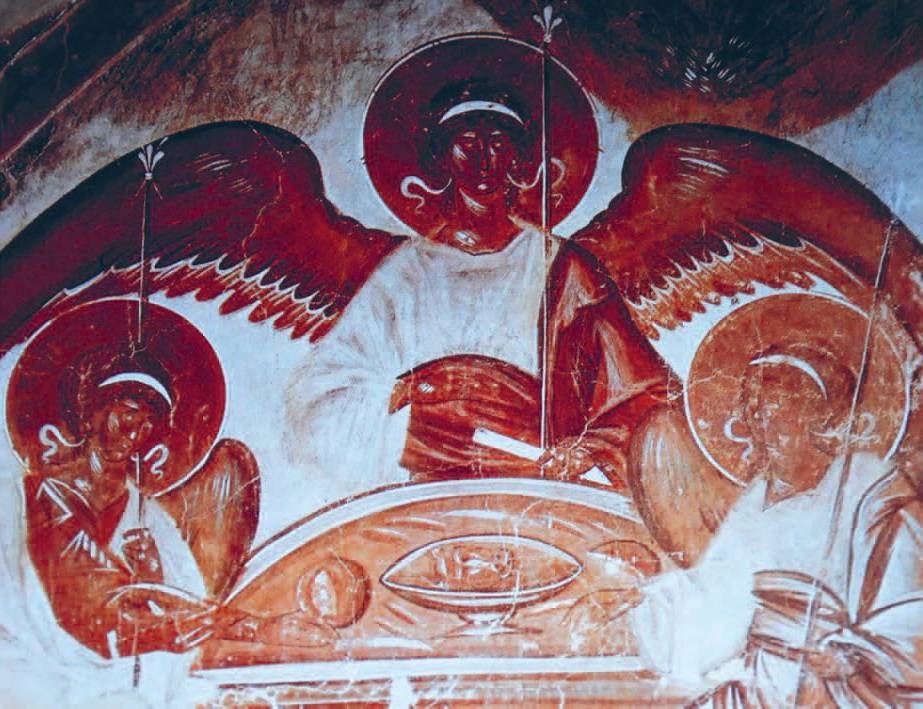
2 Theophanes the Greek, The Holy Trinity (Hospitality of Abraham), c. 1374,Cathedral of Transfiguration, Ilyina Street, Novgorod, Russia
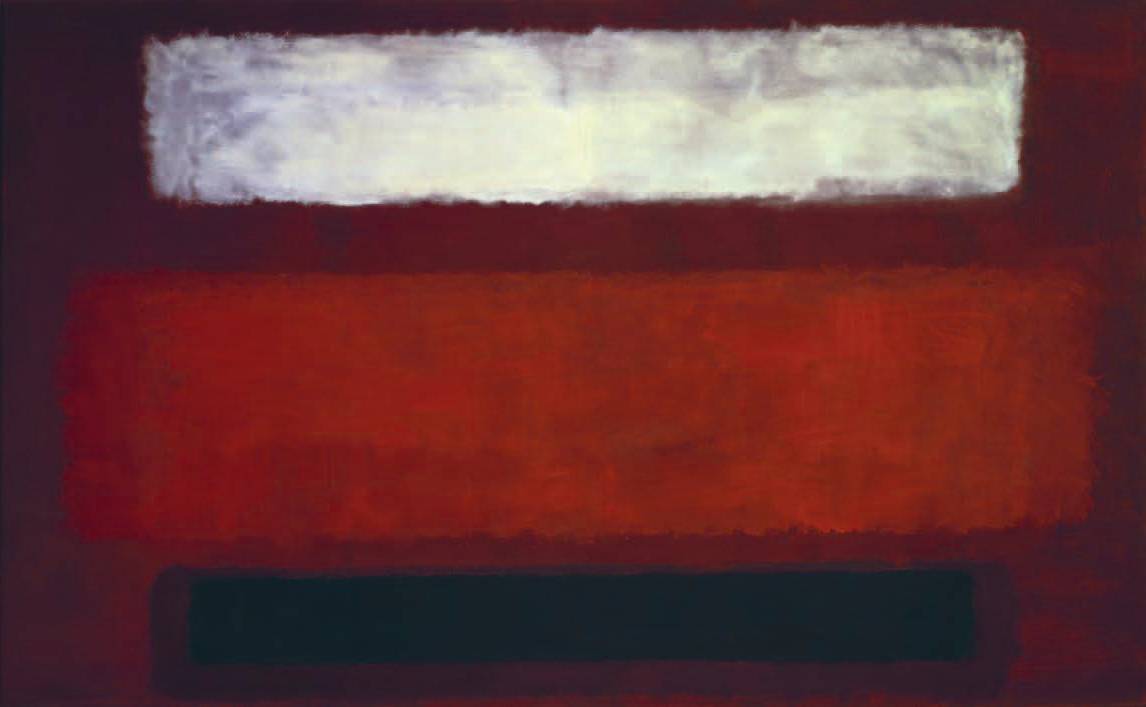
3 Mark Rothko, No. 9,1958, Collection of the Fukuoka City Bank Ltd., Fukuoka, Fukuoka Prefecture, Japan

5 Mark Rothko, Untitled, 1951, The National Gallery of Art, Washington D.C., U.S.A.
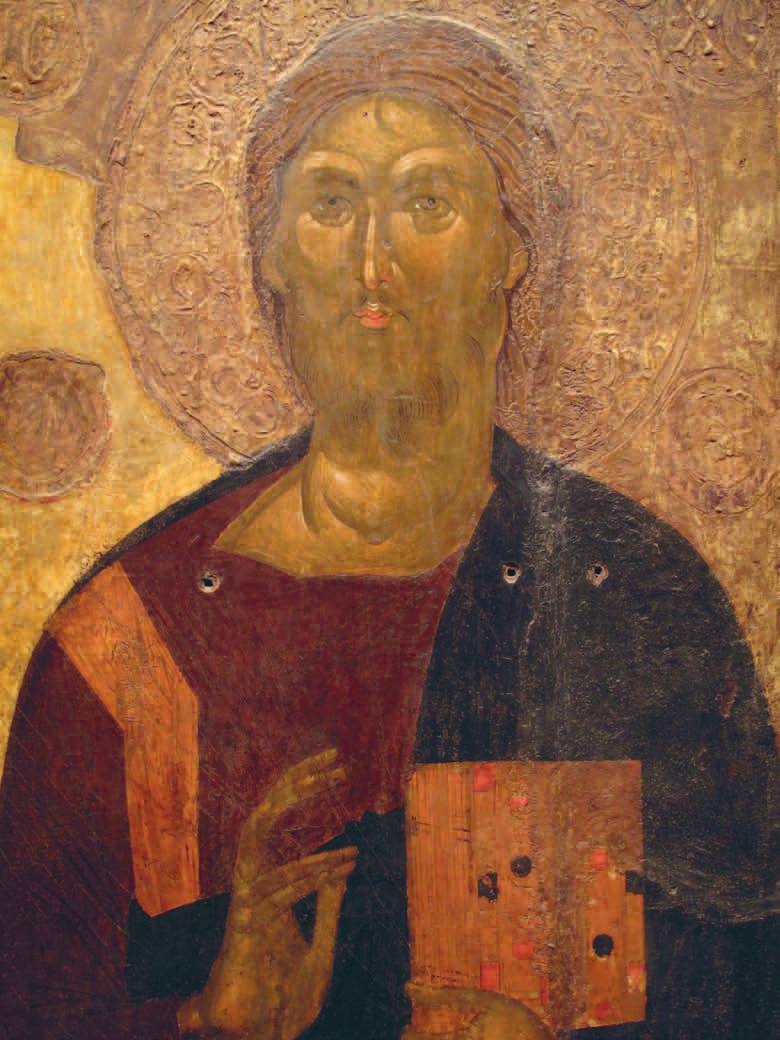
6 Christ Pantocrator, 14th century, Byzantine Museum, Athens, Greece
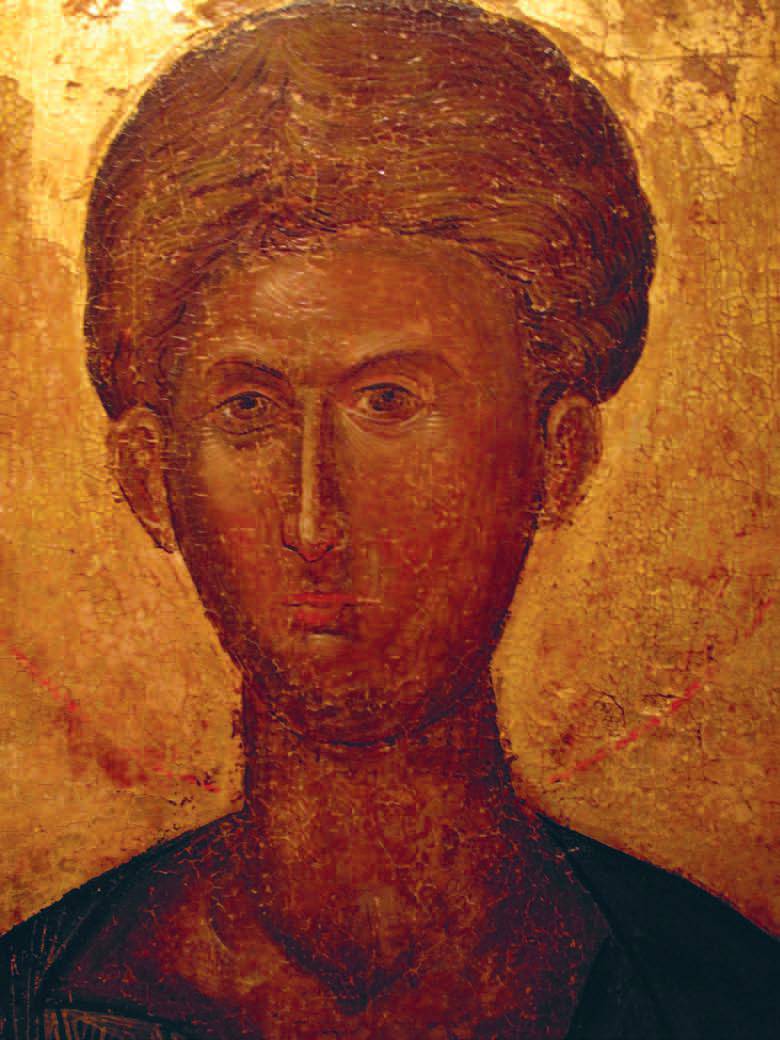
7 The Apostle Thomas, mid. 14th century, Holy Metropolis of Thessaloniki, Greece
There is a passage in the Chapters on Knowledge where Maximus sketches the cruciform logic of Christian theophany (and cosmophany). His writing in this instance recalls a type of speech and composition present in Greek literature from the time of Homer. In it patterns of thought and patterns of world are brought together in a singular form and sentences are structured (e.g., using polarity, analogy) like the objects or events they portray.641 Combined with philosophical and theological abstraction, it can have an impressive effect, as we see in this passage:
The Mystery of the Incarnation of the Word bears the power (dynamin) of all the hidden meanings and figures of Scripture as well as the knowledge of visible and intelligible creatures (ktismaton). The one who knows the mystery of the cross and the tomb knows the principles of these creatures. And the one who has been initiated into the ineffable power of the Resurrection knows the purpose (skopon) for which God originally made all things (ta panta). All visible things (phainomena) need a cross, that is, a capacity which holds back their participation of what is active in them according to sense. All intelligible things (nooumena) need a tomb, that is, the total immobilization of the activities of the mind in them. For when this natural activity and movement with respect to all things is taken away along with their participation, the Word which alone exists by itself (o monos eph'eauton hyparchon) as if he had risen from the dead is manifested anew (ek nekron egegermenos anaphainetai), having in outline all which is from him, though absolutely nothing has any kinship with him in any natural relationship. For it is by grace (kata charin) and not by nature that he is the salvation of those who are saved.642
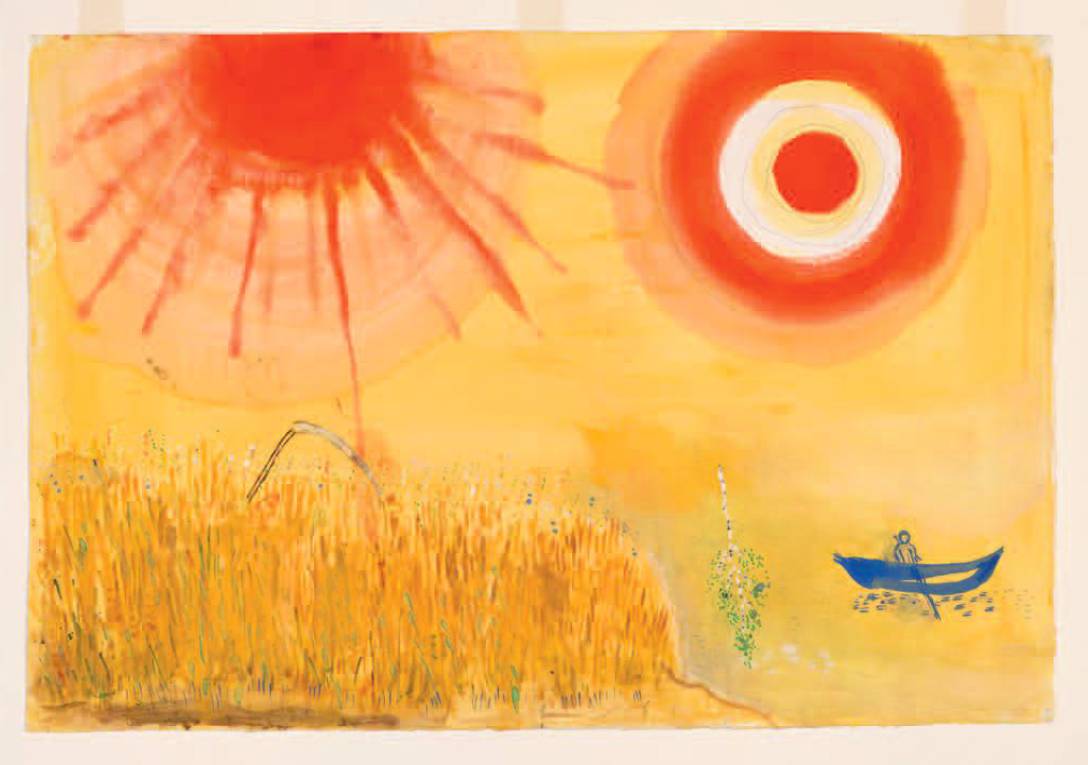
8 Marc Chagall, A Wheatfield on a Summer’s Afternoon, Study for backdrop for Scene III of the ballet Aleko, 1942, The Museum of Modern Art, New York, N.Y., U.S.A.
Christ is the ontological and epistemological «gate» through which all beings and ideas pass as they strive to realize their nature. Crucifixion, burial and resurrection are cosmic mysteries. They form an ongoing divine, human and natural drama of strife (mortification), surrender (death) and divinization (resurrection) in which the ascetic engages together with all creation. Redemption is inscribed in the very being of things but it is a «door» that only Christ can open.
Maximus uses the three key moments of the incarnational mystery as a theological iconography and relies on its stark imagery–Cross, Tomb, Resurrection–to bring the reader's thought to a standstill, as if confronting her mind with the ineffable and ungraspable reality of God's sacrifice. To come close to the divine Word, to hear it speak and understand it, theology must first strip itself of all that it knows and resign to silence. It is in that state that it will discover its true voice, one given to it as a gift (kata charin). We must learn, Maximus insists, to theologize through Christ together with the rest of creation. Christian theology is radically ontological. Christian ontology is radically theological. Ontology without God misses the «passion» or truth of beings.
The lines «all visible things (phainomena) need a cross» and «all intelligible things (nooumena) need a tomb» are carefully structured (composed) to deliver this point. It is things and thoughts that need the Cross and the Tomb–rather than those that sense and think them. Here we have once again the notion that all beings exist as hypokeimena (i.e., from the depth rather than the surface of their existence) and that those who sense and think them must actually live this truth and do so through Christ's Passion.
The theologian and the philosopher must first suffer the existence of creation, as Christ did. They must reach the dead end of their own perceptions and thoughts, of all their familiar tropoi, and rise again into the full reality of the substances they claim to understand and explicate. Communion rather than mere participation is the key and the difference is conveyed by the entrance and descent of Christ–his literal death–into the non-being (the separation from God and from themselves) that torments creatures. This act of divine empathy stands opposite the luminous mystery of the Transfiguration. In the darkness of Christ's death, the salvific power of the Cross extends to all corners of creation (including Hades).
Maximus' imagery has amazing plasticity and conceptual range. But it is also disciplined and logically structured. On the subjective side, the ascent is outlined in increments. The removal of the obscurations caused by inordinate sensations (aistheseis) and passions (pathe) comes first and is followed by the ascetic's sensuous and affective encounter with the true natures of things.643 Tempted by these new sights that beg knowledge and explanation, the intellect must exercise a similar discipline. It must cease its reasonings and come to a state of repose, to the empathic contemplation of the actualizing reasons (logoi) of things.
Beings are to be perceived and thought from their own standpoint, in the terms that they pose by being what they are. The perceiver’s standpoint is that of humility and reverence (eusebeia). This pluridimensional vision becomes increasingly lucid and exact but also vivid and relational. Thus instructed and formed by beings, the intellect grasps totality as a communal “passion” where beings persist in their distinctiveness. This is the moment associated with the Resurrection. Creation is now dynamic and unitive; things exist in contained plenitude, charismatic immanence and unceasing communion. The “coinherence” of God and creation becomes clear.644
This notion will resonate four centuries later with St. Symeon the New Theologian (949–1022), whose poetry we will discuss in some detail later, in Chapters 11 and 12. Symeon wrote that in the soul's experience of divine union the senses are «gathered together wholly within the intellect» and become one simple act.645 «He [God] is both seen and heard, is sweet to the taste and perfume to the sense of smell: he is felt and so made known. He both speaks and is spoken.»646 The transference of the senses to the intellect recalls Dionysius but the resemblance disappears once we realize that they are fully present in the divine vision: «those who have been deemed worthy see by means of all of their senses Him Who is all good and yet transcends every good thing. As by a single perception compounded of many senses, they grasp Him Who is Himself both One and Many.»647 Symeon's universe is inclusive, relational and communicative. Contracting into the person and voice of the One that he seeks and loves, it simultaneously expands into a multitude of beings until it is enveloped and transfigured in divine light.
Symeon's obsession with finding the right (adequate) language for his visions is absent from Maximus who brings to this task the full powers of an incisive intellect infused with the imagination of a poet and the austere sensibility of an ascetic. His Aristotelian conception of being as act and passion brings movement, measure and elegance to his entire theological enterprise and allows him to align theophany with divine love and ontological perfection in a profound way. It is important to take a closer look at this aspect of his thought.
As with enargeia in painting–where the image is so lively that it moves out of itself (and cannot for this reason be a simulacrum) and so rooted in its own being that this outward movement never exhausts it but instead affirms it as substance–it is the overflow and abundance of being that catches the attention of the ascetical intellect. Beings call upon it, because their logoi belong to the summative Logos of all beings and speak in his voice. This is not a mute, impersonal causality (such, for example, that underlies the Buddhist universe) but rather one that touches each creature and speaks through it and to it intimately: «would he not know that the one Logos is many logoi? ... that the many logoi are the one Logos to whom all things are related and who exists in himself without confusion, the essential and individually distinctive God, the Logos of God the Father.»648
Seen in their distinctive, hypostatic being (ten kath'hypostasin tautoteta), things enact the logoi that define them by giving them sensible form. An implicit unity sustains this movement and brings it to fruition (enopoiou dynameos) in a thing's existing for itself while also surrendering itself, in every instance of its existence, to others–in what Maximus calls «the kinship in love (philikes syggeneias) mystically inspired for them in union.»649 Being a substance, a thing has «the aptness to exist in itself» and at the same time be «towards-others,» to quote the noted Thomist Norris Clarke.650 But there is more to this expressive and relational act. As George Berthold eloquently observes of this passage, it is love rather than nature that determines identity.651
Reaching out to each and every creature, this love whose source is the Trinitarian life, defines Maximus' vision of a resurrected universe in which «the unique divine power will manifest itself in all things in a vivid and active presence (enarge te kai energon parousian) proportioned to each one (analogos ekasto)."652 Here, enargeia describes the diverse (open) and binding communion (enoseos synterouses desmon) between creation and God in which beings shine with «dignity and splendor» (kat'euprepeian kai doxan).653 Rather than stand inert under the brilliance of divine light and surrender passively to its blinding rays (as in Areopagite theophany), creatures emerge as the vibrant and self-contained recipients of a hypostatic redemption by means of which they can (now) truly belong to themselves – because they finally belong (actively, communicatively) to God and to each other.
The entire Maximian universe is in a state of enargeia. Beings actualize their natures as unconscious and conscious participants in the divine economy. enargeia is the hypostatic expression of divinization. Consummated eschatologically, it is present in the acts which unite finite beings with their nature at every single moment of their being. If we think of the Christian image in this context, enargeia becomes its distinctive quality. We can see why mere representation, however beautiful or integral, proportional and clear it may be, will not suffice because what it delivers is ultimately only a likeness. In a Maximian aesthetic, wherever enargeia is present, something is actually bringing itself to existence. Therefore nothing needs to be represented. enargeia is the coming out of itself and toward its nature of substance. It is the parousia of a being to itself and others, the intensity with which it makes itself present. The concept invites us to look at the work of art not as a replication of reality (an image-copy, detached from that which it represents) but as a reality in its own right.
Enargeia is possible because beings have the capacity to enter synergically in the divine love that perfects them–Maximus, as Louth reminds us, calls this the «blessed passion» (makariou pathous).654 They receive love, realize love and share love. God does not offer himself to finite beings abstractly and uniformly. His love informs their concrete acts of existence, the way that they go about being their particular selves. This unceasing theophany becomes evident to those who strive to make the love of God (theophilia) rather than the love of self (philautia) the measure of perception.655 Love is the dispassionate (apatheia), selfless surrender to the being of things in the course of which their inherent logoi or actualizing reasons are revealed and seen in their integral being.656 It is this holy singularity that Christian art is called to realize within its own domain.
When creatures are perceived spiritually or in a God-loving manner (theophilos), they are seen in their true nature and subsistence, as his living (incarnating) works.657 When, by contrast, they are perceived from the standpoint of desire or self-love (philautia), this vital, animating reality in them disappears and the mind imposes its own self-serving and distorted reasons (physikos tes eautou proskeitai logous) on things.658 When art draws its subjects from the realm of an «unloving» conceptuality, its beings become illustrators of ideas or worse still, their intellective shadows. From a Maximian standpoint, this is an aesthetic of self-indulgence. The passions obscure the inherent divinity and sanctity of creation and it is therefore in their activities rather than in the things themselves that evil arises.
... in applying itself to visible things the mind knows them in accordance with nature through the medium of the senses, so that neither is the mind evil, nor is natural knowledge, nor the things, nor the senses (aestheseis), for these are all works (erga) of God. What then is evil? Evidently it is the passion of natural representation (pathos kata physin noematos)...
Perception finds its true object when the «according to nature» (kata physin) is replaced with what we might call the «according to God» (kata Theon). We then see things from the standpoint of the Trinitarian mystery, and grasp in the distinct particularity of their being the choreography of the divine essence. They now appear as mysterious and sacrosanct beings, free from our own intentions and yet yielding to them–in reciprocity to the love that makes them what they are and in which their particularity finds its fruitional moments. This is the station of the saint who stands still (hesychos), attentive and humble before creation and allows it to reveal itself in its full being.
The one who is not attached to the things of this world (o me paschon pros ta tou kosmou) loves stillness (hesychia); the one who does not love (agapon) anything human loves all human beings (pantas anthropous).659
With great subtlety Maximus captures the predicament of the self-loving person–who struggles in pain against other beings (paschon pros ta tou kosmou)–and experiences them in a false particularity determined by desire.
By contrast, love that has God as its starting point enters deeply into the being of things and persons and loves them not by abstraction (e.g., humanity) but in a concrete, hypostatic love exercised on a simultaneously universal and particular scale (for each and every human being)–a love made possible (as is its accompanying vision) by divine grace.
The mind (nous) of the one who loves God (theophilous) does not engage in battle (polemei) against things (pros ta pragmata) nor against their representations (noemata), but against the passions joined to the representations (ta tes noemasi synezeugmena).660
Things themselves and what our senses and intellect make of them in pictures, words or figures of any kind are holy to the lover of God and unholy to the narcissist. Iconoclasm, to the extent that it denies the reflection of divinity in sensuous form, is a type of narcissism (philautia), an attempt to take possession for the self of the God who belongs equally (in love) to all creation.
Maximian theology engages the world from inside Christ's mystical body. To speak of God (theologo) is to speak of being (ontologo) but not externally as if one thought over its existence.661 Here episteme takes another dimension, another life. Mystically, by divine grace, the intellect enters and lingers in the being of things–it buries itself in them–and finds there the One who loves them and empties himself for their sake. Knowledge of God and being stems from such acts of ontic immersion, a form of reverence or eusebeia to which beings respond (reciprocate) by surrendering themselves–and the Creator who loves them and inheres in them–to the knowing mind.
To approach reality in this manner requires a refinement and instruction of the senses (aesthesin didaxein): one must be able to see beyond the material and finite being of things and cease subjecting them to a superficial and groundless relationality (ton pros ti... xronoikai topoi).662 Impossible for those who «live as beasts on the level of sense alone» (ktenodos monen ten aesthesin zontes), this kind of perception is the mark of souls that turn reverently (eusebos) to the world and celebrate the «magnificence» (megaleioteta) of its logoi.663 Implicit in this juxtaposition is the configuration of the Cross: the humbler (and more reverent) the viewer, the more sublime the vision.
Eusebeia describes the spiritual and intellectual disposition in a person that allows them to form images «untainted» (akeratois) by the coarse materiality of things and to therefore see (phantazesthai) the visible (oraton) world in its true form.664 It is an ascetic virtue with an inherent aesthetic dimension. Maximus likens the «humble and sincere» (tapeinophron kai aplastos) ascetic to a farmer who «transplants as a wild tree the sense contemplation (pros aesthesin theorian) of visible things into the region of the spiritual (noeton choran) and who finds a treasure: the manifestation by grace of the wisdom (kata charin phanerosin sophias) which is in beings.»665
Here, spiritual contemplation rediscovers a lost vitality in things. Rather than abandon the sensible world, one reconstitutes it as the domain of charismatic existence and sanctification. «Those who deal rightly and piously with beings (met'eusebeias tois ousi) and who conceive no sort of love of ostentation (medena philendeixias tropon epinoountes) will find coming to meet them (proypantosas) their most precise apprehension (akrivestaten katalepsin)." 666As humility gradually removes the obstructive structures of self-love (philautia), grace (kata charin) brings about the realization of the inherent holiness of creation. It takes the form of an intense ontological communion between the perceiver's unceasing (apaustos), intimate (peira) and active (kat'energeian) participation (methexei) in the being of things, and their reciprocal, welcoming (proypantosas) movement in her direction.667 Maximus describes this state as «falling suddenly (aphno prospesousa) through humility (dia ten tapeinosin) on the ascetic who did not expect it»; it is a pouring of «divine sights» (gnosis theion theorematon katakla) withheld from those who make a spectacle of mortification (pros epideixin meta kamatou kai ponou).668
Finite substances are enveloped in the divine mystery and it is in their midst that theology takes shape. Concepts live in things and have things live in them. «Being,» Maximus writes, «becomes the teacher of theology.» It is important to consider this phrase in the context in which it appears:
For what the pure mind naturally sees with reverent knowledge (eusebous gnoseos) this, they say, it can also experience, becoming this itself in accordance with the habit of virtue. Thus being becomes the teacher of theology (ousian theologias einai didaskalon). Through it we, seeking the source of all things, teach through them (di'auton) that He is ... Movement is indicative of the providence of beings (ten de kinesin tes ton onton pronoias einai ekfantiken). Through it we behold the unvarying sameness of each of the things that have come to be according to its being and form and similarly its inviolable mode of existence (ten kat'ousian ekastou kat'eidos aparallakton tautoteta kai osautos aparencheiton diexagogen), and understand how everything in the universe is separated one from another in an orderly manner in accordance with the logoi in which each thing (ekasta) consists by the ineffable One who holds and protects everything in accordance with unity (emphasis added).669
The Maximian universe is one of relationship and activity where things submit to God's acting lovingly through their being–both internally, in their unique natures, and externally in their existence and in the distinct ways in which they relate to other beings and to themselves.670 Maximus does not tire of repeating that this cosmic movement allows each being to be itself in the fullest sense possible: nothing about the existence of even the smallest being is insignificant or bereft of dignity. This is the meaning of the phrase «its inviolable mode of existence.»
Thus one is a theologian who reaches out to things in order to see in them the enhypostasizing presence of divinity–the Trinitarian mystery at work in every possible corner of creation.671 Whether probing Scripture in search of the living Christ–turning word into flesh (sarx)–or the world in search of God's spirit (pneuma)–turning things into ideas (leptynomenos)–theology is expected to bring about a new vision of reality, to be ontological in the most profound and radical sense of the word.672 This vision has aesthetic implications both in terms of its grandeur and of its subtlety.
In Maximus, the stillness and specularity of the Areopagite universe is left behind. A world in which beings are dynamically and distinctly (as tropoi) realizing their logoi cannot be locked or immobilized in images that merely simulate their sensible forms.673 Its iconography must instead turn to the divine acts of love, to the great mystery that operates within creatures and is manifested in their acts of existence, and bring that existence to life in its own terms. Like theology, (Christian) art turns to being for instruction.
Wherever the theological eye turns, things naturally submit (physikos hypomenousin) themselves to circumscription (perigraphe) through their archai and logoi.674 They are called «subjects» (hypokeimenon) because they have inside them the self-deprecating power to become objects of knowledge (auto ten tou noeisthai ten dynamin echon), to surrender their being to thought in order to free it from those acts of self-love that plague the intellectual life (and so much of postmodern thought).675 This interior movement of things toward intelligent form or expression, suggests a potential for even higher levels of activity (energeian)–and submission–an eschatological trajectory toward divinization. Thus their circumscription, their containment in form, is never total but instead leaves them open to transformation, to becoming more of what they are at any given moment of their existence.
The same movement informs language. Things that are called by their names (logon kategoroumenon) yield to verbal circumscription and by engaging in this act of surrender (and containment) to the human voice, they assume hypostatic being. But speech also sanctifies by inducting beings into a fuller participation in the divine Word in which all voices inhere. All creatures thus called or named enter the divine life.676 Theological perception reveals a world whose vibrant existence and acts of self-articulation point to its tranquil and ineffable creator–the God who rests (pauetai gar o Theos).677 In all things a tension is visible between expression and silence, movement and stillness, immanence and transcendence–as we have also seen in Maximus' mystical iconography of the Cross.
Art is mystical ontology. If by hypokeimenon we understand the ground out of which a being comes to exist in itself and therefore as a substance, then it is not things that art should pursue but instead those acts in which they subsist. It is, in other words, how a thing brings itself to being what it is, the entire drama of self-creation and self-expression of substance that is art's concern. By making this dynamic aspect of substance its object, art moves from the domain of imitation to that of communication and communion.
Things, as Maximus tells us, release their logoi only when they are treated as beings that are actively engaged in them, as self-expressive entities worthy of being heard and seen. In terms of the distinction between ousia and tropoi, one must become attentive and receptive to those ways or expressions proper to their nature in which things actualize their essence. Discerning between the tropoi that elucidate a thing's nature and those that obscure it (when a thing or being, for instance, acts or is made to act contrary to its nature) is an important part of this process. The self-creative aspect in a being's existence is associated with the former, the self-destructive aspect with the latter.
This act of expressing itself and bringing part of its being forth, presupposes plenitude in the thing itself, a deeper and more complete substratum of being out of which this act and its contents proceed. This is the ineffable hypokeimenon, the suffering and patient (hypomenousin) subject that lies at the depth of all beings and, if we follow Maximus' language, recalls the suffering and silent Christ of the Cross–the Logos who is the substance of all creation. Thus substance is never fully expressed as form or figure because in every single act of a thing's expression a silence arises which points to something in it that is not being heard or seen in its entirety. It is on this basis that we draw the distinction between communication and communion–in Greek epikoinonia and koinonia respectively.
A being's particular act of expression at any given moment of its existence is an act of communication in which it puts forth a «voice» or «image» of its nature. The configuration in one such act of the totality of its nature in silence (hesychia), as presence (parousia), is an act of interior communion (koinonia), by grace, with the ineffable totality of its being. Here, presence is the existence of the totality of a substance in one of its particular moments. An image in which this movement is evident has enargeia in that it gives sensible expression to the emergence of a thing or person out of its very own being. This meaning is reflected in Mystagogy where the term is used to describe the coinherence of divine (en auto meinai... kai autos en hymin) and human natures in the deified person who instead of being at odds with her finitude (ekstenai), experiences it (peira, pathein) through the eternal plenitude (aei plerestaton) and truth (to eu einai) of Christ.678 In such instances, Maximus explains, one knows enargos, with vivid clarity, the dignity inherent in the human person (gnorisas enargos to axioma).679
This experience is described in the language of mysticism and communion between Christ and those that love him: «Jesus my God and Savior, who is completed by me who am saved, brings me back to himself who is always filled to overflowing with plenitude and who can never be exhausted.»680 Beings that are «restored» (apokathistesi) through divine communion become in that instance of their existence exemplary icons of their own kind: «there is rendered to the image, what is made in the image (apodidotai te eikoni to kat'eikona)."681
When a being's subsistence is entirely determined by its essence, it becomes iconic to itself in the sense that it encompasses (outlines) in its particular acts of existence its own nature and in so doing exists perspicuously and conspicuously to itself. Iconicity in this context is not mere likeness (and verisimilitude). It is an act of self-realization: a being's performance of its truth. Neither is enargeia mere vividness. It is an act of self-circumscription: a being's dynamic possession of its truth. An image has enargeia, then, to the extent that it participates in the act of self-realization that it imparts on its own objects, a participation that is never objective but remains its mysterious ground. This it does by infusing them with the natures that they are actualizing in their particular acts of existence and with the energy to exist in that modality. In the absence of this grounding movement, vividness becomes a mere plastic quality that is attached to an object as a means of enhancing its presence and therefore its significance in the composition.
Two examples should help us appreciate this distinction better. Both paintings have as their subject St. Anthony the Abbot (c. 251–356). The first is by Francisco de Zurbaran (Figure 9.1).

9.1 Francisco de Zurbaran, Saint Anthony Abbot, after 1640, Uffizi, Florence, Italy
The Saint is enveloped in his monastic vestments which are soft and thick in texture, with heavy folds and a solid, sculptured appearance. Set in a landscape that does not suggest a desert or wilderness, with lush trees and foliage in the background, brown tones and a sepia sky, the elderly figure bends gently forward gesturing toward the sky, leaning on a wooden staff. More than his sun-burned face and disheveled hair and beard, and his inquisitive, supplicating expression, it is the impeccable, heavy vestments that stand out and dominate the frame begging interpretation (e.g., the monastic office, the weight of solitude and penance, the proximity to earth). Thus, rather than bring out the distinctive being of a saint in his act of prayer or in his ascetic existence (whatever specific form that might take) and present his vestments as their integral expression, the image works inversely and presents the person through the aesthetically enhanced forms of a position or ecclesiastical office. The contrast between the expressive face and the nearly monumental garments is hard to miss as is the eccentricity of placing or perhaps transplanting this figure in such an idyllic environment.
Like other paintings of ascetics from the Byzantine tradition, the Russian icon of Figure 9.2, with highlights reminiscent of the frescos of Theophanes the Greek, eliminates all spatial and temporal references and concentrates on the Saint's face.682 There are visible differences with the previous image which obviously lacks this «iconic» quality, making it necessary to limit our comparison to those elements that the two works share. The black hood frames a delicate face that seems suspended between its angular edges which yield to its quiet energy. It covers and perhaps circumscribes its bearer but it does not contain him. Round in shape with angular openings, it stands loose and still over the neck and ears in the manner of a gaping shroud, enhancing the warm colors of the man's face and highlighted, sculpted beard and his intense gaze which seems lost in contemplation or prayer. Here the garment is an integral part of ascetic existence, as its highlights match those of the man's beard and face, creating a unitive rhythm within the image that is suggestive of both exterior and interior illumination. The asymmetrical eyes are alert but also sensitive. The image is making itself present with the same simplicity and ease with which it renders the features of its subject.
The figure in this icon exists ascetically in all of its aspects–including the absence of ostentatious plastic qualities (consistent with humility). Its austere and simple garment does not exist separately from the face and beard with which it shares not only the delicate and stylized illumination but also that pronounced stillness and lightness that gives to both an air of transience and permanence. It is thus intimate to the man with whose face its own being is aligned. Instead of functioning as a symbol or sign of the monastic state or office, it becomes the companion of the one who lives in it and whose life it shares. Despite its simplicity, the image is vivid because everything in it exists ascetically and thus enhypostasizes its subject. This movement is absent from the Spanish painting. The man's face, his soft and well-groomed hands and luminous eyes have an air of mundane sentimentality unmatched by the impersonal and imposing cassock and hood which here have a life of their own as if they will continue to exist for other bodies that will live in them or even as plastic beings in their own right–a marvel of form, texture and color.
The aesthetic implications of Maximian theology deserve a more systematic examination than is possible in this study. The hesychastic tradition on which his writings continue to exercise such influence is an equally untapped source for the study of the Christian image. But there is one area where the aesthetic vision of this theology has always found expression: in the exemplary icons that the Eastern Church has created in its long and creative dialogue with the aesthetic legacy of Hellenism and with its own experience of things divine. Here many voices have a place and we turn next to St. John Damascene, the last of the Greek Fathers, whose theology of the image remains to this day the principal text for the study of Orthodox iconology during and after Iconoclasm.

9.2 St. Anthony the Great, 16thcentury, Russian State Museum,St. Petersburg, Russia
The Image in St. John Damascene
Damascene lived in Syria, in an Arab Muslim environment dominated by an opposition to images and away from the major centers of Byzantine art and culture which he never visited. He wrote theology with the sensibility of a man of letters and if we are to judge by his hymnography, of a poet. Given the classical education that he received in his youth and the prominent position of his family in the Umayyad court, it is safe to assume that he was not altogether unfamiliar with the visual arts.683
As its title implies, In Defense of Holy Icons is a polemical text. Its aesthetics is defined largely by this objective. Damascene's reliance on patristic authorities makes his views on the subject canonical. The Defense treats images as visual statements or descriptions and assigns to them an auxiliary role in liturgy and worship defined by their holy archetypes. The author occasionally recognizes presence and animation in paintings, and appears familiar with aesthetic canons known since Greek antiquity. But his theological treatment of the image is not significantly affected by these considerations.
Damascene adopts the Areopagite view of dissimilar signification according to which, as we have seen, all nature is a divine simile and beings the signs of transcendent realities.684 "Eikon," "morphe," "charaktir," "ektypoma," "graphe,» are used indiscriminately to refer to painted figures and words. Damascene's understanding of painting is reflected in the formula «write in words and colors» (see below), variations of which are repeated in the text.685 It is based on the idea that to write a word is to give visual form to what it names: «the letter pictures (eikonizei) the word."686 He draws no clear distinction between writing and painting, and repeatedly returns to the notion that words describe in letters what pictures describe in colors and shapes. Painting may bring color and vividness to things but it is in all other respects inferior to the spoken and written word.
The Defense shows little interest in the aesthetic qualities of pictures. What matters most and for largely theological reasons is their physical nature. The Incarnation fills matter with «divine energy and grace» and makes it worthy of reverence.687 This affects all the materials (pigments, panels etc.) that the painter uses to craft an image and in this manner sanctifies the art of painting. God takes the form of a human being–an act of self-representation that painting to a degree simulates. Damascene's ontology is very different from that of Maximus. In Damascene, pictures signify divine realities; in Maximus, they incorporate and express them. A comparison of a passage from the Defense with a very similar passage from Maximus' Difficulties should make this clear. According to Damascene:
God, therefore, not wishing that we should be completely ignorant of the incorporeal beings, bestowed on them (perietheken) figures (typous) and shapes (schemata) and images (eikonas) that bear some analogy with our nature (analogian tes phuseos), bodily shapes seen by the immaterial sight of the intellect, and we depict these beings and give them shapes, just as the cherubim were depicted (eschematisthe) and given shapes (eikonisthe). But Scripture has shapes and images (schemata, eikonas) of God too.688
The idea of God as a painter links theophany with written and painted pictures. Angelophanies are one example of the divine art. Accounts of angels in Scripture and pictures of them in art copy the work of divine hands (like an acheiropoietos). But all are sensibles that conceal insensibles. The purpose of form is to deliver what it contains (perietheken) to sight. Form and content coexist, they do not mix. Thus, the aesthetic dimension of the image, which rests on the creative fusion or synergy of the two aspects, disappears. Showing that images have a place in the divine life comes at a price. The image will always point beyond itself, to the one who made it possible. Once its content is deciphered or grasped intellectually, the rest of it, the image as such, can be discarded.
Maximus uses a similar analogy involving theophany but the difference is readily apparent. He describes Christ as «coming to be next to us, for us and to us, thickened in a body, in syllables and letters for the sake of our senses» (os ton kath'emas, di'emas pros emas genomenon dia somatos kai syllavais kai grammasi pachuthenta dia ten aesthesin).689 Words that were once only heard and seen are now lived and come alive. The divine body utters itself and can be read and seen in its spoken and written life. Words do not anymore allude to his presence; they are actual instances of it. Expression and presence replace symbolism and allusion.690 Language acquires a depth and mystery that it did not have before. The movement from signification to existence recalls the enhancing (auxesis) presence of divine grace in creation and human experience that we discussed in the previous chapter.691
Maximus' language underscores the creative energy of the Incarnation. Christ enters matter and transforms it from within instead of merely impressing it with his presence or form from the outside. The idea of a divine being engaged in an expressive act that involves the vital motions of a breathing and speaking body is consistent with the iconic conceptuality that informs Maximus' writing and the spiritual dynamism of his theology. In the Maximian cosmos, ciphers and symbols, allegories and stories, cannot fully express Christ's profound and perpetual presence in creation. Only actual beings can. This, as we shall see, is not the case for Damascene. The image is a semblance, a necessary form for the appearance of the divine but never a being in its own right. It is a transient manifestation of divine presence much like the reflection of an object in a mirror.
The Defense consists of a protracted theological argument complete with florilegia and appeals to Patristic authority, embellished with poetic and homiletic interludes that extol images and express the author's deep devotion to them. Celebrated in Byzantium and in the Orthodox world to this day for his liturgical poetry, Damascene does not hesitate to deliver his arguments in terms more akin to his own piety and hymnography than to the nature of the object he sets out to defend.692 His laudation in the Liturgy of his feast day (December 4) as a «sweetly speaking (glykorremon)» David, whose verse «sweetens both hearing and the reasoning mind» and places him among «the orders of angels,» is an example of the dominance of ekphrasis in Orthodox hagiographies.693 This is also Damascene's style when he frequently interrupts his theological arguments to praise images. By contrast, Maximus' rhetoric reflects the complexity of the mystical realities whose logic he sets out to describe, and has no use for colorful language and hyperbole.
Damascene's view of Scripture as an iconic form of Christ recalls imagery used by the great poet and theologian of Syriac Christianity, St. Ephrem the Syrian (c. 306–373). In his Hymn on Paradise, God has «clothed Himself» in metaphors in order to become accessible to human understanding.694 Scripture «is a book which, above its companions, has in its narrative, made the Creator perceptible.»695 The sacred word has pictographic and anagogical powers. «Scripture brought me,» he writes in the same hymn, «to the gate of Paradise.»696 In Letter to Publius, Ephrem describes Scripture as an animated mirror which «reproduces the image of everyone who gazes at it and the likeness of everyone who peers into it.»697 Ephrem's metaphors and analogies can be intricate and provocative. The following passage from the Letter extols the creative, expressive and paradoxical nature of the sacred Word: «Although it is silent, it speaks/Although it is mute, it cries out/ ... Although it is still, it dances/Although it has no belly, its womb is of great expanse.»698 Deep in its «hidden inner chambers» the animated and almost corporeal biblical text generates and maps «with undetectable quickness» images of «every limb ... and every body.»699
Damascene is not quite as dramatic and mystical as Ephrem. This is understandable since his principal task is to show that the Incarnation legitimizes painting and justifies the use of images in worship. He is not interested in the aesthetic character of the Christian image. The Defense accords images only an elemental aesthetic subsistence (mainly colors and shapes)–what is sufficient to render a simple likeness of a thing or person or to replicate the types and figures described in Scripture. Images are either visual equivalents of words or replicas of things.700
The relationship between the three persons of the Trinity resembles the way in which ideas become pictures: the Holy Spirit is the image of the Son who is the image of the Father.701 An invisible (aoraton), immeasurable (amegethos), incorporeal (asomaton) and formless (aneideon) God assumes visible human form in the person of Jesus.702 God is the prototype (prototypon) of which the Son is the eikon or likeness. This act of divine art expresses God's love for humanity (philanthropos).703 One can see the Father in and through the Son just like an object is visible in and through its reflection in a mirror or in copy in a picture. It follows that Christians should not despise art for drawing attention to the material world and the senses since this is also how God draws attention to his Triune mystery through Christ. For Damascene, a picture depicts in the same way that a mental image presents and a sentence states.704 It serves as an aid to memory (hypomnema gar estin e eikon).705 Before words are heard and images are seen, they are formed in the mind (noetos de enoumetha).706 They are a natural part of how we perceive and understand things. The argument here is from cognition. To remember Christ is to put him in some kind of sign or picture or mental object. There is no fundamental difference between thinking of him and painting him.
This is a good argument but it does not quite respond to the Iconoclast challenge. Painting was acceptable as long as it was not God that was being painted. Iconoclasts had no problem with secular art, as we have seen. Thus, the problem for them was not the portrayal of Christ the man. It was the portrayal of Christ the Man-God. The Iconoclast position included an aesthetic thesis: the depiction of Christ's divinity goes beyond the abilities of art. We can think of the divinity of Christ but we cannot put that idea in a painting. We paint what we see; the unseen we do not paint. This is very similar to the Modernist problem. The solution for some avant-gardes was to make the image signify sublime realities through its plastic qualities rather than its content (i.e., as representation).
Damascene's solution was to present painting as a form of writing, to hide the image behind the word and use the unquestionable authority of the Gospel text and the rhetoric of ekphraseis to justify its existence:
Depict (charatte pinaki) his ineffable descent, his birth from the Virgin, his being baptized in the Jordan, his transfiguration on Tabor, what he endured to secure our freedom from passion, the miracles, symbols of his divine nature, performed by the divine activity through the activity of the flesh, the saving cross, the tomb, the resurrection, the ascent into heaven. Depict (graphe) all these in words and colors (logo kai chromasi).707
The listing of events from the life of Christ has a homiletic tone. The painter is a homilist who like a good orator depicts his subject in a vivid, colorful way. If the homilist paints in words, why shouldn't the painter speak in pictures?
Damascene takes St. Basil's analogy «we will display with words (logo) the way we would with pictures (graphe)» and gives it a tighter reading: «the work (ergon) of word (logou) and picture (eikonos) is one and the same.»708 Basil's statement is an accurate description of ekphrasis. The good orator turns words into pictures. Painters (zoographoi) and writers (logographoi), adds Damascene, «signify» (diasemainousin) the same things in different ways: painting makes visible through imitation (mimeseos) what writing makes audible through hearing.709 If hearing a word and seeing its referent is the orator's success, the painter's success is exactly the same (except that no sound is required). As in Simonides' famous phrase (but with a slight variation), pictures according to Basil are silent speech. The difference between a homilist and a painter is technical. The content and effect remains the same:
Moreover both writers of words (logographoi) and painters (zographoi) many times describe clearly human deeds of valor in war, the former adorning them with rhetoric (to logo kosmountes), the latter inscribing them on tablets, and both arousing many to deeds of excellence. For what the word of a story makes present through hearing, the very same is shown silently in a picture through imitation (sioposa dia mimeseos).710
It is important to notice the comparison between the embellishments (kosmountes) of rhetoric and representation in painting.711 Both are acts of veneration directed to the holy figures they represent. There is little concern here about how veneration is expressed or shown in the image. It is the act and content of representation that expresses reverence, not its form. It is assumed that the figure depicted is immediately recognizable (as are the events in Christ's life and the characters and places of the Gospel).
On Basil's authority, Damascene presents two strong arguments in defense of images: one from the Gospel and one from rhetoric. The Gospel has already told the story of Christ to no objection for its use of ordinary words. Hymnography has done the same and conveyed profound theological truths. Ekphraseis too have been painting with words for centuries (and no one objected). To transfer the same function to painting is logical and harmless. Perhaps he was thinking of the educated hierarchs who found the popular cult of images distasteful but readily appreciated the use of powerful oratory. Damascene has rhetoric come to the rescue of the Christian image–which in part explains his own abundant use of ekphrastic writing in the Defense. But the aesthetic question remains unanswered. What will these ekphrastic images look like? And can they show the full Christ?
Damascene believes that the conversion from statement to picture is fairly easy. We know that it is not. It is one thing to state something; another to translate it visually. Words may bring images to one's mind and in this sense they may be said to paint, but painting has its own rules and the analogy to speech breaks down the moment painting begins. Having read Balzac's description of a «white tablecloth, like a covering of snow newly fallen, from which rose symmetrically, the plates and napkins crowned with light-colored rolls,» the young Cezanne wanted to paint it.712 He realized eventually that only some words mattered to the painter. The rest were not about painting but about literature.713 We cannot expect Damascene to think this way since he was not a painter. But lack of understanding of how painting works seriously undermined his iconology.
When he writes, for example, «I do not depict the invisible divinity, but I depict God made visible in the flesh (ou ten aoraton eikonizo theoteta, all'eikonizo Theou ten oratheisan sarka),» the distinction is mute.714 Of course we paint what we see and we paint physical things. But in Christ some saw divinity directly (e.g., in the Baptism, Transfiguration and post-Resurrection encounters) while others saw it through his miracles. If he is to be painted «in the flesh,» we cannot paint him as we would an ordinary person. Neither can we exclude the theophanic episodes from the iconography of his life. It is not the invisible Christ that we are called to paint but the Christ in whom the invisible-becomes-visible (the divine-becomes-human). The Iconoclasts said that this was an impossible thing to show in a picture. Damascene saw the same limitations and redefined the image in rhetorical terms, shifting attention away from its composition to the emotional and edifying effect it has on the viewer.
Damascene's commentary on the Basil passage that we quoted earlier is especially interesting. It shows how the Christian image becomes a rhetorical object. First, its resemblance to a written description is confirmed. A picture makes present what writing cannot show. It cannot be read and heard but it can be experienced just as intensely visually. The viewer's piety and devotion are not disrupted by the presence of the holy person in painted form (we may recall that this is a problem in ascetic prayer and contemplation). On the contrary, they are enhanced. Aesthetic qualities are recognized in this context but only to the extent that they fit the spiritual response they are expected to elicit. The luster of the image corresponds to the fervor it inspires. It glows and glitters; the viewer's soul is on fire.
What could demonstrate more clearly than these passages, that images are books for the illiterate and silent heralds of the honor of the saints, teaching those who see with a soundless voice (en aecho phone) and sanctifying the sight (ten orasen aghiazousai)? I may not have many books, nor have much time to read, but, strangled with thoughts, as if with thorns, I come into the common surgery of the soul (psuchon iatrion), the church; the luster of the painting (tes graphes to anthos) draws me to vision and delights my sight like a meadow (leimon) and imperceptibly introduces my soul to the glory of God. I have seen the perseverance of the martyr, the recompense of the crown, and as if by fire (puri) I am eagerly kindled to zeal, and falling down I venerate God through the martyr and I receive salvation. What do you say? Shall I not paint (grapso) in words and in colors (logo kai chromasi) the martyrdom of the martyrs and embrace (periptyxomai) with eyes and lips 'what is wonderful to angels and the whole creation, painful to the devil and fearful to demons,' as the same beacon of the Church (Saint Basil) said?715
The actual aesthetic aspect of the image is here conveyed by «anthos,» a classical term used by the Byzantines to describe the brightness and saturation of color (chroma), especially in the human face and skin (chros).716 Painting is writing in color. Color animates the content of a picture in the same way that the human voice animates the text that is being read or performed. John Chrysostom had written: «for as long as somebody traces the outline as in a drawing, there remains a sort of shadow; but when he paints over it brilliant tints and lays on colors then an image appears.»717 When the human voice enters into the vowels, consonants and diphthongs of a word and reads it aloud, it has the same effect on them as color does when it is added to a drawing. Four hundred years later, Mesarites brings a mosaic depicting the miracle of the draught of fishes to life on «the wings of speech» (logou pterois).718 Color is painting's voice.
For Damascene, color justifies the existence of images because it affects so powerfully the soul–something that writing can also do but only indirectly, through the imagination. Through color, painting calms the mind that is tormented (literally strangled) by temptations (akanthais tois logismois sympnigomenos) by putting it in the presence of lively models of sainthood. Thus art can heal. The saints' vivid and brilliant appearance is then transferred to the soul in the form of spiritual fervor and it is immediately reciprocated. It puts it on fire (pyri). Pyrauges or fiery suggests shimmering or gleaming hues, particularly red.719 Instead of pointing to the material world and causing sinful thoughts, paintings soothe the soul, surround it with holy figures and put it on a path to spiritual salvation. Color is painting's most pronounced aesthetic element because of its non-materiality and fluidity. It is also the element that least resembles writing and readily draws analogies to emotions. Damascene is aware of this, I believe. But color's prominence is also the result of the apparitional and mirroring qualities assigned to images, a conduit for emotions as well as theophanies.
Images «make manifest» and «demonstrate» (ekphantorike, deiktike), writes John, the existence of «hidden» things (kryphiou).720 These include the obscure (pros amydran katanoesin) poetic images encountered in Scripture, things and events in the Old Testament that prefigure holy persons (e.g., burning bush for the Virgin Mary), and episodes from the life of Christ that hint at his divine nature etc.721 Biblical stories also use figures as didactic and mnemonic devices to outline virtues.722 In all cases, whether it is a figure of speech or an actual picture, an image points beyond itself to a less tangible but more encompassing reality that has no other way of expression. Its imperfection is a sign of the perfect things that are hiding behind it; it is a veil through which divine things are dispensed or a mirror in which they vaguely take shape.
Thus, every image is a theophany but not in its own time and space. Representation keeps it tied to its holy originals and it is in that connection that it participates in the original's life. Tirelessly Damascene quotes his sources on this subject. From Cyril of Alexandria: «images are like archetypes; for it is necessary for them to be thus and otherwise.»723 And according to Gregory Nazianzen: «It is the very nature of the image to be a copy of the archetype and to be called after it.»724 And John Chrysostom: «For if the image of the invisible were itself invisible, then it would not be an image; for an image, because it is an image, should be taken by us as precisely similar to what it represents, just as the type of a likeness (charaktera homoioseos)."725 Verisimilitude leads to veneration. It is the thread that connects material and spiritual realities and enables the mind to find its path to the immaterial through the material. Damascene quotes Dionysius «Truly visible things are manifest images of invisible things» and explains that images (aesthetais eikosin) in the world and in art are the expression of divine love because they draw the soul to the contemplation of divine and immaterial realities (theian kai aylon theorian).726
Images of angelic beings should reflect their intellectual nature and activity (noetos pareinai kai energein), the «bodily image disclosing (delouses) a certain incorporeal and intellectual vision (asomaton kai noeten tina theorian)."727 To become an object of contemplation, a picture must participate in an act of signification that originates outside its own being. It must contain its object like a mirror contains the image that forms on its surface. As in the Areopagite cosmos, images are spectacles, never beings in their own right–masters, so to speak, of their own identity and life. They capture divine realities the way they capture the world: always in semblance and by reflection– spontaneously. We can see this in the third treatise, when Damascene explains their nature (ti esti eikon): «it is a likeness (omoioma) and pattern (paradeigma) and impression (ektypoma) of something, showing in itself what is depicted (en eauton deiknyon to eikonizomenon)."728 Pictures (like photographs) register the physical appearance of objects, nothing more.
The three different terms used here are intended to emphasize exactly this quality. A picture has no independent existence; it is always some thing's trace, imprint or reflection. It could even be a shadow and in this way look like a letter–the reverse happens sometimes with Buddhist and Islamic calligraphy (the letter is turned into a picture). It is shallow; it has no depth. Pictures do not have «the powers of the soul» (psuchikas dynameis ouk exei).729 An image that «does not live nor does it think, or give utterance (ptheggetai), or feel, or move its members,» cannot be mistaken for its original (e.g., Christ). But it can signify it (from a safe distance). In the same spirit, Mesarites describes figures in a mosaic as being «not among the living (empsychois) but among the soulless (apsychois) and painted things» and tries to bring them to life by putting them in words (logo diagraphomena).730
The only way that this letter-like image can be animated is by words or color. Color can of course be scripted (e.g., a combination of colors, like blue and gold or silver, used to denote the divine light), as Liz James has shown in her original study of rainbows in Byzantine iconography.731 Shape, outline and color (schemata, perigraphen, chroma), the three qualities that define bodies according to Damascene, are the means of art as well as literature and rhetoric.732 Since verbal descriptions and ekphraseis also use color, color is not exempt from rhetorical treatment.733 Damascene actually does that, as we have seen, when he gives an emotional interpretation of red in the passage that we discussed earlier. The passage is actually a topos since it repeats a similar experience recorded by Asterios of Amaseia (d. c. 410).
After struggling over a difficult passage in Demosthenes, Asterios enters a church seeking peace and quiet–exactly like Damascene. The coincidence of classical scholarship, devotion and art is consistent with the author's rhetorical approach:
Having spent a long time on this speech, I became congested in my mind and had need of recreation and a walk so as to relax the strain of my spirit. So I left my chamber and after a short stroll in the marketplace in the company of friends, I proceeded to God's temple to pray in peace and quiet. When I arrived there ... I saw a painting that captivated me entirely – a work of art you might have ascribed to Ephranor [fourth century B.C.] or another one of the ancients who raised painting to such great heights by making pictures that were all but alive. So, if you please–and indeed we have time for a story–I shall describe the painting to you. For we, men of letters, can use colors no worse than painters do.734
Asterios then describes the icon conceding at some point: «for art, when it so wishes, can convey the semblance of wrath even by means of inanimate matter.»735
Here, there is little attention to aesthetic qualities. Instead, the main focus is on the action that is depicted and the character (especially that of the Virgin) of the figures involved in it. Asterios, however, has three aesthetic moments. The first is when he praises the artist for «having blended so well the bloom of his colors» to show contradictory affections (e.g., modesty and virtue). In the second, he describes how different shades of red were used in the painting of a martyrdom scene. It is obvious that Damascene borrowed from Asterios: «... the painter has kindled a great fire and he has given substance to the flame by high-lighting on this side and that with red color.»736 The third instance is less conspicuous but it occurs when Asterios completes his description by returning to a comparison between writer and painter: «At this point the painter stayed his hand and I shall stay my speech.»737 He then asks the reader to compare his description to the actual painting to see «how far I have fallen short of it in my account.»738 Even though rhetoric dominates, the painting is given some authority as to its content and, based on his earlier statement, most likely also its form.
We cannot entirely dismiss aesthetic considerations in this and similar texts. The use of a topos appears formal and void of personal relevance or fresh observation but this is not always the case. Experiences that are both significant and formative in cultural perception can still be conveyed using stylized forms.739 St. Gregory of Nyssa (c. 335-c. 395), for example, uses the verb perianthizo to refer to the application of colors that together constitute the form of an object.740 Color and shape give splendor to form: «the divine beauty is not made resplendent (enaglaizetai) in a certain external figure (schemati) of fortunate shape (morphes) through certain beautiful colors (euchroias) ..."741 Color defines the human face. It literally «transfers» (metaferetai) its shape and expression (morphe) from life to art (to the panel, pinaki). The face settles on a panel like it settles on a glass surface. Color both mediates and ensures (finalizes) resemblance.742
In a speech commemorating St. Theodore, Gregory praises the iconography of a church dedicated to the martyr Saint, using the color-as-speech formula. The painter «wrought by means of colors» scenes of martyrdom and Christ in his «human form» «as if it were a book that uttered speech.»743 And he concludes: «for painting, even if it is silent, is capable of speaking from the wall, and being of the greatest benefit.»744 The emphasis is on rhetoric and painting is typically didactic. But on the reverse side of this analogy is the notion that under certain conditions images can communicate meaning directly, as if they were speaking or coming alive.745 This is an aesthetic observation tucked behind a rhetorical topos like a two-sided icon.
In a different text (De Fide Orthodoxa), Damascene describes color as the primary object of sight and a conduit for all other aspects of aesthetic perception. A body is perceived to the extent that it is «colored» or by virtue of its color: «sight first perceives color and it is through and in color that it recognizes (syndiaginoskei ... to chromati) a colorful (kechrosmenon) body, its size and shape, the place where it exists, the space in between, and the number.»746 Color does not only dominate perception, psychologically. It also dominates form and the composition of an image, whether in art or in actual experience. This is an example of aesthetic sophistication that is absent from the Defense.
In the Defense, by contrast, the icon is part of a sequence of representational acts in creation that reflect the mystical life of the Trinity. It is through these acts, as through a chain, that it remains actively connected to its divine or holy archetypes. Theophany is gradual rather than spontaneous. The painting hosts the divine likeness but it does not incorporate it. It cannot present its own instance or moment of theophany (qua image) because it does not have the integral being and interior space needed for self-disclosure. Conceived almost as a pictograph, it is experienced as a type of script in need of a reading act–its sole chance for animation. Damascene knows that color is essential for modeling and that under certain conditions it can convey vitality, fluidity and emotion. But he is only interested in analogies between spiritual fervor and redness. He does not acknowledge the role of size, shape, texture or line in a composition and his view of painting is shallow and simplistic. Even though he singles out color as the most expressive component of a painting, he treats it more like a pigment than an aesthetic quality.
It is important to put these observations in their proper context. Damascene was neither an aesthetician nor a painter. As a theologian, he had an urgent project to complete. Considering the ferocity of the Iconoclastic reaction, it was necessary to tie religious images unequivocally to a transcendent original. It was also important to remove from them any kind of inner animation and thus put an end once and for all to their association with magic and idolatry. His fascination with color should be read in this context as suggestive of a discarnate quality in things. By reducing the image to its essential plastic elements, one could make it appear as the transient reflection of the divine presence, an apparitional reality not easily circumscribed.
The Defense established the theological significance of images and legitimized their place in Church liturgy and life. But its iconology is more about theology than it is about art. Ironically, it is in Maximus, who never wrote about images, that we find a compelling ontological foundation for an Orthodox aesthetics. To tie his ontology to Byzantine perceptions of art, we will examine a small number of ekphraseis and epigrams in which classical ideals about painting assumed their Byzantine, Christian form.
The Living Image in Byzantine Experience
Byzantine aesthetics and art criticism did not produce any classical theoretical texts comparable to works that we find in other traditions. In the fifth century, for example, Liu Hsieh (c. 465–522) wrote The Literary Mind and the Carving of Dragons, a critical examination of literary theories with significant implications for aesthetic perception.747 These and other treatises show an interest in literary and artistic theory in China that is absent from Byzantine sources. Outside the domain of theology, Byzantine writing about religious art was confined to ekphraseis. We have no indication that the authors of these texts were interested in inconsistencies between the nature and judgment of a work of art or in the application of critical standards. On this basis, it has been argued that the Byzantines were unsophisticated consumers of religious art who easily attributed life-like qualities to images with an obvious lack of naturalism.748
This may have been true of the uneducated viewer in Byzantium, as it is true of the uneducated or ideological viewer today who feels entitled to see in the work of art whatever she imagines or desires. Conventions or cultural standards that allow religion, the state or subjectivity to direct perception are an inimical part of the aesthetic experience, whatever form that might take. The Byzantines were not any different in that regard. But to see art through conventions is not necessarily an unreasonable or uncritical act. What appears abstract from a naturalistic standpoint is realistic by the standards of an iconography that seeks a particular kind of transcendent simplicity in form and composition. Icons were meant to recreate a spiritual realm, to paint a world in which temporal beings live eschatological lives. The objective was to impart on matter a spiritual quality and eliminate the physical and sculpted sense of flesh that painting can achieve under certain conditions (e.g., in oil painting with the blending of pigments).
To this day, volume in Byzantine icons is created by the layering over an opaque surface of thin washes of paint. Colors become progressively lighter so that in the end, as one contemporary iconographer put it, the «flesh shines from below.»749 Painted in this manner or outlined with a few brushstrokes and highlights, as we can see in the unique iconography of Theophanes the Greek, a face or figure combines expressive power with a subtle physicality to suggest the ethereal and majestic presence of holy beings. Not all icons achieve this quality but some do in an exemplary way.
The challenge for painting that looks at the world through a religious prism is to convey the transcendent realities that are essential to its vision. Volume, depth, texture, color, composition and illumination can be used to reconfigure the forms and relationships that we ordinarily associate with things and persons. Far from being incompatible with naturalism, abstraction can bring landscapes, animals and humans to a state of vibrant existence and unitive presence. This approach to composition has a parallel in other traditions, as we shall see below. Chinese ink paintings in the Sung period combined abstraction with a distinctive type of naturalism that reflected Taoist and Buddhist ideas of reality.750 By placing objects only in a small part of the overall composition, and making space its dominant and enveloping reality, painting could suggest the transcendent union of emptiness and form.751
When we consider continuity and originality in the Byzantine response to the living image, we should be careful not to exaggerate their difference. Anthony Kardellis has argued convincingly that an uninterrupted «classical inheritance provided the vehicle and the inspiration for the moral, aesthetic, and literary expansion of Byzantine literature.»752 Novels, in particular, showed a «playful reflexivity» in their rhetoric and adaptation of classical topoi and concepts.753 The creative and idiosyncratic manner in which Maximus enriched his tradition shows the same movement in theology. The Byzantines, as Andrew Louth put it, were especially good in creating an «impression of permanence.»754
To gain legitimacy within a certain paradigm was essential, but it did not necessarily translate into imitation. As James Cahill has argued in the case of Chinese art, we should be careful not to approach Byzantine art as nothing more than an improvisation on established themes and interpret it on that basis as performance or a form of visual rhetoric.755 The recognizable patterns generated in Byzantine art, literature and theology worked like a grammar. Rather than exclude creative and original expression, they set the parameters within which it could resonate with collective experience. Archaism was often a pretext and a framework for introducing new ideas or forms. In Byzantine art, wrote Kiteinger, «ancient formulae are carried along in fossilized form but have an uncanny way of becoming revivified and of being filled with emotional content.»756
Constantly re-interpreted and infused with new sensibilities, the archaic became in that sense the ground of creative interaction and continuity rather than repetition: «Byzantium never really ceased to respond to the life force that animates all Greek art and that had found its most varied and emphatic expressions during the Hellenistic period.»757 This is also the view of no less an authority on Byzantine art than Manolis Chateidakis: «Sometimes they [Byzantine painters] were scrupulous imitators, but more often they took liberties which permitted them to express, more or less, the taste of their own period while preserving the traditional iconographical features of the model.»758 Far from being a stultifying force that enveloped the work of art from the outside like a rigid formula, permanence was understood dynamically and we might say organically, as the flourishing in recognizable patterns of vital form. The same dynamic is evident in the history of Chinese and Japanese art, as we shall see in our concluding chapter.
The view of the Christian image as a locus of encounter with holy persons and realities, and an affirmation of their continuing presence in the life of the faithful, is standard in most ekphraseis and epigrams. As we have seen, the creation of vivid verbal imagery was the defining feature of the genre from the time of Quintilian (c. 35-c. 100) who argued that the graphic description of facts could rival if not surpass their actual experience.759 This idea has parallels in the Byzantine perception of the icon as a physical object tied to a transcendent original with miraculous powers. Exaggeration of a painting's aesthetic qualities for spiritual reasons was always a risk and it happened frequently. To that end, Byzantine authors were quite capable of paraphrasing and copying classical topoi that gave them a facile formula for laudation.760 But they were also capable of using these topoi creatively to communicate what they saw and admired in icons and mosaics. In such instances, aesthetic qualities were assigned a spiritual significance of their own and the topos was not so much a rhetorical device as it was a verbal means of recording an extraordinary experience–as we shall suggest later, a kind of photograph. Thus, to fully appreciate Byzantine aesthetic experience, we must always keep in mind this tension between rhetoric and reality, between a theologically imposed spirituality and a spirituality that is inherent in the art object.
Nowhere perhaps is this tension more evident than in two archetypal versions, one Christian, one pagan, of the same story, a topos about the spiritual poverty of art which at the same time recognizes its extraordinary power over the human memory and imagination. We read in the second-century apocryphal Acts of John about a talented (euphues) painter who was commissioned by John's disciple Lycomedes to secretly paint a portrait of the Apostle from life, for veneration in a private altar.761 The portrait was apparently the highest form of gratitude Lycomedes and his wife could show to John for bringing them back to life! It was executed in two days, suggesting the artist's virtuosity and perhaps the impressionistic quality of the image. On the first day, an outline was drawn (skiagraphesas). On the second, colors were added (chromasin katakerasen), the portrait was finished and was immediately placed on an altar.
The Apostle who has difficulty recognizing his face (toioutos eimi morphen?) until he sees it in a mirror (katoptron), reprimands Lycomedes for venerating an idol. He dismisses the painting as being only a reflection or semblance of his carnal self (to sarkiko mou eidolo). This image resembles me (omoia me), he explains, but «it is not like me» (ouk emoi the).762 The resurrection miracle provides a context for juxtaposing the life-giving power of faith and prayer with the lifelessness and artificiality of art. The contrast is underscored when John tells Lycomedes to forget about his physical appearance and instead paint a picture based on his words and on the palette (chromata) of virtues that Jesus painted on the human soul (zographon ... eikonographon Iesous).763 The art of preaching and restoring souls replaces painting. Like Jesus, the timeless artist, John uses words to turn his listeners (didosi di'emou) into ideal paintings–images of God.764 But Lycomedes holds on to the portrait:
And Lycomedes remained with the blessed man, united in faith and in the knowledge of our God; but rejoiced still more that he was to have him in a portrait (pleion the egalliasato hoti en eikoni emelle auton echei).765
The Apostle's final objection that the painted image is only a «dead picture of what is dead (nekrou nekran eikona),» does not dissuade his disciple. The story gives us a good sense of the power exercised by paintings as memorials and substitutes for living persons on the contemporary imagination. From a spiritual standpoint, art seems useless to those who have died to the world and are seeking a different form of life. The portrait may be a credible recreation of the physical man in John but based on his reaction, it shows nothing of the spiritual man that he has become. The appearance is accurate; the person behind (or in) it is not. Still, the ambiguity remains. John does not reject Lycomedes' explanation that the painting helps keep his presence and teachings constantly before him. He calls his disciple's eagerness for art «childish and imperfect» (paidiodes kai ateles)–by no means a total condemnation of painting. His strongest remark is that poor Lycomedes has something dead in his hand which he thinks is alive. But for Lycomedes, the icon is a powerful substitute for the real man.
The story reappears in the next century in Porphyry's biography of Plotinus. Once again painting's ability to register the living form of its subject (an equally charismatic personality) is first emphasized and then rejected on the grounds that the image fails to capture the essence or truth of its subject.766 The painter (Carterius) who is commissioned to paint Plotinus' portrait is one of the best (aristos) and easily retains accurate mental impressions (ek tou oran fantasias) of his subject. These eventually enable him to draw a masterful (eufuia) portrait (eikona) from memory (eikasma) with some help from his friend Amelius who knows the philosopher well. Like John, the sage dismisses the work as «a likeness of a likeness» (eidolou eidolon).767 When he dies, the picture will remain behind to speak falsely of him in years to come (polychronioteron). How, we are not sure, but the implication is that the portrait says something about the man that he cannot change. If true, then art has a voice of its own and the image is rejected for this reason: because Plotinus cannot make it speak as he wants to (both now and in the future).
The speaking image that has a life of its own is a recurrent theme in Byzantine aesthetic experience. An ancient epigram that praises a statue of Zeus by the sculptor Phidias is used as a model by Nicephorus Callistus to praise an icon of Christ:
Either God came from heaven to earth to show you his image, Phidias, or you went to see God.
Either Christ Himself came down from heaven and showed the exact traits of His face to him who has such eloquent hands (eulalon), or else the famous Eulalius mounted up to the very skies to paint with his skilled hand Christ's exact appearance.768
Except for the persons involved, the texts are nearly identical. But here is one little difference. It is the term «eulalon» which puns on the name of the painter that Nicephorus extols. It suggests an idea that is absent from the ancient text. The painter's hands are eloquent because they paint eloquent pictures. The icon's exact resemblance to Christ includes its liveliness. This is what makes the work stand out and seem heavenly. In another epigram composed by Callistus about a different work by Eulalius, the discussion of aesthetic qualities goes a step further to include color and its impact on form (see below).
We know that the Byzantines could be very careful observers of art. Henry Maguire has shown that a significant number of ekphraseis were written on the basis of «spontaneous observation,» with attention to the salient features of the mosaics and icons they described.769 Thus, developments in the world of art, as for instance the depiction of the crucified Christ in post-Iconoclastic iconography in a wounded, curved posture, were often reflected in contemporary ekphraseis.770 To emphasize the attention given to accuracy in this and other contexts, Maguire cites one instance in Mesarites' description of the Church of the Holy Apostles, where the author's account of the Miraculous Draught of Fish follows the order of its iconographic depiction rather than that of the Gospel story.771 He also notes the fidelity of certain descriptions to the use of illusionistic devices in Byzantine painting and their attention to details of expression and gesture in the depicted subjects.772
An epigram by the fifth-century author Neilus Scholasticus calls the depiction in sensuous form of the incorporeal Archangel «daring,» and reminds the reader that despite its sensuous nature (morphose ton asomaton), the painting (eikon) actually elevates (anagei) the viewer's mind to the recollection (noerin mnestin) of discarnate realities.773 There is an implicit distinction here between the painted (physical) object and the aesthetic object that impresses us with its psychological astuteness. The image of the angel is lifted out of its physical frame or outline. The mental impression immediately recalls its archetype and triggers an ascent from the sensuous to the spiritual, from the physical to the intellective. The form given to the angel (as painting requires) immediately suggests his incorporeality. A better known epigram by the anthologist and author of epigrams Agathias Scholasticus (531–580) that will be discussed in detail later, gives the same reason for praising an encaustic icon of the Archangel Michael. Its powerful presence is said to energize vision, imprint the image (en eauto ton tupon eggrapsas) deep in the viewer's mind (vathu noon) and lift it to a state of prayer and contemplation.774
In both examples, the transition from image to archetype is instantaneous, as if both occupy the same place. To see something in art is to see it as a living reality. In Agathias' epigram, the viewer «trembles (tremei)» as if in the painted figure he encounters the angelic being in person.775 This is not mere rhetoric. The image does not represent its object; it realizes it. Theodore the Studite described an icon of St. Demetrius in a baptism as a type of logos that played the role of the infant's godfather.776 A testament to an icon's power of presence, this view reflects the legacy of Greek portraiture that reached exceptional levels of vivid form, as we saw in the Fayum panels.777 When Gregory of Nyssa described a portrait as «speaking from the wall,» he was not exaggerating.778
According to Ernst Kiteinger, Byzantine interest in the insubstantiality of physical forms can be traced to Hellenistic painting: «Glowing colors and shimmering lights not only give shape and heightened life to figures and objects, but often also dissolve them and make them transparent.»779 The Byzantines eagerly embraced Hellenistic illusionism: «In all centuries, from the fourth to the fifteenth one finds innumerable instances in which highlights and shades help to convey an impression of physical presence, of movement, and sometimes of inner life as well.»780 Artists infused form and space with an ambient luminosity and tried to bring things and persons to a state of living presence, consistent with the transcendent realities of the Christian cosmos.
The restrained lyricism of Byzantine portraiture may resemble Greek art of the fourth century B.C., but it does not copy it. The relationship is far more dynamic and creative. This is why Kiteinger is reluctant to speak of Hellenistic influence and prefers instead to use terms like «affinity» that more accurately explain the «autonomy of Byzantine emotional expression.»781 Byzantine illusionism was not «a convenient idiom» or «a mechanically repeated technique»; it was «a new aesthetic value,» «a positive aesthetic element deeply tied to the new spiritual values and content.»782 Gold highlights, not seen in Christian painting before the fourth century, and inseparable from the Byzantine panel and mosaic painting ever since, gave form to the experience of material and spiritual illumination.783 A sophisticated understanding of color, light and spatial composition underlined the construction and placement of mosaics and frescos.784 Combined with the Hellenistic emphasis on facial expression, pose and gesture, it brought to the human figure the aura of eloquent holiness so essential to the Christian conception of human existence.
Thus topoi and cliches in Byzantine literature about art should be understood dynamically in terms of cultural continuities rather than imitation. Given the fluid relationship between painting and the written word, written descriptions should not be seen exclusively as rhetorical exercises or as attempts to impose on images theological ideas. In fact, ekphraseis and epigrams become more interesting when considered as verbal analogs of paintings, mosaics and statuary and shorthand for the aesthetic qualities they contained–a kind of photography in words. Some were more accurate than others. Some were especially precise in their use of artistic analogies and metaphors and their ability to formulate aesthetic ideas. Others were as impressionistic as the works they set out to describe. In some instances, this impressionism had an actual aesthetic basis; in many, it was rhetorical.
In their best examples, they were building on a certain pattern in aesthetic perception that was compatible with the experience of transcendent realities. This pattern, as we shall see in the next chapter, had been established in Greek antiquity and persisted through the gradual transition to a Christian aesthetic. It explains why one could praise a statue of Zeus in the same terms that one would praise an icon of Christ.785 In both pagan and Christian art, the viewer either saw or imagined (that he saw) an aesthetic ideal that he knew by heart: the aura of the image that was capable of enargeia. This was the painting that could establish not so much its veracity vis-a-vis an original, but rather an aesthetic form of life, a sui generis reality–as we saw in the case of Eutyches. In some cases, theologians tried to impart this aesthetic form on their writing by creating concise analogies between theological ideas and the act of painting–becoming in that process painters themselves and casting their work as a visual object or phenomenon in its own right.
It was because Christian images aspired to this ideal and some actually achieved it that Byzantine accounts of art can often sound so repetitive and formulaic. The experience of these ideal works was powerful and their qualities gradually became the standard for the perception and judgment of all religious art, irrespective of achievement. The recollection of classical and Hellenistic antiquity informs Byzantine writing about art, nature and life and frames its approach to the aesthetic object and to aesthetic experience more generally. When not praising icons or churches, Byzantine churchmen and scholars turned to the artistic and literary legacy of antiquity in order to immortalize youth, celebrate physical and moral beauty, or extol the power of the written word and the enduring splendor of art.
St. Gregory the Theologian (c. 329-c. 390) made frequent references to Tantalus, Phthonus, Sisyphus, Eros and the Muses, and showed his mastery of Greek mythology by recalling tales of metamorphoses and drawing analogies between athletic and martyrial feats.786 He composed poetry on Christ's Resurrection using the idiom and forms of classical literature, while some of his homilies contain allusions to pagan gods and mythology.787 Agathias, whom we met earlier, described an encaustic painting that showed a Satyr thoroughly absorbed in playing his pipe but lively enough to turn to the viewer and smile (gelon sigesen).788
Writing in classical meter, the monk, humanist and hymnographer John Mavropous (fl. c. 1050) supplicated Christ to spare Plato and Plutarch in the final judgment, because the two sages had embraced virtue. The court poet and author, Theodorus Prodromus (c. 1100–1158), borrowed expressions from Homer, Hesiod and Aeschylus, among others, while during his time it became fashionable to quote Sapphic verse (more on Theodorus later).789 The Metropolitan of Athens, Michael Acominatus (c. 1140–1220), confessed his «artless and lovesick» nostalgia for antiquity and sought to recapture in verse the boisterous splendor of ancient Athens–a city where words once had great power–by «setting up an image of it in writing (indalma graphikon)."790 In the thirteenth century, the Emperor Theodore II Lascaris visited the ruins of Pergamon in Asia Minor. He expressed his admiration for the city's Hellenic past and lamented the poverty of its inhabitants, noting that «the works of the dead are more beautiful than those of the living.»791
In these and other examples, educated Byzantines freely invoked antiquity to justify their aesthetic judgments. But painting divine and holy persons was a different matter. There the aura of the image as an integral reality capable of a transcendent life existed side by side with its denigration for lifelessness and superficiality. Sometimes the one took over, sometimes the other. It was as if Platonism was being weighed against an alternative view of the image for which theology and culture did not yet have a language. In the next epigram, an anonymous wonders about a picture of Odysseus. The topos pits word against picture. The painting seems to have a similar fate to that of persecuted icons that are washed off miraculously on sea shores:
Ever is the sea unkind to the son of Laertes; the flood has bathed the picture (eikona) and washed off the figure (typon) from the wood. What did it gain thereby? For in Homer's verse the image (eikon) of him is painted on immortal pages.792
In reality, written records are as vulnerable to the elements of nature as are paintings. Despite the simplistic comparison, Odysseus' two portraits seem equally vivid and their existence in time suggests the timeless trajectory of poetry and art. Poetry's immateriality may be something that art lacks but then again the memory of an image can linger as long as a verbal description and maybe even longer–which is why one would draw the comparison. When poetry is intensely visual, the fusion of word and image leaves a lasting impression. But the same can happen with a painting that brings its subject to life and speech. Both exist in memory from where they may perish or survive.
This is also the theme of an epigram by Agathias. It acknowledges the great pleasure of owning and experiencing works of art in this life, but, like the topoi that we examined earlier, objects to investing them with any kind of permanence, a quality that he ascribes only to virtue, wisdom and the written word:
Columns and pictures (graphides) and inscribed tablets are a source of great delight to those who possess them, but only during their life; for the empty glory (kena kydea photon) of man does not much benefit the spirits of the dead. But virtue and the grace of wisdom both accompany us there and survive here attracting memory. So neither Plato nor Homer takes pride in pictures (chromasin) or monuments, but in wisdom alone. Blessed are they whose memory is enshrined in wise volumes and not in empty images (keneas eikonas).793
Wise words last longer and are of more benefit than the monuments made to those who spoke them. A text speaks of its author in ways that a painted portrait cannot.
By contrast, a tenth-century epigram by Constantine Rhodius recognizes the ability of art to convey transcendent realities in its own terms:
If one would paint (zographein) thee, O Virgin, he had need of stars rather than of colors (chromaton), that thou, as the Gate of light (photos), mightst be painted in luminaries (fostersin). But the stars yield not to the voice (logois) of mortals. Therefore thou art delineated and painted by us with the material that nature and the laws of painting afford (phusis kai graphes nomos).794
Here colors are the equivalent in nature of stars. The Virgin's portrait deserves to be represented by nature's most glorious and luminous pigments. Painting transcribes the voices (logoi) of those who praise her and through its use of colour conveys her luminosity and majesty, thus mirroring the heavens which reflect her glory. The text's tacit analogies are fertile ground for theological and aesthetic reflection. They provide insights into the nature of art and the demands placed on it by its holy subjects, while suggesting a mystical quality in both. Like stars, the laws of nature and art and those of human expression are perfectly aligned. The icon that captures the Virgin's stellar holiness will be a work of nature, art and divine grace–a miracle in its own right. The epigram's voice addresses her as if she is already painted. The mere sight of her image prompts it to utter these words in her presence.
Less intricate but clearly focused on the art object and its aesthetic and contemplative aspects is the following excerpt from a seventh-century manuscript. It describes a ciborium in the basilica of St. Demetrius in Thessaloniki, Greece, in which the Saint's icon and sarcophagus were first housed.795 Like many descriptions of churches, paintings, mosaics and liturgical objects often produced by Byzantine piety, it appears first in a dream. The almost photographic clarity of the description underscores the dreamer's devotion and reverence for the Saint and for the holy nature of the object itself. The ciborium impresses its form on the dreamer's mind in the same way that it will later create a real visual impression.
... it is hexagonal in plan, having six columns and as many partitions, shaped out of carved, assayed silver. Its roof is likewise held up all round by the six sides and terminates in a circular conjunction from the base up. At the top it bears a silver sphere of no small size, its lower part surrounded by shoots of lilies. At the very summit flashes forth the trophy that is victorious over death: by its silver composition it amazes our corporeal eyes, while by bringing Christ to mind, it illuminates with grace the eyes of the intellect – I mean the life-giving and venerable cross of God our Savior.796
The description continues with the ciborium's interior which is seen in the actual church, after the dream prompts an onsite visit. Dream and reality are fully (and miraculously) aligned, with an implicit recognition of the visual intensity experienced in dreams and in real life in the context of devotion. The intricate floral design in precious silver is especially admired for its delicate form and splendor. At the very top, the gleaming silver cross illuminates the viewer's mind with thoughts of Christ, suggesting a perfect alignment between aesthetic experience and contemplation, art and spiritual life. Its exquisite quality keeps the object in sight. As long as the silver shines and the lilies move, the intellect contemplates the divine presence in thought and form. The two co-exist and coincide. Dream, reality and the ciborium's written description paint the same picture. Keeping the holy object intact in one's intellect, memory and sight is an act of reverence. Built as an expression of reverence for the Saint, the structure translates and perpetuates his presence through time.
This recalls the concept of «eusebeia,» used by Maximus to describe the ascetic's reverent vision of creation.797 In fact, the term appears in a number of epigrams but has none of the qualities that Maximus assigns to it. In the three examples that we consider next, reverent perception centers on discerning and emulating the work's spiritual meaning. Aesthetic qualities are not explicitly mentioned but the experience of images in such terms presupposes aesthetic attention.
Mathew notices the term in an enigmatic epigram in the Palatine Anthology, dedicated to «Moses and the pharaoh's daughter.» It reads: «An Egyptian woman, a hidden infant and nearby the water; these symbolize the Logos only for those who are reverent (eusebeis)."798 The reverent viewer is an apt reader of the painting's typological meaning which is here encrypted in the simple picture of a woman covering a child next to a river. This is a good example of the treatment of pictures as pictographs that we saw in Damascene. The actual image stands for a type (Moses) which stands for another type (Christ).
In an epigram by Gregory Nazianzen the term takes a more aesthetic meaning. Gregory describes a painting or mosaic of the four virtues (justice, courage, continence and prudence) in the church of St. Basil in Caesarea. «As you look on the image (eikon) of the four life-giving virtues, stir your mind (leusson seue noon), to willing toil (mochtho); for the labor (idrotes) of piety (eusebeias) can draw us to a life that knows not old age.»799 The reader is told to concentrate on the content of the picture and internalize the spiritual qualities associated with the four figures. Eusebeia is the act of seeing and reading the image for its spiritual significance. Gazing at the picture is a type of ascetic act. As one's eyes move from figure to figure, the mind must follow, charting a parallel spiritual path.
Another epigram celebrates the restoration of a mosaic of Christ situated over the imperial throne in the opulent palace room known as «Chrysotriklinos» (destroyed during the Iconoclastic controversies).800
The light of Truth hath shone forth again, and blunts the eyes of the false teacher. Piety (eusebeia) has increased and Error (plane) fallen. Faith flourishes and Grace grows. For behold, Christ pictured again shines (eikonismenos lampei) above the imperial throne and overthrows the dark heresies. And above the entrance, like a holy door (theia pule), is imaged (steilographeitai) the guardian Virgin.
The image exudes piety and splendor. It is not clear if this is the result of its own qualities or simply a reflection of the pious acts that have reinstated images in Church and public life. Like a mirror, it reflects the truths of Orthodoxy which is why it is honored and celebrated. While it seems to disappear in the light of the truth that shines upon it, the icon fully embodies it in a way that makes its description possible. Put in the present tense, as if the author has never lost sight of the majestic image–so powerful is its impact–the account resembles a verbal and theological cinematography where Christ's radiant divinity reveals not only his icon but also that of the Theotokos. The luster of the mosaic and that of the teaching that restored it are indistinguishable. From his position over the imperial throne and inside the painting, Christ conveys the truths that made his image possible.801 The icon's luminance is as much theological and intellective as it is aesthetic.
The Platonist Michael Psellus (1018–1078) was a master of ekphrasis and precise observer of the personalities and art of his time. Psellus found in Homer and Greek philosophy a depository of Christian allegories and never tired of voicing his admiration for Greek wisdom.802 But he seemed to have recognized in an icon of the Crucifixion the refutation of the Platonic view of images as semblances of distinct archetypes. The reason was its liveliness and dynamism:
... the icon is full of life and nowhere lacks movement. If one lets one's eyes rest successively on different parts, one can see them change, grow larger and move ... Thus the dead man seems to be alive, yet one sees precisely what is dead ...803
Psellus places the cause of the icon's «beauty» (kallos) and «transcendent luminosity» (hyperphyos apolampei) in a tension between «contrast» (antilogies) and "harmony" (euarmostias) rather than in its suggestive nature of colors.804 Even though this view of beauty recalls the radiant emanation of the One taught by Neoplatonism, Psellus goes on to explain the liveliness of the icon in terms similar to the Ch'an ideal of chi'yun (spirit resonance), using a combination of Platonic and Christian terminology:
Although this living painting (empsychos graphe) is built up from the skillful composition of such parts, the appearance of life (empsychon eidos) goes beyond such means. The icon lives on the one hand from the fact that it imitates [life] from art, and on the other in that it does not merely copy it but reproduces it in spirit through the influence of grace (charis). What use now is Plato's comparison of images with shadows?805
The notion that the Christian image refutes the aesthetic ideas of Greek philosophers – and no less an authority on matters spiritual than Plato–may be a sincere opinion in this particular case as Psellus marvels at the icon's unique ability to show «Christ living, at his last breath ... at once living and lifeless (empsychos, apsychos)."806 It is interesting that his explanation of the icon's extraordinary liveliness in this case agrees with his description in another work of a friend's personality that combines opposites in a way that recalls sculpture: «[the sculptors] had so arranged the eyes on either side that they seemed to be both still and in movement.»807
In fact, on at least two occasions in Psellus' well-known Crucifixion ekphrasis, the exceptional liveliness of the icon's presence is described as «enarges.» Charles Barber translates the term to mean clear or clarity, referring to the icon's resemblance of its original. A more careful consideration of the context and of the term's history, as we have seen, would suggest a very different meaning. Psellus' expression «tes emphereias to enarges» identifies the quality in the aesthetic object (i.e., its rendering of Christ's body) that ensouls it or brings it to life, suggesting the painting's exceptional animating powers.808 This is also the sense in which the term is used again to characterize the movement between liveliness and rigidity (empsychon kai nekron) that the painting achieves.809 The divine body is «enarges» in that it motions toward life even as it appears dead. This is something that painting accomplishes, and is as such an aesthetic phenomenon.
Psellus' self-confessed love of art–he admits stealing icons from churches – may be understood as a true statement or as an attempt, as elsewhere, to convince his critics of his piety.810 Either way, he seems quite aware of the aesthetic qualities that impart on images and statues' life-like forms.811 Moreover, despite his mostly rhetorical interest in theology, the Crucifixion ekphrasis is theologically astute as it affirms Christ's theanthropy at the very crucial moment of his Passion, while at the same time recognizing in art the ability to depict the most profound truths of Christianity (see Photius' ekphrasis in the next chapter).
Finally, very impressive from an aesthetic and theological point of view is a poem by Manuel Philes (c. 1275–1345) of Ephesus. It focuses on an icon in encaustic and describes it in terms of its actual physical formation but with due attention to its aesthetic qualities. The molten beeswax and pigments are visualized at the moment that they are being applied to the panel's prepared linen foundation (hyphasma). The image has the appearance of a ghost but it is also an unmistakably aesthetic object. It exists somewhere between the icon's physical surface and its own animated form. The opening lines suggest that it may have been captured while floating in space or that it lost its way and walked right into its own picture:
What might this be? In what way and by what art did you find yourself, a faint and shadowy image (eikon amydra skiodes), gripped in the weaving of a humble (eutelous) woof? And how did the wax, melted by the flame, not burn the inflammable cloth upon which it fell, but artfully shaped (plastikos) this, your form (typos)? Ah, Mary, how you transform nature: you, who once appeared in the guise of a bush unconsumed by flames, now paint yourself in this strange fire; and here Christ himself pours from above a secret dew on the torch's flame so that the viewer who gazes at the image may escape the passions' ghostly flame.812
The poem addresses the image (eikon) directly, as if it were its interlocutor, and describes it as «faint and shadowy» (amydra, skiodes)–possibly a reference to its impressionistic, ambient form and subtlety or, perhaps, to its aged, faded colors.813 An analogy is drawn between the biblical image of the burning bush and the figure of Mary that is portrayed in the panel. Both are described dynamically, as acts initiated by their subjects. Pre-figuration in Scripture and figuration in art (encaustic) are instances of theophany. The Virgin is emerging out of the gleaming flames and is being painted in color at the same time–as actually happens in the encaustic technique. It is simultaneously an act of art and the epiphany of a holy person. Word and image are equally receptive to the Virgin's presence but art's openness is far more tangible and graphic.
Like Mary who paints herself in her own picture and brings it to life, Christ participates in the physical act of painting his Mother's image, by allowing sufficient moisture to moderate the flame and not burn the icon's linen surface. The image forms spontaneously like an acheiropoietos but the contribution of human art to its formation is unmistakable. It suggests admiration for art's ability to create vivid divine realities out of matter. The allusion to the Incarnation is hard to miss and introduces a third «encaustic» act, that of the Holy Spirit carving Christ inside Mary's womb.
The contrast between the radiant intensity of the painting act and the nearly imperceptible, almost ghostly, character of the finished image is striking and can be used to underscore the ethereal presence of the holy figure it depicts. Mary's appearance in art and Scripture pales in front of her person which in true mystical form is not fully revealed. In the poem's last line, visual contact with the image has a soothing, calming and cleansing effect on body and soul. The viewer's rescue from the flames of passion (pathon floga) underscores the extent to which the painting, through divine grace and human art, embodies its holy subjects and participates in their sacred life.814 One enters the interior life of the image as if it were a window or door to the transcendent reality that animates it. The intensity of the experience recalls a hymn by Symeon the New Theologian (949–1022), written nearly three centuries earlier that draws a distinction between images imbued with passion and those in which the human figure is depicted dispassionately (apathes).815
In Philes' poem, Mary's theological and scriptural personae (Mother of God and Burning Bush) are physically and pictorially active. With Christ's help, they determine the material processes that create the painting, and the way that the viewer will experience it. Implicit in the dense imagery is a distinction between the physical and aesthetic object. The two make up the icon in a mystical synergy analogous to the one that formed God's image in the Virgin's womb. The portrait, still forming as the poem speaks, dynamically captures the likeness and mystical life of its subject. Art and life, figure and person are in such instances indistinguishable.
The use of intricate analogies and metaphors to elucidate the relationship between art and theology, and describe the transference of transcendent realities to physical form in art and life, has conceptual, logical and rhetorical advantages. Conceptually, it establishes parallels between the two without the need to create a new aesthetic vocabulary or probe the image analytically. One who understands how encaustic works, and what paintings made with that technique look like and can achieve in terms of their aesthetic form, will understand the Incarnation better. An appreciation for the similarities between divine and human art will enhance both theological and aesthetic reflection.
Logically, it makes sense to try and elucidate the work of the Holy Spirit by using the image of fire slowly shaping the likeness of the Mother of God on a wax tablet. In encaustic, the flame is repeatedly used to fix the layers of pigment and wax that are applied on the panel surface and to achieve the translucent quality that is characteristic of the medium. The softness and plasticity of the molten wax is an apt metaphor for the spiritual virtues of humility and faith which make the Incarnation possible and define Christian spirituality. From a rhetorical standpoint, the recourse to imagery and the multiple levels at which the poem's analogies operate impart a riddled quality to it that intrigues the reader and prompts reflection.
The lack of an art critical literature in Byzantium is problematic from our perspective but it does not suggests a lack of aesthetic sophistication in the experience of art, as we can see from these exceptional insights. With characteristic spontaneity, like an acheiropoietos, the icon brings to life holy persons and the transcendent realities that inform their lives. Reference to the encaustic technique helps the reader focus on the aesthetic aspects of the comparison without losing sight of its theological significance. Here, as in real life, image and holy person become, for a few moments at least, indistinguishable. The image bears in its structure the logos or pattern of the Virgin's holiness. Needless to say, what Philes does in this instance is not common. But it makes clear the need to approach what the Byzantines had to say about art with fewer preconceptions and a greater eagerness to glean their aesthetic views from a variety of directions and sources. This approach may lack the rigor that we have learned to expect from art criticism but it is very much in the spirit of Orthodox tradition.
* * *
Примечания
(Also known as theoteuktai (drafted with divine hands), agraphae (unpainted or unwritten) or hylographoumenai (written on matter), they became popular in the sixth century on the precedent of venerated pagan images believed to be of heavenly origin. See Belting, pp. 495–498. See also Mango, The Art, p. 153. Extant acheiropoietai include the Sancta Sanctorum icon of Christ, Rome (c. 600), the Salus Populi Romani icon in S. Maria Maggiore, Rome (sixth century), attributed to St. Luke, the myrrh streaming Panagia Vlahernon in St. Nicholas Monastery, Andros, Greece, and the bleeding Panagia Portaitissa (Keeper of the Gate) icon at Iviron Monastery, Mount Athos, among others. See for example Belting, pp. 194–197, 57–73, 495–496; Edward James Martin, A History of the Iconoclastic Controversy (New York, 1978), pp. 21–23.)
(Termed eikon, eikasia and mimesis, in Rep. 509e, 598e-599a. In Plotinus the sensuous and material world is the domain of semblances, non-existence and in its penultimate form, evil, in Ennead I. 8. 3 (kakon ... eikon tou ontos e kai eti mallon me on).)
(Georges Florovsky, Christianity and Culture (Collected Works, Vol. 2) (Belmont, 1974),vol. 2, pp. 118–119.)
(Ibid., 118.)
(Ibid., pp. 113–114. PG90:1129–1132.)
(Palmer, Sherrard and Ware, vol. 1, p. 23 (7); numbered paragraphs where available are indicated in parentheses.)
(Ibid., p. 62 (58). Paragraph numbers are in parentheses.)
(Ibid., p. 63 (67).)
(Ibid., p. 68 (114, 115).)
(Ibid., pp. 67–68 (106–112).)
(Ibid., pp. 119–120 (141).)
(Ibid., p. 122 (182).)
(Ibid., p. 128 (31).)
(Ibid., pp. 158–159.)
(Ibid., p. 225.)
(Ibid., p. 226.)
(Ibid., p. 230.)
(Ibid., p. 237.)
(Ibid., p. 245.)
(Ibid., p. 109.)
(Florovsky, Christianity and Culture, pp. 109–110.)
(Palmer, Sherrard and Ware, vol. 1, p. 259 (24). The Greek text is from Diadoque de Photicé, Oeuvres Spirituelles, trans. Édouard des Places (Paris, 1966). See also Theokletos Dionysiates, Tou Aghiou Diadochou tes Photikes: Ta Ekato Gnostika Kephalaia (The One Hundred Chapters on Knowledge) (Thessaloniki, 1999).)
(Palmer, Sherrard and Ware, vol. 1, p. 260 (28).)
(Ibid.)
(Ibid., p. 261 (30).)
(Ibid., p. 262 (33).)
(Ibid., p. 262 (33).)
(Ibid.)
(Ibid., pp. 263–264 (36).)
(Ibid.)
(Ibid., p. 264 (37).)
(Ibid.)
(Ibid.)
(Ibid., p. 269 (55).)
(Ibid.)
(Ibid., pp. 269–270 (56). On views of the body and images in Byzantine monasticism, see Parry, «Theodore Studites and the Patriarch Nicephorus.»)
(Palmer, Sherrard and Ware, vol. 1, p. 270 (56).)
(Ibid., p. 288 (89).)
(Plotinus, Enneads, trans. A.H. Armstrong (7 vols, Cambridge, 1966), vol. 1.)
(Palmer, Sherrard and Ware, vol. 1, p. 288 (89).)
(Ibid.)
(Ibid.)
(Ibid.)
(Ibid.)
(Ibid.)
(Ibid.)
(Pollitt, Ancient View, pp. 223–224.)
(Palmer, Sherrard and Ware, vol. 1, p. 288 (89).)
(Ibid.)
(Ibid.)
(Ibid.)
(Ibid.)
(This may help explain why monastics were fierce opponents of Iconoclasm. Confrontation between the state and monasteries was common in Byzantium and in the post-Byzantine era when monasteries opposed the modernizing and Reformist tendencies of the Church hierarchy, especially the Patriarchate. Iconoclasm was popular among the educated, Hellenizing laity and clergy. Runciman, pp. 40–41; 37–54, 208–225. Florovsky,
Christianity and Culture, p. 109.)
(John Chryssavgis, In the Heart of the Desert: The Spirituality of the Desert Fathers and Mothers (Bloomington, 2008), pp. 42, 71.)
(Mango, The Art, pp. 167, 168–169.)
(«How senseless is the notion of the painter who from sordid love of gain pursues the unattainable, namely to fashion with his impure hands things that are believed by the heart and confessed by the mouth!» Ibid., p. 166.)
(The anagogical solution is outlined by Pseudo-Dionysius (fifth-sixth century) in the Celestial Hierarchy against the view that images enhance attachment to material things. On the contrary, Divine Providence disables such attachments, as evidenced in the wisdom of Scriptural imagery, and deliberately uses dissimilarities and incongruities to raise the intellect to pure contemplation. PG3:140AB, 141AB.)
(Ibid.)
(Ambrosios Giakalis, Images of the Divine: The Theology of Icons at the Seventh Ecumenical Council (Leiden, 1991), p. 101.)
(Florovksy, Christianity and Culture, pp. 110–111.)
(Ibid., p. 110.)
(Mango, The Art, pp. 157–158.)
(Palmer, Sherrard and Ware, vol. 1, p. 269 (55).)
(Examples can be seen today in two surviving eighth-century churches, the Church of St. Irene, in Istanbul, Turkey and the Church of the Hagia Sophia, in Thessaloniki, Greece.)
(Dionysius of Fourna, p. 39.)
(Ibid., p. 43.)
(Ibid., pp. 88–89.)
(Mango, The Art, p. 158.)
(Ibid., p. 2.)
(Ibid., pp. 170–171.)
(Ibid., p. 170. For a discussion of iconoclast emphasis on the cross and the Eucharist as the only scripturally prescribed images of Christ and the Incarnation, see Pelikan, pp. 57–58.)
(Theodore the Studite, p. 90 (34).)
(Mango, The Art, p. 171.)
(Plato's point plays on the meaning of «zographia» (painting of life or living form or live image). Even the liveliest image is deficient: «posing as living» (esteke hos zonta) it cannot return questions. The notion of painting as silent speech (pany siga) that we find in this passage is adopted by Damascene (see next Chapter). Phaedrus 275de.)
(Theodore the Studite, p. 91 (34).)
(Ibid., p. 71 (44).)
(Ibid., pp. 172–173.)
(Ibid., pp. 169–170, 173.)
(Pelikan, pp. 45–46.)
( Pseudo-Dionysius: The Complete Works, ed. Paul Rorem (New York, 1987), p. 23. The English translation used in this study, unless otherwise noted, is from this text. See also Andrew Louth, Denys the Areopagite (London, 1989); and by the same “The Reception of Dionysius up to Maximus the Confessor,” in Sarah Coakley and Charles M. Stang (eds.), Re-thinking Dionysius the Areopagite (London, 2009), pp. 43–53.)
( Mystagogy, PG91:701C. On the theological and ascetical sources of Maximus’ thought particularly in connection to Origen and Evagrius, see Andrew Louth, Maximus the Confessor (London, 1996), pp. 22–38, 63–77. See also Hans Urs von Balthasar: Cosmic Liturgy: The Universe According to Maximus the Confessor, trans. Brian E. Daley (San Francisco, 2003). On the origins of Maximus’ thought in the Alexandrian tradition and the influence of St. Gregory of Nyssa and St. Gregory Nazianzen, see Georges Florovsky, The Byzantine Fathers of the Sixth and Eighth Century (Collected Works, Vol. 9), trans. Raymond Miller, Anne-Marie Dollinger-Labriolle and Helmut Wilhelm Schmiedel (Vaduz: Buchervertriebsantstalt, 1987), vol. 9, pp. 216–237. Key anthologies and studies include: Maximus the Confessor, Selected Writings, trans. George C. Berthold (New York, 1985). The English translation used in this study, unless otherwise noted, is from this text. See also St. Maximus the Confessor: The Ascetic Life, The Four Centuries on Charity, trans. And ed. Polycarp Sherwood (New York, 1955); Lars Thunberg, Microcosm and Mediator: The Theological Anthropology of Maximus the Confessor (Chicago, 1995); Thunberg, Man and the Cosmos: The Vision of St. Maximus the Confessor (Crestwood, 1985); Nikolaos Loudovikos, Eucharistiake Ontologia (Eucharistic Ontology) (Athens, 1992).)
(Andrew Louth, «The Reception of Dionysius in the Byzantine World: Maximus to Palamas,» in Coakley and Stang, pp. 55–69.)
(Von Balthasar, Cosmic Liturgy, p. 116.)
(Fran O’Rourke, Pseudo-Dionysius and the Metaphysics of Aquinas (Notre Dame, 2005), pp. 6, 9.)
(Von Balthasar, Cosmic Liturgy, pp. 239, 114–126.)
(PG3:856A.)
(PG3:856CD, 857B.)
(Ibid.)
(PG3:1117B.)
(PG3:856D.)
( Celestial Hierarchy, PG3:140A; Divine Names, PG3, 708D; Mystical Theology, PG3:1025AB; Louth, «The Reception of Dionysius in the Byzantine World,» p. 57.)
(Alexander Golytzin, “Dionysius Areopagites in the Works of Saint Gregory Palamas: On the Question of a ‘Christological Corrective,’ and Related Matters,” in Lourié and Orlov, pp. 83–105; and by the same “Dionysius Areopagites: A Christian Mysticism?” in Lourié and Orlov, pp. 128–179.)
(PG3:708D-709A.)
(PG90:1160B.)
(Ibid.)
(Von Balthasar, Cosmic Liturgy, p. 85.)
( Chapters on Love PG3: I. 100.)
(PG3: I. 97, 98, 99.)
( Letter to Titus, PG3:1108D-1109A; Ambiguum Liber, PG3:1133BC.)
(PG3:137AB, 140AB; Letter to Titus, PG3:1104B, 1108ABC.)
(Ibid. PG3:141B, 144CD-145A.)
(PG3:140A, 144BC, 145AB, 1108A.)
(PG3:1104BC.)
(PG3:1108B, 1117B.)
(PG3:1105C, 137AB.)
(PG3:1105C.)
(Ibid.)
(PG3:164A. Louth, Denys, p. 38.)
(Louth, Denys, p. 39.)
(Ibid. PG3:165A. I am using Louth's translation.)
(PG3:165AB.)
(PG3:165BC.)
(PG3:165B.)
(Louth calls it «impersonal» but suggests that transmission nullifies this quality. Louth, Denys, pp. 39–40.)
(PG3:1105BC, PG3:1104B.)
(PG3:1104B–1109A.)
(PG3:137B.)
( Mystical Theology, PG3:1025A.)
( Ecclesiastical Hierarchy, PG3:473BCD.)
(PG3:473BCD.)
(PG3:477C–480A.)
(PG3:473BC.)
(PG3:144BC.)
(PG3:476B.)
(PG3:473BCD, 480A, 473BCD.)
(PG3:476A.)
(Louth, “The Reception of Dionysius in the Byzantine World,” pp. 57–58.)
( Commentary on the Lord’s Prayer, PG90:905D–908A.)
(Russell, pp. 269–270.)
(PG91:1129CD.)
(PG91:1129 CD–1132B.)
(Jill Raitt (ed.), Wisdom of the Byzantine Church: Evagrius of Pontos and Maximus Confessor, Four Lectures by Andrew Louth (Columbia, 1997), p. 21.)
(This passage prompted me to look for a more explicit connection between the rhetoric and thought of Maximus. Louth, Maximus, p. 94.)
(PG91:664A.)
(PG91:700BCD.)
(PG91:700D.)
(PG91:701A.)
(PG91:265CD. For an in-depth discussion of Maximian terminology including ousia, hypokeimenon, hypostasis, hyparxes etc., see Von Balthasar, Cosmic Liturgy, pp. 216–235.)
(Ibid.)
(Ibid.)
(PG90:1116BC.)
(Ibid.)
(Ibid.)
(PG90:1085C.)
(PG90:1984C.)
(Von Balthasar, Cosmic Liturgy, p. 66.)
(PG90:1984B.)
(PG90:1085C.)
(See the chapter on Maximus in John Meyendorff, Christ in Eastern Christian Thought (Washington D.C., 1969), pp. 99–115.)
(PG91:664D.)
(For a discussion of this idea in Maximus and Aquinas, see von Balthasar, Cosmic Liturgy, pp. 71–72. For the terms logos and tropos in this context, see Louth, Maximus, pp. 56–58.)
(PG91:665AB.)
( Adiastaton is a term used by Plotinus to describe eternity as the life of the intellect (the Platonic eide concentrated into one Supreme Life free of variation and becoming, complete and immutable. See Plotinus, The Enneads, III, 7, 3. See also Eva Brann, What, Then, Is Time? (London, 2001), p. 98. PG91:665BC.)
(William G. Thalmann, Conventions of Form and Thought in Early Greek Poetry (Baltimore, 1984), pp. 27–32.)
(PG90:1108AB. I wish to thank Fr. Agathonikos Nikolaides for bringing this passage to my attention.)
(PG90:1105D, 1109C–1111AB.)
(Louth, Maximus, p. 73.)
(Symeon, On the Mystical Life, vol. 1, p. 123.)
(Ibid.)
(Symeon, On the Mystical Life, vol. 1, p. 124.)
( Ambiguum 7, PG91:1077C. The English text is from Maximus, On the Cosmic Mystery, p. 54.)
(PG91:685B.)
(W. Norris Clarke, S.J., Person and Being (Milwaukee, 2004), pp. 16–17.)
(Maximus, Selected Writings, p. 220, #69.)
(PG91:685BC.)
(PG91:685C.)
(Louth, Maximus, pp. 40–41.)
(“Self-love … is the cause of all passionate thoughts.” “The beginning of all passions is love of self.” The term is defined as “irrational love for the body.” PG90:III.56, 57.)
(PG90:I.93, 95.)
(PG90:IV.10.)
(Maximus likens these thoughts to those of parents who influenced by affection for their offspring find them good or beautiful when they are quite the opposite. PG90:III.58.)
(PG90:III.37. The translation is mine.)
(PG90:III.40.)
(To the early Fathers theologo described the intellect's engagement with the living God (e.g., to Evagrius it meant an intellect totally receptive to the divine reality). Raitt, pp. 1–33.)
(PG:1108C, 1109A.)
(PG90:1144B, 1149CD, 1109A, 1088BC.)
(PG90:1088BC, 1096A.)
(PG90:1089AB.)
(PG90:1092A.)
(PG90:1089C, 1092A. Maximi Confessoris Quaestiones ad Thallasium II, ed. Carl Laga and Carolos Steel (Leuven, 1990), p. 77. Maximus, On the Cosmic Mystery, p. 126. On therestoration of the integrity of the natural world in Maximus, see Andrew Louth, “The Transfiguration in the Theology of St. Maximus the Confessor,” in Raitt, pp. 20–33. Contrast Maximian eusebeia with the interior and exterior illusions generated by pride (hyperephaneia) in Climacus’ Ladder (PG88:22) and the distorted appearance of a person suffering from envy, described in stark physiognomic detail by St. Basil of Caesarea in his homily On Envy. Vasiliki Limberis, “The Eyes Infected by Evil: Basil of Caesarea’s Homily On Envy,” Harvard Theological Review, 84/2 (1991): pp. 163–184. For example: “The envious bend their heads forward in dejection. Confusion and suffering are their chief characteristics. They have ‘dry, unlit eyes, sunken cheeks, and contracted eyebrows’.”)
(PG90:1089C.)
( Difficulty 10, PG91:1133BC.)
(Loudovikos writes of a «Eucharistic dialogue» between beings and God. Loudovikos, Orthodoxia, p. 73.)
(The restoration of the integrity of the natural state is the aim of asceticism. Louth, «The Transfiguration in the Theology of St. Maximus the Confessor,» pp. 22–23.)
(PG90:1141CD-1144A.)
(Louth, Maximus, pp. 51, 57–58.)
(PG90:1085CD.)
(PG90:1116BC.)
(PG90:1101A.)
(PG90:1100BC.)
(PG91:676B.)
(PG91:676BC.)
(PG91:676B.)
(PG91:676BC.)
(Two such icons from the Monastery of St. Catherine, Sinai, Egypt are discussed in Evans, pp. 383–384.)
(Louth, St. John Damascene, pp. 5–6.)
(PG94:1269AB.)
(PG94:1240AB, 1341D.)
(Ibid.)
(PG94:1245AB.)
(PG94:1346A. Compare with Maximus' Difficulties, PG91:1129B.)
(PG91:1129D.)
(Ladner's conclusion that «the Byzantines saw the things of nature only as accompanying symbols within a vast cosmic liturgy performed by Christ and by hierarchies of angels and men, and represented by the sacred icons» applies to Damascene but not to Maximus. Ladner, «The Concept of the Image in the Greek Fathers.»)
(PG90:1096C.)
(Louth, St. John Damascene, pp. 252–253.)
(Constantine Papayiannis (ed.), Anthologion ton Ieron Akolouthion tou Olou Eniautou (An Anthology of Holy Services) (2 vols, Thessaloniki: Orthodoxos Kypseli, 1993), vol. 2, pp. 859–860.)
( Hymn on Paradise, XI 6–7. St. Emphrem the Syrian, Saint Ephrem: Hymns on Paradise, trans. Sebastian Brock (Crestwood, 1990), pp. 48–49, 156. Names, metaphors, symbols and types are forms of divine disclosure. They contain the «hidden power» of meaning of the object they symbolize. Sebastian Brock, The Luminous Eye: The Spiritual World Vision of Saint Ephrem the Syrian (Kalamazoo, 1985), pp. 41–42.)
( Hymn on Paradise, XI 6; VI 1. Saint Ephrem: Hymns on Paradise, 156, 108–109.)
( Hymn on Paradise VI 1. Saint Ephrem: Hymns on Paradise, 109.)
(St. Ephrem the Syrian, St. Ephrem the Syrian: Selected Prose Works, ed. Kathleen McVey, trans. E.G. Matthews Jr. and J.P. Amar (Washington D.C., 1994), pp. 3–5, 55, 338.)
(Ibid., p. 339.)
(Ibid.)
(PG94:1337AB.)
(PG94:1340AD.)
(PG94:1236BC, 1237D-1240A.)
(PG94:1240C, 1261A. Philanthropia appears in similar context in Pseudo-Dionysius, in The Divine Names. Damascene actually quotes Dionysius at 1260BC: «Into this we have been initiated: now analogously, through the divine veils of the scriptural and priestly traditions, [God's] love for human kind (philanthropias) covers intelligible things by that which can be perceived by the senses and things beyond being by the things that are, and provides forms and figures for what is formless and without figure, and makes manifold and gives
form to simplicity that is beyond nature and shape in a multitude of separate symbols.» See The Divine Names, PG3:592AB. Maximus, On the Cosmic Mystery, p. 40. See also Dionysius (Pseudo), Pseudo-Dionysius, p. 52.)
(PG94:1248C.)
(Ibid.)
(Ibid.)
(PG94:1240AB, 1341D-1344A. Maximus, On the Cosmic Mystery, p. 24.)
(PG94:1265D.)
(PG94:1267A. Maximus, On the Cosmic Mystery, pp. 45–46.)
(PG94:1267A.)
(Ibid. See also Basil, Homily on Gordius the Martyr, PG31:501B; Homily on the 40 Martyrs of Sebaste, PG31:524C.)
(M. Merleau-Ponty, Phenomenology of Perception, trans. Colin Smith (London, 1962), pp. 197–198.)
(He wrote: «Literature expresses itself by abstractions, whereas painting by means of drawing and color gives concrete shape to sensations and perceptions.» Chipp, p. 20.)
(PG94:1236C. Unless otherwise indicated, English translation is from St. John of Damascus, Three Treatises on the Divine Images, trans. Andrew Louth (Crestwood, 2003), p. 22.)
(PG 94:1268 A–B. Maximus, On the Cosmic Mystery, p. 46. This passage is cited for its lyricism and love of icons in Cavarnos, Guide, p. 243. The description of paintings as “flowering” into vivid narratives equivalent to read-aloud books is found earlier in St. Gregory of Nyssa (c. 335–c. 395): “The painter, too, has spread out the blooms of his art, having depicted on an image (en eikoni) the martyr’s brave deeds, his resistance … all these he wrought by means of colors as if it were a book that uttered speech …” Mango, The Art, pp. 36–37, 39.)
(For a glossary of Byzantine color terms including anthos see, James, Light and Colour, pp. 73–77. On chros James cites Aristotle, Metereologica, III 4 375.)
( Epistle to Hebrews, PG63:130A, quoted in Liz James, «Colour and the Byzantine Rainbow,» Byzantine and Modern Greek Studies, 15 (1991): pp. 66–94.)
(John 21:8–14. Mesarites, «Description of the Church of the Holy Apostles.»)
(James, «Colour and the Byzantine Rainbow.» See also James, Light and Colour, pp. 83–84 where pyrros, flame or fire, is the term used to describe the radiance of a metallic halo on the image of Christ Antiphonetes, which speaks through the contrast of its pale and fiery hues.)
(PG94:1337BC, 1341A.)
(PG94:1341A-C.)
(PG94:1341CD-1344A.)
(PG94:1367C.)
(PG94:1360D.)
(Ibid.)
(PG94:1360ABC.)
(PG94:1344B. Angels were a favorite subject in Byzantine iconography (and iconology). Ladner, «The Concept of the Image.»)
(PG94:1337A. Maximus, On the Cosmic Mystery, p. 95.)
(PG94:1337B. This is obviously an attempt to counter the Iconoclasts' charge that pictures inadvertently end up as magical objects or as idols.)
(Mesarites, «Description of the Church of the Holy Apostles.»)
(James, «Colour and the Byzantine Rainbow.»)
(PG94:1344B.)
(James, Light and Colour, pp. 125–126.)
(Mango, The Art, pp. 37–38.)
(Ibid.)
(Ibid., p. 39.)
(Ibid.)
(Ibid.)
(James, Light and Colour, p. 131.)
( De Hominis Opificio, PG 44:137A; also in Ladner, «The Concept of the Image in the Greek Fathers,» and James, Light and Colour, pp. 135–136.)
(PG94:1269A; Maximus, On the Cosmic Mystery, p. 47.)
(PG94:1269B. Ibid.)
(Mango, The Art, pp. 36–37.)
(Ibid., p. 37.)
(The use of optical devices to bring images closer to the viewer is discussed in the next chapter. Mathew, Byzantine Aesthetics, pp. 29–33.)
( De Fide Orthodoxa, II, 18, PG94:933D-936A. James, Light and Colour, p. 135. The translation is mine.)
(Liu Hsieh, The Literary Mind and the Carving of Dragons, trans. Vincent Yu-chung Shih (Taipei, 1957). Henry Maguire, “Originality in Byzantine Art Criticism,” in A.R. Littlewood (ed.), Originality in Byzantine Literature, Art and Music: A Collection of Essays (Oxford, 1995), pp. 101–114.)
(Mango, The Art, pp. xiv-xv.)
(Statement by the iconographer Stathis Trahanatzis communicated to the author on December 29, 2010.)
(Jerome Silbergeld, Chinese Painting Style: Media, Methods, and Principles of Form (Seattle, 1982), pp. 38–40, 48–49.)
(Ibid.)
(Anthony Kaldellis, Hellenism in Byzantium: The Transformations of Greek Identity and the Reception of the Classical Tradition (Cambridge, 2007), pp. 252, 262–263.)
(Ibid.)
(Louth, Maximus, p. 19. By contrast, Mango sees Byzantine literature as «static, locked within the bounds of its inherited conventions,» a notion also applied, unfairly, to the icon. Cyril Mango, «Byzantine Literature as a Distorting Mirror,» in Cyril Mango (ed.), Byzantium and Its Image: History and Culture of the Byzantine Empires and Its Heritage (London, 1984), pp. 3–18. A review of how stereotypes about Byzantine art developed in the aftermath of the 1453 conquest in Mathew, Byzantine Aesthetics, pp. 7–11.)
(Richard M. Barnhart, Three Thousand Years of Chinese Painting (New Haven, 1997), p. 6.)
(Ernst Kitzinger, “The Hellenistic Heritage in Byzantine Art,” Dumbarton Oaks Papers 17 (1963), pp. 95–115, 110.)
(Ibid., pp. 114–115.)
(Chateidakis, «An Encaustic Icon of Christ at Sinai,» pp. 203–204.)
(According to the Acts of the 787 Council, the faithful should «look not at what is seen but at what is signified in it.» For Quintilian an ekphrasis has maximum effect when «the facts ... are displayed in their living truth to the eyes of the mind.» See James and Webb, «To Understand Ultimate Things.» Sahas, p. 98. Kazhdan and Maguire, «Byzantine Hagiographical Texts.»)
(Mango, «Byzantine Literature as a Distorting Mirror.» Cyril Mango, «Antique Statuary and the Byzantine Beholder,» in Mango, Byzantium and Its Image, pp. 55–75.)
(J.K. Elliott, The Apocryphal New Testament: A Collection of Apocryphal Christian Literature in an English Translation (Oxford, 2005), pp. 313–314.)
(Ibid.)
(Ibid.)
(Greek text in Eric Junod and Jean-Daniel Kaestli (eds.), Acta Iohannis (Corpus Christianorum Series Apocryphorum) (17 vols, Turnhout, 1983), vol. 1, pp. 26–29.)
(Elliott, pp. 313–314.)
(Porphyry, «On the Life of Plotinus and the Order of His Books,» in Plotinus, Enneads, pp. 3–4. More striking is John's equation of colors with virtues and his reference to Christ as a «painter» (zographos), which recalls Plotinus' famous passage about sculpting the virtuous soul, Enneads I.6.9.)
(Ibid.)
(Mango, The Art, pp. 231–232. Mango, «Antique Statuary and the Byzantine Beholder.» The Greek Anthology Books XIII-XVI, trans. W.R. Paton (Cambridge, 2005), Book xvi, epigram 81.)
(Maguire, «Truth and Convention in Byzantine Descriptions.»)
(Ibid. According to Maguire, in his description of the Incredulity of Thomas, Mesarites «shows an appreciation of one of the most important innovations of Middle Byzantine art, the portrayal of Christ suffering on the cross as a man.» Thus «ekphraseis were not entirely the product of a dead literary tradition; they can also be shown to reflect contemporary changes and developments in the visual arts.» Maguire concludes elsewhere that for iconodules «the work of art has no life of its own right.» Kazhdan and Maguire, «Byzantine Hagiographical
Texts.")
(Maguire, «Truth and Convention in Byzantine Descriptions.»)
(Ibid.)
( The Greek Anthology Books I-VI, trans. W.R. Paton (15 vols, Cambridge, 1999), vol. 1, p. 21 (33).)
(Ibid., pp. 21–22 (34).)
(Ibid.)
(Mango, The Art, pp. 174–175. Epistles I, PG 99:961.)
(Doxiadis, The Mysterious Fayum, pp. 91–93. Chatzidakis, “An Encaustic Icon of Christ at Sinai,” pp. 197–208.)
(For a discussion of presence and potency in the portable icon from an anthropological perspective, see Annemarie Weyl Carr, «Originality in the Icon: The Panel Painted Icon,» in Littlewood, pp. 115–124.)
(Kiteinger, «The Hellenistic Heritage in Byzantine Art,» pp. 95–115.)
(Ibid.)
(Ibid.)
(Ibid.)
(Ibid.)
(Mathew, Byzantine Aesthetics, pp. 22–37.)
(Similarities between classical and Byzantine topoi and their types are discussed in detail in Maguire, «Truth and Convention in Byzantine Descriptions.» For an attempt to define realism in terms of a viewer response that adopts Mango's view of ekphraseis, see James and Webb, «To Understand Ultimate Things.»)
(See, for example, epigrams 85b, 90, 91, 97, 104, 110, 121, 124, 126–129 in The Greek Anthology Books VII–VIII, trans. W.R. Paton, ed. G.P. Goold (15 vols, Cambridge, 2000), vol. 2, pp. 437–457. A resurgence of Greek letters in tenth-century Byzantium led to a number of collections of epigrams, among them that of Constantine Kephalas. O. Hatzopoulos (ed.), Hellenike Anthologia (Athens: Kaktos, 2003), vol. 7, pp. 9–44.)
(Christos Simelidis, «Honouring the Bridegroom like God, Carm.Hist.6.46,» Greek, Roman, and Byzantine Studies, 46 (2006): pp. 87–100. J.M. Hussey, Ascetics and Humanists in Eleventh-Century Byzantium (London, 1960), p. 11.)
(Epigram 244 in The Greek Anthology Book XIII–XVI, trans. W. R. Paton, ed. G.P. Goold (15 vols, Cambridge, 2005), vol. 5, pp. 305–306.)
(Simelidis, «Honouring the Bridegroom.»)
(“I suffer artlessly what lovers suffer (erotolepton atechnos pascho pathos)” Trypanis, pp. 441, 445–446. Hussey, pp. 15–17.)
(Mango, «Antique Statuary and the Byzantine Beholder.»)
(Epigram 125 in The Greek Anthology, vol. 5, p. 231.)
(Epigram 125 in The Greek Anthology, vol. 1, p. 125.)
(Epigram 17 in The Greek Anthology, vol. 5, pp. 121–122.)
(The base of the ciborium was discovered in the basilica in 1917. Part of the structure can be seen in the church today. Mango, The Art, p. 129.)
(The account is recorded in Miracula S. Demetrii. Ibid., p. 129. PG116:1265.)
(PG 90:1088BC.)
(Epigrams 31, 59 in The Greek Anthology, vol. 1, pp. 20–21, 30–31. Mathew, Byzantine Aesthetics, p. 79.)
(Epigram 93 in The Greek Anthology, vol. 1, pp. 40–41.)
(Ibid., epigrams 106, 107. Epigram 107 refers to Michael III (842–867) who restored the mosaic. The Chrysotriklinos was also known as «Christotriklinos» on account of the mosaic. Hatzopoulos, pp. 187–188.)
(On the importance of physiognomic details for Byzantine viewers see Kazdhan and Maguire, «Byzantine Hagiographical Texts,» pp. 8–9.)
(His description of the Empress Zoe «Her eyes were large, set wide apart, with imposing eyebrows. Her nose was inclined to be aquiline, without being altogether so. She had golden hair, and her whole body was radiant with the whiteness of her skin …» is an accurate description of her portrait in mosaic in the Hagia Sophia. Michael Psellus, Chronographia, trans. E.R.A. Sewter (New Haven, 1953), pp. 116, 6–7.)
(Belting, pp. 528–529. For an in-depth discussion of this ekphrasis and Psellus’ interest in anatomical precision see Charles Barber, “Living Painting, or the Limits of Painting? Glancing at Icons with Michael Psellos,” in Charles Barber and David Jenkins (eds.), Reading Michael Psellos (Leiden, 2006), pp. 116–130.)
(Belting, p. 529. Myrto Hatzaki, Beauty and the Male Body in Byzantium: Perceptions and Representations in Art and Text (London, 2009), pp. 78–79.)
(Belting, p. 529.)
(Ibid., p. 529. Kaldellis' point is worth keeping in mind: «Psellus' interest in 'physical appearances,' and beauty was not innocent. It too was a self-conscious correction of Christian attitudes.» Kaldellis, p. 217.)
(Kaldellis, p. 213.)
(Barber, «Living Painting or the Limits of Painting?»)
(Ibid.)
(Ibid.)
(This is also the view of Anthony Cutler and Robert Browning, “In the Margins of Byzantium? Some Icons in Michael Psellos,” Byzantine and Modern Greek Studies, 16 (1992): pp. 21–32.)
(The translation with some modifications is by Trypanis. Trypanis, pp. 446–447. For the encaustic technique see Doxiadis, pp. 93–100. On Philes and his sources, see Maguire, «Truth and Convention in Byzantine Descriptions.»)
(Trypanis, pp. 446–447.)
(Ibid.)
(The full human anatomy of Christ can be depicted in an image that shows nakedness as «immobile, innocent, and without passion (apathes).» Here the distinction is not, as Kazhdan and Maguire suggest, between nakedness and passion but between two different ways of depicting the naked body. Kazhdan and Maguire, «Byzantine Hagiographical Texts.»)