


PART II. Theology and art
The Orthodox Icon and Modernism
Modernism names a variety of early twentieth-century developments in European and American art. Anti-establishment and often anti-clerical and fascinated by secular Utopias, it rejected academicism and long-standing artistic and cultural conventions. It overturned normative perceptions of reality and representation, and idealized the arts and crafts of Asia, the Pacific and Africa. Artists (e.g., Salvador Dali, Georges Rouault, Emil Nolde) who took an interest in religious art, saw in the iconography of Christ's life and Passion powerful metaphors for the expression of intense existential and psychical experiences.
In Russia, avant-gardes turned to the Russian folk icon and occasionally to classical Orthodox iconography to find indigenous prototypes of the art they envisioned. Their interest in icons was defined in that context. An experimental object, the icon was viewed as «spiritual» only because of its expressive character and simple (primitive) composition. Russian artists showed a deeper appreciation for the aesthetic particularity of the icon than did their European colleagues but like them, they understood its spirituality in arcane, theosophical terms.
In this chapter, we begin a critical examination of the relationship between the Orthodox icon and Modernism that will conclude in Chapter 14. The avant-garde rediscovery of the icon in Russia was eclectic and highlighted those aesthetic qualities that agreed with the type of abstraction these artists embraced. In most instances, abstraction was used to create a purely plastic, non-representational or non-objective «object» that would function as a symbol or analog of emotional and speculative realities. This object was part aesthetic and part significational. For the most part, abstraction was conceptually driven. Purely aesthetic (plastic) abstraction, by contrast, is hypostatic in nature and brings its objects to a condition of vivid existence and self-realization.
Contemporary philosophical and theological critiques of Modernism have relied mainly on conceptual abstraction which they associate with sublimity or nihilism. They are influenced by what Modernists wrote about their art and by the works themselves viewed from that perspective. For Jean-Francois
Lyotard, for example, Modernism is defined by the «withdrawal of the real» from representation and a deep «nostalgia for presence.»219 Thus the Modernist work is dominated by intuitions of sublimity. The image alludes to the existence (somewhere) of an object whose greatness it cannot encompass: «it is in the aesthetic of the sublime that modern art (including literature) finds its impetus and the logic of the avant-gardes finds its axioms.»220
It is a Kantian view of noumenal realities that always lurk undetected behind their phenomenal forms: «The avant-gardes ... devote themselves to making an allusion to the unpresentable by means of visible presentations.»221 As the gap between form and transcendence grows, Modernism, according to Lyotard, becomes more radical. Postmodernism (its ground and culmination) «puts forth the unpresentable in presentation itself» and «denies itself the solace of good forms.»222 In Modernism, art becomes speculative: «it must bear witness to the indeterminate.»223 The sublime is experienced as privation and emptiness of form. The work of art has no truth to show. It is a broken being without a life of its own that constantly defers its existence beyond itself. It therefore becomes the site of intense conceptual and emotional activity–the very opposite of what Orthodox ontology implies for the art object, as we shall see.224
«Intensity is associated with an ontological dislocation. The art object no longer bends itself to models, but tries to represent the fact that there is an unrepresentable.»225 It gives evidence of something that does not exist and cannot exist aesthetically: «The avant-gardist attempt inscribes the occurrence of a sensory now as what cannot be presented and which remains to be presented in the decline of great representational painting.»226There are affinities with Ch'an art in positing a phenomenal object that withdraws its (objective) being the very moment one perceives it. Lyotard interprets Modernism as a form of aesthetic iconoclasm. This attempt to purge art of objectivity (immanence) is perfected in Postmodernism (which is therefore, from a Hegelian standpoint, its ground). The only way to undo objectivity is to place the plastic object in a perpetual state of self-negation or self-displacement.227 Non-art is art's way to its true (false) being. The art object becomes the site of speculative and rhetorical activities about art; it is forcibly theorized.228
This is consistent with how some Modernists explained their work. The founding figure of Suprematism, Kasimir Malevich (1878–1935), for example, argued that «non-objectivity» was the sole means for communicating feeling, the «fullest possible expression» of which was the paramount purpose of art.229 To succeed in that regard, art «wants to have nothing further to do with the object, as such, and believes that it can exist, in and for itself, without 'things'.»230 The adaptation of plain geometric forms and color as alternatives to objectivity was based on the belief that «the visual phenomena of the objective world are, in themselves, meaningless,» and their occasional inclusion valid only to the extent that it served the communication of feeling.231 Of his painting Black Square (1913) Malevich characteristically wrote this formula: «The square=feeling, the white field=the void beyond the feeling.»232 The public's negative reaction to the piece was due to its failure to «grasp the evident fact that feeling had here assumed external form.»233 The painting translated «painterly essence» into «painterly sensation».234 Free from external references and associations, the Suprematist work existed as a pure aesthetic object, and in a state of absolute rest or «non-existence,» similar to that which God assumes at the end of creation.235
Eventually, even that precarious aesthetic object had to be abandoned. Thus by 1951, it was already evident that Modernism was becoming an establishment art. New York School painter and Abstract Expressionism theoretician Robert Motherwell (1915–1991) wrote:
in 'finishing' a picture they [young French painters] assume traditional criteria to a much greater degree than we do. They have a real 'finish' in that the picture is a real object, a beautifully made object. We are involved in 'process' and what is a 'finished' object is not so certain.236
This was also the view of art critic Harold Rosenberg (1906–1978) in 1952:
At a certain moment the canvas began to appear to one American painter after another as an arena in which to act – rather than as a space in which to reproduce, re-design, analyze, or 'express' an object, actual or imagined. What was to go on the canvas was not a picture but an event.237
The image was now a stage for enacting the work of art or art itself (as concept, theory, ideology etc.).
The open process made all kinds of interventions possible. An act implies an actor and the role typically goes to the artist. As the process now stands open and its product deferred, it becomes possible to posit multiple works. These works are not things (objects) that stand on their own but stages or moments in an unfolding totality that eludes representation. Like speech acts, they follow and precede other speech acts and point to their speaker(s). Subsumed in this process (and the acts that constitute it), the art object is impossible to extricate. It cannot stand on its own, posit and contain its own reality and come in this sense to a resting point. Since it cannot take charge of its own being, its identity will have to be designated from outside by a discerning voice (or text). Thus speech (and any given grammar that regulates or dictates it) takes over experience; the aesthetic becomes rhetorical.
Rhetoric has had a long association with the painted image. The ancient Greek view of painting in which words and pictures were seen as equally powerful expressive acts, comes to mind and challenges these views. The Greek lyric poet Simonides of Ceos (566–468 B.C.) famously described painting as silent poetry and poetry as painting (zographian) that speaks (lalousan).238 This did not mean that the two were equal. Poetry has the ability to create images which painting cannot match. But painting is not dependent on this act. It has its own rhetoric which poetry cannot replicate, a voice that the image delivers on its own. Despite giving the spoken word an advantage, Simonides does not suggest an equivalence of word and picture. He simply says that painting can bring things to a state of enunciation that is uniquely its own. Thus, the inscriptions that were added (in funerary stelae) were meant to make an image say, what it could not (or would not) say on its own, and do so with the vivacity the living demanded of the deceased (as we can see in the Fayum portraits). Speaking through the inserted inscription, the letters came to life as the viewer read the words.239
There is a streak in Modernism that deprives the work of art of its own rhetoric, intentionality and life. In this respect, Lyotard is right. But
Modernism is not uniform on this matter. Artists like Picasso gave the work of art a voice to which even they were not privy. As in Greek antiquity, for Picasso the work speaks as it pleases and no one can speak for it. The Orthodox and Byzantine approach to the image is fundamentally Greek in this sense. An example is the acheiropoietai and miraculous icons. Animated and efficacious, these images interact with the faithful. They behave like persons by stating their needs, perspire (e.g., milk), reveal secrets, undertake journeys, and through reproduction become perpetual points of contact with the healing and protective energies of saints' relics.240 They are inserted in liturgical acts where they become the passive recipients of hymns of praise and veneration. They are decorated and incensed and participate in processions as surrogates of the divine and holy persons that they portray. Emerging from this tradition, the icon appealed to Russian Modernists because in addition to its abstract qualities, it had a life outside the realm of art and speculation. It was an object in which the Russian people had centuries of psychic investment. The folk icon in particular was free of ecclesiastical and institutional influences. It was imaginative and unpredictable.
To appreciate better the Modernist interest in the icon (particularly in Russia), it is important to compare briefly Catholic and Orthodox iconography. There is evidence of mutual influence in the twelfth and thirteenth centuries during the Crusades and later after the Reformation when both Russian and Greek iconography borrowed Latin themes, styles and motifs.241 Leonid Ouspensky (1902–1987) discusses this period in Russia: «carried away by Western novelties, educated society accepted the substitution of the Orthodox icon by an imitation of the Roman Catholic image.» Russian avant-garde paintings influenced by icons contain elements from both Orthodox and Catholic piety.242
From the end of the high Middle Ages, when the influence of Byzantine models declined, Catholic iconography was characterized by anatomical detail, perspective and naturalistic rendering of the human figure and natural world.243 Despite its stylistic pluralism (e.g., Gothic, Baroque, Mannerism etc.), the art of Catholicism is doctrinally driven. Concepts like beauty and splendor are meant to suggest theological truths rather than aesthetic facts. Since the Late Middle Ages, Greco-Roman inspired sculpture and architecture, indebted to classical naturalism and Hellenistic monumentality, is the preferred way to express the temporal and spiritual authority of the Church. Attempts to modernize Church art following Vatican II (1962–1965) affected most dramatically works in that style.
The Orthodox icon owes its distinctive appearance to a number of qualities. They include: a gilded or gold background, inverted and psychological perspective, frontal depiction of figures and objects, emphasis on facial expression, extroverted scenes and even illumination. Illusionism, anatomical details and chiaroscuro are absent. Modernism had little impact on Orthodox iconography even though it was the first Western movement to draw attention in a positive way to its unusual qualities e.g., its luminance, rhythmic composition, stark expressivity etc.244 There have been attempts subsequently to define and defend the icon as a Modernist prototype. The icon-like qualities of the figure impressed on the Shroud of Turin have been compared to those of Expressionist paintings.245 Greek scholars, eager to align Orthodox iconography with contemporary art, have made similar observations.246
These and similar comparisons tend to be superficial because they are either too general or too uncritical of Modernism.247 At the heart of the Modernist venture is a quest for cultural and psychic archetypes.248 But it cannot have confidence (or faith) in its findings. Having «lost a fixed historical reference,» it seeks to ground itself in something ideal and transcendent. Avant-garde interest in the Russian folk icon or lubok is a perfect example.249 Many Russian avantgardes painted icons and studied them but their ideas did not find aesthetic realization in them. Lyotard is right to suggest that totality both fascinates and eludes Modernism and explains its Romantic nature. As Jurgen Habermas has written: «The avant-garde understands itself as invading unknown territory, exposing itself to the dangers of sudden, of shocking encounters, conquering an as yet unoccupied future. The avant-garde must find a direction in a landscape into which no one seems to have yet ventured.”250
Thus, Western artists embraced African and Polynesian art and popular entertainment such as the circus, the side-show etc. shunned by European society. In Russia the lubok served a similar function.251 Rather than venture entirely outside normative forms–as happened in the more radical (and according to Peter Burger dangerous) aspects of Modernist exploration– the Russian Modernists turned inward, to these indigenous woodblock prints which had as their subject saints, satire, legends, everyday life etc.252 Religious lubki first appeared in the seventeenth century. They were based on iconographic models and were made for pilgrims who could not afford icons. Gradually they developed their own aesthetic (an amalgam of the popular imagination and the canons of classical iconography) and combined religious stories with Russian and Asian (e.g., Indian) folk tales, symbolism and on occasion fantasy landscapes that recall the inverted and floating figures of Chagall's paintings.253
In contrast to European academic art, lubki were naive and native. They bore witness to Russia's Eastern, Asiatic identity, and the creative spirit of its people. Circulating in print, in contrast with the handpainted icon, they fit (and foreshadowed) the Modernist ideal of mass-produced art.254 Once translated in the avant-garde vernacular, they could become an integral part of the path to progress and socialism. The fact that they were also a religious object was an additional attraction. Artists could implant in them personal notions of spirituality and transcendence and exploit their folkloric and mythical aspects as suited the sensibility of the time.
Thus, when Malevich rediscovered Russia's Orthodox heritage, he found in tradition an affirmation of his own spiritual vision. It was like a theatrical grand entrance into a magical world and an occasion for the artist to expand his creativity. In 1920 he wrote:
... now I have returned or rather I have entered the religious World. I do not know why this has happened. I visit churches, look at the saints, and the whole active spiritual world; I see in myself and, perhaps, in the world, that the time for a new religion has come.255
Factory and church have a similar iconography: «The walls of both are decorated with countenances and portraits ... martyrs and heroes exist both in the former and the latter; their names are also listed as saints ... the question is identical, the meaning is identical, and the meaning is the quest for God.»256The saint strives for spiritual perfection, the worker for technical.257
The description of the factory as a sacramental space is not peculiar given its nearly mythological role in Soviet ideology and the primacy of industrialization in its utopian vision. Indeed, from a formal perspective, painting a saint and painting a factory manager is not fundamentally different.258 The conventions used for the depiction of the one can be transferred over to the other. This fluidity is attractive and has an aesthetic dimension. But the ensuing image is decorative and superficial. Malevich's interpretation of Christian iconographic themes in The Triumph of the Heavens (Study of a Fresco Painting) (1907) is a good example of this new aesthetic.259 The work is in the decorative style. Its haloed, overlapping figures, paradisiacal ambiance and radiating colors suggest classical iconography. The figures are ethereal, the landscape idyllic and illumination has a discarnating (incinerating) effect.
Peasant Head (1928) is another example (Figure 4.1). It is painted on a wooden panel.260 The frontal arrangement of the face with its open, inert and serene physiognomy has an iconographic quality. Nothing else about the picture in which geometric forms and chromatic fields visibly dominate, recalls an icon. Colorful solids tightly packed in tubular zones that simultaneously channel and arrest movement frame the placid face which poses like a mask suspended in their midst. Malevich's «icons» included the classical Suprematist square in black. He described it as an expression of God's perfection and a mystical image of the divine essence in which all form was reduced to color and color itself became a divine (divinized) symbol.261 «I had the idea,» he wrote in 1920, «that were humanity to draw an image of the Divinity after its own image, perhaps the black square is the image of God as the essence of His perfection on a new path for today's fresh beginning.»262 A new religion (and cult) needs a new symbolic language: «A mystery is the creation of a symbol and the symbol is the real appearance of the mystery; by it new sacraments are attained.”263
According to Yevgena Petrova, «Malevich employed the black square to incarnate the perfection of modern God . Malevich's icon oeuvre was reclaiming the icon for art, in a new, updated form.»264 Alfia Nizamutdinova wrote about another, very similar, version of this painting, titled Head of a Peasant (1928–1929): «The red Suprematist cross is Malevich's Golgotha.

4.1 Kazimi rMalevich, Peasant Head, 1928, Russian State Museum, St. Petersburg, Russia
This image is the key to understanding the peasant theme in Malevich's oeuvre and the artist's own personal philosophy of the world.»265We should be careful not to take these statements too literally. It is actually quite difficult to infer from the flat, stiff face of the figure in the picture anything about the artist's identification with Christ's Passion. The composition's stillness may seem to suggest something of the tranquility of icons–here translated into a work of pure geometry and form. But as in Figure 4.1, it is a plastic reality that one encounters rather than a world of persons or beings to which painting yields. There is no interior space from where stillness originates, only a disembodied fixated gaze, an iconic simulacrum. Expressively vacuous, the face stares at the viewer with the blank eyes of a mannequin. Writing about the 1933 Self-Portrait that borrows from portraits of the Virgin Mary Hodegetria and other «Byzantine» works of the period, Andrew Spira comes to the same conclusion: «Their facelessness and expressionlessness are frequently more indicative of vacancy than of universality.»266 Malevich's true opinion of icons explains why: «But as we go deeper into new creative meaning it loses even that significance and nothing can be invested in it, for it will be the soulless mannequin of a past spiritual and utilitarian life.»267
The new spirituality would have its characteristic images. An example is Malevich' Suprematist Painting (1917–1918) (Figure 4.2). A solitary rectangle of saturated gold is projected diagonally against a richly toned white background, its open side evaporating like irradiated mist.268 The luminous, vibrating field that forms where the edges dissolve, has an intensity and warmth that bring color to a state of ontological exuberance and animation (see also Chapter 13). Geometry and color dominate the composition. The contrast between the solid, closed and descending lower side of the rectangle and that of its vaporous, open and ascending upper side creates a tension and a dynamic balance. The figure descends toward solidity and ascends toward dissolution. Surrounded by a luminous space, it has a metaphysical quality that would be appropriate for the contemplation of the Platonic eide. Abstraction here is hypostatic in one respect only. There is an inherent resistance to dissolution. This precarious state, however, is not the result of a visible act of self-integration (or self-determination). The rectangle seems to be sustained in that position by an invisible trajectory or force rather than by its own integral being. Yet, despite its dominance, the object does not have a life of its own; it does not posit itself as a being (rectangular, yellow, at rest etc.). The image is «spiritual» only in a philosophical, metaphysical sense. Its universe is one in which God is a force and beings its abstract objects.
Other artists also experimented with lubki and icons. They include Natalia Goncharova, Wassily Kandinsky, Vladimir Tatlin and Mikhail Larionov. Like Malevich, they were formalists.269 Kandinsky's St. George (Version II) (1911) is based on the Saint's traditional portrayal in Orthodox iconography. It is composed of disjointed planes and patches of intense color. A vaguely visible figure is superimposed on what might loosely be interpreted only as an animal of some kind (we shall return to Kandinsky and this work in Chapter 14).270 It is possible to imagine a symbolic reading of the image based on its title and the artist's remarks but this would be an imposition. Its dominating quality is the sharp colors and the explosive arrangement of the intersecting and colliding planes. An exaggerated plasticity dominates the painting.
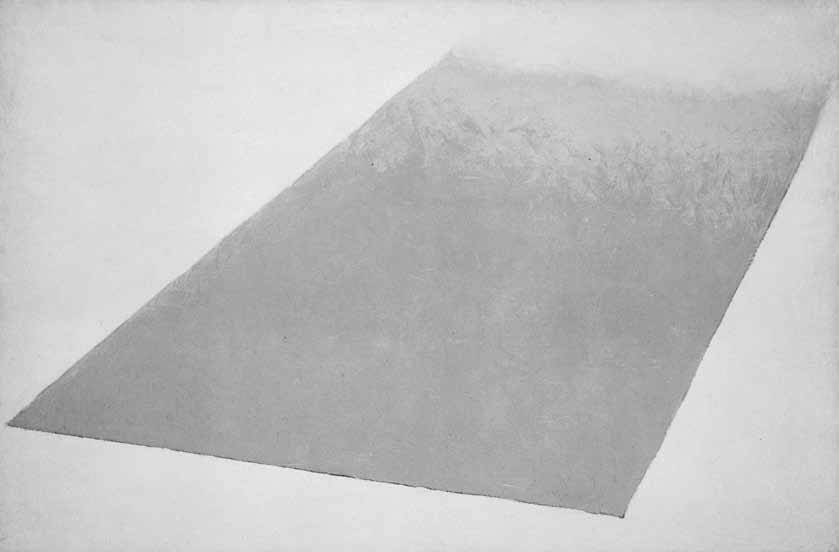
4.2 Kazimir Malevich, Suprematist Painting, 1917–1918, Stedelijk Museum, Amsterdam, the Netherlands
Another example is The Sailor (1911) by Tatlin (Figure 4.3). The painting dramatizes facial highlights, uses size to impart significance on a figure and exaggerates geometrical qualities found in folk iconography, associated in Russia with the Old Believers.271 Unlike Goncharova, Malevich and Larionov, Tatlin was interested in the classical Byzantine icon. He had trained as an icon painter and early in his career copied frescos in Novgorod churches. His careful study of icon composition, color and lighting is evident in other paintings (e.g., Nude, 1913) in which arched lines and highlights impart rhythm, volume and figural integrity that recall medieval Russian icons (see Chapter 13, The Appearance of the Angel to the Myrrh-Bearing Women, Moscow c. 1497). 272

4.3 Vladimir Tatlin, The Sailor, 1911, Russian State Museum, St. Petersburg, Russia
Spira finds this and other Tatlin works that were inspired by icons moving: «Tatlin clearly acknowledged the expressionistic and socialist potential of icons (as exploited by Larionov and Malevich) but at this stage of his career [1913] it was primarily the melancholy poetry of their pictorial style to which he kept returning.»273 The evocation of character and mood is evident in the sailor's honest, youthful appearance and the introspective, solitary posture of the woman in Nude. It is conveyed by the dynamic intersection of planes and the presence of highlights in areas that define facial and bodily expression. But in both paintings expression is the effect of the composition rather than of the beings that it constitutes. It is a formal phenomenon. Personal being is here an aesthetic value like color or tonality that points not to the painting itself but to the painting act.
Goncharova idealized peasant life and folk art. Her series of lithograph illustrations based on Alexei Kruchenykh's parody of desert ascetics, titled Hermit, Demon, and Angel (1913), Two Startsy (1913) and her Mystical Images of the War (1914), are in the naive style of the lubki.274 These primitive icons were Russia's national resources and the path to its cultural awakening. Writing in 1913, she declared: «Now I shake the dust from my feet and leave the West, considering its vulgarizing significance trivial and insignificant–my path is toward the source of all arts, the East. The art of my country is incomparably more profound and important than anything that I know in the West...»275 In his 1913 Rayonnist (Rayist) manifesto, Larionov saw Western culture in similar terms: «Hail beautiful art of the Orient! We unite ourselves with contemporary Oriental artists for communal work . We are against the West vulgarizing our Oriental forms, and rendering everything valueless!»276 He envisioned the translation of physical objects into units of light rays and like Goncharova exaggerated the influence of Asian (Indian) symbolism on the lubok.

4.4 Natalia Goncharova, The Evangelist (Saint Mark) in Blue, 1911, Russian State Museum, St. Petersburg, Russia
«The West has shown me one thing» Goncharova wrote in 1913, «everything it has is from the East»; «For me the East means the creation of new forms, an extending and deepening of the problems of color.»277 This view contrasted with the more sentimental adaptation of the icon among artists like Mikhail Boichuk and Dimitry Stelletsky in works that recall contemporary versions of the Mexican retablo.278 Goncharova's interest was purely formal. Rather than recycle the icon in a contemporary form, she saw it as the source of valuable raw materials. Matisse had seen an exhibition of restored icons in Moscow in 1911. He had come to the same conclusion: «The icon is a very interesting type of primitive painting. Nowhere have I ever seen such a wealth of colour, such purity, such immediacy of impression... The modern artist should apply them with a sense of measure to create a work of high artistic value.279
«Goncharova's controversial tetraptych The Evangelists (1911) shows four stark, monumental figures in blue, red, gray and green. As in the panel depicting St. Mark (Figure 4.4), the Evangelists appear thoughtful and bemused as they point to the white empty scrolls they display. The narrow frame in which they are confined exaggerates their wide halos, the length of the scrolls and the grotesque character of their faces, hands and feet.280 As with Tatlin, color and composition are the dominant elements but unlike Tatlin there is no evocation of mood or feeling.
Another Goncharova painting, Nativity (1910), is a primitivist version of Nativity scenes as depicted in Orthodox iconography.281Like the lubok, it is supposed to be spontaneous and unaffected by ideas and concepts. «If religious art,» Goncharova wrote in 1912, «and art exalting the state had always been the most majestic, the most perfect manifestation of man's creative activity, then this can be explained by the fact that such art had never been guilty of theorizing.»282 It is a nostalgic quest for certainty and authenticity: «The artist well knew what he was depicting, and why he was depicting it. Thanks to this, his idea was clear and definite, and it remained only to find a form for it as clear and as definite.»283
Avant-garde interest in Russia's religious art did not occur in a vacuum. Advancements in anthropological and ethnographic studies, a renewed scholarly interest in antique icons and their restoration, and significant exhibitions of Orthodox art and ritual items (e.g., at the Stroganov Institute in Moscow in 1901 and at the Imperial Moscow Archaeological Institute in 1913) played a significant role.284 The contemporary writings of Pavel Florenksy on Byzantine iconography are an accurate reflection of this climate. Highly idiosyncratic at points, they are best understood in the context of the controversial sophiological views that he, Sergei Bulgakov, Vladimir Soloviev and others developed in that period.285 Florensky was critical of avant-garde artists on numerous occasions, but his ideas were very much at the center of the Modernist appropriation of the icon.286
Like Goncharova and others, Florensky was intrigued by folk art. He developed an elaborate symbolics of color that could be used as a spiritual key for understanding the deeper meaning of icons.287 His iconology is an amalgam of theology, metaphysics, occultism and gnostic notions of a cosmos comprised of ciphered spiritual realities. Nothing physical is what it appears to be. The garments of saints are extensions of the illuminated bodies they assume in the course of their spiritual struggles: «[the saints] generate in their physical bodies new tissues of lightbearing organs so that their bodies may be brought continually closer to the great sphere of spiritual energies; in terms of visual perception, this spiritual expansion of the body is symbolized by the clothes.»288 These ideas are further developed in his 1922 essay «Celestial Signs: Reflections on the Symbolics of Colours.»289
Their theosophical nature cannot be fully appreciated unless read in the context of an earlier work, his 1913 essay on «The Stratification of Aegean Culture.» «To understand the philosophy of the New Age,» he writes, «we must turn to the philosophy of Antiquity, the distant, half-ghostly shades of the Minoses and Pasiphaes, the shade of those who bore the most ancient daytime culture of the pre-Hellenic world.»290 The inclusion of the icon in a world of images, emanations and mythical realities imparts a cosmic and magical significance to its symbolism and connects it with the transcendent realities that shape culture. Five years earlier, in 1908, Lev Bakst had painted a statue of a Greek kore emerging from the chasm of a primordial landscape. Florensky was very impressed by the painting and praised its mythical and primordial content: «It is not surprising that for one of the most cultured of Russian artists, Lev Bakst, the destruction of Atlantis became a source of inspiration for his painting Terror Antiquus, surely the most significant work that our history painting has produced in recent years.»291
Modernists used the icon to create a similar mythology. They assigned to icons an Eastern and Asian origin (e.g., with Armenian and Georgian roots) that was meant to emphasize both their primitiveness and their superior aesthetic quality. An aesthetic archetype, the icon had essentially given rise to Western art.292 Its rediscovery would initiate a new beginning, the return of an archetypal form of art. The artist, critic and theoretician of Neoprimitivism, Aleksandr Shevchenko, wrote in 1913: «The simple, unsophisticated beauty of the lubok, the severity of the primitive, the mechanical precision of construction, nobility of style, and good color ... Primitive art forms–icons, lubki, trays, signboards, fabrics of the East etc.–these are specimens of genuine value and painterly beauty.» The fact that since the seventeenth century, lubki had been mechanically reproduced does not seem to affect their authenticity.
Mechanized but also arcane, simple and yet powerful, these images had the power to re-civilize Europe:
Russia and the East have been indissolubly linked from as early as the Tatar invasions... the whole of our culture is an Asiatic one, and foreign craftsmen, architects, weavers... who came to our 'barbaric' country from the West... fell under the influence of Tatar culture, of the East, of our more distinctive, more temperamental spirit, and Western civilization crumbled to dust before the culture of the East.293
They were sources of inspiration but they were also there for the artist to exploit: «We take lubok, the primitive, and the icon as the point of departure for our Art, for in them we find the sharpest and most direct perception of life; moreover, a purely aesthetic perception.»294
Goncharova's admirers included the Russian poet Nikolai Gumilyov (1886–1921), a fan of contemporary developments in ethnography and anthropology. Avant-garde theoretician and poet Guillaume Apollinaire (1880–1918) praised her designs of the stage sets and costumes for the Diaghilev production of Nicolas Rimsky-Korsakov's Le Coq d'Or, at the Paris Opera in 1914. He described her as «an Eastern artist» and praised her «command of aesthetics, where the great truths of modern scientific thinking combine with the secrets of the rich Oriental tradition.»295 In his 1917 poem «Goncharova and Larionov,» Gumilyov wrote: «The tender and splendid East/Goncharova discovered within herself ... The delirium and the singing of peacock colors/ From India to Byzantium ... Who's dozing, if not Russia?/Who has a dream of Christ and Buddha?»296
Goncharova was commissioned in 1915 to design the stage sets for Diaghilev's aborted Byzantinesque ballet Liturgie, a choreographed reenactment of the Byzantine liturgy.297 Spira considers her sketches and paintings as «the most abstract and dramatic works of Goncharova's entire oeuvre.»298 Like the Evangelists, Design for the Stage Set of Liturgie (1915) was inspired by the naive figuration and makeshift composition of the lubki rather than the introspective eloquence and expressive subtlety that characterizes the classical Russian icon.299 The work is unemotional, impersonal and hollow, with exaggerated gestures and abrupt movements. Lubki have a charming and sometimes enchanting roughness. Here, this quality is exaggerated in form and scale and it turns into yet another metaphor for the primitive.
In Modernist hands, icons and lubki are deprived of their identity and serve as aesthetic resources. They become displaced and appropriated objects, colonized in their own space and through their own language by the very people who idealize them as originary and discard them as redundant. For Malevich, «an icon in a museum collection is an object in which the religious fiction has been dropped while the non-objective art and reality have remained in it.»300 Russians traditionally placed icons at the corners of rooms. Malevich chose this position for his Black Square in the first Suprematist exhibition in Petrograd (St. Petersburg): «... I see the justification and true significance of the Orthodox corner in which the image stands, the holy image, as opposed to all other images and representations of sinners.»301
The avant-garde interpretation of the icon was Romantic, sentimental and utilitarian. Having separated the aesthetic aspects of the lubok and icon from their theology, history and tradition, it was easy to see them as formal objects. But the separation was not total. The discarded elements could be used rhetorically, as we have seen. The religious lubok was an expression of piety and popular imagination. The classical icon reflected an ascetic sensibility. The avant-garde «icon» had none of these qualities. And yet, it was often embedded in a language of transcendence (theological and metaphysical), as if it had to go on speaking in the voice of its obsolete archetype. Malevich claimed that his art could restore for humanity the «absolute perfection» that marked man's original state before the fall.302 And yet his art is devoid of any tangible emotional and existential significance.
But there were also exceptions. When they turned to the classical icon, some avant-gardes were particularly insightful and sensitive. Larionov's comparison of Russian icons with their Greco-Byzantine models shows an appreciation for the theological dimension of form in iconography:
They [saints in Russian icons] are not human beings transformed into saints, as in Greek and Byzantine icons; they are saints that have taken on a remote and symbolic human appearance, without crossing the limit of verisimilitude, in order to be recognised, and to be seen to be of human origin. They preserve their human forms but these forms are transposed into rhythmic style through which life – spiritual and mystical life rather than naturalistic 'real' life – expresses itself, flows and is held before the human eye.303
The icons he has in mind here are the legacy of Russia's medieval iconography. The association of a delicate, ambiguous verisimilitude with the mystical life is especially perceptive as is the observation of how these icons contain a unique visual rhythm that is essential to their spirituality (the comparison with the Greek icon is another matter).
Larionov's comments recall the work of contemporary art historian Nikolai Tarabukin. Tarabukin studied the narrative and compositional dynamics of medieval icons, and the use of geometrical abstraction and symmetry to impart rhythm. Spira identifies these elements in the non-objective paintings of Aleksandr Rodchenko.304 In the 1930s, while Modernism was becoming unpopular with the Soviet state, the technical study of pigments and wall painting techniques in Russia’s medieval monasteries and churches became part of the curriculum of art schools and clubs.305
Tarabukin was part of a rising academic and scientific interest in the techniques and preservation of medieval iconography that ran parallel with the various avant-garde movements and intersected with them at various points. Florensky’s iconology is one example. It combined a scientific interest in light and color with the view of the icon as a cultic object whose hidden symbolic life could be expressed dynamically in the liturgy. His idea that the icon is “the center of an entire cluster of conditions, which alone make possible its existence as something artistic” is replicated in contemporary studies of the icon as a dramatic (performative) object (e.g., by Pentcheva).306
The most remarkable response to the Byzantine icon was that of Marc Chagall. More than most of his contemporaries, Chagall was aware of the aesthetic limitations of folk art and realized that the religious content of Russian medieval iconography is too essential to its form to be compatible with a secular and eclectic sensibility. On numerous occasions he cautioned against the infringement of theory on the making and experience of the work of art. We will discuss Chagall's views on this subject in detail in Chapter 14. Here, we briefly consider the influence of Orthodox iconography on his work.
Even though it is dominated by Hasidic imagery, Chagall's early work reveals a very careful student of the Orthodox icon.307 This is evident in paintings with Christian themes like the 1912 Dedicated to Christ, but also in the 1913 Pregnant Woman (Maternity) in which a female figure dressed in peasant clothes displays a child contained in a nimbus in her womb. The similarity to icons of the Virgin with the Child Christ standing with arms raised in an Orans position is apparent. Similarly, in The Flying Carriage (1913), the gestures of the figure in the ascending carriage recall medieval depictions of Elijah's fiery ascent to heaven.308 Another early work, The Cattle Merchant (1912) (Figure 4.5), shows a variation on the gestation theme while the shaping of the body and clothing of the woman shown carrying a calf on her shoulders (reminiscent of «The Good Shepherd») is very much in the manner of Byzantine iconography.
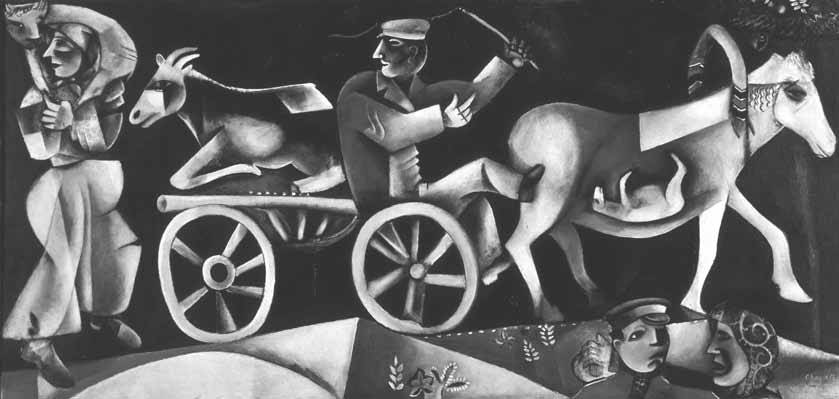
4.5 Marc Chagall,The CattleMerchant, 1912,Kunstmuseum,Basel, Switzerland
The influence persists in later works. The 1920 panel, titled Literature (State Tret'iakov Gallery, Moscow) prepared for the State Jewish Chamber Theatre in Moscow (GOSECT), has no Christian theme but its composition is also indebted to Byzantine compositions.309 It recalls icons of the Evangelists seated at the scriptorium either in a monastic room or in the desert.
This is evident in the positioning and posture of the painting's solitary figure, in its elongated form, in the faceting and reverse perspective, the angular contours of the scribe's clothing, and the overlapping and intersecting planes that surround him. Like the icon of St. Luke that we see here in Figure 4.6, Literature exudes a pensive and tranquil mood. One gets the sense (even with the more lubki-like upper part of the painting) that it belongs to the same place and time, with its Byzantine archetype, and that it too inhabits a world in which to write is an act of silent conversation with words and with one's soul. Cattle Merchant, Literature and other works from this period show more than a casual familiarity with Orthodox iconography and an eclectic experimentation with its forms. They are actually Hasidic icons.
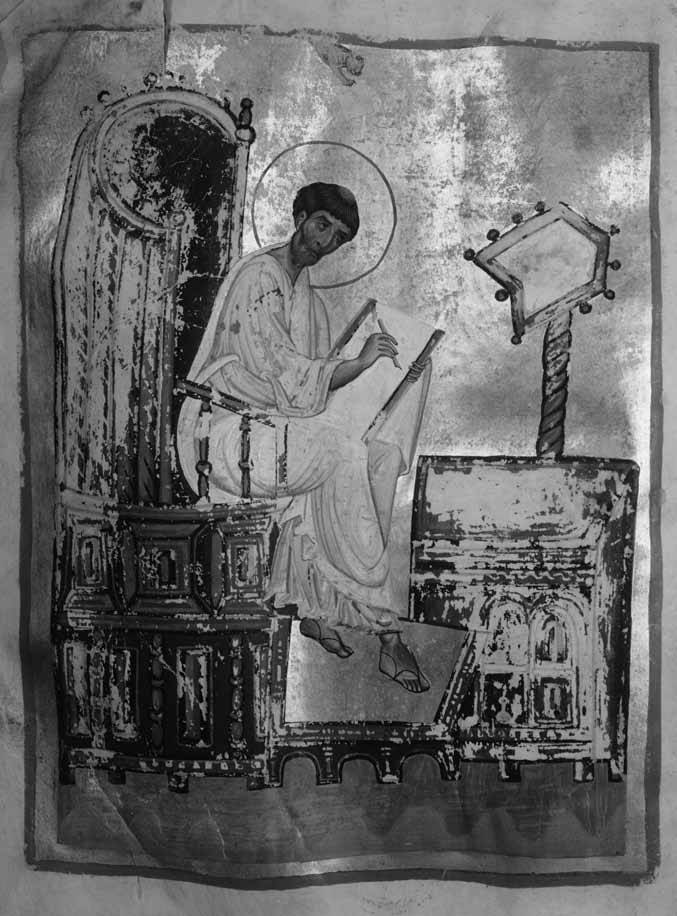
4.6 St. Luke Writing at his Desk, 12thcentury, National Library, Athens,Greece
Indeed, in a 1946 interview, Chagall explained that in his early years he had turned to Russian folk art hoping that we would find there «an art of the soil, not one uniquely of the head» only to realize that it lacked «the refinements of civilization.»310 But it was the classical icon that impressed him deeply:
The refined art of my native land was a religious art, I saw the quality of a few great productions of the icon tradition–Rublev's work, for example. But this was fundamentally a religious art and I am not, and never have been religious . To achieve the combination of refined expression with an art of the earth, I felt I had to seek the vitalizing waters of Paris.311
Another statement is even stronger:
To see the world as an indivisible whole, to embrace both the beginning and the end at once, what purity! That is why I love icons so much. I owe a lot to icon painting. It is an art full of spirituality, unembarrassed by devices. For devices kill purity.312
In The Cattle Merchant, animals and humans penetrate the night with their luminous forms and dignified existence, their bodies tangible and solid and yet light enough to float in space and move within their own realities, full of a mystical eloquence. In Literature too there are voices. The timelessness and intimacy of the mystical moment of the writing and reading act in which the scribe is engaged suggest a world of solitary communion that unites human beings, animals and nature. The animal breathes out (or feeds on) letters while the child somewhere in that space is either learning to read or chant. The man's faceted body, the table set open, the overlapping planes and collage-like flatness of the composition, the tranquil vivacity of its colors (particularly the contiguous planes of dark and lighter blue), and the elegance and simplicity of form, line and shape, create an image in which Modernism and the icon converge. Here there is no tension between one style and the other, one aesthetic and the other. And it is not really necessary to speak in terms of movements or schools etc.–exactly as Chagall explained.
The Byzantine icon inhabits Chagall's art. It permeates his works in the way that memories permeate our minds and senses. Sometimes it is a fleeting image, buried deep inside a painting's colors and the mood and atmosphere they exude. Other times, it appears as a quality in the composition of a picture and sometimes it is only an intuition of something in and about the image that has escaped time and lives in eternity. Many of his paintings (especially between 1911 and 1940) create effulgent plastic and visceral worlds – rooms, streets, fields and landscapes–where beings of all kinds live vibrant, resolute and ineffable lives, even in the midst of great turmoil and suffering (see Chapter 13).
His friend and publisher, Teriade saw his work in similar terms.313 «In Chagall,» wrote Teriade,
abstraction is constant, but rather than reducing things to geometric elements, abstracting them first, in order to then construct the unity of his plastic world, he prefers to leave them as they are. As if through a dream pursued that spontaneously connects things on the plane of the imagination, he arranges his memories of beings and objects according to an order dictated by his soul, and with the feeling of establishing a reality that is truly his own.314
Chagall spoke about art plainly. Compared to the writings of Kandinsky or Malevich, his words have the simplicity and terseness of a craftsman. This is largely because what he said as a painter was said in what he painted. While his contemporaries improvised on the icon, Chagall simply painted his own. This was ironically what Goncharova had aspired to do in her work. Literature has no hint of rhetoric. It is not part of a programmatic vision about art. It has no dreams of transcendence. It does not signify the theophany of a new religion or ideology. It is in its own being an instance of immersion in the transcendent and immanent mystery of the divine Word. We see in this instance how Modernism is not opposed to Christianity (or Judaism). But we also see that in this instance it is not the art-critical and -historical category that we take it to be but a historical manifestation of the perennial being of art.
In a 1973 interview with Russian critic and art historian Aleksandr Kamensky, Chagall talked about the need to keep the artist free from conceptual forms and constructs: «Movements! There are painters and that's it. Movements–they are theoretical conceptions. And the great painters have always been above movements . In order to speak of art you must talk in concrete terms and not clutter your thoughts with abstract concepts.»315 «You are far too preoccupied with theories,» he explained to a young Italian painter, «when all that matters is quality, and one is born with that. There may be quality in your work, but it is obscured by schools of thought.»316
Chagall, in my view, painted the only avant-garde icons of his generation. Literature is one of them and further study of his early works may reveal more. His appreciation for the distinctiveness of the classical icon was shared by Tarabukin and Larionov. But the poetry he perceived in it was not. Many of his early paintings, like Solitude (1933), exude the joyful melancholy (in Greek, charmolype) found in the Orthodox iconography of the Passion (we shall return to Chagall in Chapter 14). Their emotional subtlety, oneiric atmosphere and sonorous life resonate with the qualities that Russian Modernists admired in the religious imagery of Old Russia: the naive simplicity and spontaneous reality of the lubok, the elegant and mystical figures of the medieval icon and its discarnate forms. It is almost as if the Modernists dreamed an icon and Chagall created it for them.
For us, Chagall is a bridge between the Orthodox icon and Modernism. His works allow us to abandon the idea that Modernist art is in some essential way opposed to the Christian image. Many Modernist works are certainly incompatible with the way in which Orthodox (and Catholic) Christianity envisions existence. We have seen examples. Malevich's squares and rectangles may resonate with metaphysical notions and perhaps even create a visual vernacular for a new spirituality (Platonic, Gnostic etc.), but they cannot really stand on their own as spiritual beings or realities of any kind. Programmatic art is good for illustrating ideas but it has to take them along wherever it goes. Ultimately, it is overshadowed by them and becomes their accessory.
There are in Modernism–as in all artistic movements and epochs–works that stand on their own and which one must address directly as if they are persons. When we are in their presence, it makes little sense to consider what movement they belong to or what theory of art defines their principles or explains their form. Aesthetics is in this sense a discipline that begins and ends with the work of art. To observe this rule is to resist the natural tendency in the theorist (philosopher, theologian) to bring the work under a concept or paradigm and see it from that vantage point only.
This is what the noted Catholic philosopher Jacques Maritain tried to do with Chagall and other Modernists. The result, as we shall see in more detail in Chapter 6, is a good example of how not to approach Modernism from a Christian perspective.317 Maritain did not get Chagall wrong but he took what he saw in his work and rather than leave it where he saw it and pursue it aesthetically, he used it in order to speculate about the artist's unconscious insights and intuitions.
This obsession with miracle and freedom, with the innocence and a fraternal communication among all things reveals to us in Chagall an evangelical sentiment unconscious of itself and as if enchanted, where sometimes a certain grating of the world of the senses reminds us that here and there the devil furtively shows his horns through the flowery bars of his luminous universe. Chagall knows what he says; he does not perhaps know the range of what he says. That St. Francis would have taught to him, as to the larks.318
Maritain had been impressed by George Rouault's prints of the Virgin Mary in the Miserere Serie–ambitiously titled «In These Dark Times of Vainglory and Unbelief, Our Lady of Land's End Keeps Vigil» (1914–1927). Occasionally icon-like in their stark simplicity and modeling, the pictures recall the primitivist paintings of Goncharova and Larionov but have a sharp tonality and a dramatic intensity that their works lack. Rouault's religious art has none of the subtlety and elegance of Chagall's imagery. Maritain was convinced that his interpretation of Thomist connaturality would enable the fusion of theological truths with the intuitive, «mystical» processes invoked by many avant-garde artists.319 This is the formula that he used with all Modernist art. It did not work. Today, as we shall see next, the Catholic Church continues to approach Modernism in these terms.320
The New Iconoclasm
Catholic and to a lesser extent Orthodox theologians have made a pessimistic assessment of Modernism and its influence on Western art (religious and secular). It is not surprising that the term iconoclasm has been used in recent years to describe a set of interrelated problems.321 Principal among them is the absence of contemporary art with a Christian character, the lack of interest in Christian art (present and past) among artists and the public in general, and the steady movement of painting away from representation. Modernism is blamed for replacing representational with abstract art and promulgating through abstraction a visual and imaginational relativism that is at odds with the Christian conception of reality. Secular humanism is blamed for introducing Modernism to Christian art.
In their opposition to avant-garde art, theologians are not battling a stranger but a construct of their own making and one that rests on familiar premises. From its beginnings, Christianity assigned to images two conflicting roles: one of a privileged object of veneration, the other of a humble object (instrument) of service. In the first case, the image is treated as an extraordinary being that is imbued with divine grace and is therefore weeping myrrh, motioning, walking etc. – a dynamic form of existence that contrasts with its material, inanimate character. In the second, it is determined both thematically and to a degree aesthetically by liturgical and didactic priorities. Idealization and utilization are, as we have seen, approaches to the art object that Modernism also embraced together with the ambivalence the latter brings to art's social and cultural significance.
Interestingly, its opponents have also privileged an image that is not properly speaking art. In their attempts to define the distinctive character of the Christian image and present it as a corrective of the Modernist and Postmodernist work of art, Catholic and Orthodox theologians typically make reference to the archetypal images of Christianity, the acheiropoietai, images supernaturally formed and untouched by human hands.322 These images are supposed to demonstrate (how exactly we are not told) the spiritual and aesthetic distinctiveness of Christian art despite the fact that miraculous formation has no specific aesthetic prerequisites. From an anthropological perspective, they are cultic objects invested with psychosocial significance and reflecting practices that go back to pagan antiquity.
This does not prevent theologians from using them to valorize the icon. Thus Paul Evdokimov considers all icons to be superior art because they participate in some kind of theophany. In other words, because some Byzantine images are supernaturally formed and partake of divine grace, the type itself is sanctified and its instances assume not only spiritual but also aesthetic significance of the highest order. Reminiscent of the dreams of Goncharova and Larionov, this Romantic view of the icon invests it with extraordinary qualities. Icons are even poised to save Western art in a «baptism ex Spiritu Sancto ... nothing less than the death of art and its resurrection, its birth in the epiphanic art whose highest expression is the icon.»323
The irony of this argument is hard to miss. Acheiropoietai are actually indifferent to stylistic peculiarities or artistic skill and may appear in any medium, sometimes on rocks, pieces of wood or cloth, and even in icons printed on paper. On some of these icons time has brought abstraction and ambiguity as often the figures they depict are barely recognizable. But this has no impact on their significance which is determined largely by their function as loci of theophany. Thus Christianity embraced abstraction long before Modernism elevated it to one of its programmatic principles and even invested it with spiritual and metaphysical significance.
Acheiropoietai have a long and fascinating history and as expected have caught the imagination of both East and West. In the West, the Veronica (vera icona)–the Latin equivalent to acheiropoietos–succeeded the Byzantine Mandylion that was kept from the tenth until the early thirteenth century in Constantinople.324 Together with other variants with which its history has fused–e.g., the sixth-century image of Christ's face in Capella S. Matilda in Rome, Vatican and the Constantinople Mandylion in S. Bartolomeo degli Armeni, Genoa–the Veronica depicts Christ not by virtue of human art but by a miraculous transference of his face on a piece of cloth.325The Shroud of Turin is believed to record a similar impression, left by Christ's body on the burial cloth, a lasting mark of his carnality (and mortality) on the one hand, and his divinity on the other.326 The image visible on the cloth has a graphic quality similar to that of a woodcut, and shows a human face characterized by a significant degree of abstraction.
But this matters little in this case as the origin of the impression and its evidentiary significance for those who believe that it was left by Christ's body, makes any artistic consideration redundant or at best secondary. Art pales in front of a divine or metaphysical reality. If we recall, lubki and folk art in general were valorized by Russian avant-gardes because they were supposed to reveal the metaphysical realities of peasant and national life in ways that academic art could not. However, aesthetic superiority can only be argued on an aesthetic basis, in terms of the qualities of the art object itself rather than its model, paradigm or archetype. As we suggested earlier, the only aesthetic claim that one could make in this context is analogical. An icon is aesthetically significant when it can simulate in its form what the miraculous icon delivers charismatically in its «physiology.» This analogy is not arbitrary. It has an ontological foundation: the animated and self-fulfilling existence that all beings assume in a Christian universe (see Chapter 9). Using this form of thinking, theology can actually inform aesthetics rather than dictate it. A lubok can assume a similar function vis-a-vis a painting. It is the independence of analogates that makes their comparison valuable.
This may seem an endorsement of eclecticism but it actually is not. Analogates need to be studied carefully with an eye to their distinctive qualities. Acheiropoietai are the result of a direct contact between the wood, pigments etc. and the divine or holy person whose agency they host and embody. By becoming animated and personalized in this manner, they remain supernaturally active, engaging in miracles and other forms of physical expression (e.g., secretion of myrrh). In so far as they emit actual substances (e.g., oily perfume or tears) and depict recognizable figures (e.g., a Virgin or Christ-like face etc.), they have a tangible enunciating force, similar to that of speech acts. They weep in anticipation of a disaster that will affect a community, or as a sign of empathy and consolation for the faithful. These icons, moreover, are neither exquisitely beautiful nor engaging in an aesthetic sense. For all the emphasis given to beauty by Western theologians, it is not beauty that distinguishes these extraordinary images and has a role to play in their efficacy.327 It is, rather, a certain kind of presence. Where there is myrrh bleeding or tears, for instance, streaks of the substance mark the face and body of the depicted figures and often distort their form. But for the faithful, the experience of divine presence has an abrogating effect on any kind of deformity.
Acheiropoietai are experienced as unique instances of divine revelation, like the holy relics and the fragrant bodies of ascetics and exhumed saints. They are endowed with corporeal qualities of which the faithful may partake (e.g., in being anointed with myrrh), and considered exemplary not for their form but for their ontological peculiarity. They exist, in other words, as material objects, sacramentally constituted, bearing witness to a deified creation. They display intentional, emotive and somatic states and acts typical of living persons. These images thus come alive, an idea as we have seen that Greek art criticism valued in painting. They have enargeia in a literal (physical) sense.328 This is where we can draw the analogy to the exemplary Christian image which has a similar type of vitality and puts forth instances of deified being and existence, not in the manner of supernaturally mediated nature (i.e., as in the acheiropoietai), but in the manner of art.
Ironically, theologians who consider Modernism iconoclastic do not realize that they are engaging in a form of iconoclasm themselves by not allowing the art object an independent subsistence. This makes it difficult to calibrate and explore similarities to the miraculous icon and to the full gamut of Christian and secular visual experience where other helpful analogies may be discovered. The independence of the art object, in other words, opens the way to theological investigation. It does not close it. This openness is essential to a Christian encounter with contemporary culture. We know that we have a problem when the use of the term «iconoclasm» to discuss the state of Christian art today is adopted intact from the polemical theology of the eighth and ninth centuries, as if little has changed since. Thus Modernism is approached from an adversarial standpoint despite the fact that it occasionally (and by no means systematically) shares the same disregard for the aesthetic object that Christian theology has embraced for centuries.
We already stated that the theology produced by Byzantine Iconoclasm continues to hold the scholarship of the icon captive. It has an equally strong hold on the way that contemporary theologians deal with modern art. Briefly, the Iconoclastic controversies consist of two radical state-sponsored movements against the veneration of images in Christian worship which ended with the victory of the supporters of the icons (iconodules). The first movement, preceding and leading to Nicaea II, lasted between 730 and 787, during the reign of Leo II and Constantine V. Restoration followed under Emperor Constantine I and Empress Irene. The second wave of iconoclasm occurred between 814 and 842, under Leo V and Michael II, and ended under the reign of Empress Theodora.329 Pronounced a heresy because it refused to give artistic form to the human body of Christ, Iconoclasm was defeated on the basis of its theological rather than aesthetic implications.330In 787, the Council of Nicaea, made a heresy of unregulated artistic expression, and gave full authority over the image to the Church. One of its statutes read: «The making of icons is not an invention of the painters but an accepted institution and tradition of the Catholic Church; and that which excels in antiquity is worthy of respect, according to the divine Basil.331
«By thus posing a false dichotomy between tradition and innovation and linking tradition with institutional authority, the Council discouraged genuine dialogue between art and theology and the aesthetic exploration of theological ideas. Stylized halos, gold leaf background, script identifying the divine or holy figure portrayed, symbolic objects, colors and gestures, and quotations from Scripture and hymnography were adopted as solutions and are still standard features of Orthodox icons and Christian art in general. Rather than dismiss Iconoclastic arguments on aesthetic grounds, the Church promulgated devotional portraiture and narrative paintings of Christ's life in which his divinity was stated rather than shown. Questions about the ability of art to convey the divine nature of Christ, something the Iconoclasts deemed impossible, were thus relegated to iconographic conventions that functioned as a universal visual language for the faithful.332
This helps explain why Christian theology in both East and West has not genuinely engaged art and has taken a defensive posture when dealing with the experimental nature of Modernist and contemporary art. The tendency is perhaps more pronounced in the East where some Orthodox authors even avoid using current art-critical and philosophical terminology when discussing icons, preferring instead the idiom and categories of Patristic texts dating to the Iconoclastic controversies.333 There is nothing wrong with Patristic terminology in this instance. The problem is the restrictive way in which it is approached. The notion that the icon's sanctity prevents it from being discussed in contemporary idiom or in non-Christian categories (e.g., in a comparative context) «freezes» the Christian image in a certain historical and conceptual framework that presumably guarantees its survival but in effect ensures its marginalization. We have seen earlier that this exclusivism is not consistent with the Orthodox view of tradition.
The idea of locking the icon within what is understood as its tradition and even presenting it from that standpoint as an exemplary type of art can be seen in Florensky who writing in 1922 argued that the icon is the work of the Church and itself an object that resonates with collective spiritual significance: «every icon belongs in essence to the collective work of the Church; and even if, by chance, a particular icon is fashioned entirely by one single master, some ideal participation of other iconpainters is always implied.»334 From his perspective «the icon is a work of witness that employs art as well as many other things... 'mass-production' is therefore essential to iconpainting, for its sensory evidence must enter into every home and every family… »335
These remarks are fully within the Iconophile spirit as is another Florensky statement that sharpens the contrast between fine art and the icon where the latter is seen as an object that serves a utilitarian and yet idealized, function:
In fine arts, an artist's stylistic uniqueness demands the absence of other people; in iconpainting, the primary goal is always the clarity of a collectively carried and transmitted truth; hence, if by chance some purely subjective view of things spontaneously creeps into one moment of the inconpainting process, it will be balanced in the final icon by other masters mutually correcting one another.336
It is hard to miss here the echoes of the collectivism preached by the Soviet state and the notion that the Church is the real avant-garde since its art is not only free from the subjectivism of bourgeois culture but has preceded the communist experiment in being the work of an anonymous and yet sanctified body of workers and painters.
This emphasis on ideality and functionality characterizes recent Catholic arguments about sacred art that are critical of Modernism but do not single out any particular school or style as normative for Catholic art.337 According to Joseph Rateinger and Christoph Schonborn, the diverse gifts bestowed by the Holy Spirit on the Church and the free character of artistic expression justify a stylistic pluralism in Christian iconography.338 But this is not given unconditionally. Christian art must be representational or figurative. As long as this standard is observed, any style is admissible. The importance placed on representation assumes that the term itself is pretty straightforward. From an aesthetic point of view, we know that this is not the case since even a simple line or a dot can represent something in certain contexts. But the predominant mood in these statements is inclusiveness or the notion that the Church is open to all kinds of artistic and cultural expression with minimal conditions. Thus, the spiritual integrity of the Byzantine icon is praised but its style is not considered exemplary in any way. Rateinger's and Schonborn's sense of the aesthetic is limited to a work's style. The aesthetic object has no other dimension worthy of interest. In addition to being representational, art should be theologically correct and thus deliver the right message.339
Rateinger insists on representation because he wants to see in the work of art evidence of creative activity, an essential aspect of its ordination to grace and to the Church. A recognizable house in a painting, for example, reflects the artist's commitment to the integrity of creation. This integrity must be shown in all things. And as in Plato, art is essentially imitative and must deliver solid rather than impressionistic and imaginational forms. In the Pope's view, subjective or idiosyncratic realities (related to phantasy) have no place in Christian art. God creates clear and legible things. Human art must do the same:
... art itself which in impressionism and expressionism explored the extreme possibilities of the sense of sight, becomes literally object-less. Art turns into experimenting with self-created worlds, empty 'creativity,' which no longer perceives the Creator Spiritus, the Creator Spirit. It attempts to take his place, and yet, in so doing, it manages to produce only what is arbitrary and vacuous, bringing home to man the absurdity of his role as creator.340
By this standard, an impressionistic picture of Christ would be marginally admissible, the implication being in the above statement that the visual experiments that preceded Modernism led to the extreme forms of abstraction that it eventually embraced: «Forms of art that deny the Logos of things and imprison man within what appears to the senses are incompatible with the Church's understanding of the image.»341 A picture that shows patches of color or a few lines without clearly delineating a subject would be problematic in this view. Rateinger's realism essentially requires of artists two things: to paint the world as it is, and to paint it as God's creation rather than their own. It is interesting that these conditions are not confined to Christian art but must extend to all art if the «iconographic crisis of the West» is to come to an end.342The cause of the new iconoclasm is an anthropocentric, narcissistic humanism that has forgotten God and being.343
Iconoclasm is thus symptomatic of moral and spiritual flaws which art, like the culture that surrounds it, embodies and expresses: «True, Christian subjects are still being depicted, but such 'religious art' is no longer sacred art in the proper sense. It does not enter into the humility of the sacraments and their time-transcending dynamism.»344 Rateinger's criticism of modern art is part of a more general criticism of contemporary culture that targets secularist tendencies within the Church, the misinterpretation of Vatican II by clergy and laity, and the emergence of historicism as the dominant paradigm of theology.345 Naturally, then, aesthetic problems will be resolved as part of a systemic solution, on theological and spiritual grounds. John Damascene's (676–749) warning to the Iconoclast emperor Leo III, «you are not struggling against icons but against the saints,» is used to emphasize the spiritual nature of this struggle.346
Byzantine Iconoclasm influenced Catholic iconology through the Libri Carolini. Based on a misunderstanding of Greek philosophical and theological terms in the arguments of Nicaea II (787), the Libri, according to Leonid Ouspensky, embraced a «de-sacralized,» functionalist and materialist view of the image.347 Ouspensky considers this document the source of Reform Iconoclasm and the reason why Catholicism has not produced genuinely spiritual art.348 From his standpoint, the reason of the demise of Western religious and secular art can be traced to Catholic iconology and ultimately to Catholic theology. Ironically, like Rateinger, Ouspensky assumes that the character of individual works of art is uniformly shaped by their underlying theology and by eschatological factors.
This idea has become a common place in theological discussion. Its secular corollary is the idea that works of art take a specific form that reflects their ideological environment. Evdokimov describes all icons as having «a mystical sense, a mysterium tremendum."349 Only in theory or from a systemic standpoint (e.g., Hegelian) can one argue that all art is in crisis, or that every icon is spiritual, or that only Christian art is truly art (even though that position has not been fully argued by Rateinger or other Catholic theologians). The following statement by Ouspensky is typical of this approach:
Indeed, if spiritual decline manifested itself in a neglect of the icon, the spiritual renewal prompted by catastrophes and upheavals leads back to and encourages man to learn its language and meaning, to become truly aware of the icon. It is no longer viewed as something of the past: it is reborn in the present.350
Ouspensky actually rediscovered the icon (and Orthodoxy) as part of an iconographic revival that affected Russia (mainly Russian expatriates in Europe) and Greece in the second and third quarters of the twentieth century.351 His quest for roots, authenticity and certainty was very much in the Modernist spirit.
The tendency to subject the art object to theological, ideological and in general theoretical priorities, owes a lot to the rhetorical conventions of a more distant era. The rhetoric of Catholic and Orthodox iconologies is in substance a Greek and Byzantine rhetoric associated with ekphraseis. It gives a superlative position to art with regard to divine realities or human memory but with few significant exceptions shows limited interest in the art object itself. To the extent that it adds to the image layers of descriptive imagery-much like photography would today in reproducing its likeness–it does not interfere with its structure. It is not in other words analytical or preoccupied with decipherment and deconstruction in the manner of contemporary art theory that considers these methods to be culturally and spiritually purgative if not redemptive. Here the objective is to glorify the image but the end result is ironically obscuration and displacement. Still, as with Modernism, to recall Kandinsky and Malevich (more in Chapter 14), it is the aura of spirituality and transcendence that provokes and sustains rhetorical interest and the work does at times emerge from this verbal reconstruction to show its actual reality to which, ironically, it pales by comparison.
Thus iconoclasm is from this perspective, the legacy of a rhetorical reality and its practices–a legacy that post-Iconoclastic Byzantium vigorously revived–in which political and institutional objectives found expression. Transplanted by Byzantine intellectuals that moved to Italy before and after the fall of Constantinople, it became a universal language for the art of Christianity, practiced by clergy and lay intellectuals (see Chapters 11 and 12). Starting in the twelfth century, under the Comneni dynasty, Byzantine art became interested in secular subjects. In true humanist form, artists of distinction were accorded both honors and creative freedom, and as one would expect took a more personal interest in how their work was presented in public.352 Gennadios Limouris writes of this period:
We too often forget that it was from Macedonian art and Serbia that the affirmation of the human in the beautiful reached Italy and in the 13th century inspired there a 'transfigured renaissance,' a divine humanism, which quickly disintegrated in the succeeding centuries. The movement lasted longer in the Byzantine world, culminating in the first frescoes of Mistra in the Peloponnese, and still more in Constantinople with the tenderness and dynamism of the Karie monastery.353
Byzantine influence on Franciscan and Dominican iconography and devotion was especially strong in the early decades of the orders' history while Byzantine art criticism was far more sophisticated than its Italian counterpart until the late fourteenth century.354 The artistic exchange with the West was most conspicuous in the island of Crete, which came under Venetian rule in 1210 and developed after the fifteenth century into a major center of iconography serving local but also Italian and Flemish patrons.355 Starting in the ninth century, ekphraseis in Byzantium became increasingly more interested in the dramatic effect of the described works on the viewers and, like Italian devotional literature a few centuries later (e.g., St. Bonaventure's Arbum Vitae), engaged in graphic and theatrical lyricism that emphasized the psychological and physiological details of a sacred character's behavior.356
Examples include works by the ninth-century author, Ignatius the Deacon (c. 770-d. c. 843), and later by Nikolaos Mesarites (c. 1163-?).357 Mesarites describes the mosaic cycle of the Church of the Holy Apostles through the narrative and teachings of the Gospel. He shows a remarkable mastery of classical literature, Scripture and theology and casts the figures of the mosaics he is describing in the role of instructors and agents of the theology they embody.358 Only occasionally he turns to aesthetic qualities: «And the lines are not plain, but they please the senses and impress the mind by their varied colors (poikilo ton chromaton) and the brilliance of the gold (katachryso) and the brightness of their hues (euanthei)."359 Here is an attempt to guide aesthetic perception for the reader who has not seen the work or has not realized its significance. When ekphraseis were actually delivered in public, they inserted the images they described in performative acts that impressed the popular imagination.360
In their hagiographic variety, they described churches, monuments, landscapes, apostles, saints, martyrs, angelic beings and of course Christ and the Virgin Mary. In some instances, they presented them as living beings, very much in the mode suggested by enargeia and phantasia: «every painting, every icon was utterly lifelike, and expressed the very essence of its subject.»361 But more often than not, they followed stylized literary conventions and showed little interest in the aesthetic qualities of the frescos, mosaics and buildings that they described. Expressive elements were typically attributed not to the painted figures but to the holy persons they depicted which in part explains Mango's view that Byzantine aesthetic theory was unremarkable and unoriginal both before and after the Iconoclastic controversies.362 Mango's question on this subject is very much in the spirit of our argument and as we shall see in the next chapter, accurately describes a problem evident in most contemporary theologies of art:
the discussion was conducted almost entirely in theological and scholastic terms without reference to the basic artistic problem that any serious theory of images must take into account, viz. what constitutes a likeness. How do we know that an image of Christ looks like Christ? Neither the Iconoclasts nor the Orthodox appear to have asked this fundamental question.363
There are of course exceptions which suggest that theology's hand was not always as strong as we might assume. An example is a commentary by the early fourteenth-century historian and poet Nicephorus Callistus on an icon of the Archangel Michael that was painted by the famous twelfth-century artist Eulalius. The name means «eloquent» and was most likely adopted to pun on the vivacity and expressiveness of his images–they were called «eulalon" and "lalounta."364 It reads:
It seems either that the painter has dipped his brush in immateriality to delineate a spirit, or else the spirit remains unobserved in his picture, hiding in color his incorporeal nature. How is it that matter can drag the spirit down and encompass the immaterial by means of colors? This is [a work] of ardent love (as shown by the facts), and it kindles the heart.365
The use of color to suggest the subtle corporeal existence of an angel–"a fine body of an aerial or fiery nature» – is a praised aesthetic quality.366 The artist's attitude to his subject is inferred from the qualities of the image («the facts»). Intentional elements present in the icon connect the viewer to the artist and cause a sympathetic response. The reference to the iconological and theological problem of rendering spiritual beings in sensuous form suggests the Incarnation but also serves to underscore the work's extraordinary quality and express the author's admiration and refined sensibility.
Today, official Catholic documents show the same combination of piety, eloquence and praise for art seen in Byzantine ekphraseis and the same reluctance to engage art in its own terms.367 There is a sense of entitlement with art being seen as belonging ontologically to the domain of religion from where it draws not only its meaning but also its raison d'etre. According to Sacrosanctum Concilium, the Church «has always been the patron of fine arts» but «has not adopted any particular style of art as her own.»368 It «admitted styles from every period in keeping with the natural characteristics and conditions of peoples and the needs of the various rites.»369 At the same time, these documents are always careful to make the conditions of this relationship clear and affirm Church authority. Patronage is to be exercised «in accordance with faith and piety,» with «the reverence and honor due to the sacred buildings and rites.»370 The right of the Church to implement its judgments through local ordinaries or diocesan commissions and experts on the basis of these general principles is also affirmed, but no reference is made to the standards or criteria that will be used in such cases.
Good art should have «noble beauty.»371 What this means is not explained. «Depraved forms,» works deficient in «artistic merit» or characterized by «mediocrity» or «pretense» should be excluded or where already admitted, removed by bishops. None of these key terms are defined). Gaudium et Spes embraces «new art forms adapted to our times,» and urges that «every effort should be made . to make artists feel that they are understood by the church in their artistic work»372 Sacrosanctum Concilium leaves judgment in matters of art to pastors who should be duly educated in order to advise artists and assess their work.373
For Rateinger, by contrast, only ecclesiastical formation can guarantee the sanctity of the work of art. Like priests and religious, artists must be «inwardly formed within the Church.»374 Active participation in the sacraments and life of the Church is essential although standards and conditions are not specified. The implication is that if the artist is appropriately formed, the work will somehow fall in line with the mediation of divine grace: «Sacred art stands beneath the imperative stated in the second epistle to the Corinthians. Gazing at the Lord, we are 'changed into his likeness from one degree of glory to another; for this comes from the Lord who is the Spirit'.»375
This is also the view expressed by Karol Wojtyla (Pope John Paul II) in his May 1999 Letter to Artists (henceforth Letter).376 The Letter has ekphrastic qualities–as one would expect of a poet and playwright. It emphasizes art's «vocation» in the Church. For Wojtyla, all art is religious in nature and a means to redemption. Being thus incompatible with secularism, it must ultimately be Christian to fulfill its nature. Artists are called to «rediscover the depth of the spiritual and religious dimension which has been typical of art in its noblest forms in every age.»377
John Paul II attributes the origin of art to the stewardship of the world granted by God to human beings in Genesis and to an impulse in human nature to create art for God.378 Like most theological literature, the Letter concentrates on the artist and the psychological aspects of the creative process–the prevailing tendency of Catholic theory, as we shall see later in our discussion. Artists are invited to a dialogue with the Church but the framework of the conversation is predetermined since art is said to originate from the artist's inherent need for God.379 They seek «the hidden meaning of things» which the Church possesses and eagerly waits to share with them.380 They crave for spiritual realities which only the Church can dispense: «Every genuine inspiration . contains some tremor of that 'breath' with which the Creator Spirit suffused the work of creation from the very beginning.»381 Thus, what the Holy Spirit is to natural creation, the artist is to art. Art is an act of faith and a religious experience. It finds its proper aim and mission in the Church. The spiritual character of a work of art is to be judged not by its inherent qualities but by how its maker's life measures up to the teachings of the Church.
The Letter praises the Orthodox icon but in general terms.382 An earlier document, the 1987 Apostolic Letter, Duedecimum Saeculum (Veneration of Holy Images), presented on the 1200th anniversary of the Council of Nicaea (787) gives the icon paradigmatic (but not exclusive) status as the «spiritual language of authentically Christian art.»383 Aesthetic aspects are not addressed. The Pope affirms art's «mission of service» to elevate not only Christian art to its proper vocation, but also the art of Western culture as a whole.384 «Authentic Christian art is that which, through sensible perception, gives the intuition that the Lord is present in his Church, that the events of salvation history give meaning and orientation to our life, that the glory that is promised us already transforms our existence.»385 Images are auxiliaries to prayer and piety: «The believer of today, like the one yesterday, must be helped in his prayer and spiritual life by seeing works that attempt to express the mystery and never hide it.»386 Once again, art is theology in pictures. As Mango had observed of Byzantine ekphraseis, aesthetic questions are not raised. What do these pictures look like? What is distinctly Christian and Catholic about them besides their narrative content and symbolism? Works of art are assigned extraordinary psychological and spiritual power but their aesthetic identity remains undefined.
Like Rateinger, Wojtyla counts among his sources Damascene and reiterates the key argument of Iconophile apologetics that the Incarnation sanctifies matter and incorporates it in the work of salvation thus exculpating art from its once fallen state and securing its place in the divine economy.387 Once the materials and instruments of art are sanctified, the work itself becomes holy.388 The Damascene passage from where the Pope quotes reads:
Of old, God the incorporeal and formeless (aschematistos) was never depicted (eikonizeto), but now that God has been seen in the flesh and has associated with human kind, I depict what I have seen of God (eikonizo Theou to oromenon) ... Therefore I reverence the rest of matter and hold in respect that through which my salvation came, because it is filled with divine energy and grace (theias energeias kai chariots empleon). Is not the thrice-precious and thrice-blessed wood of the cross matter? Is not the holy and august mountain, the place of the skull, matter? ... Is not the ink and the all-holy book of the Gospels matter? ... Is not the gold and the silver matter, out of which crosses and tables are fashioned?389
Damascene's language is colorful and poetic and the rhetoric flowery. Yet, the text is too burdened with metaphors to allow for the careful distinctions and observations that are needed in order to bring the art object in the conversation (see Chapter 10).
Rateinger's call for a new kind of art that will «make the Church's common faith visible and speak again to the believing heart,» an art that will make visible «the logos of things» and paint the Crucifixion as «transparent to Easter» and Christ as «an icon of the Eucharist» is in the same spirit.390 So are Orthodox claims that icons make manifest the sublimity of God (Evdokimov's «mysterium tremendum»), or reach out from an obscure past to fulfill an eschatological mission in the midst of war and catastrophe (Ouspensky and the philosopher E. Trubetskoi).391 These statements rely on ideas that are too lofty (and abstract) to reach down and actually touch the art object. And they never engage Modernism or its works directly and substantively. It is as if art does not really matter but talk about it does.
Of course, theology should be free to express itself in creative ways. At times, it needs to become metaphysical and poetic, and go out of its way to borrow words that are usually reserved for art and its experience, and use them metaphorically or speculatively. There is promise in this kind of undertaking but also significant risk. Recently, David Hart has defined Christian beauty as
the expression of an order of vision that cannot be confined within the canons of taste prescribed by myths of power and eminence, because it obeys the aesthetics of an infinite that surpasses every sinful ordering, every totality, as form, as indeed the form of peace; an order of vision that thematizes the infinite according to the gaze of recognition and delight, which finds in every other the glory of the transcendent other, and which cannot turn away from the other because it has learned to see in the other the beauty of the crucified ... Because the God who goes to his death in the form of a slave breaks open hearts, every face becomes an icon: a beauty that is infinite.392
The subject here is not art but one's experience of other human beings. This experience involves some kind of extraordinary vision of infinitude and transcendence that remains undefined. It is something that we perceive in others when we perceive them through Christ's sacrifice. But we do not really know what exactly it is that we are seeing. The experience is emotionally intense and the transformation of the other happens in that context. We see the person from the standpoint of the Cross and Christ's interminable love, as another Christ. No actual aesthetic qualities are involved in this experience. Infinite, beauty, icon, taste are terms that are at best used metaphorically.
With so much left undefined, questions naturally arise. Why is this experience aesthetic and not simply emotional, a realization of unconditional love for others? What exactly is «aesthetics of an infinite» and what form does it take or in what objects is it made manifest? What exactly is the «beauty of the crucified?» Is the «glory of the transcendent» other the glory of theosis? Is theosis a form of aesthetic experience? Is seeing the other in that light, an instance of visio dei? Moreover, is this something that happens only to ascetics, or does it happen to anyone who brings Christ's Passion to mind? And finally, is theophany a feeling or an experience similar to that of beauty, in the Kantian sense of the aesthetic?
When theology co-opts aesthetic language and tries to do theology in these terms, it shows too much confidence in its own formulations and too little confidence in the object of its praise–be it the work of art or the categories its experience generates. This, as we have been arguing, is a form of iconoclasm. The image in this case is not shattered. It is either displaced or exploited. Keep the image intact and give the art object the reverence it deserves as a sui generis being, and iconoclasm in all its varieties vanishes. Modernism had its excesses and its own battles with art's integral being but its art also affirmed, as we shall see later, the autonomy of the aesthetic object. By contrast, Orthodox and Catholic studies of art continue to ignore this object for reasons that we shall consider in detail next.
Theological Fallacies
It is common in art criticism to refer the meaning of the art object to the artist's intention, psychology and milieu. The assumption is that the work is made in a certain way by the artist for a variety of reasons, some of which are made evident in the work while others remain unknown. Thus the work of art is the end result of the artist's intentions, emotions, life-experiences etc. Combined with the viewer's response, this kind of interpretation is supposed to provide a comprehensive framework for establishing the meaning of a work of art. Indeed, these elements are indispensable for creating an engaging narrative about the art object and enabling its integration in historical, anthropological and cultural analyses. But they are not indispensable for establishing its aesthetic identity.
Aesthetic identity is determined by the inherent and «residual» (what is left after external, contextual factors are eliminated) qualities of a painting that result from the combination of plastic or aesthetic elements such as line, hue, tonality, texture, saturation, shape, form etc.393 These elements constitute the work as an aesthetic object. They enter in dynamic relationships with each other that reach different levels of complexity. Depending on the level, they may be more or less ambiguous and rich in signification. In certain works, as we have already seen, these elements achieve a level of complexity that gives them a significational autonomy or ability for self-expression. In this respect, these works may be said to resemble persons.
This idea is obviously at odds with contemporary aesthetic theory and criticism which approach the work of art as an intentional object subject to psychological, institutional, ideological or gendered construction. There are two problems with this kind of approach. First, it is in many instances irrelevant to the aesthetic object at hand. In other words, there is no demonstrable connection between the biographical, ideological or cultural fact and the aesthetic fact. Second, ideological and psychological determination cannot be extended unilaterally to the art object. It must also be extended to its criticism. This raises questions about the degree to which one can say anything about art that is not socially or culturally construed. Moreover, the fact that some art can be validly explored and appreciated in this framework does not mean that all art can or should. Propaganda art is certainly ideological. But not all art is propaganda art. Neither does it have to be.
The logical problem that underlies this approach was formulated by Monroe Beardsley and William Wimsatt nearly four decades ago, as the intentional and affective fallacies, both species of the genetic fallacy.394 In two seminal articles, Beardsley and Wimsatt demonstrated that the artist's intentions and life, the tenets of artistic schools and movements, the nature of viewer response and in general factors external to the work, cannot reliably determine its meaning. The fallacies are defined as follows (in this instance with regard to poetry):
The intentional fallacy is a confusion between the poem and its origins, a special case of what is known to philosophers as the genetic fallacy.
The affective fallacy is a confusion between the poem and its results (what it is and what it does) ... it begins by trying to derive the standard of criticism from the psychological effects of the poem and ends in impressionism and relativism. The outcome of either fallacy ... is that the poem itself, as an object of specifically critical judgment, tends to disappear.395
In both cases what is undermined is the integral being of the work of art. Chagall, Picasso and Rothko, among others, objected to intentionalist interpretations of their work (see Chapter 14). Picasso, for example, said about Guernica: «They [bull, palette and lamp] don't represent anything in particular. The bull is a bull, the palette a palette, and the lamp is a lamp. That's all. But there is definitely no political connection there for me. Darkness and brutality, yes, but not fascism (emphasis added).»396 This insistence on keeping the work in what Heidegger called its «native sphere,» and thus opposing its possession and displacement by subjective or intersubjective agents (e.g., the museum or the collection), turns our attention to what is transpiring inside it, to its inner life in relation to which the «artist remains inconsequential, almost like a passageway that destroys itself in the creative process for the work to emerge.»397 Rather than vanish, as Heidegger suggests here, the artist, in my view, remains enveloped in the work inextricably, so that it is not possible to extract her from there by using biographical information or identifying in the work relevant cultural signifiers.398
Thus, the objects found in Guernica are empowered by the composition itself to be in a certain way and to continue existing as such. The painted bull is a bull; it does not stand for one. It is not the artist's idea or ideological sign; it is a being in its own right (and place). Being a painted thing does not alter that fact. The work continues to signify what it is by being as it is, by positing or presenting itself. It is very difficult, by contrast, to perceive an intentionally (conceptually and affectively) determined or apprehended object in such terms, in its own act of aesthetic subsistence. Intentions require a semiotic field, a language of sorts and the textualization of the work. And they inevitably turn it into an autobiographical statement–even when it does not actually qualify as such.
The two common mistakes that arise in art criticism and in theological interpretations of art are related to these fallacies. The first is the imposition or projection on a work of various conjectural qualities that are based on the viewer's disposition and preferences or on the artist's psychological peculiarities and assumed spiritual state (e.g., her anguish, piety, holiness). The second is the perception and interpretation of a work of art according to historiographical priorities that reduce it to a prime or typical example of the art of a certain historical period, school or movement. This is the legacy of Hegel's argument that art is historically determined and a substitute for thought until it reaches its end state and dissolution (Aufldsung).399 The movement is determined circularly by its latent conceptuality and culminates in the theorization of the art object, its loss of presence and its assumption of a symbolic or semiotic function in Hegel's own dialectic.400 In its last stages this development centers on feeling where it overlaps with the Kantian aesthetic judgment. The viewer's relationship with the work is mediated and determined by various conceptual constructs which assume visual authority over it–as the verb theoro implies–and dictate the terms of its perception.401 This kind of intervention–which in Hegelianism systematizes art's historicized self-transcendence–has at least two implications relevant to our argument.
The first is the suppression of the reflection-free, spontaneous apprehension of the art object. This notion forms the core of the Kantian argument that aesthetic experience requires the suspension of preconceived ideas and regulating principles. Although Kant shifts his analysis toward the cognitive states that accompany this experience, the fact remains that in the aesthetic moment per se it is the object that dominates perception. It does not matter that on the subjective side this act is based on feeling. The second implication is the suppression of a work's inherent dynamism, its ability to «speak» or deliver its meaning to the viewer on its own terms rather than in the terms of those who claim authorship or expertise over it either as perceiving subjects or as users of normative systems of signification.
The influence of Hegel's thought on subsequent art theory and criticism cannot be underestimated. To integrate the work of art in the trajectory of a necessary and encompassing movement–be it that of ratiocinated divine providence (the dialectic of the Absolute) or of the collectivized intentionality that we encounter later in the Marxist analysis of ideology and culture–is to undermine its ontological peculiarity. A work may resist integration by not fitting this schema, but integration in some form or another is unavoidable (i.e., of the work which refuses to be integrated or historicized). The aesthetic is thus removed from its natural repose in the present tense. It does not anymore command attention here and now. Its expressive power is relegated to a concept or conceptual mechanism. Rationality (e.g., Spirit, Absolute) is thus infused in its ontological ground. At some point in the future it will surface and take full charge of its form.
In theological studies of art, the genetic fallacy gives rise to the idea that the work has a supernatural origin, either through the artist's inspiration or by means of a direct relationship to its holy subject. Theological beauty, for example, presupposes or at least involves divine presence or intervention. Where the work is deemed sublime, the distance between the aesthetic object and its absolute and transcendent subject is so radical, that the work exists in a state of extreme heteronomy. Since it can be no more than a semeion or sign of the deity's presence or efficacy, it cannot have a substance and ground of its own and must gather its meaning from an outside source. It is understandably difficult to contest the attribution of sanctity, spirituality, beauty and purity to an image that is understood a priori as the result of divine intervention. Moreover, descriptions of works by Giotto, Fra Angelico, Raphael, Rublev, Theophanes the Cretan and others place the artist's spirituality, state of mind, life, character and the meaning of the work in a continuum, as if they necessarily imply or corroborate each other. This is a very old idea that we find in Plato's magnetic chain in the Ion: the artist's mind and senses are possessed by a deity that has full control over the creation, meaning and dissemination of art.
The notion that a holy (or pious) artist creates holy (or pious) art is accepted by both Orthodox and Catholic theologians, even though they differ on the conditions that make this possible. Works made by men and women committed to the Catholic faith and sanctioned by the Church, are supposed to reflect (to some degree, at least) the pious and spiritual qualities or intentions of their makers. Once incorporated in the liturgy, an additional layer of sanctity is added. They become sacred. In Orthodoxy, qualities present in an original and holy archetype that is faithfully reproduced are transferred through this process to its picture, as if the image were a mere receptacle for the holy figure whose presence it charismatically embodies. Icons painted by monks or nuns striving for a life of holiness are appropriately called hagiographies–paintings of holy beings (painted in sanctity).
To the Orthodox, an icon is holy and thus beautiful when it is created within the Church as an expression of its life in the Holy Spirit, when it faithfully reproduces a holy archetype and is blessed and hallowed by a priest. Holiness is attributed to an image on account of its genealogy or lineage, its orthodox content, and participation in the liturgy (icons are never simple bystanders of religious rites)–Orthodox iconographic manuals see to the first two conditions as we shall see below. Catholic studies of art favor categories established by Scholastic ontology like pulchritudo, splendor, veritas etc. In their aesthetic application, these categories remain largely speculative and their relationship to the art object is never specific.402
Essentialy, three agents participate in the making of an icon: the artist, the holy person and divine grace. The qualities of these subjects are automatically transferred to the image. The problem is readily apparent. Christ, for example, is meek but it does not follow from this fact that any given painting of him will contain this quality. Christ is holy but a painting of him is holy when it depicts him as existing in a state of holiness. As we have mentioned earlier, many icons fail in this regard. Paintings of the Virgin Mary are a good example. She has a specific kind of grace (unrivaled by Apostles, Saints and Martyrs). But that is certainly not present in every painting that depicts her. It is actually absent in most. The abundance of genetic fallacies in theological discourse about art turns works of art into sympathetic acts. The image emerges spontaneously by divine fiat.
Many talented painters like Beato (Fra) Angelico (c. 1387–1455) and St. Andrei Rublev (c. 1360/70–1430) were monastics that by most accounts lived holy lives. But not all of their paintings are holy and spiritual. Aesthetic differences may actually decide this matter. The sculptural aesthetic that has dominated Catholic figuration since Giotto makes it very difficult, as many Orthodox theologians and artists have rightly observed, to convey discarnate realities (see below). For example, the statuesque appearance of Angelico's angels and saints with their flat, shallow and frozen postures is incompatible with the presence in them of spiritual life (even in the much praised frescos of San Marco)–or, to put it in a more dynamic sense, with their existing as the spiritual beings that they are.403By contrast, the simultaneously intimate and distant face of Christ, formed in a radiating and nearly immaterial flesh, seen in Rublev's Zvenigorod icon of The Savior (c. 1394), presents a spiritual being in its own right–even though there are Orthodox iconographers who would find that form too spiritualized or discarnated to reflect Christ's humanity.404
We see the two fallacies at work in this passage from the Catholic Catechism:
Sacred art is true and beautiful when its form corresponds to its particular vocation: evoking and glorifying, in faith and adoration, the transcendent mystery of God–the surpassing invisible beauty of truth and love visible in Christ, who 'reflects the glory of God and bears the very stamp of his nature' (cf. Heb 1:3), in whom 'the whole fullness of deity dwells bodily' (cf. Col. 2:9). This spiritual beauty of God is reflected in the most holy Virgin Mother of God, the angels and saints. Genuine sacred art draws man to adoration, to prayer, and to the love of God, Creator and Savior, the Holy One and Sanctifier (emphasis added).405
Art that is sacred, true and beautiful is supposed to «evoke,» «glorify» and «adore» what it depicts, and to «draw» or engage the viewer. It is difficult to imagine what features of a work would actually do that, largely because of the subjective nature of most of these terms which transpose states of mind or intention to the work. What kind of form «adores» or «glorifies»? One gilded in gold or precious stones? But what does gold (when not used symbolically) have to do with the «transcendent mystery of God» and how is it that this transcendent mystery can find expression in sensuous form? We adore or glorify but can form do that also, and if so how? The authors are confusing the effect that a work can have on the viewer with its nature. The tendency to look at art in terms of what it does for us (the affective fallacy) or of what affective and intentional states it communicates (the intentional fallacy) is here evident, as is the practice of imposing on art a host of abstract and unspecified theological qualities and operations.
Thus, we read that sacred art should make «visible» divine beauty which is itself «invisible» but appears nevertheless in the person of Christ. Yet, it is not clear what criteria or specific examples we should follow in order to meet or at least understand these conditions. Equally unclear is what it really means to make an invisible beauty visible or to paint a beauty that properly belongs to two abstract concepts: truth and love. What kind of form can do that? And how would one go about showing «the fullness of the deity» in a picture? What is the visual equivalent of this expression?
What exactly is the «beauty of truth and love» which is said to be visible in the Virgin Mary? With respect to what is her face true and what distinguishes the beauty of truth from, say, the beauty of a young woman? Theologically speaking, the rhetoric is compelling and eloquent, but unless these and similar questions are answered, what the Catechism is recommending is not of much use to either artists or theologians. In essence, it says almost nothing about art. The suggested correspondence of form and vocation is also problematic, since vocation implies service and service points to what the work of art can accomplish rather than to what it is.
Finally, the claim that a work is truly sacred if it succeeds in generating adoration and devotion uses the viewer's response as a criterion of both artistic merit and sanctity, and as such begs the affective fallacy. If the authenticity of sacred art is to be measured by the kind of response it elicits, then any kind of painting or sculpture, from the most intricate to the most simple, from an El Greco to a plain Mexican retablo, can meet the standard. A plain cross, made of two pieces of cactus wood tied together, could conceivably drive a person to adoration. A paper icon, as an Orthodox nun once said to me, can bleed myrrh. Is this in itself sufficient to make it «genuine sacred art» as the Catechism implies? I do not think so.
Let us take another example, John Paul II's account of the Sistine Chapel in the Letter: «Here,» he writes eloquently,
[the Sistine Chapel] speaks the delicate and profound genius of Raphael, highlighting in the array of his paintings, and especially in the Disputa (15101511) in the Stanza della Signatura (Palace of the Vatican), the mystery of the revelation of the Triune God, who in the Eucharist befriends man and sheds light on the questions and expectations of human intelligence.406
The fresco (Figure 6.1), in short, is supposed to convey among other things the mystery of the Eucharist and the revelation of God in the person of Christ. Does it, really? Neither Raphael's genius nor the author's holy life and position should influence our answer.
Without a doubt, the Disputa is a spectacular dramatization of the theology of the Blessed Sacrament, a kind of visual epic of the Catholic doctrine of the Eucharist. But its aesthetic qualities are far from meeting the mystical nature of the sacrament itself. Neither does the image have a sacramental quality to it e.g., showing the gathered persons and the space in which they exist in a spiritual modality that would validate the interpretation offered by John Paul II. We do not see a visual equivalent to the statement that describes the fresco as «highlighting ... the mystery of the revelation of the Triune God.» The image shows Christ in majesty enthroned in heaven. But this is not what the statement is suggesting.
The Disputa's composition, colors and emphasis on the human figure have an epical and majestic quality, conducive perhaps to the contemplation of the grandeur of the Church that partakes of Christ's tangible divinity. Yet, it is the sculptural qualities and the expressly physical, robust bodies set in staged gestures and classical costume that dominate the image. They point to the colorful and exuberant celebration of a mystery rather than the mystery itself. The Church Triumphant is distinguished only by its elevated position in the celestial hierarchy. Nothing in the composition suggests a spiritual manner of existence.

6.1 Raphael(Raffaello Sanzio),The Disputa ofthe Sacrament,1509–1510,Vatican PalaceVatican State
Another example comes from Cardinal Schonborn. In discussing the seventh-century encaustic icon of The Ascension of Christ at St. Catherine's Monastery, Sinai, he gives the following interpretation of the mandorla in which the figure of Christ is enclosed:
an icon within an icon ... this indeed is the deeper significance of the icon of Christ. It will not merely recall the past, the historical earthly story of Jesus; it is equally some kind of 'anticipation' of the contemplation of Christ that will be granted to men at this return.407
It is difficult to see in the icon the complex Christological meaning that is assigned to it in this description. The rendering of the mandorla itself, its shape, color, texture etc. do not suggest contemplation or a state of anticipation. There is no evidence of a «deeper significance» in the enclosed figure of Christ. The author in essence treats the mandorla as a symbol of the theological concepts that are relevant to the Transfiguration.408 But these concepts have no visible presence in the work. Schonborn uses the icon to make a theological statement that the image itself does corroborate.
We should consider next the concept of beauty. As was stated earlier, its theological use is especially susceptible to the genetic fallacy. Etienne Gilson has written about beauty, as have Maritain, Dietrich von Hildebrand, von Balthasar, Aquinas and Bonaventure.409 Ouspensky, Evdokimov and George Florovsky among others, have used the concept in their theologies. In the remainder of this chapter, we will look at representative examples from the work of Catholic and Orthodox theologians and philosophers.
John Saward's moving study The Beauty of Holiness and the Holiness of Beauty centers on the work of Fra Angelico. His discussion of Fra Angelico's San Marco Altarpiece (c. 1439) which shows the Virgin Mary with the Christ Child enthroned surrounded by angels, evangelists and saints, is a good example of theological overdetermination. Under the rubric of a «theological aesthetic,» it barely distinguishes between theological and artistic beauty. All claims about the painting are based on the theological qualities of the persons it depicts. The prototype determines the quality of its copy. Claims that «angels are beautiful» or that the «altarpiece gently suggests the beauty of the Triune God» are too vague to say anything substantial about the aesthetic object at hand.
It is not at all clear what angelic beauty consists of and how, if at all, the Altarpiece figures deliver it. The same holds true for the beauty of the Trinity. It is hard to tell what aspect of the image it refers to and what differentiates it from angelic beauty or saintly beauty. Moreover, the two concepts, beauty and holiness, are treated as commutable–which is the thesis of the book– when in fact a figure may be beautiful (e.g., the Mona Lisa) and not holy, or holy and not beautiful (many icons of the Virgin Mary portray a woman that does not meet Saward's standard of beauty).410 Readers who follow Saward's discussion of other Fra Angelico paintings will also notice numerous instances of the affective and intentional fallacies, the latter especially in connection to Fra Angelico's preaching vocation.
In Painting and Reality, the great Thomist scholar Etienne Gilson defines beauty as a transcendental, according to its Thomistic and medieval conception (in which Platonism remains influential). As we have seen earlier, integrity (integritas) is an intrinsic property of the work and refers to the unity of its own constitution considered in the modality of existence or organic form.411 Harmony (proportio, consonantia) articulates the mutual alignment of parts, and the third quality, radiance or claritas, describes the inner illumination of all material elements that constitute the image or work.412
In its standard form, this definition of beauty offers an excellent template for understanding how an image or any other composition can be coherent and its form distinctive. From our perspective, integritas, debitas proportio and claritas are inimical to the aesthetic object in so far as it is compositionally sound–always according to the individual qualities of the work. But in the absence of enargeia, they are not of themselves sufficient to activate it spiritually (see Chapter 15).
Gilson insists that claritas–which describes a condition of radiance in the material aspects of a work of art–is the unspecified «effulgence of the whole painting that owes its existence to the art of the painter and by which we feel softly invaded.»413 This is how the work engages the viewer in a pure act of cognition. But the underlying force, the reason that the work reaches this quality, is an intentional one. The more subtle and luminous the form, the closer it is to the nature of the intellect, the easier it is to grasp, and the more it pleases. Writes Gilson:
instead of being the colors, the shapes, the attitudes, and the motions of natural mountains, trees, animals and men, all the sensible qualities that constitute such paintings are entirely subservient to the sole end pursued by the painter's art. And this end is a spiritual one–namely to provide our powers of apprehension with an object integrally constructed in view of their own act (emphasis added).414
It is apparent that in Gilson's view, the work of art is integrated in an intentional trajectory which originates in the artist and terminates in the viewer. It evolves according to the conditions of their interaction. It cannot therefore be autonomous. The work is full of radiance but ironically this mark of metaphysical and divine exemplarity is not its own. «This radiance,» Gilson explains in the same context, «is not that of color or of form, or of any particular combination of lines ...”415 It is, rather, something that the artist projects through these elements–as if the art object were a screen in which a creative mind is amplified.
Gilson describes Domenico Veneziano's St. John in the Desert (c. 1450) (Figure 6.2) and Paolo Uccello's St. George and the Dragon (c. 1455/60) (The National Gallery, London) as «spiritualized» or «transfigured.»416
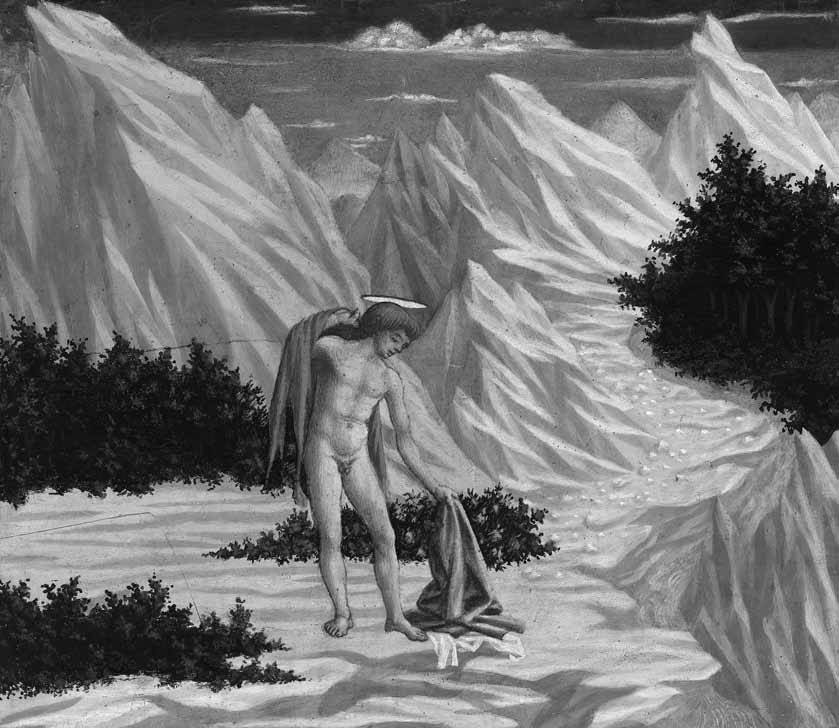
6.2 Domenico Veneziano, St.John in the Desert,c. 1445/1450,The National Gallery of Art, Washington D.C., U.S.A.
The two works are symbolic-allegorical images. They evoke surreal rather than spiritual realities. The Saints resemble mythical and fantastic heroes rather than holy men who actually embody the Christian life.417 The ornamental figures in Ucello's painting seem to inhabit a fairy tale world where legend and chivalry rule, with no hint of sanctity or spiritual life. In St. John in the Desert, the Saint is rendered in the style of a classical nude that suggests his beauty, charm and youthfulness but nothing of the stark asceticism that defined his life. The soft but pointed hills recall sandstone or marble and create an exotic landscape. Part painting, part sculpture, the young man blends with the mountains that surround him in what seems a blissful and charming moment. If there is transfiguration, it happens at the level of the plastic object. Painting sculpts reality and reality takes the form of a painting. The image points to art (to painting's ability to simulate). The identity of the Saint-Hero is secondary. Resembling an illustration of a fairy tale or a painted tapestry, St. George, belongs to a similar universe.
Gilson's approach is consistent with a tendency in Catholicism and in Western religious art since the Renaissance, to equate the phantasmagoric and mythological with the spiritual (e.g., in the often admired painting by Salvador Dali of the Christ of St. John of the Cross, 1951). A phantasmagoric image usually combines realism and allegory (Christian or pagan) in a way that takes advantage of their incongruity. Holy figures and supernatural events are inserted in highly naturalistic landscapes and secular spaces, or in palace rooms, idealized landscapes etc. Saints appear as classical heroes or as their painterly versions. Arts are played against each other. Juxtapositions of this type enhance the painting's imaginary or otherworldly character, as we have seen above.418 The only way that such images can be called «spiritual» is metaphorically or in a rhetorical sense (e.g., a painterly improvisation or pun on desert sainthood). We can see the appeal of such images (and their religious interpretation) to the postmodern imagination.
In the view of Dietrich von Hildebrand, a critic of liturgical changes brought after Vatican II, artistic beauty should be determined on the basis of qualities inherent in the art object. The concept is qualitative rather than transcendental. It belongs exclusively to «the sphere of the visible and audible»; its elements are «proportion, composition, melody, harmony, rhythm.»419 Hildebrand argues correctly that genetic aspects, like the artist's life cannot explain the spiritual significance and overall meaning of the work of art.420 But he does not avoid ordaining the work of art to a higher order of being in relation to which the work becomes an emanation or reflection. Beauty is not a transcendental but it alludes to a transcendent reality. Thus, a work of art is beautiful when “the reality about which it speaks qualitatively, the being whose intrinsic fragrance it is, is a spiritual world towering high above everything corporeal.”421
According to von Hildebrand, Mozart’s sacred music, Raphael’s The Miraculous Draught of Fishes (1515–1516) (Figure 6.3) and Christ’s Charge to Peter (1515–1516) have “the same redeemed, sublime note, the same quality of mysterious holiness, the same quintessentially Catholic spirit.”422

6.3 Raphael(Raffaello Sanzio),The Miraculous Draught of Fishes,1515–1516,Victoria and Albert Museum,London, U.K.
It is difficult to understand what «Catholic spirit» describes in this context. Are we to look for it in the muscular figures of Christ, disciples and fishermen hard at work on their nets, in the naturalistic rendering of the birds, the reflective, glassy surface of water or in the idyllic landscape? Is it expressed in the intensity of human emotion here captured in the dramatic gestures of the Apostles and Christ's calm response? What is distinctly Catholic about form in these paintings? Where exactly are redemption, sublimity and mysterious holiness to be seen? Is it in what we know about the Gospel episodes? Or, in what we imagine is happening in the scenes that stand before us? Is it what we know or what we see?
The visual facts do not corroborate Hildebrand's statement. There is nothing mysterious in the atmosphere of the two paintings; nothing holy in the way that persons, animals and nature are depicted. We can certainly see attention, supplication, submission. We can observe chromatic symbolisms or analogies: the white cloak of Christ and the white sheep that follow him in Christ's Charge to Peter and the absence of that color from the clothes of the disciples. In the Miraculous Draught, Christ is in white and naturally that area of the composition stands out. But where exactly can we see the «redeemed, sublime note?» A group of animated, robust and well-groomed men are very much in this world. In fact, if anything stands out about them, it is their physical presence and that of their plush and colorful clothing. Sublimity too is hard to see. Usually this requires a visible tension in form, one that is conveyed, for example, through high tonality and contrast.
An iconographic standard is clearly implied in Hildebrand's description, but it is not clear what it consists of, at least not in an aesthetic sense. To anyone familiar with European art history, the works cited belong to a Catholic iconographic tradition and are recognizable as such. Familiarity with the events narrated and their theological significance can help make them even more meaningful. But the stories that these paintings condense in a singular incident are delivered in a manner that says more about the epoch in which they were painted than the spiritual realities that permeate them. Similarly, the author's statement conveys more about his sensibility (his love of sacred art and the Catholic tradition) than it does about the works that please it.
Let us turn now to how Orthodox theologians' approach Christian art. A good example is what Ouspensky and Lossky have written about the famous icon of The Savior Acheiropoietos (12th century) (Figure 6.4).423
The grave and impassive expression of this visage of the God-Man has nothing in common with impassiveness of indifference towards the human world that one finds so often expressed in effigies created by the religious art of the Far East. Here, it is the impassivity of an absolutely pure human nature, which excludes sin, but remains open to all the sorrows of the fallen world. The large dilated eyes, turned towards the onlooker, have an attentive and saddened look which seems to penetrate to the depths of consciences, without overwhelming them: Christ is come into the world not to condemn, but to save it (John 3: 17) (emphasis added).424
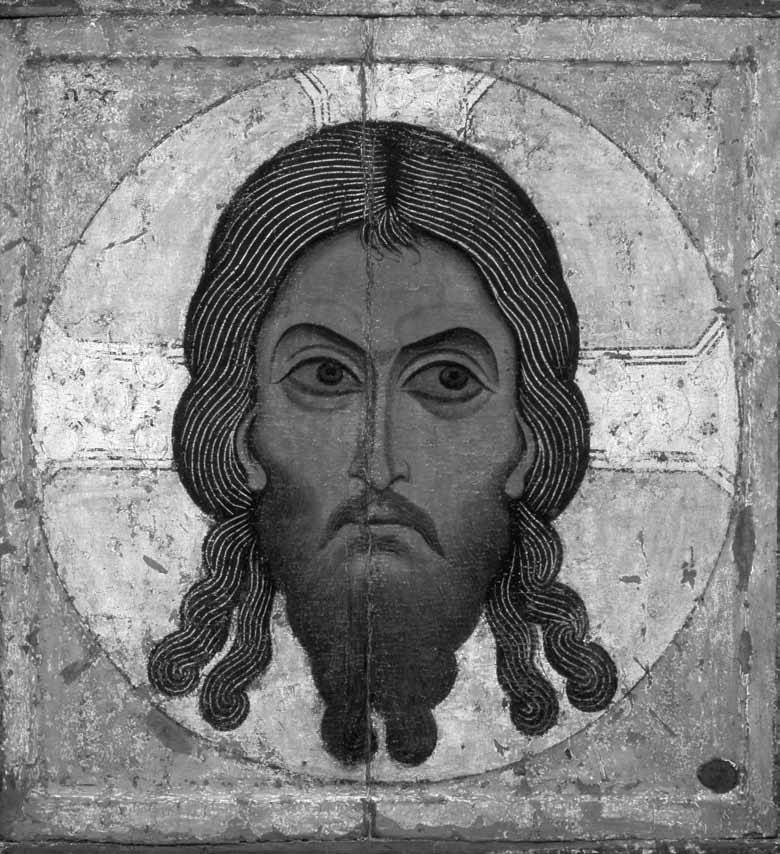
6.4 The Savior Acheiropoietos (Holy Face), 12th century, Tretyakov Gallery, Moscow, Russia
There are a number of problematic assertions in this passage. Take for instance the claim that the icon depicts Christ's sinless human nature and openness to the sorrows of humanity. These qualities certainly belong to Christ by nature but before they are assigned to a picture they must be specified in visual terms. What makes a face look sinless, what kind of features and expression? How is that effect achieved by the aesthetic elements that constitute this particular image? The description does not really match the icon.The man's face can at best be described as solemn and attentive, detached and remote, open and exposed. These qualities result from its flatness, frontal depiction, centered composition, stylized features and suspended head. To call it moral, spiritually pure and compassionate is an extrapolation. An association with the ascetical virtue of dispassion (apatheia) is possible but dispassion as such is not clearly visible in the face, particularly as the authors describe it.425 Christ's gaze is neither penetrating nor sad in the depth and manner suggested. It may be a saving gaze to the viewer who associates it with salvation or who brings this idea to the image. Openness is present but it is a quality of the composition rather than of the face it depicts. Christ's face is actually quite emotionless. Openness to human sorrow, considered as a specific kind of openness consistent with empathy, is nowhere present. This is not an empathic or sad face. The dominant expression of the eyes and face is watchfulness (in Orthodox terminology nepsis that is, spiritual alertness or keeping vigilance with one's heart and mind). This is surely a neptic Christ. We can claim it with some confidence because we can actually see it.426
For Paul Evdokimov, as noted earlier, the Byzantine icon is the exemplary Christian image:
The face of Christ is the human face of God. The Holy Spirit rests on him and reveals to us absolute Beauty, a divine-human Beauty that no art can ever properly and fully make visible. Only the icon can suggest such Beauty by means of the Taboric light.427
The existence of a kind of beauty that is unique to Christ is something the icon captures by its unique luminance. All icons, it seems, are capable of displaying this particular beauty and transcendent illumination. In so far as they embody these qualities, they cannot be classified as art. Like the Transfiguration on which they are modeled, they are instances of revelation.
Perhaps the most puzzling of these claims is that all icons convey the uncreated light manifested in Christ's Transfiguration. We must assume that they do this through the glowing qualities of gold leaf used in the background and halos of holy figures. Gold is a precious mineral with certain distinctive qualities. Like the silver «worn» by many miraculous icons, it reflects light and illuminates the figures it surrounds. This glowing effect, especially when observed in the proximity of lit candles, is indeed a good visual and conventional approximation of the presence of uncreated light in human experience. But to assign this quality to all icons by virtue of their golden background is to aestheticize an element of the image that may or may not be an integral part of its composition and plastic character. In most icons, for example, gold is not an aesthetically active part of the composition but a decorative element.
There are additional difficulties associated with the depiction of the theophanic vision. According to Orthodox theology, uncreated light does not belong to the order of created things. It is not a natural light (e.g., sunlight, candlelight) even though it can be seen under certain circumstances (see Chapters 13 and 14). Not only is a face illuminated by divine light a rare sight, but given the synergical nature of divine Grace, it may not be visible to the viewer who is not pure in heart and mind. An iconographer that strives for holiness and is immersed in the life and sacraments of the Church may see God, but an actual aesthetic translation of this sight is understandably not easy. It is therefore a mistake to assume that all icons succeed in such a difficult task and do so simply by placing their subjects against a golden background.
According to Evdokimov and others, icons are distinguished from works of art by their mystical lives. This extraordinary claim is never tested in an actual icon. The reason, as we have pointed out, is that according to most theological accounts a spiritual life is imparted or bestowed on an icon; it is not constituted in it. The same reasoning is applied to beauty which is in essence the reflection of uncreated light on created things, intensified in the case of the icon by its holy subjects (thus icons are doubly beautiful). This means that a very plain face which is neither radiant nor proportionate nor integrally structured can be beautiful in this transcendent sense. But since it is not by virtue of aesthetic qualities that it gets to be that way, it must come to this condition either by an act of divine intervention or simply by means of the icon's conformity to a canonical style. If the former is true, all icons are somehow miraculous in origin. If the latter is the answer, they are effectively scripted and seen through the structure imposed on them by a set of conventions. Combining the two options defines the icon as a stylized hieratic image on which is bestowed a charismatic (grace-filled) existence.
In his study of the icon, Leonid Ouspensky explains technical aspects of icon painting and identifies their theological basis. Gold is the most suitable medium for depicting divine light in icons, as it is both luminous and opaque.428 The absence of perspective eliminates the viewer's vantage point and the illusion of reality it creates, and arranges objects frontally with their surfaces open to the foreground of the image. Pointing forward and toward the world of the viewer, the icon brings an event or person which occurred or lived in the past forward to the present, where the viewer is situated. In this regard, according to Ouspensky, it assumes a liturgical, Eucharistic modality. Appropriately, the icon must be made of quality materials and be «authentic,» true to its ecclesial vocation.429
Ouspensky wants us to see the icon's luminous background as a screen or veil that conceals the essence of God. Whereas God's energies made visible as light are open to human knowledge (theognosia)–Ouspensky quotes St. Symeon the New Theologian on this point–his essence remains hidden. Thus the icon is suspended between light and darkness:
The radiance of gold symbolizes the divine glory. This is neither allegorism nor an unfounded imagery, but an expression that is quite adequate. Indeed, gold radiates light, but at the same time it is also opaque ... what remains unutterable and inaccessible is the source itself, concealed by an impenetrable light-darkness ... this particular feature of the background-light must be understood as a symbolic transposition of the very principle of apophatic theology–the ultimate impossibility of knowing the divine Essence.430
Icons are here presented as coded objects. They are fully legible to anyone who is familiar with Orthodox theology and its visual language. This esoteric vocabulary includes the physical qualities of luminance and opacity in gold without which an icon fails to signify divinity and holiness. Ouspensky is very clear on this point which links the material components of the icon with its theological signification: «The light is this divine energy; consequently, we can say that it is essential to the content of the icon. Indeed, it is the light that is the basis of its symbolic language.»431 Here the aesthetic object is irrelevant. It is due to this extra-aesthetic significance that the icon is deemed superior to Western religious art.
For Evdokimov, the icon is a locus of divine revelation and grace. For Ouspensky, it is a theological object that is symbolically constituted, an articulate messenger with an extraordinary mission: «to reveal the true relationships between God and man ... to bring a testimony ... of the reality of another way of life, of other norms of existential relationships brought about by the Incarnation and unknown to man enslaved by biological laws.»432 It is crafted with that purpose in mind, to «function as the artistic language of the Church.»433 The art object is transparent to the theologian because it speaks a language that he or she masters.
It should be clear by now that the theological treatment of the art object in both Catholicism and Orthodoxy is problematic. But in one important aspect, the East may have a philosophical advantage: its adherence to the Patristic, hypostatic conception of the human person.434 In the West, following Descartes, the human «subject» or consciousness has emerged as an invisible agent of intentional acts that are in need of externalization. This subject is contained within its own ratiocinated space. From there, as in a palindrome, it reaches out to the world by means of its imagination only to revert to itself driven by its autoscopic impulses. Art is incorporated in this trajectory which, as we have argued, undermines the integrity of the art object and transforms it into a construct of consciousness or, in the best case, of unconscious insights into the unitive relationship between mind and being. Jacques Maritain's aesthetics is a good example of how pervasive this disorientation can be and to his work we turn next.
Jacques Maritain's Dialogue with Modernism
A discussion of Christian iconography and Modernism is incomplete without an examination of the work of Jacques Maritain. Through his revival of Thomism, his significant influence on the Second Vatican Council, and his friendships with Modernist artists, Maritain emerged as the most authoritative Catholic voice to speak in defense of Modernist art.435 At the same time, Maritain, as we have shown elsewhere, was well aware of the problems this encounter entailed.436 He realized that not all Modernist works could be integrated in the spiritual life of the Church and he understood that the dialogue between the Church and contemporary art would not be easy. This is consistent with his overall approach to contemporary culture. When in 1965 he criticized the intrusion of rationalist and humanist ideas in conciliar theology, he earned the unusual distinction of being the philosopher (and aesthetician) of both progressive and conservative Catholicism.437 No other philosopher, Catholic or Orthodox, has engaged artistic and cultural Modernism in the way that Maritain did.
Thus this chapter is as much an acknowledgment of his significant contribution to the study of the subject as it is an attempt to show where it went wrong. Maritain, in my view, paid too little attention to the expressive integrity of the art object and allowed his aesthetics to be overdetermined by the creative aspects of art. Thus, his aesthetics is essentially a spiritual epistemology of the creative subject which strives for redemption and transcendence through externalizing its intuitions.438 Consciousness becomes creative as the artist struggles psychologically, in interior movements, to find personal integration (salvation) in unitive forms. There is an eschatological dimension to this process but it operates analogically as the artist, through this struggle, gets to know divine suffering and love.
Maritain interests us for three reasons, two of which relate directly to the intentional and affective fallacies. The first is his application of the Thomistic concept of connaturality to the creative process and the impact it has on construing the art object as an extension of unconscious intentional processes that incorporate portions of the world through the artist's emotional and spiritual involvement. This, as Maritain clearly acknowledges, creates an amalgam of subjective and objective realities which «calls forth in the manner of a sign.»439 The second is his attempt to justify Modernist art on that basis rather than on the actual qualities of the aesthetic object at hand. Instead of extending the concept of connaturality–and especially the notion that in it the subject is fitted to the world and the world to subject–to the art object as an independent entity, Maritain allows it to remain attached to its creator. This attachment undermines its expressive integrity. Finally, Maritain's ideas are especially relevant and instructive to contemporary theological debate in Greece about the future of the Byzantine icon.
I would like to start with the last point first, as it helps us appreciate the continuing relevance of Maritain's thought to the Christian engagement with contemporary art and culture. Here we can see a divergence and convergence of views between this thought and that of Greek scholars. The former concerns Maritain's commitment to Thomism as the perennial philosophy of Roman Catholicism. The latter concerns his significational view of the art object and the notion that its spiritual significance rests on this function.
While insisting on the icon's theological exceptionality and eschatological character, Greek theologians criticize its failure to express the religious experience and sensibility of the artist in a contemporary context. Maritain's problematic was similar but it had the advantage of using the rigorous philosophical method of Thomism and the benefit of his critical dialogue with Bergsonian philosophy.440 By contrast, Greek theologians show little interest in the view of Orthodox tradition presented by Lossky and others441. Categories like «originality» and «authenticity» which in Orthodoxy, as we have seen, belong to realities (and objects) that reach deep within the mystical ground of tradition, are now sought in cultural norms and forces in which artists are supposed to find the new forms that will rekindle their creativity. According to Stamatis Skleres, for example, the icon is anachronistic and symptomatic of a «false Orthodoxy.»442 Skleres wants to replace «stereotypy» with «authenticity» in a move that is reminiscent of the Russian avant-gardes.443 As he puts it, it is «civilization» rather than tradition that can give rise to new visual languages. The product of a now defunct civilization, the «Byzantine» style has lost its existential significance and truth.444 The result is the absence of original compositions in iconography and the rehashing («collage») of gestures, expressions, anatomical features etc. taken from older icons.445
For Skleres, innovation and originality are the outcomes of shifting paradigms which redefine artistic styles and give artists new opportunities for self-expression: «When authenticity comes, it will write a civilization even without the Byzantine script. Freedom cannot be contained to a singular visual language, because freedom means to write in a new alphabet and a new artistic vocabulary.»446 Like a metaphysical Absolute, Christ's theanthropy is «the ultimate originality» and the standard for all art. If the icon is to remain Orthodoxy's premier image, it cannot be predictable but «should always present us with a surprise.»447 Thus the aesthetic character of the icon is determined by the unique qualities of its archetypal subject. The icon must be original in its aesthetic form, to resemble Christ who was original in his divine humanity. Icons that remains confined within one style fail their exemplary subject, Christ. Since the only imperative imposed by Christ's Incarnation is originality, the iconographer is free to look for new styles in contemporary culture.
Here the Incarnation is the act of divine genius that created Christ, the ideal (and inimitable) work of art. Just as Christ is the prototype of Christian art by virtue of the act of genius that created him, so must the icon set its own rules by virtue of the genius of its iconographer. Thus the icon becomes the avant-garde image par excellence: it belongs to its times but also stands apart as a question mark or challenge to see the world and art differently. The Christian identity of a work of art lies in this critical relationship to cultural and aesthetic norms rather than in its aesthetic qualities. Its meaning is determined on the basis of the subjective and intersubjective realities that determine its creation with an emphasis on the latter. By contrast, Maritain's turn to Thomism was an attempt to frame the dialogue with contemporary art and culture solidly in the Catholic philosophical tradition.
The views of Georgios Kordes emphasize the theological significance of aesthetic form in the icon. Kordes stresses its ecclesiastical and liturgical character, particularly its «sociocentric» role in perpetuating communion among the faithful.448 In contrast to the sense of urgency that we get from Skleres and others, Kordes believes that «ecclesiastic art» is inherently capable of generating new forms.449 How exactly this process will take place and what will define it is not clear. For Kordes, the icon's distinctive composition eliminates natural space and brings objects (in reverse perspective) out of their plane and into the viewer's physical and cognitive space.450 This quality is applied uniformly to all icons and tied to their symbolic meaning. In this way, aesthetic qualities become theological metaphors. Visual rhythm, for example, is «that element, movement or breath, which can reconcile everything that appears within plastic form, and in so doing brings unity to the broken face of this world, creating an image filled with the elements of the coming Kingdom of Heaven.»451 The unqualified transition from aesthetic to theological meaning serves to remind us that the icon is a functional object. It is also a background against which eschatological concepts like redemption, restoration etc. can be outlined and contemplated.
By a combination of form and content and with the help of theological concepts, the icon becomes a theological signifier. It is also representational to the extent that it shows the world as we know it. Where relevant, abstraction is part of the theological idiom that ensures the icon's ecclesiastical conformity. This call for integral and recognizable content in the work of art, we also find in Maritain. In an attempt to accommodate abstract painting, Maritain opts for a moderate view of abstraction very different from that of Ouspensky who calls abstraction (of any kind) «alien» to Orthodoxy and dismisses modern art for its «chaotic innovations» and modern culture for its «incoherent novelties.»452 Non-representational painting, Maritain argues, cannot convey «the mystery of integral reality» that the artist senses through her «poetic intuition.»453 Abstraction that lacks the fundamental structure of experience and world «renounces seeing into the inner depths of the world of Nature, of visible and corporeal Being,» and deprives art of its «poetry» and «beauty,» the qualities that best «express the originality of the creative self.»454 Abstract paintings of this kind therefore «lack personality to such an extent that they can scarcely be distinguished from one another.»455
The problem here is not the emphasis on figuration, but rather the definition of the work of art from the standpoint of the subjective processes that precede it. The recognition of artistic meaning is therefore experienced as a form of fittedness between world, image and subject in which the subject retains the principal role. Granted that this union of the three is essential to the creative process, once the work of art is finished, it projects its own identity. In other words, the representational trajectory ends where the work of art assumes an independent existence, where it emerges as a hypostatic being. Without this transition (and as long as it is not recognized), the work of art will remain a function of subjective and intersubjective agencies and powers. Inevitably then, one who approaches art in this manner will be drawn more to what artists say or write about their work than to what the works themselves communicate.
Maritain's assessment of Modernism is largely based on what Modernists wrote about their art and what they tried to express or achieve through it. Thus, when he discusses individual works, it is through the prism of the artists' statements, never on the basis of what the works show. Art object and idea are interchangeable and criticism of the ideas and intentions of the artist often replaces the direct study and criticism of his work. In the case of Malevich, for example, Maritain is critical of what the artist wrote about Suprematism and the role of feeling in art.456 He describes Marcel Duchamp's paintings as «an attempt at integral transmutation» and tries to explain their underlying cognitive principles with no reference to specific works.457
Neither lucid nor precise in these and other examples, his writing favors the uniformity of the concept rather than the distinctiveness of the aesthetic object. Works are swept under categories, as if the objective is a conceptual history of art. Cubism «set out to transpose natural appearances by decomposing and reshaping them in reference to the free expansion of forms and volumes»; Futurism «attempted a similar transposition in reference to the lively shiftings and mutual interpenetration of visual impressions produced by motion.»458 It is ironic that this disregard for the art object comes from a critic of abstraction.
Maritain delighted in art as we know from his numerous works on the subject, his friendships with prominent avant-garde artists, and from accounts of friends and intimates.459 Starting with his seminal work on Thomistic aesthetics, Art and Scholasticism (1920/1962), Maritain tried to explain (and justify) avant-garde art in Thomistic terms and show that all great art is Christian in nature. He argued that art is the result of profound spiritual and existential crises and as such has a central role to play in human redemption. Redemptive creativity is the work of the divine subject. The artist works in the image of God to redeem self and world.460 From the perspective of the creative self engaged in a struggle for meaning and unity, the boundaries between Christian and secular art are artificial.
The concept that Maritain used in order to explore the nature of the creative process is «poetic intuition.» It is based on connaturality, a form of knowledge made possible by the fusion of cognitive and artistic form in the unconscious.461 Connaturality has ethical, mystical and aesthetic qualities. In art, it is essentially a mysticism of (self) expression. Whereas the artist speaks through the work, the mystic speaks to herself, in silence (in «internal fruition»).462 Maritain defines the concept this way (with reference to virtue): «In this union through knowledge or inclination, connaturality or congeniality, the intellect is at play not alone, but together with affective inclinations and the dispositions of the will, and is guided and directed by them.»463 He then specifies its artistic form as follows: «Poetic knowledge is non-conceptual and non-rational knowledge; it is born in the pre-conscious life of the intellect, and it is essentially an obscure revelation both of the subjectivity of the poet and of some flash of reality coming together out of sleep in one single awakening.»464
Being «knowledge in act,» connaturality brings aspects of reality and self together in a single transcendental intuition mediated by emotion.465 The application of this Thomistic concept in one of the most obscure areas of artistic activity is masterful. But Maritain, as we have pointed out, makes one crucial mistake. He does not allow the work of art to take full possession of itself, to become a separate being that internalizes (and even suffers) its own form.466 As we observed earlier, it is the epistemology of art that concerns him most, not its ontology.
It may be objected that the absence of a programmatic act of consciousness in the originative, connatural moment has the opposite effect; that the artist, in other words, actually discovers the work before she discovers her self or discovers herself through the work. It is easy to see that this is not the case. Rather than eliminate the intentions of the agent, the esoteric nature of the act ensures that they will never be fully understood or deciphered and will therefore follow the work at all times. If the art object is genetically a mystery, its experience cannot be complete or be contained within its boundaries. A subject is always hiding inside and its elusive presence points somewhere outside the work, to an order of meaning that it cannot master. As with Plato's inferior images, the painting carries a trace of an archetype whose full form it can never capture. Only now this is subjectively posited. It occupies an ideal place deep inside the artist's experience, being at once a remote and intimate reality. Here the work cannot be its own person but belongs inadvertently to the temporality of its maker. What is trans-temporal about it must be sought in the horizon of this creative impulse that belongs, Maritain claims, to all human beings irrespective of religion and culture.
Maritain may have never intended this outcome which follows directly from the determination of connaturality as an epistemic act that affects the subject and through it the work. By contrast, it is possible, as we have shown in the case of photography, for connaturality to characterize the work of art, to belong, in other words, to its inherent and independent (from the subject) existence.467 Thus, even though the presence of certain ineffable subjective elements in artistic form is undeniable, we can see them as inextricably tied to its aesthetic qualities and dynamics. The greater their depth and complexity, the more the work resonates with its own peculiar personhood. In this objective (aesthetic) connaturality, habits of the mind and habits of the world fuse and become a new reality, a new being. The elements involved in these formative moments are therefore intelligible within the context supplied by the art object; in fact, they are the art object. This identity is an aesthetic-intentional reality. Despite its genetic connection to a subject and its interior life, the work eventually enters an objective existence and communicates the world it embodies rather than the world that made it possible. It is in this position and to the extent that it exists by positing its own reality, in a present rather than a past or future tense, that it resists the structures of historicity (the Hegelian reduction). The recollecting subject cannot reclaim it, no matter what authority it invokes.
For Maritain, the work of art arises out of the expressive struggle of a subject whose intuitions overflow with transcendental significance. This esoteric contact with the world is mediated and sustained by divine love. Creation is an act and expression of this love for the world and the self. The projection of divine love continues in the art object. The formative intuitions that define the creative process can be «fully expressed only in the work,» but once there, they continue their interior life.468 The only difference is that they now exist as signs. The work's «spiritual depth» is not an aesthetic reality but a semantic one. Characterized by «an infinite openness to the richness of being,» informed «with infinite horizons» and overflowing with meanings, the art object exists in a state of expressive rupture.469
With these ideas, Maritain is opening the work of art to unqualified polysemy and relativism. Expressively explosive, the art object is unconfined by form, incapable of containing its own sense and resting in its own reality. Open-ended in signification, burdened with unspecified meanings and imbued with mystifying powers, it risks collapsing under the weight of a significance that it does not really possess. Thus we read:
... it (the work) is a sign–both a direct sign of the secrets perceived in things, of some irrecusable truth of nature or adventure caught in the great universe, and a reversed sign of the subjective universe of the poet, of his substantial Self obscurely revealed. Just as things grasped by poetic intuition abound in significance, just as being swarms with signs, so the work also will swarm with meaning and will say more than it is, and will deliver to the mind at one stroke, the universe in a human countenance.470
There is little in this ekphrastic passage that is of actual aesthetic relevance; that we can demonstrate, in other words, aesthetically, right in the art object itself. Idealized in a way that makes it difficult for one to grasp, the work of art is an arcane object with supernatural powers, a place where world and self are ever intimated but never found, and where the cosmic mystery of life remains ciphered. It is everything else but itself. As we have seen in so many examples (from Goncharova to Florensky, to Evdokimov and Gilson), theological and metaphysical claims of this magnitude are never grounded in a work's aesthetic reality. Even though they are associated with the art object, they are never part of its aesthetic being.
Nothing in this passage helps us distinguish the Christian image from its Buddhist or Hindu equivalent. All works of art, for example, to the extent that they are made by a thinking being and are in one form or another about something, can show «the universe in a human countenance.» And something of «the subjective universe of the poet,» is reflected in every work of art. However, what matters from an aesthetic point of view is not the fact that the art object suggests humanity and subjectivity. It is, rather, a question of modality, of how this object (which is so rich, according to Maritain) goes about communicating these meanings aesthetically and in a Christian way.
This lack of attention to the aesthetic object and its particularity is typical of Maritain's approach. When he writes that «after the 'liberation' accomplished in modern times» painting will attain «to a kind of metaphysical vastness,» one wonders how a work can actually accomplish this feat and whether this is an endorsement of non-representational art or of the kind of art that denies (or questions) its own conditions of existence as a plastic object (i.e., the premise of Postmodernism).471
But the most problematic aspect of Maritain's aesthetics is his intentional definition of aesthetic meaning: «the first condition necessary for such judgment is a kind of prior consent to the artist's general intentions and to the creative perspective in which he has placed himself (emphasis added)."472 In another passage he writes:
art will be Christian, and will reveal in its beauty the interior reflection of the radiance of grace, only if it overflows from a heart suffused by grace ... the quality of the work is here the reflection of the love from which it issues, and which moves the virtue of art instrumentally (emphasis added).473
The role of the subject becomes even more central and radical here:
They [modern artists] have understood – and sometimes at a terrible cost–that the first duty of the artist and the poet is to be unshakably faithful to their own truth, to the individual and incommunicable truth about themselves and about things, which is obscurely revealed to them and which must take shape in their work (emphasis added).474
So many of the errors already identified are present in these examples: the intentional fallacy, the supernatural determination of art (here mediated by love), and the Romantic view that gives the artist a nearly solipsistic and messianic role in the advance of art and civilization–a notion that Modernists found so attractive. This explains why Maritain was repeatedly drawn to avant-gardes who became converts to Catholicism and how he came to see in their work proof of the validity of his argument. The idea of the artist as an alter Christus–a role that his friend Jean Cocteau consciously embraced–is the prism through which he saw not only the artist but also his art.Maritain's aesthetics helps us appreciate better the philosophical roots of the ambiguities that characterize the views expressed in conciliar documents about art and in the writings of Rome's most distinguished theologians.475
Maritain’s aesthetics helps us appreciate better the philosophical roots of the ambiguities that characterize the views expressed in conciliar documents about art and in the writings of Rome’s most distinguished theologians. 476The solution he offers to the Catholic encounter with contemporary culture remains intriguing but also risky since it lacks the discrimination needed to counteract the contemporary tendency to see distinct religious and artistic traditions as variations on a common idea or set of principles. This is evident when he proposes the Thomistic view of the work of art as the universal paradigm for art: «Wherever art–Egyptian, Greek or Chinese–has known a certain degree of grandeur and purity, it is already Christian, Christian in hope, because every spiritual radiance is a promise and a symbol of the divine harmonies of the Gospel.»477 This parallels his notion that mystical experience is universal and that intuitions of Christ are possible in many religions.478 Christ is present in the suffering of a Muslim mystic or in the experience of radical love between human beings. Similarly, any work of art that conveys transcendent realities is Christian.
It is difficult to believe that all it takes for an Egyptian statue from the middle of the third millennium or a thirteenth-century Chinese scroll-painting to be integrated in the universe of Christian art is radiant form.479 From Maritain's perspective, where form shines, Christ is present. Where Christ is present, form shines. But what exactly does this «spiritual radiance» consist of and how can a Ch'an painting suggest the truths of the Gospel or the view of a world created by a personal God that is absent in Buddhism?
The exemplary Christian image and the Buddhist image that stands as an aesthetic moment of enlightenment do have, as we have seen, certain qualities in common (more in Chapter 15). But they do not have them in the same modality. Even if we were to think of family resemblance in this case, differences are essential since that is how resemblance is established. From the vantage point of his subjectivist aesthetics, Maritain understandably wants unconditional unity and the spiritual and aesthetic supremacy of the Christian (Catholic) image. This recalls the aspirations of Evdokimov and Ouspensky about the Byzantine icon and echoes Modernist dreams about a universally spiritual art. But it fails for the same reason. It does not allow the art object to make the claim directly. Such confidence art deserves.
There is, finally, a tacit Hegelianism in Maritain that becomes obvious when he defines Oriental art by its interest in nature (a characteristic also of Greek art which he puts in the same category) and Occidental art by its interest in the self.480 No matter how appealing in its power to integrate, this kind of conceptual history does not measure up to the reality of the individual work. And it also creates systemic inconsistencies. Thus the distinction drawn here is at odds with his core thesis that self and reality exist connaturally in the poetic intuition. Similarly when he argues that «[Chinese art] remains, nevertheless, dominated by the supremacy of Things over the human Self which characterizes Oriental art in general,» it is unclear how this view can be reconciled with the notion that all art is ultimately subsumed under Christ, the universal and absolute subject.481 If this is the crucial truth of all art, then it matters little whether a work belongs to the Oriental or Occidental type. And the distinctions themselves become largely rhetorical. What does it mean, for instance, in concrete aesthetic terms to say, as Maritain does, that the Byzantine icon is «so close, in one sense, to Oriental art, though freer from Things–with its glorious and royal, not suffering Christs?»482
These rather superficial observations are consistent with the positing of a transcendental subjectivity on the other side of the work of art. Whether it is Christ, the model of the suffering artist, or the Romantic self that converts beings into signs of its own ineffable existence, the aesthetic object is never what it appears to be. It is part of a great anthropological drama, a sign of human greatness and grandeur, and a mirror to our spiritual adventures. Works of art «make present to us the spirit of those unknown men who drew them, they tell us that their makers were men, they reveal a creative Self endowed with immortal intelligence, pursuing deliberately willed ends, and capable of sensing beauty (emphasis added).»483
Maritain's idea that in order to integrate avant-garde art in Christianity we must situate behind the art object a Christian subject that consciously or unconsciously strives to express the inexpressible, was in part a Thomist's solution. Aquinas' definition of beauty as an intellective experience where mind and object match and their union pleases (id quod visum placet) implies, on the creative side, a genealogy of unitive moments between consciousness and world that is mediated by divine love. This is the path that Maritain followed. If the work of art is experienced mentally, as the realization of concepts in sensuous form, its inception must follow a similar trajectory. But here, because the concept is sensuous and the mind deals directly with sensibles, ideas are experienced intuitively–similar to the aesthetical ideas of Kant. Otherwise they cannot be aesthetic or make art. Since what is intuited is inexpressible, this failure of the concept–its regression into form and feeling–in the presence of the sensible becomes a mystical act that allows the intellect direct, non-discursive perception.484 It is this connatural, Incarnational, moment that is the foundation of art's spiritual nature and the basis of Maritain's claim that all art is spiritual and Christian.
Thus, the artist suffers her intuition until she incarnates it mentally, an act not possible without divine grace and love. There is a parallel between what the artist knows and what the mystic experiences, as Maritain explains in his essay on connaturality: «For the spiritual man ... knows divine things through inclination or connaturality; not only because he has learned them, but, as the Pseudo-Dionysius put it, because he suffers them.»485 It is because the mystic loves that he comes to know things directly, «obscurely uniting the intellect with the thing known.»486 The same happens to Maritain's artist-mystic. Once love enters the process, what is a mere conceptual failure becomes a perpetual redemption and fruition of the intellective act in countless signs that «swarm» the work of art with meaning.
For Maritain, love is the catalyst. When it is «received in the preconscious life of the intellect, [it] becomes intentional and intuitive, and causes the intellect obscurely to grasp some existential reality as one with the Self it has moved, and by the same stroke all that which this reality, emotionally grasped, calls forth in the manner of a sign.»487 Feelings attune the intellect to the world. The traces (signs) of this primal form of knowledge create art in the artist and rupture in the mystic. But the swarming meanings of the work of art are very different from the mystic's silent locutions. The art object never really possesses them as the mystic possesses his. Instead, it is reconfigured every time the question of its meaning arises or its origins are sought in some intentional act or affective state.
Thus, in Maritain the freedom of the work of art lies in its fluid identity and openness to perpetual redefinition, and reflects its cognitional origins rather than its aesthetic existence. Its mystery is not that of a sui generis being but of a puzzle. By contrast, the enargeic image combines in its own act of (aesthetic) existence the expressive, creative qualities that Maritain attributes to art with the interior unity that he assigns to the spiritual life. The combination of expressivity and unity is consistent with the emphasis placed in Orthodox theology on an existential, ascetical spirituality that is not defined by intense intellective and affective movements and interior ruptures. The Orthodox visio dei is experienced as an ontological transformation and perfection of one's being. This perfection belongs to things (and to the hesychast) by virtue of an act of charismatic existence in which they fully partake without shedding their finite natures. Art is no exception.
* * *
Примечания
(Jean-Francois Lyotard, The Postmodern Condition: A Report on Knowledge, trans. Geoff Bennington and Brian Massumi (Minneapolis, 1989), pp. 77–79, 81–82.)
(The imagination cannot find a physical, sensible analog for its concepts. Ibid., pp. 79, 78, 77. See also Jean-Francois Lyotard, «The Sublime and the Avant-Garde,» in Andrew Benjamin (ed.), The Lyotard Reader (Oxford, 1993), pp. 196–211.)
(Lyotard, The Postmodern, p. 78.)
(Ibid., p. 81.)
(Lyotard, «The Sublime and the Avant-Garde,» p. 207.)
(The reference is to Edmund Burke's 1757 treatise Philosophical Inquiry into the Origin of Our Ideas of the Sublime and Beautiful. Ibid., p. 204.)
(Ibid., p. 206.)
(Ibid., p. 208.)
(Lyotard, «The Postmodern,» pp. 81–82.)
(Ibid.)
(Herschel B. Chipp, Theories of Modern Art (Berkeley, 1968), p. 341.)
(Ibid., p. 343.)
(Ibid., p. 341.)
(Ibid., p. 343. See also Nicoletta Misler and John E. Bowlt, «The 'New Barbarians',» in Deborah Horowitz (ed.), Origins of the Russian Avant-Garde (New York, 2003), pp. 26–45.)
(Ibid.)
(Troels Andersen (ed.), K.S. Malevich, Essays on Art 1915–1933, trans. Xenia Glowacki- Prus and Arnold McMillin (2 vols, London, 1968), vol. 2, pp. 22–27. See Malevich's essays «An Analysis of New and Imitative Art (Paul Cezanne)» and «New Art and Imitative Art (Picasso, Braque)» where works by these artists are examined; vol. 2, pp. 19–29, 31–55.)
(«God is rest; rest is perfection; everything has been achieved; the building of worlds is completed and movement is established in eternity.» See Andersen, vol. 1, pp. 214–215, 124.)
(Willem de Kooning, speaking in the same forum: «They have a particular something that makes them look like a 'finished' painting. They have a touch which I am glad not to have.» Chipp, pp. 564–565.)
(Ibid., 569.)
(See Plutarch, De gloria Atheniensium, 3, cited in H.S. Thayer. Thayer links the two words, zographian and lalousa, on the basis of the liveliness implied in both. Simonides is reputed to have invented mnemonics, a technique of associating specific images and locations with words and verbal descriptions. Socrates also demonstrates an elaborate description (eikon) of the soul composed in words (logos). H.S. Thayer, «Plato's Quarrel with Poetry: Simonides,» Journal of the History of Ideas, 36/1 (Jan.-Mar. 1975): pp. 3–26. For an exploration of the visual and performative (elenctic) qualities of archaic verse see C.A. Tsakiridou, «Her
Voiceless Voice: Reviewing Sappho's Poetics,» Angelaki: Journal of the Theoretical Humanities, 8/3 (December 2003): pp. 95–107.)
(Jesper Svenbro, Phrasikleia: An Anthropology of Reading in Ancient Greece, trans. Janet Lloyd (Ithaca, 1993), pp. 8–63.)
(Annemarie Weyl Carr, «Icons and the Object of Pilgrimage in Middle Byzantine Constantinople,» Dumbarton Oaks Papers, 56 (2002): pp. 75–92.)
(Leonid Ouspensky, Theology of the Icon (2 vols, Crestwood, 1992), vol. 1, pp. 441–461, 436, 450.)
(Spira, p. 130.)
(The influence of Byzantine iconography on Italian and Northern European painting in the post-Crusade period and all through the seventeenth century is discussed in Maryan W. Ainsworth, «'A la fagon grecque': The Encounter of Northern Renaissance Artists with Byzantine Icons,» in Evans, pp. 545–593.)
(Henry Maguire, “Truth and Convention in Byzantine Descriptions of Works of Art,” Dumbarton Oaks Papers, 28 (1974): pp. 111–140. Kenneth D. Lindsay and Peter Vergo (eds.), Wassily Kandinsky: Complete Writings on Art (1901–1921) (2 vols, Boston, 1982), vol. 1, p. 217. Gabi La Cava, “The Expressionist Animal Painter Franz Marc,” CSA Discovery Guides (April 2004), pp. 5–6, http://www.csa.com/discoveryguides/discoveryguidesmain.php.)
(Gino Moretto, The Shroud: A Guide, trans. Alan Neame (New York, 1999), p. 11.)
(K. Kalokyris, H Zographike tes Orthodoxias (The Painting of Orthodoxy) (Thessaloniki, 1972), pp. 132–134. Eleuterio Fortino, “The Role and Importance of Icons: A Roman Catholic Perspective,” in Gennadios Limouris (ed.), Icons, Windows on Eternity: Theology and Spirituality in Colour (Geneva, 1990).)
(The pseudo-mysticism of Nolde and especially Kandinsky in his essay «On the Spiritual in Art,» are good examples. Chipp, pp. 146–147. Lindsay and Vergo, vol. 1, pp. 120–219. Mark C. Taylor, Disfiguring: Art, Architecture, Religion (Chicago, 1992), pp. 50–95.)
(Jurgen Habermas, «Modernity versus Postmodernity,» New German Critique, 22 (Winter 1981): pp. 3–17. This essay was originally delivered when Habermas was awarded the Theodor W. Adorno prize in Frankfurt (September 1980).)
(Ibid., p. 4.)
(Ibid.)
(Ibid., p. 5. See also David Crowley, «National Modernisms,» in Christopher Wilk
(ed.), Modernism: Designing a New World 1914–1939 (London, 2006), pp. 340–373.)
(Habermas, «Modernity versus Postmodernity,» p. 4. Peter Burger's response to Habermas, «The Significance of the Avant-Garde for Contemporary Aesthetics: A Reply to Jurgen Habermas,» New German Critique, 22 (1981): pp. 19–22.)
(E.g., in a lubok titled «The Pure Soul.» On lubok composition, Boguslawski notes: «From icon painting the lubok inherited the tradition of making the most important figures disproportionately large in relation to the others, using no aerial or mathematical perspective but rather a perspective based on multiple points of view, and called, for the lack of a better word, inverted or reversed.» Examples of lubki in Alexander Boguslawski, 1999, http://tars.rollins.edu/Foreign_Lang/Russian/Lubok/lubok.html.)
(Rationalizing the production of art relates Modernism to the Enlightenment. Habermas, «Modernity versus Post-Modernity.» Burger, «The Significance of the Avant-Garde for Contemporary Aesthetics.»)
(Quoted in Deborah Horowitz (ed.), Origins of the Russian Avant-Garde (New York, 2003), p. 21, and in Yevgenia Petrova, «Malevich's Suprematism and Religion,» in Matthew Drutt (ed.), Kazimir Malevich: Suprematism (New York, 2003), pp. 89–95.)
(Horowitz, pp. 21–22. See also Spira, p. 67 for Malevich's impressions of lubki: «I discovered in them the whole spiritual side of the 'Peasant Age'.»)
(Andersen, pp. 204–205.)
(In 1930 Malevich was accused of bourgeois tendencies and practicing «formalism» in the official press and imprisoned by the OGPU (United State Political Agency). See Horowitz, p. 21.)
(The painting is shown in Spira, pp. 53–54, #19.)
(Two different versions of the painting exist from the same period in the collection of the Russian Museum, St. Petersburg, Russia. The image is reproduced in Horowitz, p. 193.)
(Petrova, «Malevich's Suprematism and Religion,» pp. 89–95. Nina Gurianova, «The Supremus 'Laboratory-House:' Reconstructing the Journal,» in Drutt, pp. 45–59. Christina Lodder, «Searching for Utopia,» in Wilk, pp. 23–69.)
(Petrova, «Malevich's Suprematism and Religion».)
(Andersen, p. 80.)
(Ibid., p. 91.)
(On Malevich's use of the symbols and composition of Orthodox iconography to convey personal experiences e.g., in Head of a Peasant (1928–1929), see the brief commentary by Nizamutdinova and a more extensive discussion by Misler and Bowlt, «The 'New Barbarians',» in Horowitz, pp. 26–45.)
(Spira, p. 163.)
(Andersen, p. 170.)
(Drutt, pp. 190–193.)
(Horowitz, p. 33.)
(Ibid., pp. 134–135.)
(Ibid., pp. 138–139. The painting was part of a series of studies on sailors based on Tatlin's 1909–1911 trips to Greece, Turkey and Libya. See also Camilla Gray, The Russian Experiment in Art 1863–1922 (London, 1962), p. 135.)
(Spira, pp. 72–73.)
(Ibid., p. 74.)
(Horowitz, pp. 206–211, 214–215.)
(Goncharova later settled in Paris where she died a French citizen in 1962. John E. Bowlt (ed.), Russian Art of the Avant-Garde: 1902–1934 (New York, 1976), pp. 55–56. Spira,pp. 49–50, 131.)
(Gray, pp. 137–138. See also Spira, p. 61 for Larionov's interest in the writings of theosopher Pyotr Ouspensky (1878–1947) (e.g., The Fourth Dimension, Tertium Organum). Goncharova and Larionov were drawn to his ideas.)
(Spira, pp. 58–60.)
(Ibid., pp. 56–58. See also Misler and Bowlt, “The New Barbarians.” Luboks are comparable to Mexican retablos.)
(Of Matisse's fascination with Byzantine art Spira writes: «The example of Byzantine colourism inspired Matisse throughout his life; photographs of Hagia Sophia adorned the walls of his home in Nice until he died.» Spira, p. 55.)
(The work was confiscated twice and considered blasphemous by censors. Horowitz, pp. 88–89, 32. Spira, pp. 138–139.)
(Spira, p. 132.)
(Ibid., p. 78.)
(Ibid.)
(Yevgenia Petrova, «The Origins of Early Twentieth-Century Russian Art,» in Horowitz, pp. 9–24. Misler and Bowlt, «The New Barbarians.»)
(In Florensky, «Sophia» is «metaphysical dust,» «divine light,» the «paradisiacal aspect of being,» the «infernal darkness,» etc. Ouspensky, whose fusion of anthropology, myth, scientism and the occult resembles Florensky's–and Kandinsky's–was opposed to avant-garde art. Misler, Pavel Florensky, pp. 121–122, 59, 61.)
(Ibid., pp. 115–117. For a comparison of Florensky's and Kandinsky's views of icons,
see Victor Bychkov, The Aesthetic Face of Being: Art in the Theology of Pavel Florensky, trans. R. Pevear and L. Volokhonsky (Crestwood, 1993), pp. 61–62.)
(Misler, Pavel Florensky, pp. 46–53.)
(Pavel Florensky, Iconostasis, trans. Donald Sheehan and Olga Andrejev (Crestwood, 1996), p.118.)
(Ibid., pp. 119–122.)
(Ibid., p. 143.)
(Ibid. pp. 54–55.)
(Bowlt, p. 49.)
(Ibid., pp. 45, 48.)
(Elena Basner, «The Creators of Neo-Primitivism in Their Own Words,» in Horowitz, pp. 47–55.)
(Yevgeny Kovtun, Russian Avant-Garde: The Uncompleted Chapters, ed. Yevgenia Petrova (Moscow, 1999), p. 28.)
(Ibid., pp. 32–33.)
(Spira, pp. 133–135. Composer Igor Stravinsky refused to write the score for the ballet on the grounds that it presented Orthodox liturgy as «art.»)
(Ibid., pp. 135.)
(This work is reproduced in ibid., p. 134.)
(Ibid., pp. 142–144.)
(Ibid.)
(Ibid., pp. 148–149.)
(Ibid., pp. 59–60.)
(Ibid., pp. 95–98.)
(Ibid., pp. 84–85.)
(Misler, Pavel Florensky, pp. 106–107.)
(Benjamin Harshav, «Jewish Art and Jesus Christ,» in Jacob Baal-Teshuva (ed.), Chagall: A Retrospective (New York, 1995), pp. 299–302.)
(Misler, Pavel Florensky, pp. 128–129.)
(The Guggenheim Museum, Marc Chagall and the Jewish Theatre (Exhibition Catalogue) (New York, 1992), Plate #7, pp. 149–150.)
(James Johnson Sweeney, “An Interview with Marc Chagall,” in Baal-Teshuva, Chagall, pp. 276–279.)
(Ibid.)
(Ibid.)
(Teriade was the pseudonym of the Greek critic and art collector Efstratios Eleftheriades, publisher of Chagall's illustrations of the Bible. E. Teriade, «Chagall and Romantic Painting,» in Baal-Teshuva, Chagall, pp. 136–145.)
(Ibid.)
(Aleksandr Kamensky, «A Conversation with Chagall,» in Baal-Teshuva, Chagall, pp. 321–325.)
(Virginia Haggard, «Homage to Chagall,» in Baal-Teshuva, Chagall, pp. 256–268.)
(For Modernism in Catholic theology, its official condemnation in 1907, and the debate that ensued between its adherents and critics see Michael Kerlin, “Reginald Garrigou-Legrange: Defending the Faith from Pascendi dominici gregis to Humani Generis,” U.S. Catholic Historian, 25/1 (2007), pp. 97–113. See also Constantine Cavarnos, Orthodox Tradition and Modernism (Monographic Supplement Series, V), trans. Patrick G. Barker (Etna, 1992).)
(Jacques Maritain, «Chagall's World,» in Baal-Teshuva, Chagall, pp. 147–149.)
(The etchings are currently in the collection of the Museum of Contemporary Religious Art, at Saint Louis University, Saint Louis, Missouri.)
(Joseph Ratzinger, The Spirit of the Liturgy, trans. John Saward (San Francisco, 2000), p. 130.)
(Most famously by Joseph Ratzinger (Pope Benedict XVI): «The last of these led to a new iconoclasm, which has frequently been regarded as virtually mandated by the Second Vatican Council. The destruction of images, the first signs of which reach back to the 1920s, eliminated a lot of kitsch and unworthy art, but ultimately it left behind a void, the wretchedness of which we are now experiencing in a truly acute way. Where do we go from here? Today we are experiencing not just a crisis of sacred art, but a crisis of art in general of unprecedented proportions» (emphasis added). Ratzinger, p. 130.)
(Paul Evdokimov, The Art of the Icon: A Theology of Beauty (Redondo Beach, 1990), pp. 73–95. See also, Constantine Cavarnos, Guide to Byzantine Iconography (2 vols, Boston, 1993) vol. 1. For the icon as instrument of theological correction for the Catholic Church see, Ouspensky, Theology of the Icon, vol. 2, pp. 508–513.)
(Evdokimov, p. 65.)
(For an extensive discussion of acheiropoietai and their provenance and dissemination, see Belting, pp. 208–224, 208.)
(The Genoa Mandylion was given in 1384, in Constantinople, by Byzantine Emperor John V to Leonardo Montaldo. See Belting, pp. 210, 268 Pl. III, 54 (#15).)
(Moretto, pp. 74–77.)
(Von Balthasar: «the blissful, gratis, shining-in-itself of the things of beauty is not meant for individualist enjoyment in the experimental retorts of aesthetic seclusion: on the contrary, it is meant to be the communication of a meaning with a view to meaning's totality; it is an invitation to universal communication and also, preeminently, to a shared humanity.» Han Urs von Balthasar, Theo-Drama, Theological Dramatic Theory: Dramatis Personae: Man in God, trans. Graham Harrison (5 vols, San Francisco, 1990), vol. 2, pp. 29–30.)
(On the hypothesis that the face imprinted on the Shroud of Turin was the model for early portraits of Christ (e.g., the Daphne Monastery Church Pantocrator (near Athens), c. 1100 and the St. Catherine, Sinai Pantocrator), see Moretto, pp. 52–53.)
(Belting, pp. 144–184.)
(Leonid Ouspensky and Vladimir Lossky, The Meaning of Icons, trans. G.E.H. Palmer and E. Kadloubovsky (Crestwood, 1982), p. 36. See also Ratzinger, pp. 123–124; Christoph Schonborn, O.P., God's Human Face: The Christ-Icon, trans. Lothar Krauth (San Francisco, 1994), p.238.)
(Sahas, p. 84. Examples of Byzantine construction of iconographic «tradition» and «conventions» in Robin Cormack, Writing in Gold: Byzantine Society and Its Icons (London, 1985), pp. 146, 156, especially the chapter «After Iconoclasm: The Illusion of Tradition,» pp. 141–178.)
(We find distinctions of some aesthetic interest in the writings of the Patriarch Nicephorus of Constantinople (c. 758–828). See K. Parry, «Theodore Studites and the Patriarch Nicephorus on Image-Making as a Christian Imperative,» Byzantion, 59 (1989): pp. 164–183.)
(Ouspensky, pp. 463–515.)
(Florensky, pp. 134–135.)
(Ibid., p. 134.)
(Ibid., p. 135.)
(On the impact of post-Conciliar changes in the liturgy on the priesthood and laity and the erosion of «sacramental iconography» see George Weigel, The Courage to Be Catholic: Crisis, Reform, and the Future of the Catholic Church (New York, 2004), pp. 187–188, 26, 76. On the relationship between the liturgy and the desacralization of Christ's humanity in certain post-Conciliar theologies, see Dietrich von Hildebrand, The Devastated Vineyard, trans. John Crosby and Fred Teichert (Harrison, 1985), pp. 66–77, 109–125. See also Rateinger, pp. 129–133; Schonborn, p. 238.)
(Rateinger, pp. 133–135. Schonborn: «We do not imply, of course, that a revival of the ancient iconographic art would be the way toward the renewal of sacred art, even though it can be, and frequently already is, one of the ways.» Schonborn, p. 240. See also Fortino, «The Role and Importance of Icons,» pp. 124–131.)
(Ouspensky attributes this «dehumanizing art» on Catholicism's embrace of culture as an autonomous category bound to human experience rather than to the supernatural life of the Church.» Ouspensky, pp. 490–491.)
(Rateinger, pp. 131, 123–124. Evdokimov, p. 85.)
(Rateinger, p. 134.)
(bid., p. 120.)
(Ibid., p. 129. Maritain: «If Erasmus and his friends ... had realized that reason does not suffice in order for one to be right, above all if there had not been for so long such manifold abuses of grace in Christendom, the Renaissance would not have deviated so far from that line, humanism would not so quickly have proved itself inhuman.» Maritain, Art and Scholasticism, p. 136.)
(Rateinger, p. 129.)
(Ibid., p. 130. According to Ratzinger the uncritical acceptance of modern art “has frequently been regarded as mandated by the Second Vatican Council.” Ratzinger, p. 130. On June 23, 1973 at the inauguration of Vatican Museum’s permanent collection of modern art Pope Paul VI called for art to “go beyond the authentically human and express the religious, the divine, the Christian.” Fortino, “The Role and Importance of Icons.” For critical views of current Catholic art and architecture see Michael S. Rose. Ugly As Sin: Why They Changed Our Churches from Sacred Places to Meeting Spaces–and How We Can Change Them Back Again (Manchester, 2001). For a Catholic artist’s point of view, see Anthony Visco, “The Anatomy of Sacred Art: Presence, Witness and Transcendence,” Sacred Architecture: Journal of the Institute for Sacred Architecture, 8 (2003): pp. 14–17; “The Anatomy of Sacred Art, Part II: Ad Quid Venisti? Quo Vadimus?” Sacred Architecture, 9 (2004): pp. 25–28. Sacred Architecture also documents recent and current examples of Modernist and Postmodernist influence on Catholic art and architecture. See, Breda Ennis, “A Vacuum in the Spirit: The Design of the Jubilee Church in Rome,” Sacred Architecture, 9 (2004): pp. 10–13. For a Catholic Byzantine perspective on this subject, see Abbot Boniface Luykx, “Liturgical Architecture: Domus Dei or Domus Ecclesiae?” Catholic Dossier (May–June 1997): pp. 31–40.)
(Damascene and Evdokimov are Rateinger's Orthodox references on the subject. Evdokimov, p. 164; Rateinger p. 132; Dietrich von Hildebrand, The New Tower of Babel (London, 1954), p. 197.)
(Stephen Gero, «The Libri Carolini and the Image Controversy,» The Greek Orthodox Theological Review, 18.1/2 (Spring/Fall 1973): pp. 7–34.)
(Ouspensky, pp. 489–490. During the Renaissance images were also valued for their ability to incite devotion in the viewer. Devoto, a term taken from preaching where it meant «contemplative, blending joy and sadness, unelaborate, certainly, and intellectually unassertive» was used to describe the painting of Fra Angelico, by Latin scholar Cristoforo Landino (1424–1498). Michael Baxandall, Painting and Experience in Fifteenth Century Italy (Oxford, 1988), pp. 41, 149–150, 114.)
(Evdokimov, p. 180.)
(Ouspensky, p. 463.)
(To counter the influence of Catholic art on Orthodox iconography Ouspensky and, in Greece, Fotis Kontoglou based their work on medieval and post-Byzantine models. For Kontoglou, the beauty of the icon is «spiritual and not carnal»; iconographers are urged to «write the highlights not just in white but add a little ochre, so that they have humility and compunction.» Fotis Kontoglou, Ekphrasis tes Orthodoxou Iconographias (Expression of Orthodox Iconography) (2 vols, Athens, 1993), vol. 1, p. 17 (iZ). Cavarnos, Guide, echoes Kontoglou. See also Constantine Cavarnos, Meetings with Kontoglou (Belmont, 1992).)
(The painter Eulalius, whose prestige in the Constantinopolitan court gave him license to include his own portrait in a New Testament scene, is a good example. Mango, The Art, pp. 182–183. See also Christopher Walter, «Expressionism and Hellenism: A Note on Stylistic Tendencies in Byzantine Figurative Art from Spatantike to the Macedonian 'Renaissance',» Revue des Etudes Byzantines, 42 (1984): pp. 265–287.)
(Gennadios Limouris, «The Microcosm and Macrocosm of the Icon: Theology, Spirituality and Worship in Colour,» in Limouris, Icons, Windows on Eternity.)
(For early Franciscan and Dominican iconography in Byzantine style in Constantinople and elsewhere in the Levant and mutual artistic influence following the 1204 Crusade, see Anne Derbes and Amy Neff, «Italy: The Mendicant Orders and the Byzantine Sphere,» in Evans, pp. 449–487. For Byzantine influence on European religious and secular culture in the period before and after the Ottoman conquest, see Robert S. Nelson, «Byzantium and the Rebirth of Art and Learning in Italy and France,» in Evans, pp. 515–543. In his opinion: «the complex and multifaceted culture of Byzantium still had something that the West desired: its learning, its knowledge of ancient Greek language and literature, and its vast collections of manuscripts.»)
(On Cretan artists during that period and the influence of the Western Renaissance on the perception and status of artists in Cretan society, see Maria Vasilake, «Apo ton 'Anonymo' Byzantino Kallitechne ston 'Eponymo' Kretiko Zografo tou 15ou Aiona» (From the Anonymous Byzantine Artist to the Eponymous Cretan Painter of the Fifteenth Century), in Maria Vasilake (ed.), To Portraito tou Kallitechne sto Byzantio (Heraklio, 1997), pp. 161–201.)
(Especially in connection to the Passion in the «Seventh Fruit: His Constancy under Torture.» Bonaventure, The Soul's Journey into God, The Tree of Life, The Life of St. Francis, trans. Ewert Cousins (New York, 1978), pp. 147–153. On this subject, Gervase Mathew: «The characteristics in spirituality which Western medievalists associate with the Cistercian and Franciscan schools were already apparent in eleventh and twelfth century Byzantium.» Gervase Mathew, Byzantine Aesthetics (New York, 1963), p. 145.)
(Ignatius: “For who would see a man represented in color and struggling for truth, disdaining fire … and would not be drenched in warm tears and groan with compunction?” Mesarites on the women at Jesus’ tomb: “Like statues of wood and stone are the women bearing myrrh, and a strong yellow tint descends on the aspect of their faces, the redness of their blood having run away to the heart, which was the first organ to suffer the shock ….” On Ignatius see, Leslie Brubaker, “Perception and Conception: Art, Theory and Culture in Ninth-Century Byzantium,” Word and Image, 3/1 (January 1989): pp. 19–32. Mesarites’ work was composed some time between 1198 and 1203. Nikolaos Mesarites, “Description of the Church of the Holy Apostles at Constantinople,” trans. Glanville Downey, Transactions of the American Philosophical Society, New Series, 47/6 (1957): pp. 855–924.)
(Mesarites, «Description of the Church of the Holy Apostles.»)
(Ibid.)
(Mango, The Art, pp. 116–117, 175, 189, 231.)
(Typical are passages like the following: «His Mother, who has transformed motherhood, and His disciples are standing there, fashioned with such lifelike character by the painter, that they seem indeed to be seized by the various emotions of living persons.» The author is Emperor Leo VI (866–912). Ibid., pp. xv, 205.)
(Ibid., p. 150.)
(Ibid.)
(Henry Maguire, Art and Eloquence in Byzantium (Princeton, 1981), pp. 11–12.)
(Mango, The Art, p. 231.)
(According to John, bishop of Thessalonica (fl. early seventh century) angels are circumscribable spiritual creatures but their corporeality differs from that of human beings. The point is made in dialogue with a pagan opponent who argues that Christians are also practicing idolatry when they give physical form to God and the angels. Ibid., p. 140.)
(Wojtyla's writings about art reflect his work in poetry and theatre. See Karol Wojtyla, Collected Poems, trans. Jerzy Peterkiewicz (New York, 1982), p. 24.)
( Sacrosanctum Concilium, December 4, 1963, §§122–123.)
(Ibid.)
(Ibid.)
(Ibid., §124.)
( Gaudium et Spes, December 7, 1965, §62.)
( Sacrosanctum Concilium, §129.)
(Rateinger, p. 134.)
(Cor. 3:18. Rateinger, pp. 134–135.)
(Pope John Paul II, Letter to Artists. An attempt to bridge the gap between the Church and modern art was made by Pope Paul VI on May 7, 1964. See Pope Paul VI, “The Friendship of Artists and the Church,” The Pope Speaks, 9/4 (1964): pp. 390–395.)
(Pope John Paul II, Letter to Artists.)
(Ibid.)
(Ibid. Pope Paul VI cautions his audience not to forget «the fundamental canon of your consecration to expression.» Paul VI, «The Friendship of the Artists and the Church.»)
(Pope John Paul II, Letter to Artists.)
(Ibid. Paul VI: «In the very act of making the world of the spirit accessible and comprehensible, you have also the prerogative of preserving its ineffability, its transcendence, its aura of mystery, the necessity of grasping with ease and yet with effort.» Paul VI, «The Friendship of the Artists and the Church.»)
(Pope John Paul II, Letter to Artists.)
(Ibid.)
( Duedicimum Saeculum, December 4, 1987.)
(Ibid.)
(Ibid.)
(Ibid)
(On Damascene's treatment of matter, see Parry, «Theodore Studites and the Patriarch Nicephorus.»)
(PG 94:1246A. Andrew Louth, St. John Damascene: Tradition and Originality in Byzantine Theology (Oxford, 2002), p. 29.)
(Rateinger, pp. 133–134, 121–122.)
(Evdokimov, p. 180. Ouspensky, p. 463. Prince Eugene Nikolayevich Trubetskoi (1863–1920) came under the influence of Soloviev but was critical of Florensky and his circle. See V.V. Zenkosvky, A History of Russian Philosophy (2 vols, London, 2003), vol. 2, pp. 803–808.)
(Hart, p. 344.)
(Monroe Beardsley, Aesthetics: Problems in the Philosophy of Criticism (Indianapolis, 1981), pp. 88–97, 165–177.)
(W.K. Wimsatt and Monroe Beardsley, «The Intentional Fallacy,» in Hazard Adams (ed.) Critical Theory since Plato (New York, 1971), pp. 1014–1022; «The Affective Fallacy,» pp. 1022–1031.)
(Ibid., p. 1022. Beardsley, pp. 17–21.)
(Chagall also emphasized the limits of art-critical categories relating to methods, movements, schools etc. on interpreting art. Chipp, pp. 488–489, 440–443.)
(Heidegger, Poetry, p. 40.)
(Harries, p. 98.)
(G.W.F. Hegel, Aesthetics: Lectures on Fine Art, trans. T.M. Knox (2 vols, Oxford, 1975), vol. 1, p. 10.)
(For a discussion of presence in the work of art, see C.A. Tsakiridou, «Darstellung: Reflections on Art, Logic and System in Hegel,» The Owl of Minerva, 23/1 (Fall 1991):pp. 15–28.)
(“Now Christianity brings God before our imagination, as spirit not as an individual, particular spirit, but as absolute in spirit and in truth … the unity of divine and human nature is a known unity, one to be realized only by spiritual knowing and in spirit.” Art’s subject matter is “the spiritual consciousness of God in the individual,” which sensuous form cannot render. Hegel, Aesthetics, pp. 80–81, 520. See also Charles Karelis, Hegel’s Introduction to Aesthetics with an Interpretative Essay by Charles Karelis, trans. T.M. Knox (Oxford, 1979), pp. xliv–xlv. William Desmond, Hegel’s God: A Counterfeit Double? (Burlington, 2003), pp. 111–113, 148–151, 193–194.)
(Von Balthasar uses these terms to free theology from its speculative character and make it a concrete (hence «aesthetic») enterprise. Von Balthasar, The Glory of the Lord, vol. 1, pp. 119, 18–19, 120–121, 124. For an Orthodox example, see Hart.)
(For a discussion of the two San Marco Annunciations (1438–1450) and an explanation of their lack of expression on a different hermeneutic basis, see George Didi-Huberman, Fra Angelico, Dissemblance and Figuration, trans. Jane Marie Todd (Chicago,1995), pp. 112–113.)
(On fact and legend in the life and work of Rublev see Leonid A. Beljaev, «Andrej Rublev: The Invention of a Biography,» trans. Ada M. Beljaeva, in Michele Baci (ed.), L'artista a Bisanzio e nel mondo christiano-orientale (Pisa, 2007), pp. 117–134.)
(U.S. Catholic Church, Catechism of the Catholic Church (Liguori, 1994), #2502.)
(Pope John Paul II, Letter.)
(Schonborn, pp. 140, 154–155.)
(Symbolism has a long and complex history in Christian art and theology. This icon does not have the sophistication of the Sinai Pantocrator which predates it. Symbolism can be especially intricate (e.g., Renaissance myth and allegory) or it can be naive (e.g., the lubok, the Tridentine art of New Spain). On the latter see Solange Alberro, «Retablos and Popular Religion in Nineteenth-Century Mexico» in Elizabeth Netto Calil Zarur and Charles Muir Lovell (eds.), Art and Faith in Mexico: The Nineteenth Century Retablo Tradition (Albuquerque, 2001), pp. 57–67, and Manuel Olimon Nolasco, «Sermons of the Religious Orders and Retablo Art in Mexico,» in Zarur and Lovell, pp. 89–94.)
(Gilson is of particular interest as we will explain below. Etienne Gilson, Painting and Reality, Bollingen Series XXXV.4 (New York, 1957), pp. 174–206.)
(John Saward, The Beauty of Holiness and the Holiness of Beauty: Art, Sanctity and the Truth of Catholicism (San Francisco, 1997), pp. 33, 49. The Virgin Mary is depicted with nearly masculine features in the frescos of the Deposition and Epitaph (1312) in Vatopedi Monastery, Mount Athos, Greece. I.M. Hadjifoti, Makedonike Schole: H Schole tou Panselenou (1290–1320) (Macedonian School: The School of Panselenos) (Athens, 1995), pp. 113–115, 232.)
(Gilson, Painting, p. 192.)
(Ibid., pp. 193–194.)
(Ibid., p. 194.)
(Ibid.)
(Ibid.)
(Ibid.)
(Ibid., p. 192.)
(See e.g., Giovanni Bellini’s Madonna Adoring the Sleeping Child, Madonna of the Red Cherubim, The Archangel Gabriel and the Virgin, Titian’s St. John the Baptist, Tintoretto’s Assumption of the Virgin etc. Giovanna Scirè Nepi, Treasures of Venetian Painting: The Gallerie dell’ Accademia (New York, 1991). Dali’s Crucifixion was based on a drawing sketched by St. John of the Cross on a piece of paper, following a vision, between 1574 and 1577. Kieran Kavanaugh, O.D.C. (ed)., The Collected Works of St. John of the Cross, trans. Kieran Kavanaugh and Otilio Rodriguez, O.D.C. (Washington D.C., 1991), pp. 37–38. The actual image is reproduced on the opposite side of the title page.)
(Dieterich von Hildebrand, “Wolfgang Amadeus Mozart,” trans. John Henry Crosby, Logos, 7/2 (Spring 2004): pp. 189–212.)
(Ibid.)
(Ibid.)
(Ibid.)
(Ouspensky and Lossky, p. 69. See also Alfredo Tradigo, Icons and Saints of the Eastern Orthodox Church, trans. Stephen Sartarelli (Los Angeles, 2006), p. 238.)
(Ouspensky and Lossky, p. 72. Phrases which are difficult to substantiate in the icon are in italics.)
( Apatheia is defined in the Philokalia: «[for some] dispassion signifies passionlessness, the uprooting of the passions [for others] a state in which the passions are exercised in accordance with their original purity and so without committing sin in act or thought. Dispassion is a state of reintegration and spiritual freedom; when translating the term into Latin, Cassian rendered it 'unity of heart'.» Palmer, Sherrard and Ware, p. 359.)
( Nepsis is defined in the Philokalia: «literally, the opposite to a state of drunken stupor; hence spiritual sobriety, alertness, vigilance. It signifies an attitude of attentiveness (prosoche) whereby one keeps watch over one's inward thoughts and fantasies (q.v.), maintaining guard over the heart and intellect (phylaki kardias/nou-tirisis kardias/nou)." Ibid., p. 367.)
(Evdokimov, pp. 289–298, 13, 87, 179.)
(Ouspensky, p.496.)
(Ibid., p. 499.)
(Ibid., pp. 496–497.)
(Ibid. p. 495.)
(Ibid., p. 491.)
(Ibid., p. 503.)
(For the Orthodox conception of the human person in this context by a contemporary Greek theologian, see Loudovikos, Orthodoxia, pp. 61–103.)
(Maritain's contribution was officially recognized by Pope John Paul VI. See Julie Kernan, Our Friend, Jacques Maritain (New York, 1975), pp. 165–166.)
(See C.A. Tsakiridou, «When Art Fails Humanity: Jacques Maritain on Jean Cocteau, Modernism and the Crisis of European Civilization,» in Gavin Colvert (ed.), The Renewal of Civilization: Essays in Honor of Jacques Maritain (Washington D.C., 2010), pp. 152–173; and «Redeeming Modernism: Jacques Maritain and the Catholic Vocation,» in John P. Hittinger (ed.), The Vocation of the Catholic Philosopher: From Maritain to John Paul II (Washington D.C., 2019), pp. 94–109.)
(See William B. Smith, Jacques Maritain: Antimodern or Ultramodern: An Historical Analysis of His Critics, His Thought and His Life (New York, 1976), pp. 21–28. Maritain argued that concepts of renewal embraced by the Council undermined Catholic teaching. Jacques Maritain, The Peasant of the Garonne: An Old Layman Questions Himself about the Present Time, trans. M. Cuddihy and E. Hughes (New York, 1968), p. 98.)
(John G. Trapani Jr., Poetry, Beauty and Contemplation: The Complete Aesthetics of Jacques Maritain (Washington D.C., 2011), pp. 55, 40–52.)
(Jacques Maritain. «On Knowledge through Connaturality,» The Review of Metaphysics, 4 (June 1951): pp. 473–180. See also Thomas Ryan, S.M. «Revisiting Affective Knowledge and Connaturality in Aquinas,» Theological Studies, 66 (2005): pp. 49–68.)
(Trapani, Poetry, p. 39.)
(On tradition and traditionalism in twentieth-century Greek iconography and the work of Fotis Kontoglou, see Loudovikos, Orthodoxia, pp. 347–355. On modernizers and traditionalists in the Greek Orthodox Church of America and the influence of Kontoglou on church iconography (i.e., the Church of the Holy Trinity in Charleston, North Carolina) in the second half of the twentieth century, see Kostas Baroutas, «Demetrios Doukas: EnasDiakekrimenos Mathetes tou Foti Kontoglou” (Demetrios Doukas: A Distinguished Student of Fotis Kontoglou), Synaxis, 85 (January–March 2003): pp. 63–69.)
(Stamatis Skleres, «Eleuthere Demiourgia kia Antigraphe mesa sten Orthodoxe Eikonographike Paradose» (Free Creation and Imitation in the Orthodox Iconographic Tradition), Synaxis, 85 (Jan.-Mar. 2003): pp. 21–31.)
(Ibid.)
(Ibid.)
(Ibid.)
(Ibid.)
(Ibid.)
(Georgios Kordes, «Proodos kai Paradose sten Orthodoxe Eikonographike Techne: H Theologia tou Rhythmou Odegos sto Pelagos tes Eikastikes Demiourgias» (Progress and Tradition in Orthodox Iconography: The Theology of Rhythm as a Guide to the Sea of Artistic Creation), Synaxis, 85 (Jan.-Mar. 2003): pp. 32–39.)
(Ibid. See also Stelios Papalexandropoulos, «Pera apo to Byzantio, te Mimese kai te Demiourghia: Yia mia Xhristianike Eikonographia» (Beyond Byzantium, Imitation and Creation: Toward a Christian Iconography), Synaxis, 85 (Jan.-Mar. 2003): pp. 40–46.)
(Kordes, «Proodos kai Paradose sten Orthodoxe Eikonographike Techne.»)
(Ibid.)
(Ouspensky, p. 502.)
(Jacques Maritain, Creative Intuition in Art and Poetry, Bollingen Series XXXV.1 (Princeton, 1953), p. 218.)
(Ibid., pp. 218, 219–220.)
(Ibid., p. 220.)
(Ibid., pp. 216, 219.)
(Two of Duchamp's works are reproduced in Maritain's text: The Bride/Mariee (1912) and Nude Descending a Staircase (1912). Ibid., pp. 218–219, plates #46, 47.)
(A number of Cubist, Surrealist, and Suprematist paintings are nevertheless reproduced. Ibid., pp. 212–213, 219–220.)
(Trapani, Poetry, pp. 11–26.)
(In March of 1919 Raissa Maritain wrote in her diary that Georges Rouault and Cocteau have achieved «purity of intention.» Catholic critics of modern art are ignorant, narrow-minded and «hard on artists»; a new art is needed to reflect «the full and luminous Catholic doctrine.» Raissa Maritain, Raissa's Journal: Presented by Jacques Maritain (Albany, 1974), pp. 95–98. According to Maritain, Raissa's ideas influenced Art and Scholasticism and her notebook contained extensive comments on art that were not published. See also
Maritain, Art and Scholasticism, p. 60.)
(Aquinas applies the term to moral knowledge. See Maritain, «On Knowledge through Connaturality.» See also Maritain, Creative Intuition, pp. 111–134; The Range of Reason (New York, 1952), pp. 22–26. For other applications of this concept in the visual arts, see Tsakiridou, «The Connatural Eye.»)
(Maritain, «On Knowledge through Connaturality.»)
(Ibid.)
(Ibid.)
(Maritain, Creative Intuition, p. 112.)
(Von Hildebrand, The New Tower, p. 183 #1.)
(Tsakiridou, «The Connatural Eye.»)
(Maritain, Creative Intuition, p. 118.)
(Ibid., pp. 126–127.)
(Ibid., p. 128.)
(Ibid., pp. 130–131.)
(Maritain, The Range of Reason, p. 20.)
(Maritain, Art and Scholasticism, p. 67. I come to a different conclusion in my «Vera Icona: Reflections on the Mystical Aesthetics of Jacques Maritain and the Byzantine Icon,» in John G. Trapani, Jr. (ed.), Truth Matters: Essays in Honor of Jacques Maritain (Washington D.C.,2004), pp. 224–246.)
(Maritain, The Range of Reason, p. 20.)
(Cocteau liked to compare himself to Christ and present his conversion as a form of
Passion. Jacques and Raissa saw this as a sign of his genuine return to Catholicism. Christ
was also a favorite celebrity persona for Salvador Dali: «He [Christ] loved publicity, just like Dali. He certainly beat me at it because he managed to have himself cuckolded, only in order to force people to remember him. He completely succeeded, but religiously he was a nonentity!» Jacques Maritain, Art and Faith: Letters between Jacques Maritain and Jean Cocteau, trans. John Coleman (New York, 1948), pp. 46, 68, 37, 38, 41. See also Raissa Maritain, p. 182; Alain Bosquet, Conversations with Dali, trans. Joachim Neugroschel (New York, 1969), pp. 83–84, 59.)
(For a discussion of Maritain's impact on Vatican II and his rejection of certain Modernist trends in theology in his 1965 book, The Peasant of the Garonne, see Smith.)
(Maritain, Art and Scholasticism, pp. 65–66; Maritain, Creative Intuition, plates 1–8.)
(Jacques Maritain, The Degrees of Knowledge, trans. Gerald B. Phelan (Notre Dame,1995), p. 7.)
(I am referring to Nen-Khefet-Ka and His Wife Nefer-Shemes, Oriental Institute University of Chicago. The work Fishermen, by Wu Chen (1280–1354), is shown in Siren, p. 108.)
(Maritain, Creative Intuition, pp. 20–21.)
(Ibid., pp. 32–33.)
(Ibid., p. 22. See also Jacques Maritain, On the Grace and Humanity of Jesus, trans. Joseph W. Evans (New York, 1969), pp. 30–34.)
(Ibid., p. 34.)
(For a critical view of this position and Maritain's reading of Aquinas, see Umberto Eco, The Aesthetics of Thomas Aquinas, trans. Hugh Bredin (Cambridge, 1988), pp. 60–63.)
(Maritain, «On Knowledge through Connaturality.»)
(Maritain is referring to John of St. Thomas. Ibid.)
(Maritain, «On Knowledge through Connaturality.»)