


PART I. Preliminaries
The Need to Redefine the Christian Image
Painting is dignified by age, it is distinguished by antiquity, and is coeval with the preaching of the Gospel... these sacred representations, inasmuch as they were tokens (sumbola) of our immaculate faith, came into existence and flourished as did the faith from the very beginning; undertaken by the apostles, this practice received the approval of the Fathers. For just as these men instructed us in the words of divine religion, so in this respect also, acting in the same manner as those who represent in painting the glorious deeds of the past, they represent the Savior's life on earth, as it is made manifest in evangelical Scripture, and this they consigned not only to books, but also delineated on panels...1
These words of the Iconophile Patriarch of Constantinople (758–828), Nicephorus, were written in the midst of the second Iconoclasm in Byzantium. They were meant to persuade among others the Emperor Leo V not to banish painted images from worship. Considered from an aesthetic point of view, they carry a strange irony. They justify the existence of the Christian image by effectively undermining its art. Pictures are treated like words. They resemble documents and testaments of faith. To paint a picture of Christ is to declare that he is a real person, an incarnate God. To point at countless portraits of him is to prove that the need to depict his life is as natural and legitimate as the need to describe it. Those who love God want to see God and show him to others. The Patriarch opposed Iconoclasm but not its simplistic view of images. The Iconoclasts saw icons as little more than talismans and idols; their opponents, as little more than confessional instruments and symbols of devotion.
Yet, when Iconophile tracts like St. John Damascene's apologia for images, describe intense visual and emotional responses to icons encountered in churches and dreams, an entirely different view of the image emerges. Here icons come to life. They exist on the verge of speech. They overflow with expression. They are as vital as apparitions. Was this mere rhetoric? Or was it also a way of conveying an aesthetic reality? Were religious and aesthetic experience somehow intertwined in a way that the Byzantines could not discern? Was their rhetoric the outcome of an astute aesthetic perception, a fusion of theology and form? The defense of images was a doctrinal affair and the priorities were clearly set. These «aesthetic» moments were quickly overshadowed by arguments aiming to show the absurdity of accusing the defenders of icons of idolatry.
In many ways, little has changed since. Weaved into the long history of the image in Christianity, the irony of Nicephorus' defense has become almost invisible, its form hard to discern beneath the patina of praise and adulation layered on Christian art for centuries. Today, Christian theologians and hierarchs may speak the language of art criticism and history but they have little to say about the Christian image as an aesthetic object. Beauty is a favorite concept but it is rarely used critically. In theological studies, it is treated as a metaphysical concept, a transcendental when applied to God and being, a universal when predicated of sensible things. But its use with reference to the art object itself is often metaphorical rather than descriptive2. Theological aesthetics works with the tension between supersensible and sensible, transcendent and immanent, but its principal subject is theology not art3. It is not interested in the aesthetic object itself, the plastic existent put forth by the work of art. There is little interest in how beauty is associated with the presence of holiness in things and persons. Particularly where theology tries to engage postmodern thought, the beautiful is an occasion for taking flight from the world rather than dwelling in its being or actuality4.
This is a book about a type of Orthodox image that embodies and realizes deified existence aesthetically. Images of this type bring what they present to a state of temporal realization, as if in showing it they are bringing it into existence and keeping it alive and present in time. But they also invite a comparison to persons because like human beings they are capable of self-presentation and enunciation. Aesthetic objects with these qualities exist also in Modernist art and in the Ch'an (Zen) schools of Buddhism but not with the same modality as their Christian equivalents. They are aesthetic beings par excellence, exemplary images.
We take the aesthetic to mean what its name suggests: that which has sensuous form as the manner of its existence. It is common today to approach the aesthetic as the converging point of multiple rationalities that take charge of the art object to pluralize and disperse it in meta-aesthetic narratives5.5 Often it is treated as a category that is irretrievably lost. Various ploys of rediscovery and substitution are proposed. Rhetorical exercises are devised in order to deconstruct it and find something inside, some sort of remnant or echo of a once real being. In my view, the aesthetic is that which presents itself as an aesthetic being or reality (on aesthetikon). All that we can say about it lies in this form of existence.
When one can see tension or fragility in the way that a line is drawn, one is in the presence of an aesthetic being. When a face is painted in such a way that it seems to withdraw itself from view, it exists as an aesthetic being. It is not just a picture or a work of art. It makes itself seen and noticed by virtue of its act of being itself: being a fragile line rather than one that conveys solidity (or resilience). This kind of aesthetic existence can reach different levels of complexity. When it thoroughly permeates an image, it sets it in motion. By subsisting in an act of self-expression and self-realization, it ceases to be a mere likeness and becomes a living thing, a life-form in art. It is then exemplary.
Exemplarity is in this sense the fulfillment of art (the perfection of its being). When in a picture we meet figures which stand in contained rupture, which speak through their silence, or move toward the viewer as if to open themselves to view (and yet not completely), we know right away that we are in the presence of something that commands its own reality. In that moment, it is hard to speak of an aesthetic of absence or similitude. It makes little sense to interpret or analyze the image because it speaks for itself. This is something that Chinese painters and critics, as we shall see, have known for centuries.
Icons with these qualities have always existed in the Eastern Church alongside those that seem motionless and devoid of expression. Noticing them often requires putting aside their devotional history or miraculous power (or our assumptions about «icons» and «Byzantine art») and instead engaging them directly for what they are. This is a relationship to the image that photography can sometimes enhance as it may draw an icon out of its ornate and precious encasing and by focusing on the painting itself, discover qualities that would otherwise have been overlooked.
Figure 1.1, a photograph of the miraculous icon of the Panagia Dexia is a copy of a celebrated sixteenth-century Cypriot original (Panagia of Kykkou) that was offered to the Byzantine church of St. Hypatius that stood on the same location. «Dressed» in silver, it appears smaller in scale when seen with the naked eye. It is here significantly enlarged. Expressions of austerity and tenderness but also detachment and sadness are drawn on the faces of the two figures. The use of bold, thick lines to carve out their features especially around the eyes gives them a distant and yet dramatic presence, a quality of stillness, energy and pensive tranquility in which emotion is at once released and restrained.
In the next photograph (Figure 1.2), the Saint's intense and somber expression cuts through the blurring effect of light and motion. Tucked inside its silver «shirt» (hypokamison), the austere face seems absorbed in an act of grasping and arresting whatever may transpire in front of it and beyond it, in a space that is at once intimate and indefinite. Behind the glittering silver and gold and the flickering oil lamps and candles, the image posits its own reality, keeping watch of its own time. It makes itself present.

1.1 Panagia Dexia (detail), undated, Church of Panagia Dexia, Thessaloniki, Greece
Photography can bring to the icon the selective vision of its lens which impresses on the image the view of the one who photographed it. But it can also open the image to its own reality by capturing its visual life. Not all icons are receptive to this approach that we may call an act of «awakening» the aesthetic object. It takes an exemplary icon to do this or at least an image in which we can see elements of enargeia, an expressive frequency that photography may help underscore or make focal.

1.2 St. Marina (detail), undated, Monastery of St. Marina, Andros, Greece
Enargeia is usually translated as vividness. Where it is present, something in the art object moves or comes alive. There are Zen paintings that also have this quality, even though their type of enargeia and that of the exemplary Christian image differ. The word, as we shall see in Chapter 3, has a long history. It is used, among others, by Plato in the Ion (535bc) to describe the coming alive (ephallomenon, ekphane, ekcheonta) of a Homeric character on stage in an act of divinely inspired impersonation. enargeia brings to the art object the dynamism that is implicit in the concept of hypostasis. The image exists or actualizes its own being. It brings something of itself out to view, as if to show it.6 It «asks» to be treated as a part of life rather than its detached copy. In a Christian world, where things participate in the being of God, the image too is a participant. It has grace. If the image is Christian ontologically, it must, somehow make this visible.
The Christian image has always been seen as a participant in divine life but not in this aesthetic sense. Icons of Christ, the Virgin Mary, martyrs and saints secrete their blessings and perform miracles. The tradition dates back to the Edessa Mandylion, a piece of cloth on which according to legend Christ impressed his face–known later in the West as the Veronica (vera icona or true image).7 Like other images made without human hands (acheiropoietai), the Mandylion type legitimized Christianity's ambivalent relationship to art.
Over time, the miraculous act of self-depiction carried a mandate for reproducing the divine likeness in physical objects by human hands. It established an aesthetic of verisimilar presence and apparitional realism that emphasized intimacy with a divine original. It focused Christian vision on the person, life and teachings of Christ with an almost documentary fervor.8 Holy beings penetrated nature and sanctified it, giving permission to art to do the same. Images of the Virgin Mary, archangels, prophets, apostles, saints, martyrs and hierarchs filled the catacombs, churches, monasteries and homes of the Christian world to affirm and celebrate both the truth and perpetuity of Christian revelation.
The image that has enargeia possesses a form of liveliness similar to that of the miraculous icon. It does not bleed myrrh or sweat tears. Instead it brings forth its own form, as if to make an offering of it. Christianity defines itself through great paradoxes or mysteries and on that basis claims the ontological transformation of humanity and nature. God takes human flesh, he dies and rises from the dead, he appears as uncreated light in theophany. In Christ beings are sanctified and live in holiness but this life is not always visible and it is often corrupted by the failings of nature and human choice. Still, there are moments in Christian life when sanctity can be clearly seen in those who have transformed themselves in divine union. Then everything about them becomes a witness to the presence of a Triune God in human life.
Some icons seem to capture this transformation in their own terms, aesthetically. Looking at them, we have the sense that we are in the presence of something actual and alive. There is nothing symbolic about them or suggestive of representation. Instead, they deliver directly what they show, as if they speak it or enunciate it in silence. It is not concepts or ideas that they convey but states or forms of existence. Some are pensive and still; others are quiet and sad. Their stillness is palpable because it is aesthetically delivered. It becomes a kind of theology but one that is similar to the theology conveyed by a saint, a man or woman for whom holiness is a way of life. Christian exemplarity, as we shall see, involves the presence in the plastic object of a locutionary motion, of a logos or voice. It is a particular form of enargeia that we do not, for example, find in the Zen image.
This is not how Christian art has been approached by Orthodox and Catholic theologians. Certainly it has been celebrated and venerated. It has also been given a theology of its own, where beauty is the principal category. But except when miraculous, icons have not been allowed to speak for themselves. In paintings featuring apostles, martyrs and saints, humility, simplicity, tranquility and the virtues that make holiness Christian are rarely in the aesthetic object itself. Trees and flowers, rivers and mountains are part of Christ's life but they do not come alive in his presence. It is easy to convey holiness by conventions of halos, crosses and physical beauty, or create visual catalogs of saints and martyrs. Byzantine iconography has its austere and emaciated ascetics; the Catholic Church its statuesque saints and monumental passion scenes. What is the aesthetic problem here? It is rather simple. Emaciation is not in and of itself sufficient to suggest holiness. Neither is robustness by itself adequate to convey the heroic nature of spiritual feats.
For all the art created in its name, Christianity does not consider aesthetic perception as a means to spiritual communion. Among the Orthodox, reverence for the holy person(s) an icon depicts and awe for its miracles and healing powers is the norm, and supplication remains the customary form of interaction. Sometimes aesthetic qualities are noticed. During long services, the eyes linger on images, objects and sounds and then aesthetic perception comes naturally. Yet, the icon is most often seen as liturgically rather than aesthetically powerful. Once included in liturgy, icons are somehow equal. The view of Archibishop Damianos of St. Catherine's Monastery, Sinai is a good example:
... in the eyes of every Orthodox Christian, holy icons are more than artful and historical objects. They are a vital entity and a vibrant presence in the liturgical life of the Church, which is the very context that sanctioned and fostered their creation, existence and use from early Christian times.9
A contemporary Athonite describes his encounter with a miraculous icon of the Theotokos in vivid and sensual terms. It is an experience of holy desire. The image comes alive but as a physical being, one that breathes and fills the church with her aroma. It is as if one ran into a photograph of a loved one and the moment they laid their eyes on it, the person came alive. An icon, like a photograph, can trigger all kinds of experiences that do not include its aesthetic form.
As I come closer, she pulls me toward her as if she were a magnet. And I need to be alone because I want to embrace her for hours. A breath of life enters my soul and filled with grace, I do not wish to leave. Love, longing (eros) for God, a burning fire; when the icon is miraculous, the very moment you enter the church it exudes such a sweet-smelling breath that you remain ecstatic for hours, being not in yourself but in fragrant Paradise.10
It is unclear what the aesthetic object contributes to this experience, besides being a picture of the Virgin Mary.
In Catholic liturgy, the integral presence of art has been affected by developments in church architecture since Vatican II that emphasized community and participation over sacramental life and devotion. Yet, devotions in which statues and to a lesser degree images play a central role persist and in such instances the faithful continue to speak of miracles and acts of intense communication. As with the Orthodox, attention is not typically directed to aesthetic qualities. Works extolled and venerated for their «holiness» and «beauty» are usually painted in Renaissance or Baroque style. In more recent art, the influence of Modernism is evident but not in an aesthetically and theologically significant way. Images and statues recount Christ's life, give form to hosts of angels, to litanies of martyrs and saints, and function as visual records of feasts, calendars and the glories of the Church and its hierarchs. In most cases, the focal point of experience and interpretation is the legend of the holy personages depicted and their efficacious presence in sacred space. Where the artist is renowned or the church famous as a cultural monument, art critical considerations may also become relevant.
In descriptions of religious art, particularly in theological contexts, terms like «beauty,» «holiness,» «splendor,» etc. are standard. They are ascribed almost unconditionally, as if they are natural attributes of the depicted figures and scenes. Questions like what makes the beauty attributed to a portrait of Christ, Christ's beauty rather than an ordinary man's, or how holiness takes form in the rendering of a saint's body (i.e., in the very physical qualities that constitute it as the body of a saint rather than the body of any man or woman), or what really defines a landscape as one permeated by Christ's presence (e.g., in which all things are integrally restored), are not raised. This is not a new phenomenon.
In Byzantium and later in the Western Renaissance, compilations of ekphraseis (singular ekphrasis)–descriptions of religious art and architecture originating in classical rhetoric–extolled the technical and dogmatic integrity of icons and their didactic and affective powers.11 In most cases, they had little to say about them as aesthetic objects i.e., the influence of plastic elements such as line, color, tonality, texture, contours etc. on their meaning. By contrast, in the same period, Chinese art criticism showed a clear and in many instances profound grasp of the relationship between spiritual and aesthetic qualities in painting, calligraphy and poetry. In most Byzantine ekphraseis, as we shall see, it is usually extra-aesthetic elements that determine judgment. But there are also significant exceptions that reveal the more aesthetic dimension of the Byzantine relationship to images.
Artificial distinctions between a work's spiritual and aesthetic aspects are common in contemporary scholarship. According to Daniel Sahas, for example, «the Byzantine icon is not a specimen of aesthetic art but an expression of spirituality.»12 The statement implies that an icon is «spiritual» in some other way than as an art object and that it cannot be experienced as an aesthetic and spiritual object at the same time. The problem with this distinction is easy to see. If something is art and is also «spiritual,» it is spiritual as art or to the extent that it is an art object (i.e., not the actual physical object made of wood, gold, tempera etc. but what is painted and shown on its surface, the aesthetic object at hand). A painting that expresses spirituality does so by putting forth a certain kind of form. In the absence of that form, nothing (spiritual) is expressed.
In addition, as Hans Belting has observed of theological writing, there is a tendency to homogenize the Christian image.13 This is done by appealing to qualities that reflect its subject matter rather than form. An example is another passage from Sahas:
The beauty of the liturgical art of iconography is not carnal or aesthetic. In the icon the flesh has been crucified, ‘along with the passions and its desires.’Here, exactly, lies the essential difference between Byzantine iconography and religious painting of the Renaissance. The Byzantine icon is lean and fasting; it is a statement of faith and of a certain ethos that expresses what is rich in poverty, humility, contrition, with a disposition to the quest for sanctity.14
The basic idea here is that icons are lean and fasting because they depict saints as emaciated («crucified») figures and in so doing convey their spiritual character. Renaissance paintings are presumably less spiritual because they show holy persons as full-bodied and robust. This view rests on the mistaken notion that a certain physical attribute translates automatically into a spiritual one. But leanness does not constitute in and of itself (even in a figure rendered with a high degree of abstraction) a saint's or ascetic's leanness. In order to fit this description, it has to be painted as such and be visibly distinct from other types of leanness in which ascetic aspects are not involved. Furthermore, if an icon is to be described as fasting, asceticism or saintliness should affect the entire composition. If plants, trees, rocks etc. are included, they too must conform to this condition. In addition, these qualities should be rendered in their Christian modality. Fasting should conform to a Christian ontology rather than a Buddhist or Hindu one.
The question, in other words, is not one of content but of modality. If all icons are ascetical in the sense suggested by Sahas, robust portraits of Christ, of the apostles, martyrs etc. should be excluded. In the exemplary sixth-century icon of Christ Pantocrator at St. Catherine's Monastery, Sinai, virility and robustness acquire intense spiritual qualities (as we shall see below), even though they are not ostensibly ascetical («lean»).15 The fact that in most instances it is difficult to convey ascetical qualities in a robust figure should not lead us to conclude that any emaciated figure is necessarily ascetic or any robust figure necessarily unspiritual. There is also the distinction between intention and reality. Icons may be intended as «statements of faith,» but that does not mean that they actually are. Furthermore, they are not the only images that are taken to function in this modality. For the icon to stand out in its class, it must consistently show Christian truths or realities better than other images do. The theological treatment of the work of art in both East and West makes these mistakes on a regular basis.
Although a comprehensive examination of the reasons for which Christian art and its theology took this direction is well beyond the scope of this study, there are three reasons that are particularly relevant to the argument I will be making. The first has to do with the ideological (to the extent that they were politically motivated) and doctrinal priorities of the imperial and ecclesiastical institutions that shaped the role of Christian art in liturgy and devotion. The second concerns certain logical fallacies prevalent in theological treatises about art. The third reason has to do with an idea that theology shares with contemporary art theory namely, that the art object cannot dictate its own meaning or engage in acts of autonomous signification.
In approaching the exemplary Christian image as an object that can deliver its own meaning, I am adopting a view that benefits from the evolution of post-Hegelian thought. It centers on the critique of categories like reason, truth, beauty through which cultural ideals are exercised that inevitably structure and confine the art object within their own hermeneutic parameters.16 But rather than deconstruct the Christian image and reconstitute it rhetorically in order to reveal and release these structures, this study attempts to rediscover it as an aesthetic being that carries and delivers its meaning in its own act of existence, a being presenting in its aesthetic form, analogically, the modality of a person. Since our aim is to find an integral place for theology in this form (rather than simply in the narrative content of the work), we try to identify images that operate theologically in a self-determining, hypostatic manner, as sui generis beings.
This requires studying the Byzantine icon for its inherent qualities rather than for qualities that it might acquire by operating in liturgical, devotional or ideological contexts. Granted that signification remains open to such variables, and extra-imaginal elements may enter the image and define it in private or public perception at any time, it is still important to keep this distinction active. This applies especially to the use of critical categories, since it often leads to generalizations that obscure rather than elucidate the aesthetic object at hand.
A case in point is P.A. Michelis' significant study of Byzantine aesthetics. Written nearly half a century ago, it is based on the Kantian concepts of beauty and sublimity and has an essentially Hegelian orientation. It argues for a Byzantine synthesis of classical and oriental elements. According to Michelis, Eastern Christianity fused rational order and rhythm with a transcendent and absolute divinity. The result was a sublime image that was contemplative and rational. In the West, by contrast, the sublime acquired a more sentimental and ecstatic quality.17 The icon became two-dimensional (and even ugly) in order to convey intense psychological realities, to enable, as he put it, our «dynamic living of the Sublime.»18 The absence of plastic, three-dimensional qualities de-materialized physical beings, exaggerated their communicative features (e.g., large, staring eyes, still, rigid posture) and brought them to a state of commanding transcendence.19
Michelis situates Byzantine art in the logical spectrum of two important philosophical categories by imposing on it a plastic and expressive uniformity that it clearly does not have. Associating transcendence with the sublime, he tries to identify in Byzantine art an apophatic view of existence that schematizes visual form, exaggerates its expressive elements, and depletes the aesthetic object in order to elevate it to a higher spiritual domain. Like many who approach the Byzantine icon from an art-historical perspective today, Michelis has little interest in relating it to Orthodox theology. The form of apophaticism that is consistent with the Orthodox view of being and existence, as we shall see, is very different from what he assumes. Rather than deplete the image, it brings it to a state of repletion. Discarnation results in a movement of self-expression and actualization. An image of this type is open to a Modernist aesthetic, as we shall see.
The present study takes a careful look at the Modernist view of the Byzantine icon and later compares exemplary icons with Modernist works. Russian avant-gardes appreciated certain aspects of the classical icon but misunderstood others mainly because they approached icons through a conceptual and at times ideological lens. They admired, among other things, the expressive quality of its color and elegance of its composition. But like Michelis, they emphasized its «Oriental» character and set out to prove it. On the other hand, folk icons or lubki were seen as primitive art and prominent artists extolled their aesthetic and anthropological significance.20 It was a Romantic view of art and nation where the icon served to prove Russia's cultural and spiritual distinctiveness. Thus, the spiritualist iconology of Pavel Florensky (1882–1937) assigned to icons a mystical life similar to that of Platonic ideas. Intellective realities, they would come alive in the liturgy. Liturgy was performance:
In this church lighting we can make out the faces of the saints, their countenances, i.e., heavenly aspects, living phenomena of another world, proto-phenomena, Urphdnomena we would call them following Goethe's example. In a church we stand face to face with the platonic world of ideas, whereas in a museum we see not icons but merely caricatures of them.21
Florensky is a precursor of contemporary interest in the icon's performative powers and specular identities or emanations. This type of study borrows from semiotics and post-structuralist analysis to interpret and where necessary to deconstruct the icon in order to expose the social and ideological construction of its sanctity and power. Writing in this context, Gilbert Dagron has drawn attention to the cultic and imaginary function of icons and their use as authentication devices for establishing canonical portraiture and representation in Byzantium.22 Vissera Pentcheva has defined the icon as a semiotic field that is dramatically constituted in liturgy to deliver intense synesthetic experiences, while Marie-Jose Mondzain has exposed patterns of state and ecclesiastical power and ideology hidden in its hieratic identity.23
Most of these seminal works rely on Iconophile polemics to establish the theological and, given the context, ideological character of the icon.24 This has created an impressive body of literature which, however, overlooks the aesthetic implications of Orthodox theology before and after Iconoclasm and particularly its theotic ontology and vision of God.25 The critical writings of St. Maximus the Confessor (c. 580–662), St. Symeon the New Theologian (949–1022) and St. Gregory Palamas (1296–1359) are either not considered at all or where they are, as in Charles Barber's Contesting the Logic of Painting: Art and Understanding in Eleventh Century Byzantium (2007), their discussion lacks a substantive theological context and therefore the appropriate hermeneutic categories in which to calibrate iconological questions. Thus Barber's elegant study of St. Symeon's visuality rewards us with an eclectic reading of intriguing texts but pays little attention to the fundamentals of the Greek Patristic tradition that inform Symeon's view of theophany and theosis, and to the integral nature of Orthodox ascetic experience and language in which his poetry is embedded.26 Similarly, Pentcheva (2010) defines Orthodox theological and liturgical terms (e.g., pneuma, epiklesis, achoretos, aprositos) to taste to outline a cultic world for the icon that is imaginative and poetic in its desire to bring the icon to life, but seriously distorts the very theology on which it relies to advance its argument.27
This kind of distraction is not unavoidable. Granted that we bring to a theological, philosophical or iconographic corpus our contemporary questions and problematics, and in that sense impose a dialogue, a revivification, it is important, if that hermeneutic is to genuinely engage text and image, to consider not only its surface morphology–which readily yields to interpretation–but also the deeper strands that sustain and ground it. Here continuities with the past are essential especially where the text or the image belongs dynamically in them (i.e., in tradition), and projects its idiosyncratic elements from that vantage point (see our discussion of tradition in Chapter 3). Also important, in the case of terms that are conceptually saturated–as Greek theological and aesthetic terms and the texts they constitute are–is to identify these dense points and follow the paths they outline. This is by no means an easy task as it leads more often to ambiguity than it does to certainty, and therefore to the temptation to impose a hermeneutic rather than discover it as an indigenous form inside the text or work. Recalling Heidegger, we can consider the truth that the hermeneut seeks to be at work in the work: to be, as he says, in its «work-being» and thus to stand there as a voice that one heeds rather than a cipher into which one projects her own voice or idiom.28
On the other hand, as is often the case with texts or images that exist vitally within a tradition, more than one voice is heard in what they say or show. St. Theodore the Studite (759–826), for example, uses the concept of hypostasis to explain how an image depicts Christ–in his act of being human.29 This is a difficult concept and its application to art in this context challenging. Rather than take this term to mean union, as its theology suggests, the Studite stumbles on the idea that art cannot convey spiritual realities: «although he [a man] consists of body and soul, he does not show the property of the soul in the appearance of his form: how could he, since the soul is invisible?»30 A painting is like a shadow, he argues; if Christ has a body and that body has a shadow, it is right for painting to replicate that relationship and paint his likeness.31 The Platonic nature of this conception is evident. So is the problem it entails. Christ's hypostasis (prosopon) unites his two natures and thus any image of him must show him as existing in these two natures fully, rather than as a merely physical, finite being. It is therefore not enough to capture his human existence. An icon must also convey his divinity. This is the aesthetic challenge of the Iconoclastic argument that the Iconophile response did not meet.
The reason lies with a view of images shared by both sides. Its roots may be traced in Platonism, desert asceticism and the influence of Origenism and Monophysitism on Byzantine views of matter.32 In Plato, painted images rouse the soul's mundane passions and prevent its contact with the divine. The solution is the ordination of art to supernal, intellective realities. All art is dissemblance and as such heteronomous. That which it represents is not fully present in it. In asceticism, discarnating the mental image or eliminating it altogether protects the soul from the assault of its own passions and the ploys of demons. Intellectualists like Origen (185–254) and Evagrius denigrated matter and sensuous form.33 This view of matter and of the image appears in the Orthodox tradition but like a thread. Some theologies reflect it more than others. But after Maximus, its traces are harder to detect. In Maximus, Orthodox theology realizes its ontological potential. In Maximian ontology the lives of beings become iconic not in the specular manner of the Platonic reflection or the Plotinean emanation but in an overflow of graceful existence in which their natures are revealed.
Thus to discuss the Orthodox icon without taking into account Orthodox ontology is to subject it to an aesthetic poverty that it does not deserve.
Similarly, to incorporate the icon in contemporary constructions of the image as tokens of an ideological or phenomenological imaginary, or to draft it into a semiotics of performance and sacred theatre, is to engage a theoretical and cultural artifact rather than the actual image whose reality we seek. For some scholars, this is a way of compensating for its formalist treatment by art historians and museums, an understandable impulse but not in my view a right one.34 Aside from subjecting the theological and spiritual foundations of religious iconography to a hermeneutic of suspicion, it shows a lack of appreciation for aesthetic expression–as if the only way to bring an image to life is to put it in some kind of action or drama external to it or to demonstrate its efficacy in psychic and social experience.
Aestheticism is a way of putting an aesthetic face on this practice. A phenomenology of ritual and synesthesia in liturgical experience certainly turns icons into vivid objects. But the price is superficiality. Orthodox liturgy is reduced to a religious drama and the icon to a visual actor. We can worry about the same effect when the image becomes a facade, a projection point of inexhaustible apparitions, a hyper-aesthetic pyrotechnic of «looks,» as Jean-Luc Merion imagines it.35 These are intriguing ventures into aesthetic experience but they incorporate the image in a universe of affective and intellective acts which ultimately direct us to the subject that negotiates them rather than to the image itself. By contrast, the approach taken in this study emphasizes the expressive integrity of the art object rather than its synesthetic and phenomenal dispersion, the theomorphic distinctiveness of its form rather than its anthropological and cultural determination, and its spiritual subsistence rather than its performative and specular force.
In those aspects of Byzantine art, church architecture and history that are relevant to this study, I rely on the work of Cervase Mathew, Hans Belting, Manolis Chateidakis, Andre Grabar, Ernst Kiteinger, Liz James and Iakovos Potamianos, among others. Thorough description of an image with respect to its plastic qualities and composition helps establish its significational autonomy where present. Once the aesthetic object is defined in such terms, non-aesthetic parameters affecting signification will be easier to identify and set apart.36 Chateidakis' discussion of the icon of the Sinai Pantocrator is a good example:
The treatment of the face, which retains primary interest, is extremely careful. Photographs clearly show how by reiterated strokes of fine brushes, the waxen colors oppose or superimpose themselves in areas of transparency or opacity, creating thereby the impression of a precious material and a surface palpitating with life. In certain places, the movement of the brush corresponds to that of the form represented. For example, a circular movement is noticeable in the region around the eyes. Moreover, the nuances in the rendering of shadows, the subtle play of warm and cool tones, and the delicate treatment of the lips and beard indicate a genuine sensitively toward coloristic effects of light, a sensitivity which appears original and not due to the traditional practice of an atelier, even one of high quality.37
There were Byzantine scholars, literati and craftsmen who actually looked at icons and mosaics with the same degree of detail. They showed both a technical and aesthetic deference to the art object and recognized its distinct character and individuality.
Four developments in European thought are also implicit in our approach. The first is the advent of historicism and the increasing significance of comparative studies in art history and theory, including the study of syncretism in Christian iconography. The second is the emergence, since Kant, of disinterested attention as one of the definitive qualities of the aesthetic and the peculiar autonomy accorded to the aesthetic object in the formative moments of this experience. The third is the legacy of Hegel's thesis that the aesthetic integrity of the art object is conceptually and historically mediated and under certain conditions subject to dissolution. And the fourth is Heidegger's idea that the radical depletion of being in Western modernity can be reversed by art's onto-poetic potency–a potency, though, that it owes to Being and not to itself. It gave rise to attempts to re-center the aesthetic in the realm of ontology rather than consciousness. An example is Hans-Georg Gadamer's definition of the artistic picture as an «ontological event» capable of fulfilling the self-expressive potential of its original–a notion indebted to Neoplatonism and to Aristotle's view of mimesis as a subsistence enhancing activity.38
Maximian theology allows us to draw aesthetic principles that are consistent with these ideas and can apply to the icon as a spiritual being. His deification (theosis) ontology suggests the radical realignment of perception and object in asceticism, under the concept of reverence (eusebeia). Reverence is essential to the perception of enargeia in the art object. There are significant parallels of this concept in Chinese aesthetics. But rather than juxtapose consciousness and being, eusebeia suggests their mutual transformation. Objects or persons that exist in this state have an evident exceptionality.
Thus, the saint and the living icon, the exemplary person and the exemplary image, exist outside institutional structures and restrictions. And yet, they embody the ideals that define them. Imperial and ecclesiastical rhetoric may interfere with their existence and lay claim to their identity. But in most instances these exemplary beings retain their autonomy. This distinction is overlooked by contemporary scholarship that takes the rhetoric too seriously and in the process misses the art.39 It ignores what an image is actually saying in favor of what it was made to say or what it allegedly said. Theology in these studies is seen as an intellectual (specifically ideological) enterprise and an accomplice of power. Certainly Orthodox Christianity, like all religions, has its share of both. But it also has another, far more significant dimension that accounts for its spiritual life.
Orthodox theology emphasizes the empirical, radical knowledge of God given in prayer. Theology is a way of life not an intellectual pursuit. Maximian theology (and all Orthodox theology) can only be understood in that context. It is rooted in the experience of the Desert Fathers, starting with the fourth century ascetics St. Macarius of Egypt and his disciple Evagrius Ponticos (d. 399). The latter's saying «... and if you pray truly, you are a theologian» is a terse summation of Orthodox life and theology, embraced by the Cappadocian Fathers and all Orthodox theologians since.40 In the same spirit, St. Gregory Palamas (1296–1359) distinguished between the intellectual nature and essentialism of apophatic theology–which can only posit difference from God and «cannot, by itself, procure union with transcendental things"–and the real and personal knowledge of a living God in deification (theosis).41 God is active in his energies but unknown in his essence. For Palamas, as for Evagrius and Macarius, intimate knowledge of God is possible in this life and involves the entire person, body and soul: «[apophatic] theology is as far from the vision of God in light, and as distinct from intimate conversation with God, as knowledge is different from possession.»42 The ascetic who converses with God inhabits God or participates in divine being. The exemplary image has a similar, intimate relationship to its object: it participates in its being and makes it present aesthetically.
This study pays special attention to the aesthetic ideas of Modernist artists. Some serve to remind us that the integrity of the art object is not only a concern for the Christian theologian. For these artists, theory is an epiphenomenon of art rather than an inimical part of its being. Painting that overlooks this distinction, ceases to be painting. In 1964 Picasso objected to the theorization of painting in these terms:
Enough of Art. It's Art that kills us. People no longer want to do painting: they make Art. People want Art. And they are given it. But the less Art there is in painting the more painting there is ... Something holy, that's it ... You ought to be able to say that painting is as it is, with its capacity to move us, because it is as though it were touched by God. You can go to the moon or walk under the sea, or anything else you like, but painting remains painting because it eludes such investigation. It remains there like a question. And it alone gives the answer.43
This is a truth that a Christian aesthetics must take into account. Catholic theologians and philosophers (e.g., Karol Wotjyla and Jacques Maritain) have argued that the only valid ontology for art is a Christian ontology.44 Orthodox theologians (e.g., Vladimir Lossky) attribute the presence of exemplary icons throughout history to God's mystical sanctification of beings in tradition.45 The argument of this study is modest by comparison. On the one hand, attention to the aesthetic qualities of icons can correct theology that treats aesthetic judgments as a species of theological judgment. On the other, an existential theology can correct Christian art that lapses into conceptualism and forgets the ontological distinctiveness that its objects can achieve.
This brings us to the concept of beauty. In the West, beauty is still the principal critical category of theological aesthetics. There are historical and theological reasons for its prevalence. In my view, the concept is overrated. The ability of an image to realize transcendent realities aesthetically does not lie with its beauty. It is enargeia that brings the image to a state of ontological plenitude and presence, and enables it to convey holiness or in the case of Christ divinity. Defined in the standard Scholastic terms of integritas, proportio or consonantia, and claritas, beauty helps explain how an image or any other composition can be coherent or achieve its integral form and intelligibility. But beauty is static and placid whereas enargeia is hypostatic and dynamic. A Christian image without enargeia either reifies or conceptualizes being. The tension between the concept of being and a thing's act of existence is recognized by both Roman Catholic and Orthodox theologians but resolved differently.46 The predominance of beauty in Catholic aesthetics reflects this difference, as we shall see below.
In our study we draw critically from the Orthodox tradition. There are four reasons for taking this direction. Iconoclasm and the Iconophile theology that opposed it have their roots in the Christian East. Their deeper roots (and inherent ambiguities) lie with Greek philosophy (Platonism), the visual character of Greek religion, the valorization of art in Greek experience since the time of Homer, and the aesthetic sophistication that Byzantium inherited and assimilated from its Hellenic past.47 Second, Orthodox iconography, particularly its monastic practice, is extensively influenced by ascetical precepts which emphasize the existential, lived, reorientation of the senses and intellect in pursuit of deification, and the personal and restorative union with God's energies in the natural life. The prevalence of aphorism in ascetic manuals and collections of spiritual counsels, the deliberate exercise of brevity, silence, attentiveness and stillness in all activities of life, interior and exterior, carry an aesthetic dimension that is absent from the more intellectually oriented asceticism associated with the Catholic tradition.48
Furthermore, the monastic character of Orthodox liturgy has distilled these qualities in the public mind, diffused them in the culture and given them a fecund subtlety that in Romantic terms we might call a sensibility. Orthodox theology, as we shall see below and more extensively in Chapter 3, prefers to go deeper and see this diffusion and its creative forms through the prism of tradition.49 In essence, it is the ascetic character of Orthodoxy, wedded to its restorative vision of theosis in which creation and humanity are both redeemed and perfected in this life, that make it the ground of an aesthetic investigation in the nature of the Christian image. enargeia captures this movement–which is at once kenotic and plerotic–in the art object.
Third, the Orthodox view of the vision of God as uncreated light has no exact equivalent in Western theology despite numerous attempts recently to show that theosis is a doctrine shared by Roman Catholic (principally Aquinas) and Protestant (e.g., Luther) theology.50 In its Christian form, theosis dates to the early centuries of desert asceticism which emphasized purifying prayer and the illuminative, irradiating presence of grace in the human heart.51 We find the themes of divinization and participation in the divine in St. Irenaus (c. 115-c. 202), St. Clement of Alexandria (c. 150-c. 215), St. Athanasius (c. 296-d. 373), St. Augustine of Hippo (354–430) and
St. Gregory Nazianzen (382–390) whose treatment of the concept, unlike that of St. Gregory of Nyssa (335–399), echoes Platonic and Neoplatonic ideas and an Origenist view of the cosmic redemption.52 St. Maximus the Confessor (580–662) is a key figure in the concept's systematic development and his theology, as we shall see, can be properly characterized as theotic in that it is permeated by the vision of the restitution of human nature, a feat at once human and divine. The doctrine was rekindled in the poetry and theology of St. Symeon the New Theologian in the eleventh century, and given its definitive formulation by Palamas in the context of the Hesychastic controversy some three hundred years later.
Perhaps the most significant Palamite concept for the study of the Christian image and the point where, as A.N. Williams has shown, we can see a clear difference from Aquinas, is Palamas' claim that the uncreated light is visible not only spiritually but also sensibly.53 It presupposes that the senses have first been sanctified and regenerated by divine grace as happened to the disciples in Christ's Transfiguration, the event which centered theosis in Christ and human experience. Thus theosis is not confined to the intellect and the will, as in Aquinas and in contemporary Catholic interpretations (e.g., Karl Rahner) of the concept, but includes the transfigured senses which can now see the world from the vantage point of humanity and divinity.54
This means that in Orthodox terms, we can speak of a deified form in art in the same way that we speak of the deified appearance of an ascetic. From an aesthetic point of view, theosis invites the reconsideration of abstraction and the role of light and color in painting, issues that were at the core of Modernist art. It thus makes it possible to identify critical similarities between certain Modernist paintings and icons. It also opens the Christian image aesthetically, without compromising its integrity and distinctiveness, to comparisons with an iconography that embraces a transcendental view of experience, that of Zen painting. Thus, in bringing Modernist and Buddhist art closer to the exemplary art of Christianity, and doing so on a solid theological and aesthetic premise, the present study views the relationship between sacred and secular art, Christian and non-Christian iconographies as constructive and dialogical rather than defensive and adversarial.
The fourth reason concerns the Orthodox understanding of «tradition» which emphasizes the ongoing creative synergy of divine and human activity in ecclesial life. In Catholicism, particularly in art and liturgy after Vatican II, the term has acquired strong historicist and anthropological connotations. In Orthodoxy, by contrast, despite some critical voices, the prevailing view of tradition equates it with the animating energy and presence of the Holy Spirit in the life of the Church (see Chapter 7). This presence is manifested as joy, vivacity and illumination and brings participants to a condition of ontological plenitude or perfection.
Concentrated diachronically and synchronically in the Church, in its mysteries and liturgical life, it expands from there into all aspects of human existence but reaches its highest forms in those human activities that are permeated by the logos of divine life. The human person is its mediating center and nature, its charismatic recipient.
Tradition may thus be likened to a flowing river in which different forms of life arise and to which they belong collectively while retaining their uniqueness and distinctive forms. Unlike traditionalism, it is a witness to its own emergence rather than a dictating, regulating matrix for expression– hence its inherent freedom.55 Immersed in this river of grace, the artist is not asserting a self-originating, self-centered vision. Rather, he emerges as the unique carrier of a dynamic trajectory of charismatic energy and vitality that actualizes yet unformed possibilities inherent in the art, ideas, literature and music of a past that opens its full life to the present. Here historicism becomes irrelevant because the now and the forever, the nun and aei, converge. When art is approached in this manner, artist and work transcend the extra-artistic influences associated with religious, social and cultural institutions and their underlying ideologies. There is evidence, as we shall see in Chapters 2 and 15, of a similar understanding and practice of tradition in China and Japan. The apprentice in Japanese traditional arts who eventually takes his teacher's name (e.g., in the Kano and Tosa schools of painting), as would a son, assumes a similar relationship to the works associated with his name.
Three final points need to be addressed. Interdisciplinary studies work at the intersection rather than at the core of disciplines. As a result, critical issues within the disciplines cannot be addressed in depth and a certain degree of ambiguity is therefore inevitable. In taking an Orthodox approach to the Christian image based on deification and theophany and in making claims for Orthodox distinctiveness on that basis, we are aware that this distinctiveness has been and continues to be the subject of debate and discussion.56 This debate is beyond the scope of this study except in one practical sense. As Andrew Louth has observed, the discussion of theosis is typically cast in terms that reflect established theological patterns of thought, Catholic and Protestant, which Orthodoxy is invited to enter and engage in order to make the case of its difference.57 What we seek in this study is to bring to this engagement an Orthodox aesthetic vocabulary and speak in its terms. This turn inwards is not meant to lock Orthodox discourse into a polemical or defensive stance analogous to that which occasionally informed the school of Fotis Kontoglou (1895–1965) that revived Byzantine iconography in reaction to the influence of Catholic art on nineteenth-century Greece (see Chapter 5). On the contrary, it is intended from the start as a dialogical opening in the full sense of the word where one is committed to speak from the logos of a subject and toward its yet unrevealed realities.
There is one more thing to emphasize in this context. As Fr. Louth has wisely pointed out, theosis is not «an isolated theologoumenon» but the very heart of Orthodox life and practice, the frequency, we might add, in which Orthodoxy can be experienced and known.58 Thus, it would be a mistake to confine dialogue between Orthodox, Catholic and Protestant theologians on this subject to doctrinal differences or to elaborate conceptual distinctions as if the subject was theory rather than life. A more integral approach that takes into account the liturgy and the arts, the ascetical practices and spirituality and the historical conditions in which these have been experienced, will lead to a deeper and more constructive appreciation of differences and common ground.
This brings me to the second point. The present study devotes a number of chapters to a critical examination of Catholic and Orthodox theologies and philosophies of art before turning its attention to Byzantine iconography, Modernist painting and Zen art. The absence of a discussion of Catholic iconography in this context is a tactical decision. In showing that the Christian image has been misconstrued by both sides, our objective is to clear the ground for a new approach which we believe should be founded on the theology of theosis. Our concentration on the Orthodox side leaves the prospect of a Catholic aesthetics in the same key open.
Finally, our turn to Zen painting and Ch'an art theory is the result of two considerations. The first has to do with their emphasis on lively form in the art object and an aesthetics that is consistent with what enargeia suggests in the Greek and Byzantine traditions and in the interpretation of the concept that is presented in this study. The second relates to the emphasis on transcendence and transformation in form that we find in Zen and Ch'an painting and their explicit association with enlightenment. The combination of these qualities constitutes a vantage point from where we can observe the Christian image outside its customary parameters and in what we hope to be a new light.
From this perspective, what has been called a crisis in Christian art is also a time of great opportunities. In recent years, the Byzantine icon has met with wide acceptance in Catholic religious circles, especially among contemplatives, assuming, at least symbolically, the role of Christianity's premier spiritual image. This, in my opinion, is not accidental, but neither is it proof, as some Orthodox theologians hasten to conclude, of its de facto spiritual and aesthetic supremacy. Rather, it indicates a shift within the broader domain of Christian iconography, toward a rethinking of the Christian image and its relationship to its others.
The present study is a first step in this direction. It is divided in four parts. The first part presents the rationale for the study and its key concepts. The second part explains the formative role played by two logical fallacies in Modernist and contemporary theological approaches to the Byzantine icon and the Christian image. The third part shows the presence in Orthodox theology and Byzantine experience of an alternative view that recognizes the art object's enargic or plenary life and integrates it in the vision of God. The fourth part further defines this view in the context of Orthodox theophany and theosis by exploring affinities with Modernist and Zen art.
The Exemplary Work of Art
Exemplarity is the first concept that needs definition. Since it is Christian exemplarity that concerns us here, our starting point is theological. At the core of exemplarity is the existential nature of Orthodox theology with its emphasis on participation in the divine life. Like the saint or holy person, the exemplary image stands out. The Orthodox theologian theologizes «existentially» striving to put to words what is revealed or disclosed to her «in the silence of faith, in silent vision.»59 In theology, as in poetry, the boundaries of language expand. Georges Florovsky described Patristic theology as «existentially rooted in the decisive commitment of faith.» For the Orthodox, any dogmatic formulation that is not filled with the experience of God is empty–a mere «contour» of the truth that only a personal encounter with the living Christ can complete.60
This is not a new idea. St. Gregory Nazianzen said that theology has to be done «in the manner of the Apostles, not in that of Aristotle» (alieutikos, ouk aristotelikos) while St. John Climacus (c. 579–649) wrote that it is «the climax of purity that is the beginning of theology» (telos de agneias hypothesis theologias).61 Since the time of the Cappadocian, Alexandrian and Syrian Fathers, the Eastern Church has emphasized the concrete and transforming experience of God in all aspects of human life. It is a «method» whose impact on thought and language has been profound.62
The ascetic theologian may speak apothegmatically in the terse, lucid and personal manner of the Desert Fathers (logos gerondikos) and of so many Athonite Elders today, who speak in order to change a life rather than prove the existence of God. Or, like Maximus and Symeon the New Theologian (949–1022), he may adopt a lateral, iconizing and paradoxical form of writing that expresses the experience of illumination (photismos) and divine vision (theophany) in the received vocabulary of Orthodox theology and spirituality.63 An exact and rigid architectonic of theological concepts, such as we find in Scholasticism in the West, is of little interest to the Orthodox theologian who experiences the fragility and limits of language while at the same time realizing its inherent plasticity and fecundity.
Orthodox ascetics consistently describe purification and deification as conditions that affect one's intellect and senses. A person in this state is enveloped in the uncreated Logos. This is not the state of total ineffability that characterizes ecstasy and rupture. The words used are those of human experience and of the finite and relative time in which it takes place. Thus one is humbled by doing theology (or for that matter philosophy). On the surface, this antinomy points to the word that operates apophatically as a sign or metaphor. But that is not the only way in which Orthodoxy opts to speak. When language becomes the locus of theophany, it is both annulled (silenced) and perfected. This poeticizing, creative dynamic is obvious in the alternation of restraint and fluidity, modesty and exuberance that informs the liturgy and hymnography of the Eastern Church.
The same dynamic informs iconography, as we can see in this reflection on the Orthodox icon:
The light in particular no longer falls on the figure from outside, but streams out from within it, and surrounds it. This is the light or glory of the divine presence in which the saint stands and which he or she also carries within as indwelling grace – hence the icon as depiction at once of the eschatological transformation of soul and body, and of the mystical experience available in the present life.64
The author here applies this description indiscriminately to all icons, a view with which we take exception. Still, what is immediately obvious is that the role of light and tonality in an icon is not a simple, technical or merely expressive matter. It requires an aesthetic orientation that builds on paradox. The light within is also the light without. The image exists in the present (now), in the luminance of the holy person it puts forth. But it also exists in eternity (forever), in the luminance of uncreated light in which the angel, saint and martyr subsists–in the time that begins and ends (chronos, nun) and in the time that begins but has no end (aion, aei).
Thus, the shifting of aesthetic terms or the reconstruction of the aesthetic object along the lines of what Orthodox asceticism discerns as the mystical lives of all beings, are attempts to make invisible realities visible. The image becomes a mystical being. And it is mystical ontologically, in its own act of being itself, rather than intellectively (as symbol or sign), as concept or idea. The Orthodox theologian defines, analyzes and proposes in order to take language to an encounter with an actual, living object. Word meets life. Similarly, she reads, writes and prays in order to see God and partake of the divine life rather than for the sake of writing or praying alone.
Exemplarity describes the actualization in the aesthetic object, and within the limits of aesthetic form, of the physical and spiritual realities evident in beings that participate in divine life and exist in communion with God. Participation is through purification (katharsis), illumination (photismos) and deification (theosis). Orthodox ascetic theology is a way of life rather than the pursuit of knowledge about God. Spiritual life and ascesis are inseparable. But not all ascetics reach the same level of proximity or parrhesia with God. Similarly, spiritual realities appear consistently in Orthodox icons in a stylized form and exceptionally in the exemplary way that concerns us here.
This ties in to an idea that we introduced earlier. The presence, for instance, of meekness or humility in the physiognomy of the ascetic has an obvious theological significance. But it is not by itself sufficient to bring the icon to a state of exemplarity. Exemplarity requires that the image itself, qua image, participate in the humility of its subject and be present as an instance of humble existence. This movement toward self-expression and realization in the aesthetic object is best conveyed by enargeia (see next chapter). Thus, whereas exemplarity also refers to the overall standing of an image with regard to images of the same class (Christian), enargeia refers exclusively to that aesthetic quality which makes an image exemplary. In its Christian sense, exemplarity suggests the kata charin or according to grace subsistence of the art object. This kind of object is typically paradoxical. It is capable, for example, of silent (visual) speech. A certain kind of movement within an image brings what is present there to such an overflow of meaning that speech is seen rather than heard.
Thus the exemplary image exists in a state of eloquent subsistence. It does not represent meekness or simplicity: it embodies them and lives (articulates) them aesthetically. In this sense, the aesthetic object exists in a modality of sanctification. It is a being that theologizes or partakes in the divine life by its very act of being what it is. Deification in Maximus will be discussed in detail later, but the following passage is immediately relevant. Logos is the actualizing and perfecting principle of being which in the human person (most completely in the saint) culminates in a conscious and synergical relationship with God:
In this way he becomes a 'portion of God,' insofar as he exists through the logos of his being which is in God and insofar as he is good through the logos of his well-being which is in God; and insofar as he is God through the logos of his eternal being which is in God, he prizes the logoi and acts according to them. Through them he places himself wholly in God alone, wholly imprinting and forming God alone in himself, so that by grace he himself 'is God and is called God.' By his gracious condescension God became man ... By this blessed inversion, man is made God by divinization and God is made man by hominization. For the Word of God and God wills always and in all things to accomplish the mystery of his embodiment.65
In Maximus, deification is the divinely informed perfection of one's being. The act itself is described as an interior movement, a realization from within of one's ontic fullness. Thus the mystery of the Incarnation is enacted perpetually in creation and in God. All things exist in Christ and realize Christ in their being. The human person participates by making katharsis, photismos and theosis a conscious and deliberate activity, a way of life.
In Aquinas, who is so important in the Western tradition, there is less emphasis on divine and human synergy and theotic transformation.66 This is largely because his ontology, though relational, is more intellective than existential in scope. In Maximus, as is evident from the above passage, the human person incorporates God in the literal sense of breathing and living him–"wholly imprinting and forming God alone in himself.» In Aquinas, God's own openness and bareness–in the Incarnation his humility or kenosis–is transcendentally present and active in all beings. But it does not penetrate and transform their being as it does in Maximus.67 The Incarnation is reflected in the actuality of human existence but that actuality does not reach deep into the carnal and visceral recesses of the human person. Instead, it concentrates in the contemplative, intellective act.
... God is in all things by His power, inasmuch as all things are subject to His power; He is by His presence in all things, as all things are bare and open (nuda et aperta) to His eyes; He is in all things by His essence, insasmuch as He is present to all as the cause of their being ... No other perfection, except grace, added to substance, renders God present in anything as the object known and loved (cognitum et amatum); therefore only grace constitutes a special mode of existence in things.68
In Aquinas, grace is the loving diffusion of divine causality in all beings through which efficacy is imparted to them in accordance with their nature and position in the cosmic order. Gilson explains:
The universe, as represented by St. Thomas, is not a mass of inert bodies passively moved by a force which passes through them, but a collection of active beings each enjoying the efficacy delegated to it by God along with actual being. At the first beginnings of a world like this, we have to place not so much a force being exercised as an infinite goodness being communicated. Love is the unfathomable source of all causality... Beneath each natural form there lies hidden a desire to imitate by means of action the creative fecundity and pure actuality of God.69
Thus, for Aquinas things reveal their sanctified being when seen intellectively in their pure act of existence. By contrast, for Maximus and Orthodox theology the intellective act is replaced in theosis with a comprehensive or total perception in which all the senses participate. For Maximus, the God who incarnates silently in the human person is the God of a purgative, re-humanizing asceticism–rather than an efficacious (Aristotelian) causality. In theosis the synergy of human freedom and divine grace reconstitute the human person as a being inside whom the mystery of the Incarnation becomes a living reality. The New Theologian wrote: «Blessed is he who has seen the light of the world take form within himself (ean eauto morphothen), for he, having Christ as an embryo within, shall be reckoned his mother ...»70 According to Lossky, theosis is a condition that affects the entire person, intellect (nous), body (sarx, soma) and senses (aestheseis).71 Every part of Symeon's body bears the divine light (photophora) (see Chapters 12 and 13).72
By analogy, exemplarity characterizes the art object that makes manifest in its act of existence an interior life and eloquence. This is readily perceived as an aesthetic fact. Ideas are nowhere to be seen. The image does not «convey» or «display» concepts. It lives them. This is also the ascetic's form of life: one of transparent, self-evident (unassuming) holiness that is inseparable from her personality. Orthodox asceticism is centered in the human person. Its austerities are intended to realize the ascetic's unique qualities and integrate the full person in her own place and time in the divine life. This is a condition of total vibrancy and animation, a flourishing of personality of which holiness is both the expression and condition.
Thus, the ascetic is not an ecclesiastical type, a man or woman who fits a model or has been formed to that end (through an ascetical regiment or program). Likewise, the exemplary image is not a picture formed strictly speaking by a consecrated artist, a sacred institution or a canonical theology. It is freely and fully theological in its own being. There are more analogies that we can draw in this context. Just as sin brings the human person to a state of resignation, to an ontic lethargy, so can painting denigrate its subject to the position of a plastic artifact and itself to simulation. By contrast, in the exemplary image, physical (sensuous) elements that stand in the way of vivid form are removed. Their removal (abstraction) brings the aesthetic object to a state of hypostatic perfection by intensifying and augmenting its expressivity. Thus in the same manner that the austerities of asceticism perfect one's humanity, abstraction (under certain conditions) helps bring perfection to the aesthetic object.
Even though exemplarity cannot be present in certain types of operationally holy or miraculous image, ontological parallels between the two types of icon and particularly the manner in which both relate to representation, are worth exploring. Perspiration or secretion of aromatic gum resins in icons (and sometimes in frescos) takes attention away from the visual object and affects its form. For the faithful, the path traced by myrrh or tears on the icon's surface and the aromatic substance itself are evidence of the efficacious presence of the figures portrayed and through them of the image itself existing as a theophanic reality. In Athonite processions, for example, miraculous icons, like the Protaton icon of the Virgin Axion Esti, are treated like living persons (rather than just paintings).73 This is because they are believed to incarnate the holy image they bear. They give to a being that is otherwise invisible but always present, the conditions necessary for its temporal (but ever iconic) embodiment. It is the conscious presence of a holy being (its self-induced visibility) that activates an icon's physical substance and brings the aesthetic object to a state of somatic animation (e.g., weeping tears).
In the icon that «bleeds» or «weeps,» the aesthetic object becomes corporealized (e.g., surface tears and secretions disrupt color and texture) and deified. In the case of the exemplary image, an evocative liveliness, an act of self-expression originates in the plastic object itself. Like flowing myrrh, this motioning form brings the image to life. Christ's painted holiness is a reality. It results from an ontological fruition in the art object similar to the one by which a panel of wood weeps myrrh or a dried jasmine bush fills with flowers. It can even be called miraculous (or on the verge of speech) because of the extraordinary way in which in such instances painting absorbs and realizes its subjects. Exemplarity is a form of aesthetic sanctification. It brings things to a state of holiness, as Christianity understands it.
An exemplary Christian image operates where representation ends and a certain kind of life begins. This is why it cannot be understood semiotically. To explain this point it is helpful to turn to the work of Roland Barthes on photography. Barthes draws a distinction between studium, the photograph as subject of convention and schematized time, and punctum, the photograph as evidence of the loss of things and persons to time.74 For Barthes, the photograph is a witness to death because it confines its object within an unreachable and finite (specular) immortality. The nature or eidos of photography (the punctum) is sought in his own being rather than in that of the image whose nature he (so desperately) wants to probe–"I would have to descend deeper into myself to find the evidence of Photography.»75 This move is significant because it establishes the image internally as a visceral reality, and externally as representation.
Barthes' is an autoscopic aesthetic: «this photograph collected all the possible predicates from which my mother's being was constituted ...»76 Of his mother in that picture he writes: «I discovered her as into herself.»77 But that is all he will yield to the image (which the reader never gets to see). The photograph's revelation is personal and incommunicable: «for you it would be nothing but an indifferent picture,» he writes. As in the Kantian judgment of the aesthetic, it is irreducibly configured to his sensibility (and trapped there): «The photograph is really an emanation of the referent.» 78 Emanation is an operation that does not take place inside the image but outside it, by means of a mechanism that is alien to its being. This split is essential to representation and it is precisely where subjectivity takes possession of the art object and appropriates it. The icon is often placed in a similar position, as we shall see.
To the extent that it retains a referent (i.e., it is assigned one and viewed from that standpoint), the photograph cannot really take possession of its subject. For Barthes this is not a problem. Photographs contain a dual motion: the fixation (in timelessness) of being (its reflection as in a mirror) and its reconstitution in the longing vision (the visceral apparatus) of the viewer. The camera dominates the image and dictates its ontology. The aesthetic is thus instrumentalized. A photograph is what a camera makes it to be: the trace of a thing caught in time. But there is another «camera» that belongs to its viewer who simulates photographic being. Embodying the mechanism of the camera and the image-mirage, the author too can undertake to construct his life of images.
Thus Barthes embodies photography as an extension of his failing memory and an arousal of his fading imagination in which things and persons lost are kept. Whatever the image of the mother may have shown, it is his to appropriate and seclude. And yet, as with Kant–where subjectivity ultimately yields to beauty's commanding actuality in the work of genius– this internalized image continues to resonate with the being of photography and assume a nearly religious life: «Photography has something to do with resurrection: might we not say of it what the Byzantines said of the image of Christ which impregnated St. Veronica's napkin: that it was not made by the hand of man, acheiropoietos?"79
The analogy is intriguing but superficially drawn. The motion of an acheiropoietos is not that of entrapped existence, but of a perpetual theophany (mediated by myrrh, or tears or speech). And Barthes' study of photography leaves no room for the aesthetic object. The photographic image is either coded collectively or subjected to a semiotics of private anamnesis (for otherwise the subject cannot dominate the image): «every photograph is a certificate of presence,» but that presence is already an absence.80 «From a phenomenological viewpoint,» he writes, «in the Photograph, the power of authentication exceeds the power of representation.»81 But the being that is caught there has no life: «it is the living image of a dead thing.»82 Thus, photography cannot really bring things to life. The comparison to the icon, which is understood by Barthes as a cultic object–perhaps an analog to his cult of the deceased mother–is predictable and ill conceived: «the icons which are kissed in the Greek churches without being seen–on their shiny surface» are like photographs in that sense.83
As in contemporary art and art criticism, the image here suffers under the authoritative vision of its subject to the point of distortion and displacement. This is evident from the way that Barthes frames the question about photography's essence: «Certainly the image is not the reality but at least it is its perfect analogon and it is exactly this analogical perfection which, to common sense defines the photograph.»84
The «special status of the photographic image,» he concludes, is that «it is a message without a code ... a continuous message» (because no code disrupts it).85 Whether it be an analog or a message, the photograph in this view has only a tenuous integrity, that of its function (mechanical, visceral, mnemonic). A subject will dominate it either as a user (the popular view of the photograph) or as a decodifier of its being (one among many). When decoded, the image is taken out of its own space and into the space of the operation itself. It becomes a rhetorical object. Its visuality is delegated to it from the outside–as if it had none to offer on its own.
By contrast, exemplarity as we understand it in this study, gathers and reconstitutes the image in its own space, and approaches it as an autarkic being (rather than a message or analog) that is capable of self-expression and self-realization. Exemplarity invites the viewer to relate to the art object in the reverent way that Maximus has called eusebeia. In eusebeia, as we shall see in detail later, senses and intellect forego their ordinary modes of relating to things and instead engage them as communicative beings.
We have used photography to show the limitations of a semiotic approach. There are also exemplary photographs that can help us appreciate how reverence becomes an aesthetic concept before we look at it from the theological standpoint. Take, for example, Sebastiao Salgado's iconic Refugees in the Korem Camp, Ethiopia 1984.86
Four figures wrapped in blankets are enveloped in a soft, palpable light. Each appears in a resigned but dignified isolation. The sky is overcast and shadows suggest a setting sun. Sand is diffused in the atmosphere and reaches the luminous clouds and softly outlined mountains in the distance. The soil is dusty and textured by wind and light. The face of the tall male figure on the right side of the frame is partially visible. The blanket that covers him is shaped in the wind's direction. As he and the two children move forward toward the viewer, a fourth figure (perhaps a woman) lingers in the background, face turned toward the distant mountains. Its presence there pulls the image in the opposite direction and brings it to a temporary stasis. The face is not visible but it is not hard to see it reflected in the figure's posture: uncertain or simply caught in the wind that inflates its sail-like shawl. Set lower in the foreground is the highlighted face of a child. Appearing close to the edge of the frame, it brings all movement to a standstill. His tilted head is defined by a protruding forehead, thin hair, large eyes and tender lips–an alternative landscape. There is more to see in this photograph but this brief encounter is sufficient to give us a sense of its integrity and autarky. Neither an analog nor a message, the image exists as a sui generis reality, a portion of world that is aesthetically configured.87 The viewer is called–by the image itself–to enter and see.
In exemplarity the image possesses and dispenses its meanings. It has no need of ritual or collective acts of religious theater to make it meaningful or bring it to life.88 There are paintings, photographs and icons that may need this kind of intervention. But there are also significant exceptions. When aesthetic perception is made dependent on ritual the aesthetic object is depleted. This is an old story. We can see it played out in the tension between cult object and work of art, in Belting's impressive study of the history of the Christian image.
According to Belting, the cult image loses its power in the Reformation. It then re-emerges in the public sphere as art and as the object of aesthetic experience. But other, more radical, processes are at work in this transition. To the post-Calvinist subject the world is an alien place. The art object is viable only as a simulacrum: «severed into the purely factual and the hidden signification of metaphor.»89 Where God once dwelled, the letter now enters and takes charge. The art object becomes mute and passive. Only the viewing subject's reified and erudite vision can bring it to (a rhetorical) life. For this object, no inherent, independent subsistence (and sanctity) is possible. The image is thoroughly scripted. Even though it appears to be full, it is actually empty. This is not the kind of emptiness that one finds in the Ch'an painting or in abstract art. It is closer to a form of death (by erudition and metaphor).
We can place Barthes in this tradition. When he looks at the photographs that have moved him and sees «the corpse that is alive as corpse,» the melancholic emanation that only his memory and imagination can revive, a similar vision of world and art is implied.90 It is a vision turned toward the self that is now summoned to fill the empty image by making an intimate and arcane narrative the center of its loss. This, of course, is performance. Possessed by its subject, the image becomes first representation, then spectacle and finally a memento mori. It is forced to become a witness to its own fictitious death. But death happens elsewhere. In a world where being has no autarky or resilience, neither does the human subject. If the image dies, so must the one who now claims its being as his own proclaim his own death (by self-consuming desire): «In each of them, inescapably, I passed beyond the unreality of the thing represented, I entered crazily into the spectacle, into the image, taking into my arms what is dead, what is going to die.»91 This esotericism that turns vision into occultation and autoscopy contrasts with the overt reality of the exemplary image.
To see from inside, to take (or discover) the picture from the standpoint (literally) of being, is to allow everything in that landscape to emerge synergically. This is how vision becomes reverent. In Refugees, we follow the lines and contours of the child's forehead to the point where light brings out its full form. We let the man's face and gaze rest in the shadows and highlights that define it. We see him in this light and in his own (which the photograph cannot picture and yet it shows). The image has its rhythms, its own logic of disclosure. The seen suggests the unseen; it becomes its measure. The face that will remain invisible for all time is revealed through the faces of others and through what we typically take to be impersonal. It is absorbed in the sight of the vanishing mountain and floating land that is left behind. The landscape is its expression, its unfolding face. It does not matter that we cannot see everything as it is supposed to be seen. Where the body is covered the sand and dry soil show it. The wind blows, the sun turns the child's hair light and thin like hay. Its face sleeps or dreams in a time of its own, as if nothing has or will happen (again). And then it keeps on walking for that too is in the rhythm that is set by the image. These are only some of the motions with which the aesthetic object manifests itself and delivers its world.
In the exemplary photograph, photography itself comes to life and to its own being. It is not anymore a medium because there is nothing for it to deliver, no function of representation. Exemplarity begs reverence. The image becomes the place and the time (the impact of the 1960s and 1980s droughts on millions in Africa) that belongs to photography and its subjects but not as two distinct realities. It is as if a certain way of seeing has entered mountains, desert and human bodies and now moves in and with them in a shared world. Exemplarity shows in shorthand (in essence), where photography's (and the world's) being may be found. For all the complexity of the language that it takes to describe it, the exemplary image has a stark simplicity, a transparency that makes interpretation inevitable. Yet, anything said about famine, poverty, or the rhetoric of the lens, is only an epiphenomenon. In front of us, something is alive. Signs will come and go but this fact will not change. Where there is reverence, it is the immediate being of things, their act of being what or who they are that matters.
2.1 Josef Koudelka, Ireland 1972, Croagh Patrick Pilgrimage 1972, Magnum Photos
In Figure 2.1, a photograph by Josef Koudelka, a landscape of rock, water, mountains, clouds and sky is dominated by three kneeling figures looking past the frame as if absorbed in an unseen sight, each in its own way and time. Against the quiet stillness and softness of the luminous peaks and clouds, and what appears like a sea or river in the distance, the men seem solid and tangible, their legs and feet framed by what looks like a field of thick, angular limestone. Leaning on wooden sticks, they have a strange solitude. Streaks of light on their hands, shirts, fingers and forehead give off a sense of sudden and transient intensity. It is perhaps most pronounced in the robust figure on the left who seems to have just landed on his knees, his stick held like an oar. In his waving hair and flopping jacket a wind is made visible, blowing beneath a ceiling of clouds. So too with the man on the right whose more uncertain posture suggests fatigue or perhaps some ailment. The five standing figures in the background seem to occupy a different world, as they gaze away almost casually in the opposite direction standing perhaps at the edge of a cliff or slope.Light comes from the setting sun in the horizon. Diffused through the thick and vaporous clouds, it turns brilliant at the far right of the image where something like a water surface sparkles and again when it illuminates the men's shirts and collars and in the case of the shorter man in the middle, his well-defined hands. Subdued in shadow but not without texture, their clothes seem to envelop and conceal them and where details have vanished, to minimize their physical weight. Outside and beyond the frame one can almost see a falling darkness, the image projecting a visual and tactile time as if anticipating a moment that will forever remain invisible and yet ever present. Here we come to «see» through the convergence of time, space and being, a modality of presence in which photography's instantaneity is both intensified and annulled. The men who wear the darkness, the mountains and clouds that assume at moments the same consistency and yet persist in their distinct identities, the rugged and bone-like rocks spreading like a mosaic as they accommodate the knees and legs that rest on them, all these are elements of a reality that belongs to photography as much as to the world in which it happens and from where the unique being of its images arises.
As light permeates and transforms objects it imparts on them something of its own being. The sense in photography that things form right where light materializes or where matter concedes to be illuminated is ontological. Croagh Patrick had been a place of pilgrimage long before Christianity reached Ireland but in this instance or portion of world that the photograph constitutes, its reality is affirmed in the rocks and the men who kneel on them. What one knows about pilgrimages or the mountain itself is secondary. Those that have arrived to a destination from afar or after a strenuous ascent, will rest and inevitably gaze at what they have left behind–a look away or inside one's own being and perhaps beyond what is known or seen. Isn't this the essence of pilgrimage, an essence made plainly visible here in the actual being of things that this photograph has gathered in its frame and with which it has become consubstantial?
This is a good point to transition to the relationship between exemplarity and its contexts. In exemplarity an image exists in its own being and space. It takes possession of its subjects and they take possession of it. It stands alone, but it is also a crossroads of multiple worlds. Exemplarity does not decontextualize or dehistoricize as some might expect. The exemplary image is normal in this regard. It is possible to detect in it the traces and paths of different histories and make them an object of study. But it will be a mistake to see only these markings and their effects, to make the image a token of its time. Since we will be working within the sphere of «Byzantine» art, it is good to get a general sense of its histories, the questions that they raise and the manner in which they frame exemplarity.
It is an art that is highly versatile and cosmopolitan. Ancient icons from different parts of the empire survive to this day in the monasteries and sketes of Mount Athos in Greece, while some of the earliest images of Christianity may be found in the Monastery of St. Catherine at Sinai.92 They come from the Paleologean period, the Italo-Byzantine style, the Macedonian School, the Cretan School of Theophanes, or workshops associated with masters like the thirteenth century painter Manuel Panselinos, Theophanes the Greek (c. 1340-c. 1410) and his student Andrei Rublev. They resonate with ideas, styles, techniques and aesthetic and theological priorities that intrigue the historian and archaeologist. We have classical icons and folk icons. The latter were idealized by Modernists and revivalists alike, as we shall see. Russian folk icons recall Indo-Catholic votive art like the Mexican retablo.93 They open windows to the fluid boundaries between iconographies in the cultures of Christianity and beyond.
Here it is important to point out that even though exemplarity cannot be confined a priori to a particular kind of style, it is more compatible with certain styles than it is with others. In Syria and Egypt, for example, the combination of Hellenistic naturalism and hieratic forms created an iconography dominated by rhythmical, rigidly stylized compositions and decorative motifs (e.g., in fifth- and sixth-century Coptic art).94 In medieval Egypt and Syria, an Islamic aesthetic defined not only decorative motifs but also the rendering of the human figure from which motion and vivacity were absent.95 In general, works in the Syriac, Coptic, Persian or Arabic style that strive to convey symbolic, narrative and devotional content – e.g., the Sinai icons Hebrews in the Fiery Furnace and Virgin Enthroned–lack the expressive complexity and subtlety required by exemplarity.96 It is not therefore surprising that most of the examples discussed in this study were produced in sophisticated artistic and theological centers or under their influence.
Occasionally, exemplary images appear in places where, through geographical proximity, conquest, commerce or exile (e.g., that of Theophanes the Greek in Russia) syncretism flourished. The influence of Greek and Roman portraiture on the icon is well documented. Classical and Hellenistic sculpture also influenced the iconography of Bactrian, Greco-Indian, southeast Asian and Chinese Buddhism.97 The famous sixth-century Sinai icon of Christ Pantocrator embodies the same intensity of personal presence that the funerary portrait from nearby Fayum reserved for the living souls of the deceased.98 Painted in encaustic with the mastery of human form and expression achieved by classical Greek art, these images are both indigenous and alien to the geography that defined them. Particularly when viewed as symptomatic of Greek and Roman appropriation of Egyptian cult, they have a complex and fragile polysemy.
But for us this is not the point of interest. In these images, other realities persist which are far more relevant to our discussion. The expressive possibilities of line and color were well-known to Greek painters from antiquity. The story of how Apelles of Ephesus and Protogenes of Rhodes recognized each other by the delicacy and precision of the lines they drew on a panel–the panel was eventually exhibited in public–is told by Pliny, as if to suggest the acuity of aesthetic vision and the indulgence it could generate.99 If painting could be so intense, then we can understand why it was Protogenes who, again according to Pliny, ate only soaked lupins while working on his painting of Ialysus, determined to «satisfy at once his hunger and his thirst without blunting his faculties by overindulgence.»100
Such asceticism may have a dose of hyperbole but it is consistent with another incident relayed by the same source. Protogenes was once very upset that he could not give a vivid impression of a panting dog: «it was foam painted with the brush, not frothing from the mouth.»101 Exasperated, he threw the sponge that was used to wipe color off his painting at the animal's mouth and finally achieved the desired effect. Painting fulfills its nature when it becomes part of life. The painter fasts for that acuity of sense and impulse that penetrates life the moment it happens. Protogenes wanted vivacity and got it by acting on the image instinctively. Art that takes hold of a thing's life and makes it its own is on the verge of painting eternal realities. It becomes so agile and sensitive that it can capture the souls of the departed and its own soul as well. This is something that Japanese painting and poetry also recognize and practice.
In the Fayum portrait, the living person suspends the death mask. Placed over the face of the deceased, the image takes over the life of the body that lies mummified (reified) underneath. It affirms the futility of death and the transcending integrity of art and life. Art captures the soul in action, in the moment where it becomes expression, form, complexion, posture. It encounters it at a depth that surpasses its philosophical exegesis (then and now) where the concept (even of hypostasis) always remains disembodied and oblivious to the particular. This is the living actuality of the body, the transubstantiation of carnality in the aesthetic moment that is so evident in the Portrait of the Boy Eutyches (Figure 2.2).102
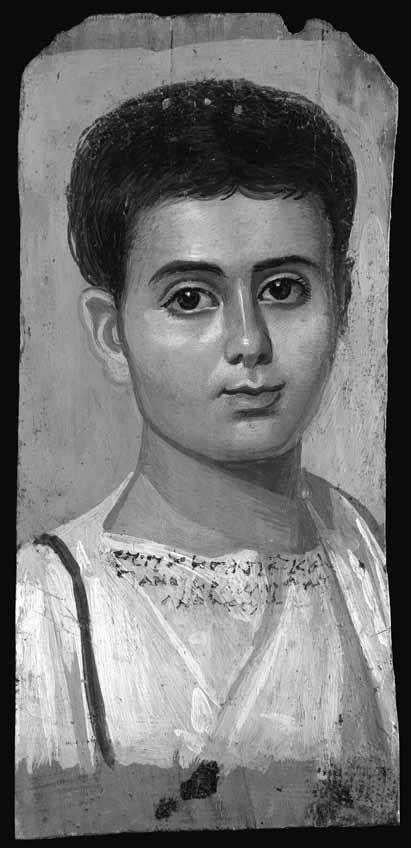
2.2 Portrait of the Boy Eutyches, 100–150 A.D., The Metropolitan Museum of Art, New York, N.Y.
It is not the boy's likeness that we see. The image does not resemble an original because it possesses its object just as it is being possessed by it. Eutyches is here. The realization of living form right where its reality is challenged (literally over the corpse), is how the image asserts its autarky and aesthetic personhood. As we indicated earlier in the case of photographic exemplarity, what culture adduces to this act is secondary if not irrelevant. Image and reality converge in a trans-imaginal and trans-real being. To this event culture is a witness not a mediator. Nothing lies outside the image. It stands alone, in charge of its own reality.In her definitive study of these portraits, Doxiadis comes close to recognizing their ontological distinctiveness:
The juxtaposition of the Fayum portraits to the corpse gives them, in our eyes, a spiritual eerie quality which sets them far apart from social portraiture and places them in a class of their own. Even away from the mummy, they retain their metaphysical potency. It is as if the portrait had really become the person it describes who now continues to be alive in a different realm.103
Another instance of aesthetic personhood is in this funerary inscription from Egypt:
Although the painter gave his work no voice,
Yet still you'll swear you hear Eurprepios,
If ever to his portrait men draw near,
They strain their ears, as though they could half hear:
'I am Euprepios, the little one's my daughter's'...104
The Fayum portrait is literally attached to the dead and participates in death rituals. But its integrity is not affected. The metaphysical power assigned to them by Doxiadis is actually aesthetic. It is the result of their intense evocation of life and their personal and dominating presence. Some among them appear caught in the light of this reality–long before photography came to be. Like the moving lips of the departed Euprepios, the light absorbed in the modeling of Eutyches' face and poignantly reflected in his eyes, imparts a liveliness that ordinary faces do not possess. This is the moment (extended in time) when painting itself breaks the silence of the mimetic object and registers as voice. Conversely, it is also the moment when nature ceases to be the measure of life and becomes art's reflection.
It is in connection to these moments and their ontological power that knowledge of Egypt's cult of the dead and its evolution under Greek and Roman rule becomes aesthetically relevant. At some point in Egypt's encounter with the Greek and Roman artistic traditions, the inertness (silence) of the painted image was broken in a way that resonated with the sensibility of those who saw the mummy as a holy being, imbued with the divinity of Osiris and Isis, but could not see it as a person.105 Something happened during the reign of Tiberius (14–37 A.D.) that caused these portraits to replace the three-dimensional masks used in the native cult. Whatever it was, it would have entailed the recognition in the painted image of something extraordinary: the divinized presence of the deceased, the revelation of the personal reality of their being that (in past times) the mask had concealed and trapped into non-existence for thousands of years.
This kind of image exists on the verge of immortality. It stands between two worlds and does so by means of its own aesthetic being. It was, perhaps, in moments like this that art assumed the power that it exercised on the Christian imagination, a power that cult was to appropriate and simulate in its miraculous images (e.g., the acheiropoietai). Positing this kind of aesthetic being as the precondition of the cult of the image helps explain why Iconoclasm could never succeed where art had given such compelling evidence of its ontopoetic power. The demand that art have a spiritual life was formulated by theology but it was originally conceived by art and delivered in its own terms, as it should be. This is the reason that some Modernists longed for a spirituality that would belong only to art.
The vital role played by art in the experience of life and nature during the first centuries of the Christian era is well-established. Between the fourth and eighth centuries, Byzantine wall painting gave exquisite examples of continuity with Hellenistic precedents. This is evident in its use of polychromy and brilliantly gilded backgrounds, and the depiction of animal and fauna life in homes, churches and in the everyday clothing of affluent adults and children.106 Aesthetic appreciation existed side by side with a theology that questioned the contribution of the senses to the experience of God. St. John Chrysostom (c. 347–407) may have criticized the ostentatious decorations of Christian homes, but polychromy was common in church interiors. An early sixth-century description of the church of St. Stephen at Gaza by the rhetorician Choricios of Gaza–with noticeable allusions to Homeric verse (d. 450)–records contemporary impressions.107
In the fifth century, even an ascetic like St. Neilus of Sinai (d. c. 430) who counseled vigilance against all sensory objects, expressed delight at the sight of the vivid description of sea life and fishing genres on the walls of a church: «the casting of nets into the sea, and all sorts of fish being caught by the fishermen's hands.»108 Neilus recommended the painting of scenes of aquatic and animal life on church walls. Sensitivity to sensuous qualities found in works of art and in nature, particularly the effect of color, is also evident in the writings of St. Gregory of Nyssa (c. 332-c. 384). Gregory finds «a pear whiter than new polished ivory» and delights in the combination of color, texture and light, when he writes in the Life of Moses: «blue is interwoven with violet and scarlet mingled with white and among them is woven threads of gold, the variety of colors shine with a remarkable beauty.»109
This is not to underestimate tensions in Christianity's relationship with the body and the senses–unless redeemed, they obstructed salvation. The view shared by all Iconoclasts that to paint divinity is to degrade it, goes back to Epiphanius, Bishop of Salamis in Cyprus (d. 403).110 Not only the depiction of divine and holy beings but actually sensuous perception (of interior and exterior objects) itself came to be viewed with suspicion, as conducive to sinful pleasures and self-indulgence. Excesses associated with image worship preoccupied Christian theologians long before the Muslim conquests.111
Symbolic representation using the cross, birds, animals, monograms and letters, prevalent in the early centuries, particularly in the art of the catacombs, was favored by those who insisted that figuration and divinity were incompatible.112 But where theophany was not an issue, the human form remained art's legitimate (and celebrated) subject. In the eighth and ninth centuries, the same Byzantine Iconoclasts (726–843) who banned images of Christ, the Virgin Mary and the saints, had their portraits painted on the walls of their houses in the polychrome style of antiquity.113
The use of painting terms by theologians in biblical exegesis attests to the vivacity accorded to images, and the desire to see Christ painted alive. The reality and physicality of Christ was often contrasted with the vague sketches of the Old Testament. They were the empty figures in which he would pour his being as if it were pigment. In the fifth century, Cyril of Alexandria referred to the Old Testament as a «skiagraphia,» an «underdrawing» which the New Testament would fill with bright colors.114 Christ's body would enter the written text like color enters the outline of a figure and gives it the resonance of life.
John Damascene (c. 676–749) quotes a version of the same trope from St. John Chrystostom (c. 347–407). It describes Melchisedek as a «proskiasma» or «foreshadowing» and Christ as the colors (chromasi).115 The same idea leads Nicephorus, Patriarch of Constantinople (806–815), to call Iconoclasts «persecutors of color, or rather, persecutors of Christ.»116 Even where the priority was to have the image intimate its archetype and leave its animation to liturgy and prayer, the experience of aesthetic vivacity never left theological rhetoric.117 It is notably present, as we shall see in Chapter 10, in Damascene.
Color and aesthetic qualities have played an important role in non-Christian iconographies that depict transcendental realities. To understand the distinctiveness of Christian exemplarity better, it is good to discuss briefly the role of painting in the Ch'an (Zen) Buddhist tradition. Aesthetic theory in both Chinese and Japanese Buddhist art has a long and significant history; aesthetics is in many instances a form of ascetism. Conversely, enlightenment has an inherently aesthetic dimension which is why, as we shall see later, exemplarity comes naturally to the Ch'an painting. Paintings and calligraphy seek to capture in form the fusion of consciousness and absolute reality. These works are of particular interest to us because they reach a level of exemplarity that in certain respects resembles that of the Christian image. Consistent with Ch'an ontology, the aesthetic object takes the form of a phenomenon rather than a hypostatic being. In Buddhism there is no hypostasis as such (for that is itself a phenomenon or construct of consciousness and as such subject to the law of emptiness).
In Ch'an Buddhism the expression of transcendental experience in aesthetic form is highly regarded. In their most accomplished instances, painting, calligraphy and poetry not only record but actually constitute instances of enlightenment. Chinese painting in particular has an ancient and distinguished tradition of infusing aesthetic principles with Taoist and later Buddhist ideas. They include the concepts of spirited vitality, emptiness, spirit-resonance, harmonization of consciousness and nature, and self-existence or mysterious fitness (miao li), among others (see Chapter 15). Miao li refers to the reflection in a painting of the ineffable spiritual unity of things.118 One must be able to penetrate contemplatively (guan) the substance of form (via sustained and fixed attention) but also to see it unfold as if it were a text and engage in an act of reading (du hua).119
The concept of chi'yun or spirit-resonance, requires of the painter to capture a thing the very moment it arises in consciousness and affects the heart.120 The life movement of the mind is transferred over to the object and records its passing form. The Ch'an rejection of dualities is expressed in the counsel «let the essence of mind and all phenomenal objects exist in a state of thusness.» It applies to the technical and conceptual aspects of painting, as we read in a twelfth-century essay by Han Cho: «the ideas must all be in the eye before they are carried out with the brush.»121 In Zen, enlightenment materializes in the painter's idiosyncratic grasp of the moment, a quality of instantaneity that the painting retains.122
Consider, for example, the famous drawing of three overlapping figures, a circle (enso), triangle and square (The Circle, Triangle and Square, early nineteenth century), by Sengai (1750–1837), a monk of the Rinzai order. According to Shokin Furuta, it is filled with «transformation and movement, the condition of being unfixed in either time or space» and as such «draws enlightenment itself.»123 Viewed from right to left, the three figures diminish in intensity and proximity to the viewer. The pale wash of ink in the rectangle and its receding position in relation to the triangle and superimposed circle, impart movement and an atmospheric quality on the composition. These contrast with its readily evident geometric and abstract character. The intensity and dynamism of the enso painted in a thick and quick brushstroke, in dark ink, contrast with the isosceles triangle which functions as a balancing center and link or transition point between the other two figures. Far from imposing itself on the image, the inscription has the same ambiguous quality. It reads: «The first Zen monastery in Japan.»
Like life, writes Daisete Teitaro Suzuki, no single act of sumiye (ink) painting can be repeated: «once done, it is never undone.»124«Caught while the thing is going on,» Zen and the act of painting belong to the instantaneous, irreversible contact between mind and world. This is where the painted object attains its vivacity and vital presence.125 Presence here is a function of the object's transience–its being in an absolute sense in the present and passing moment (or now)–rather than permanence. It is the integrity of the instance itself that matters rather than the integrity of the being that exists in it. Being is dominated by temporality; the ontology of things is that of the time in which their being is both formed and eroded. There is no sense of timeless presence–the forever is the now. It is not in the now.
The viewer's direct and «unclouded» grasp of an object is an act of union, and a suspension of dual existence, as noted in the case of tea ware by Soetsu Yanagi (1889–1991): «The thing went into them, and they went into the thing.»126 Similarly in poetry, as the great poet and critic Matsuo Basho (1644–1694) explains, the poem arises out of the fusion of self and object. The object's inner nature is revealed: «Learn about a pine tree from a pine tree and about a bamboo plant from a bamboo plant.»127 Like a painting, a poem forms spontaneously out of the symbiosis of life, feeling and world. Intimate to the poet, it is equally intimate to its subject whose expression or realization it becomes.128
Emphasis on vital form in Ch'an and Zen painting (and calligraphy) made it possible to reconcile aesthetic distinctiveness with iconographic conformity. Far from being restrictive, conventions actually furnished a framework for cultivating both iconographic orthodoxy and uniqueness.
Thus, the seventeenth century painter Shih T'ao observed that the search for originality culminated in the realization that the painter had all along been working according to the «Tao of the ancients.»129 Instructive for exploring the relationship between tradition and vital form in the Christian image, the Chinese and later Japanese emphasis on the co-existence of gu'i (Japanese ko'i) or form that evokes the ancient spirit, and «spirit-resonance» (Japanese kiin), reflect a keen interest in fusing tradition and originality.130
The iconographies and aesthetics of Christianity and Buddhism should be understood in the context of their differences. Buddhists consider the Buddha an enlightened being among many past and future Buddhas who are in charge of their eternal emanations. They are manifested in deities, various adepts, reincarnates etc. In Buddhism, beings submit as agents and recipients of actions to an impersonal and universal law of cause and effect. In Christianity, by contrast, they are sustained by divine providence and mercy dispensed by a personal God. Christianity has theology; Buddhism only metaphysics. The perfection of personality that comes to the Christian ascetic as a result of purification, illumination and deification does not have a parallel in the Buddhist meditator. In Buddhism, one meditates in order to disengage cognition from all categorial dualities, empty personality and reconfigure it to a modality of consciousness for which anything personal is an accident of existence rather than its fulfilment.
An ascetic theology, as we have defined it, starts from the notion of the human person as a self-determined existent who cooperates with God, and extends this notion to all beings (the mark of graced or kata charin existence). This is not the view of the human person in Buddhism where self-subsistence and identity are delusions. From an Orthodox perspective, the integral existence of the person is inseparable from the perfecting synergy in all things of grace and creation. In Buddhism, integral existence (e.g., the self or irreducible individual person as such) is rejected. Ontology becomes epistemology (or anthropology–as happens ultimately with metaphysical views of transcendence). Being arises in the act of perception and is inseparable from it and the perceiving subject.
For both traditions, however, vivacity in the art object is a prized quality. When consciousness and feeling penetrate things in their moment of mutual emptiness and their presence resonates in the pine or bamboo of the sumiye image, art and enlightenment converge. When persons and things exist in a state of enunciating silence, as beings that transcend in their act of existence the aesthetic form that defines them and their own finality, the icon becomes an instance of theophany in art. Seen from this perspective, exemplary paintings and icons do not simply convey the truths of Ch'an Buddhism and Orthodoxy. They embody and realize them in their distinctive way, as we shall have occasion to see later. This movement in the art object, as we have already mentioned, points to enargeia.
Enargeia and Key Concepts
The specific hypostatic act that distinguishes the exemplary image aesthetically can be conveyed by the term enargeia (evidential or illustratio in Latin). The adjective enarges means bright, shining, distinct, glistening and with regard to the fleeting quality of light, swift in motion. It was used in Homer to suggest the appearance of a divine being in plain or disguised form.131 Greek and Roman writers used the term to describe the vivid, life-like appearance of a person, object, or event in life, art or literature, and the impact of such a sight on the viewer or listener. In the first centuries of the Christian era, enargeia and its cognates were used extensively in rhetorical exercises associated with ekphraseis, known as progymnasmata, to describe the manner in which speech visually realizes its object and in this respect resembles a painting.132 The second century rhetorician Hermogenes defined ekphrasis as a type of verbal description that operates «enargos» or brings intense visual experience to the listening act.133 Words bring things to sight as if they were present in their sensuous, living form in front of the listener.
Enargeia and phantasia (i.e., the faculty where vivid images from experience are stored and activated) were adopted by Hellenistic literary critics from philosophy and became key notions in theories of ekphraseis134 This philosophical background is important to consider briefly. In Plato's Ion, the rhapsode Ion calls Socrates' account of his inspired impersonation of Homeric characters enarges not only because Socrates vividly (and brilliantly) described the dramatic effect of his performance on the audience, but also because the vividness of his account reflected the ecstatic way in which Ion was transported to the world of Homer's characters during the performance (535C). Speech that has enargeia realizes its objects and brings their reality to bear upon the senses and the intellect. Socrates' account – a performance in its own right–merits this description because of its accuracy and penetrating insight.
In the Phaedrus (250D) the term is used to describe the brilliant manifestation of the form of beauty in things.135 By contrast, the same brilliance applied to the form of wisdom (phronesis) would result in an image or thing (eidolon enarges) so lucid and brilliant that the senses would not be able to perceive it. In Statesman 277c, in a passage that recalls the comparison of Christ to color in Patristic writing (see below), Plato associates enargeia with the fusion of different pigments and color shades (pharmakois ... kai tei synkrasei ton chromaton) which must be added to the outline (perigraphen) of a figure to make it lively and life-like (hosper zoon)–in the manner of a living thing.136 In this context the term suggests the ability of color to impart motion or animation to a shape or form.
In Poetics 1455a and 1462ab, Aristotle uses enarges to suggest the creative aspect of visualization in playwriting and the audience's response to the outcome. Epicurus (341–270 B.C.) uses enarges and enargeia to describe the clear and reliable impressions (phantasiai) made by visual objects on the perceiving mind, impressions which in his view form the foundation of all knowledge.137
According to G. Zanker, the noun enargeia is of «particular importance for all ancient literary theory» and as such predates the use of ekphrasis (the standard term for highly descriptive writing), while its origin as a critical term is philosophical in nature.138 Writing that was capable of recreating the actual presence of events and beings was expected of orators and historians.139 In his definition of the term, Dionysius of Halicarnassus (fl. c. 20 B.C.) describes Lysias' style as having «abundant enargeian" (enargeian pollen) and explains that his writing makes characters so vivid that they are seen «face-to-face ... as if they were present» (prosopois omilein ... hosper parousin), while events are described as if they are «actually happening» (ginomena).140 Here, enargeia is that quality in the description of a thing or incident that creates the impression of its actual presence and occurrence. It is readily perceptible and coincides with the act of reading or performing a text. Images that have enargeia behave as facts or realities rather than as the interior, mental objects that they actually are.
Quintilian (c. 35-c. 99) associates enargeia with the formation of an object in the mind of a listener that has the appearance and resonance of an actual being.141 Enargeia makes words turn into images and images turn into perceptual realities. It moves from verbal to visual imagery, from abstract to concrete form. The aim is «to show what happened rather than tell it» by depicting the dramatic moments of an event (e.g., screams or groans in the case of a man being murdered) and recreating its actual happening in psychological and perceptual time.142 Thus Quintilian observes that enargeia brings a thing known to be absent to credible presence: «images of absent things are represented to the mind in such a way that we seem to see them with our eyes and to be in their presence.»143 Essential to the credibility of the enargic description is the capturing of the factual and psychological dynamism of an event or character. This is an instance in which rhetoric imitates painting and sculpture where this dynamism finds sensuous expression. Lucian (120-c. 180), for example, compares the «very vivid display» (enargestata epideixai) of events in historiography–so vivid that «one sees the spoken» (oran ta legomena)–to the expressive power of Phidias' sculpture.144 The conversion from verbal to visual happens as one hears or reads the description but presupposes an audience with a repertory of dynamic visual experiences in art and life.
Aelian (c. 170-c. 235) links enarges with phantasia (from phainesthai, to appear or be made visible). The term suggests both the exterior (physical, sensuous) and interior (mental) presence of an object and the presence of the activity that generates it. Aelian thus describes the unveiling of a picture of a running soldier which was so vivid (enargesteran ten phantasian) that when a trumpet was sounded, those in attendance saw him passing in front of their very eyes.145 The painting in that instance was experienced as an actual act of running–a kind of running-picture, as Wittgenstein might say–rather than as a picture creating that impression.
In such contexts, phantasia acquires ontological significance. In Ovid, for example, the term is used to describe the object-forming and animating impact of words on the listener's mind. In phantasia things emerge as if they were actually present: «we seem to see them with our eyes and have them in our presence (praesentes)."146 Phantasia identifies a distinct type of mental image that presents vividly what is constant in the appearance of a thing and in this way captures its essential qualities. It presupposes the perception of multiple instances and the engagement of its object in some kind of activity. But it can also happen as a result of a very powerful first encounter with a thing or person.
Thus, in Philo of Alexandria (c. 20 B.C.-c. 50) it is the sharp initial impression (typosis, sphragis) left by an external object on the mind.147 The addition of successive encounters, in the course of which an object's original image is refined and further distinguished, is found in Porphyry's biography of Plotinus (see also Chapter 11). In this well-known story, Porphyry tells of the famous Alexandrian painter Carterius who painted Plotinus' portrait from memory, using only the increasingly accurate mental impressions (phantasias plektikoteras) that he collected from his careful (almost photographic) observation of the philosopher at work.148 Through this mental sketching, the many appearances or impressions of Plotinus that he collected there were combined to form the philosopher's distinctive features.
Phantasia in this sense includes the mental object that is formed as a result of singular or multiple visual contacts with a thing, event or person. It is determined by the characteristic qualities made evident in the actual acts of existence in which things engage. When this image translates into a painting, the painted object appears as if it were actually present or alive. The distinctiveness and dynamism of the mental image is transferred to its plastic equivalent. Here precision extends beyond verisimilitude to penetrate the essence of a person, object or event and to do so in the course of its characteristic activities so that the subject of the painting is captured living its nature rather than merely as a likeness or impression. This aspect of enargeia should qualify our association of the term with illusion. enargeia, as Ruth Webb observes, may be «always a matter of illusion» but it is also a matter of realization.149 In the case of the art object, this realization is aesthetic.
In his Commentaries on Aphthonius of Antioch (late fourth century), the ninth-century Byzantine theologian Ioannes Sardianus, calls speech that has enargeia «alive» or «breathing» (empnous), this condition being the result of the precision and clarity or lucidity it has achieved.150 These two qualities then are enargic to the extent that they reach this state and not otherwise. Enarges is used in this sense by Ioannes Eugenikos, a fifteenth-century Byzantine official, scholar and author of ekphraseis, to describe the manner in which painted objects project their form out of the picture plane and engage the viewer as if they were actual beings.151 Commenting on this concept in Eugenikos, A.I. Pallas notes: «things are depicted as 'enarge' only when they appear to protrude from the plane on which they are painted and to thus participate in life together with their viewers.»152
We have actually seen this movement in Koudelka's Ireland 1972 and in the portrait of Eutyches. The experience of this particular person existing in a time-frame realized by its own act of being what it is, in the midst of the world it inhabits, with its identity and meaning realized in a moment that its image totally possesses, is not different from that of Aelian's runner. What stands out in both is a kind of actuality that cancels the distinction between image (copy) and original, between life and art.
A painting of a withering tree in a desert landscape has enargeia when all the elements that constitute it are depicted in their distinctive and synchronic manner of existence. The desert is shown as the particular kind of landscape that it is, the tree as the particular kind of tree that it is (e.g., a date palm tree) and as withering before our eyes. The withering itself is determined by the particular qualities of the parts or aspects of the image in which it is taking place (the leaves, branches, trunk, sky, light, landscape etc.). Much can be said from a historical or religious point of view about deserts and date palm trees. But nothing said in that context will make a difference to the aesthetic object at hand which is subject to its own, indigenous reality–it has, in that sense, its own world, its own ways of being with itself and with others and of communicating in those acts its own existence.
Thus enargeia makes it possible for an image to signify from within its own space rather than from an external position determined by the intentions of individuals (e.g., the artist) or institutions (e.g., the Church). The result is a unique and autarkic being which retains its integrity even when some of its aspects inevitably place it in a specific historical, political and theological matrix. In such cases, the image is usually disassembled (or deconstructed) and reassembled through a system of signifiers that contextualize and historicize it. To give an example, based on a variety of iconographic details, the famous icon of the Sinai Pantocrator can be explored in connection with Constantinopolitan portraits of the period in mosaics and coinage, for its indebtedness to classical and Fayum portraiture, or in comparison to contemporary works found in Rome, Cyprus, Thessaloniki etc.153 Even though its study in these terms is certainly valuable to the art historian and archaeologist, it cannot account for its aesthetic significance and distinctive presence. These are determined by how plastic qualities converge to constitute the figure's physical and mental way of existing in its own nature, in the specific space and time of the image itself and only there–something that for the historian is (understandably) an anomaly.
Thus when we ask the question «Who is this man?» of a well-known icon like the twelfth-century mosaic of Christ from the Great Deesis in St. Sophia Istanbul (Figure 3.1), we are asking it of the particular being that stands before us and whose presence the aesthetic object as such constitutes.154 How that presence comes to be and in what modalities is what we are interested in. What is its nature and how it lives it qua image is the question that we need to ask from the standpoint of enargeia, keeping in mind that we are looking for that dimension or movement in the image that brings it to realization.
The detail shown here is part of a larger composition that includes the Virgin Mary and St. John the Forerunner. Approaching the mosaic as a field of activity rather than as an object, we look for what transpires inside its space. We want to perceive it from within, from what it posits as its own space by existing in the way(s) that it does. We perceive movement within the composition–something, as we shall see in Chapter 11, that was not unknown to Byzantine viewers (see Psellus' ekphrasis on an icon of the Crucifixion below). The figure's extended hand, emerging from its splendid hymation, draws attention to the expressive qualities of his face with which it is subtly aligned. It helps intensify what is already perceived in the face itself. To the austere, watchful and concerned expression, the hand adds the stillness and concentration that is evident in its gesture. This is complemented by the robust physique and lush, sculptured cloak that gives a sense of solidity in contrast to the golden hymation that integrates the figure with the two-dimensional space around it, in an effusion of gold and light.
Though difficult at first to bracket the knowledge of his identity, engagement with the visual object itself gradually replaces the cultural signifier with the aesthetic existent. No considerations of cult, religion or technique are present here because they have been put aside. Do they exist in the background? Yes, but they need not interfere. This shift from signification to vital presence is the reverse of a process that is very popular in the study of Byzantine art today and typically brings to complex and vivid visual objects the passive condition of cultural and ideological construction.155
Enargeia is hypostatic. We see a face in its act of existing and actualizing its austerity, gentleness, authority etc. and conversely we see these «qualities» in their act of existing and actualizing that particular face. Conventional attributes–the nimbus, wings, gesture of benediction etc. – are absorbed in this movement and lose their symbolic function. In an enargic icon, the Archangel Michael would appear diaphanous and ethereal in a way that suggests vigilance and power, his nature fully and actively present in his form. St. John the Forerunner (often depicted with wings), would appear emaciated in a way that suggests the aridity and emptiness of the desert, the intensity of fasting, the tranquil concentration brought by prayer etc. The conventional (hagiographic) use of wings to designate the angel and ascetic respectively would in this case be redundant because every aspect of the image (rather than just the wings) delivers angelic and ascetical being. Enargic icons present their subjects not as a collage of signifiers but as beings realizing in their acts of existence the qualities that constitute their distinctive natures.
Thus vivacity in enargeia is not a quality of the surface, of the appearance of the image; or conversely of the image as appearance or phenomenon. It is not, in other words, what Marion calls an «idol» or «the phenomenality of the saturated phenomenon» behind and through which operates an abstract visibility, a Platonic universal of the image that haunts the intellect to multiple viewings and constant speculation (literally).156 Enargeia is not a spectacle or a denomination for perpetual specularity regulated by an invisible matrix possessed by the image and deployed where its frame exists. It is not a facade behind which, as in a prosopeion or mask, we may posit in absentia, as Marion suggests, the person or the face that painting supposedly can never reach and which it therefore can show only by fragmentation and dismembering.157

3.1 Christ Deesis, 12th century, Hagia Sophia, Istanbul, Turkey
Enargeia is that movement in the work of art that constitutes its object as a living being, existing in, through and toward its own nature, presenting its face de profundis, from a depth which it possesses and which it offers gratis to the viewer. Enargeia transforms the image from a flat semblance of world to an aesthetic being in its own right, a zoon aesthetikon. It is therefore the fulfillment of art's being, its ontological fruition. This is a moment that commands reverence and, to agree with a part of Marion's analysis, our return to the work. Yet in our case, it is not as lovers of emanations that we return but rather as participants in the lives of beings which art has embodied and transfigured.
In fact, in enargeia we attend both to the being of the aesthetic object at hand and to what that object brings to life of its own being, not representationally (as likeness) but in the sense that Heidegger recognizes in Van Gogh's paintings of peasant shoes: «Some particular entity, a pair of shoes, comes in the work to stand in the light of its being" (emphasis added).158 In Heidegger, of course, this epiphany of the painted object is a motion within Being itself, an instance of ontophany–which appears «as a clearing, a lighting» right where the peasant shoes reveal their own being.159 The difference is important to note since whereas in his view the work of art opens itself to the contemplation of Being in whose presence it arises–or has its moment–in enargeia, understood in its Christian modality, the work of art opens itself to Christ in whose person and presence it comes alive aesthetically.
Enargeia resonates with the Christian conception of the human person according to which our nature is evident in the self-determined exercise of our being which always exceeds what we are at any given time, and what we show and know of ourselves. But in a yet deeper sense, which we may borrow from this point in Heidegger's thought and call a literal «anastasis» (an upraising) of being, persons are called by Christ in this life to a resurrection of being where they may stand, in theosis, simultaneously in his light and in that of their own finite but transfigured natures. This is why, as we shall show later, this kind of image resonates with spiritual life. Like the deified ascetic who finds in the fullness of her own being both humanity and God, ascesis and gift, nature and mystery, it exists by simultaneously positing and transcending the facticity of its own being (a person is never a natural fact). Thus it theologizes by the very act of being what it is. From an Orthodox perspective, this is a form of logos which the work both renders transparent and withdraws as the same time. In enargeia what shines forth is not a surface but that movement through which a surface becomes possible. In this movement an expressive act takes place in which the reverent viewer–the one who listens or attends to the being at hand–may recognize the work of grace.160
Here grace is not used metaphorically. It actually exists as an aesthetic reality. To see this we need to touch on a theological point. In one of his seminal essays on Palamas, the Greek theologian Georgios Mantearidis shows how the imitation or mimesis of Christ is an inimical part of deification. In contrast to Lossky, who sees the imitatio Christi as a problematic position of Catholic theology, Mantearidis places the difference in the eschatological and sacramental dimension that Orthodoxy assigns to the moral and spiritual imitation of the life of Christ.161 Thus, for Palamas mimesis leads to metoche, as the former denotes the proximity of God in and through Christ while the latter brings those who strive to become Christ-like closer to what Palamas, quoting Dionysius, calls the «amimeton mimema» (inimitable imitation): the unknown God in his inimitable divine essence.162
Thus metoche completes or fulfills what mimesis initiates and mimesis therefore is never a mere simulation or projection of likeness. In an aesthetic sense, by positing a thing's lively presence as an expression of the fullness of its being, the work of art becomes plerotic. At the same time, by placing it in the world, in its natural and finite givenness as a sensuous existent, it becomes kenotic–in Maximus this movement takes the form of a crucifixion (Chapter 9). Thus, where enargeia is present, the aesthetic object exists in an eschatological modality, ordaining its «imitation» of a portion of world– «according to the image» (kat'eikona)–energically to its «participation» (koinonia, methexis) in its perfection–"in the likeness» (kath'omoiosin). It is in the convergence of these two moments that we may situate aesthetic grace and speak of art's «life-in-Christ» (en Christo zoe).
Hesychia, translated literally as stillness or silence, is another important concept.163 A hesychast is one who silences and arrests the passions and trains the senses to wait patiently for God to enter and awaken the heart. The term is associated with the invocation of the name of Jesus in the writings of St. Macarius of Egypt (c. 300–390) and St. John Climacus (c. 570–649).164 In Climacus, hesychia is the subject of an entire chapter where it is defined as a systematic discipline or «science» (episteme) that aims at moral and spiritual purity. The ascetic practices vigilance (nepsis) in the guarding (periorismos, phylake) of the senses (aestheseis), heart (kardia) and intellect (nous), and prays unceasingly, in remembrance of Jesus and in the vocal and silent invocation of his name: «hesychia is unceasing worship of God and presence before Him. Let the memory of Jesus unite with your breath (te pnoe), and you will know the benefits of hesychia."165
Thus hesychia is a type of stillness in which, paradoxically, God motions to the heart and the heart listens and responds. In this form, it is the uninterrupted discipline of Orthodox asceticism from the first centuries of Christian hermetical life in Egypt, Palestine and Syria.166 The hesychast practices detachment or dispassion (apatheia) in relation to exterior and interior objects as a result of which she comes to experience things in their own integral being rather than as the agitated and divided constructs of her passions. The concept of reverence or eusebeia in Maximus has a hesychastic basis.
The relationship between enargeia and beauty (kallos, pulchritudo) is another important matter to consider, given beauty's predominance in theological discussions of art. enargeia describes an act of hypostatic expression that originates inside the art object. Beauty, by contrast, describes the degree to which what happens in the art object agrees with a given concept and thus with its «ideal» form. In its classical and later scholastic definition in Aquinas (integritas/perfectio, debita proportio/consonantia and claritas/splendor)–from where its theological application originates in the West–beauty results from the ordering and comparison of an object to a form that exists outside it as a concept or idea.167 As such, it makes perception depend on an intellective act rather than on the evidentiary power of the art object itself–as is the case with enargeia. Even though this approach is psychologically and epistemologically salient, it is aesthetically problematic because it undermines the autarky of the aesthetic object. Fallacies associated with the subjective aspect of cognition are thus common and have dominated the theory and theology of art, as we shall see in Chapter 5.
This particular aesthetic is Greek in origin. The recognition of the dynamism of the cognitive and creative act is an Aristotelian accomplishment. In Aristotle, a thing excels when it possesses its nature perfectly, or as perfectly as possible.168 When art opts for perfection, it can actually complete nature by bringing to its subject what it may lack by accident or circumstance: «art partly completes what nature cannot bring to a finish.»169 This brings to art the function of perfecting or idealizing its subject based on the artist's comprehension of what that entails for its nature. What is teleologically structured is intentionally determined. Plotinus repeats this idea in an almost identical formulation. Starting from the forming principles of things (logoi)– literally «running back» (anatrehousin) to them–the arts «make up what is defective in things» and in so doing make them beautiful (kallos).170
For Plotinus, who is indebted to the Platonic definition of the concept, a thing is beautiful by participating in the form (metoche eidous) of beauty.171The form unifies a thing or a picture by bringing all its aspects under a concept (eis en sunacthentos).172 This is a principle that applies to all things which acquire their essence or nature by submitting their material aspects to ideas. Art (techne) is understood as the intentional activity that terminates in an object. It imparts form on a thing and makes it beautiful by that act of unification. Fundamentally, it is the transference of someone’s idea (en to ennoesanti) to a material substance which is transformed in the process.173 Thus a picture of a thing is beautiful in two ways. First, according to the degree of its participation in the form or idea of its nature and second, according to the degree of its participation in the art or activity by means of which that form was implanted in matter (meteiche tes technes).174
Another example comes from scholastic aesthetics. Aquinas' conception of being as act is in principle compatible with enargeia and an interesting point from where to pursue the application of this concept to a Catholic aesthetics (a task that we cannot pursue here). However, his discussion of beauty does not suggest the evidentiary power of aesthetic form.175 Claritas may seem the most relevant concept but its association with color and brightness (colorem nitidum) suggests a superficial quality (as splendor it means luster, brilliance) that is principally used by Aquinas as a metaphor for intelligibility.176 An image whose parts and principles are structurally (integritas) and relationally (debita proportio) formed according to its essence has claritas and therefore beauty.
The order of the definition itself is consistent with the way that the intellect operates. It starts from particulars and moves through plurality (i.e., properties and accidents) to the universal: «the human intellect knows by composition, division and reasoning.»177 Aquinas defines claritas in terms of intelligibility and the self-manifesting activity of the agent intellect in an object. The ensuing form functions as a sensuous concept that is probably most evident in the least sensuous aspect of the image: its color (an association that the Byzantines also made, as we shall see). Form is lucid to the extent that its species is clearly outlined and perceptible as such.178 How lucid form is depends on the intensity or vividness of its colors. Claritas in a thing or image is the outcome of two intellective acts: the one that created it and the one that perceives it.
A more interesting point where the Thomist concept of beauty comes close to enargeia is the association of perfection with integritas. A being must have the exact parts and principles corresponding to its essence if it is to be perfect. An object has perfection to the degree that it is commensurate with its concept (in which its parts and principles are outlined). As in Aristotle, perfection is the completion of a thing, so that nothing of its essential form is missing.179 This movement toward entelechy is important when considered in aesthetic terms. But rather than remain inside the art object, as an aesthetic reality, in Aquinas it is transferred outside, to an intellective act. Thus the image is now considered from the (critical) standpoint of its adequately fitting or matching its concept and therefore of its being a good or bad representation.
We can illustrate this with an example. Given that the Virgin Mary is pure, meek and humble, any female figure that has these three qualities will match her person or character perfectly. With the concept or type posited externally, the relationship to the object is one of correspondence. Predictably, beauty becomes in this instance a form of truth. The picture is then true to the Virgin or to what the given concept outlines. Because of this abstract, conceptual quality it is easy to isolate beauty according to types (e.g., that of Christ, of the Virgin Mary, of the Archangel Michael etc.) and then use it as a formula. In practice, the formula remains constant while the specifics (or accidents) of the individual figure–its age, dress, hairstyle, social status, nationality etc.– vary.
By establishing beauty on the basis of perfection in this sense, it is possible to call beautiful even something that is ugly as long as it matches in all respects the concept of ugliness or the specific type of ugliness it portrays. Thus Aquinas: «an image is said to be beautiful if it perfectly represents even an ugly thing.»180 A perfectly ugly picture of Judas is beautiful with regard to his essence and so his ugliness in that case is aesthetically pleasing etc. Beauty consistently poses the question of a work's matching something or fitting a standard. As such it introduces ideality in the discussion of art, as the state of perfection with regard to a thing's nature that a work achieves by approximation, in a representational act. This has a disorienting effect on aesthetic inquiry as noted by Heidegger who argues that to speak in terms of «eternity» and «immortality» about art is to avoid the precise speech that makes it possible to think about its essentials.181 enargeia, by contrast, makes it possible for an image to posit its own version of eternity or immortality and to contain the intellective act entirely within its boundaries.
Concerning the Greek word for beauty and its theological use, kallos is noticeably absent from the key passages in St. John Damascene's (c. 676-c. 749) major work on images. Damascene explains how images depict their subjects and the role played by line and color in that process but has nothing of substance to say about beauty. Even though the term is used extensively in Byzantine hymnography and ekphraseis as an epithet for Christ and the Theotokos, it is certainly not the definitive category of Byzantine art criticism.182 This may reflect the term's association in antiquity with the size (megethos) and majesty or grandness (megethos in a metaphorical sense, maiestas) of pagan deities depicted in sculpture. Dio Chrysostom, for example, has Phidias praise one of his own statues for the «beauty and the grandness of the god» (kallos e megethos theou) it portrays, and Plutarch also combines the two terms when he compares a certain statue to the statue of Zeus at Olympia (to kallos kai to megethos paraplesion).183
For Damascene, kallos is a quality assigned exclusively to the first person of the Trinity. The Logos Christ is not described as beautiful in his humanity, even when his divine nature is discussed in connection to his depiction.184 Perhaps the subject is too complicated for Damascene to address in that context. When used with reference to the Father, kallos is called «divine» and «archetypal» (theion, archetypon kallos). Following St. Gregory of Nyssa, whose opinion John echoes, it is clearly something that painting cannot convey: «since 'the divine beauty is not made resplendent (enaglaizetai) in a certain external figure (schemasi) or fortunate shape (morphes) through certain beautiful colors (euchroias),' it is therefore not depicted (ouk eikonizetai) while the human form is transferred to tablets by means of colors (dia chromaton)."185 Thus while it is not possible to paint God's beauty and splendor, it is possible (and admissible) to paint his human form. This is consistent with the view of painting as a duplicating act confined to the physical appearance of a thing–a Platonic notion, at least from a conventional reading of Plato (more on this subject below and in Chapter 12). An image can never render its original and this applies more than anything to God (ou kata panta eoiken e eikon to prototypon ... pantos oratai en autois diafora).186
We turn next to another important term: «tradition» (paradosis). In Catholicism, tradition is used in two senses. As sacred tradition, it refers to transmission «in its entirety of the Word of God which has been entrusted to the apostles by Christ the Lord and the Holy Spirit.»187 This is understood in terms of written (outside Scripture) and orally transmitted or unwritten teachings of the divine word as sanctioned by the Church through the Magisterium (the teaching office exercised by the bishops under papal authority or personally by the pope).188It is also used in the plural of all ecclesiastical and pious practices sanctioned by the same authority. In this sense, it is the generic term for a variety of historically determined, culture-specific and equally valid customs centered on Church life.189 Traditionalism may be defined according to these practices (e.g., prayers, ceremonies, liturgical and penitential rites, art) and customs. It refers to the valorization of some such practices and customs as orthodox and the exclusion of others as unorthodox.
For the Orthodox view of tradition we turn to Lossky. In a seminal article, Lossky associates the term with the disclosed and hidden realities of the Son Logos. Christ offers himself in the written and oral truths of the faith, in sacramental and liturgical customs and in devotional and ritual objects like icons, censers, reliquaries etc.190 He is therefore open to all members of the Church who partake of his presence in acts of vocal and silent communion (sacraments, hymns, icons, gestures, devotions, rites, signs etc.). The words and figures of Scripture subsist eschatologically, bearing Christ in them from all eternity and simultaneously making him available to the faithful of all times according to their individual circumstances.
Lossky's distinction between what is revealed and what it kept hidden in the life of the Church is based, as he explains, on a text by St. Basil of Caesarea (c. 329-c. 379). Basil defines «dogma» (in contradistinction from «kerygma») as «teaching (didaskalia) unpublished and secret, that our fathers kept in silence, free from disquiet and curiosity, well knowing that in being silent one safeguards the sacred character of the mysteries.»191 This is an important passage. It immediately leads us to think of icons from a new perspective. Icons are here seen as an explicit and silent form of divine speech. But what they convey in silence is not exhausted by this analogy. For inasmuch as they belong to Christ, they have a life of their own. The same applies to all aspects of Church life and culture. Christ's presence in them is as inexhaustible as it is ultimately unfathomable. And to the extent that they exist in him, they too possess these qualities.
Thus, tradition is the reality in which the Church encounters the mystery of its own existence. It therefore exists in what we may call a horizontal epiphany and a vertical theophany. To convey this difficult but essential notion, Lossky is guided by a text of St. Ignatius of Antioch (c. 35–117): «he who possesses in truth the word of Jesus can hear even its silence (tes hesychias autou akouein)."192 Hesychia or silence (in this context) is the timeless and inexhaustible vitality and communicative plenitude of the divine word, of which the human word is only an incomplete and temporal expression. But in order to hear this silence, one must first submit (descend) to its reality. Stillness, quiet and love of God (in Maximus, as we shall see, it is a form of «burial» or taphe that gives rise to eusebeia) will allow the divine word to be heard and seen (to rise). The ascetical aspects of this notion are not noted by Lossky, but they are readily evident in the way that hesychia is used by Ignatius to suggest how the person who possesses Christ or in whom Christ is alive comes to perceive what is communicated. Here we can appreciate the spiritual significance and richness of the concept.
Hesychia is also the breath of the Holy Spirit, the condition of seeing all things through Christ, in the free subsistence that he imparts on a sanctified creation. It informs invisibly all aspects of Christian revelation: Scripture, sacraments, liturgy, iconography, the lives of saints etc. Even though it permeates nature, culture and history it is not subject to their contingencies. This freedom Lossky calls «freeness» or parrhesia, a term that in its New Testament use (1John 2:28, Hebrews 3:6) implies intimacy (en auto, ou oikos esmen) with Christ or being at home in his presence and life.193 It is parrhesia that gives tradition its profound meaning and mystical life. What transpires in the canonical life of the Church is comprehensible only against a more profound, ineffable reality. This reality envelops it and allows it to be heard, seen and known at any given time beyond itself.194
Tradition in this second sense is immersion in this profound and fecund silence. It is the experience of an enhypostasized and synergic divinity in all things Christian, a perpetual baptism in the Holy Spirit. Lossky describes it as the «unique mode of receiving,» a condition of intimate, radical susceptibility in the human person: «We say specifically unique mode and not uniform mode, for to Tradition in its pure notion there belongs nothing formal. It does not impose on human consciousness formal guarantees of the truths of faith, but gives access to the discovery of their inner evidence.»195
He then adds:
The pure notion of Tradition can then be defined by saying that it is the life of the Holy Spirit in the Church, communicating to each member of the Body of Christ the faculty of hearing, of receiving, of knowing the Truth in the Light which belongs to it, and not according to the natural light of human reason.196
This communication posits its object as elliptical and incomplete (ek merous) because it allows the intuition of a fuller reality or actuality in what is immanent and transient: «The knowledge ek merous will not be suppressed because it was false, but because its role was merely to make us adhere to the fullness which surpasses every human faculty of knowledge.»197 Thus, it is one thing to have full knowledge and another to know in fullness.
In the second case, the Holy Spirit opens what is known of God to its eschatological completion, something that human understanding can experience but not fully grasp: «Any theological doctrine which pretends to be a perfect explanation of the revealed mystery will inevitably appear to be false: by the very fact of pretending to the fullness of knowledge it will set itself in opposition to the fullness in which the Truth is known in part.»198 When later we discuss the relationship between the vision of uncreated light and the theophanic image, this distinction will prove significant. The exemplary, theophanic image is incompatible with formalism and closure. Rather than stand finalized as an instance of historical understanding and iconographic orthodoxy, it must posit its being in perpetual openness. This openness is best exemplified in the way in which the human person posits its enhypostasizing reality (and dignity) thus reminding us once again of the affinities between exemplarity and personhood.
According to Lossky, «the critical spirit of the Church» arises out of this fullness.199 To view apocryphal or even heterodox sources «in the light of Tradition,» is to assume in them the existence of yet undisclosed meanings and therefore to engage them from the standpoint of discovery rather than correction.200 The idea that insights about color and illumination found in Modernist painting are relevant to the exploration of the theophanic image relies in part (because it is not ecclesial in the sense implied by tradition) on this critical sense. Lossky puts it beautifully:
The dynamism of Tradition allows of no inertia either in the habitual forms of piety or in the dogmatic expressions that are repeated mechanically like magic recipes of Truth, guaranteed by the authority of the Church. To preserve the 'dogmatic tradition' does not mean to be attached to doctrinal formulas: to be within Tradition is to keep the living Truth in the Light of the Holy Spirit; or rather, it is to be kept in the Truth by the vivifying power of Tradition. But this power, like all that comes from the Spirit, preserves by a ceaseless renewing (emphasis added).201
Orthodoxy is a condition of vital participation in divine life rather than submission to doctrinal norms and measures. It is the result of an ontological fruition that brings beings to communion with rather than subservience to God. Lossky recognizes the importance of this view of tradition to iconography. Icons arrive aesthetically, in their own terms, to dogmatic truths. They are not cast in the role of a «kind of hieroglyph or sacred rebus, translating dogmas into a language of conventional signs.»202
Thus liturgy, hymnography and iconography find their origin and expression within a plerotic «margin of silence.»203 Tradition unfolds horizontally and vertically. It is in the vertical dimension that we encounter the mystical life of the Church. This has implications for iconography. In the mystical, vertical sense, an image has depth; it posits a perpetually open horizon out of which and within its own reality its being arises. In the historical, anthropological senses, we discern only the horizontal, temporal aspect, the image's engagement with its given world and circumstances – aesthetically, the two-dimensional image (picture). On the surface, some icons may appear as institutional and cultural objects with multiple functions and meanings. But internally they have different lives. They resist the very disclosure they invite and do so aesthetically. Analyses that treat exemplary icons through a historical or cultural lens only, stumble on this fact. By contrast, exemplary icons manifest an open historicity and a trans-cultural resonance. They fascinate because they live aesthetic lives. They have internalized and transformed their own iconicity and with it all the temporal structures that inform it.
This perhaps is why certain icons persist as objects of hermeneutic fascination (if not fixation). As if in a secular act (or cult) of veneration, the hermeneut assumes the position of a hierarch and consecrator of meaning. The historian, anthropologist and semiotician partakes (for the purpose of elucidation and in the detached manner of the scholar) of the very same mechanisms to which she attributes an icon's sanctification (e.g., the semiotics of the icon autoportrait in Dagron). Even the self-disclosure (e.g., in Barthes) and dissolution of the author (sacrificed in his case to the eidos of photography) assumes theological virtues like repentance, confession, humility and self-negation. It is thus amusing to see the deconstructionist and the traditionalist converge. In placing and confining the image within certain prototypes, which are selected for their purportedly spiritual authenticity, the traditionalist establishes in her own (formalist) terms a ground of engagement, a form of artificial and arbitrary koinonia.
In sharp contrast, the mystical life of tradition liberates the Christian image from the restrictions and contingencies that affect representation (and by extension its semiotic construction or deconstruction). It draws attention to its ability to subsist diachronically as an irreducible existent. Exemplarity, in this sense, and always in a Christian context, is Christomorphic. It achieves an intimacy (parrhesia) with Christ's being. Like Christ, it subsists both mystically, within the «deeper» (vertical) ground of the Trinity, and epiphanically, in the emerging (horizontal) realities of human belief and practice. This is the sense, as we have mentioned earlier, that its being is the aesthetic equivalent of an acheiropoietos. It exists and avails itself to others spontaneously (rather than programmatically through pre-established hermeneutic structures), mystically (in bringing persons and things to a state of ontological holiness or sanctified existence) and personally (in its enunciating presence).
We turn next to person or «prosopon.» Greek usage since antiquity confines it to the human countenance, including its simulated form in a theatre mask. The Christian prosopon is a hypostasis, the Patristic term identified with Aristotle's «second ousia."204 Ousia or hypostasis was termed "prosopon» by St. Gregory Nazianzen (c. 330-c. 389) and St. Basil. Damascene defines it as an individual being «that subsists by itself and which has not its being in another.»205 Irreducible to abstract formulations of its nature, a prosopon is ontologically disposed to determine itself in communion with God. It exists dynamically in that relationship, at the center of an economy of divine grace, and is the model for the perfection (teleiosis) of all creation.206 A prosopon is the human being that is liberated to the degree possible from sin–ideally, then, the saint. By sin in this context we should understand the life of self-isolation and self-love (philautia). In Maximian anthropology, sin constricts, depletes and distorts human existence and all things affected by human action.
Lossky explains that a prosopon «is distinct from his own nature ... someone who goes beyond his nature while still containing it, who makes it exist as a human nature by this overstepping and yet does not exist in himself beyond the nature which he 'enhypostasizes' and which he constantly exceeds.»207 To be a person in this view, is to defy circumscription and exist or realize one's own nature charismatically:
The creature, who is both 'physical' and 'hypostatic' at the same time, is called to realize his unity of nature as well as his true personal diversity by going in grace beyond the individual limits which divide nature and tend to reduce persons to the level of the closed being of particular substances.208
For Lossky, the question of what really constitutes a person ontologically cannot be answered. It would require what is virtually impossible: containing this enhypostasizing activity into an essence in order to represent it conceptually. Ultimately what constitutes at the deepest level a person is a (metaontological) question about the limits of ontology. If we take this notion a step further, the liminal moment is one in which hypostasis at once displaces and posits ousia, and where it becomes necessary perhaps to theologize rather than ontologize being.
What is the exact relationship between person and exemplarity in the art object? It is one of analogy. The exemplary aesthetic object subsists beyond its physical (as thing) and representational (as picture, symbol, sign etc.) designation. It enunciates its own unique and ineffable existence through and beyond its physical and aesthetic being. In these acts (or moments), it reaches a level of personal subsistence. It exists personally not because it realizes the intentions of a person (i.e., the artist) but rather because it is engaged in its own expressive act. What is personal about it is not a trace or mark left there by the artist. It is the work's own way of communicating what it is through its act of existence. Ingrained in that act and thus inextricable is the presence of the artist. On this basis, we may draw a distinction between the presence of deep subjectivity in art and that of conventional subjectivity that ties the work teleologically to the intentions of its maker.
The last term to consider is eikon. It is not an exaggeration to say that its meaning has been shaped by Platonic philosophy and not in a positive sense. Plato allows some images to be better than others based on verisimilitude and their degree of participation in intellectual principles. These principles establish their correctness or orthotes (e.g., symmetry, proportion etc., Laws 668ab).
The term is the perfect tense (eoika) of the Greek verb eiko («to be like»). This «grammatical detail» is «significant,» according to Daniel Sahas, «because it suggests that likeness is an already accomplished fact.»209 In archaic and classical Greek, the term means not only to seem like something but also to be like it in a fitting or appropriate sense. An example would be a daughter's being like her mother–the comparison implying two beings that share a common trait rather than one that simulates the other. The distinction is important because it suggests that an eikon does not aspire to similitude; it has already achieved it in a sui generis way. This is the very opposite of what Plato suggests. It is not in this regard a mimetic object that posits itself as a simulacrum.
Plato frequently uses the term in a generic sense to mean any kind of representation or form produced by art, including that of music (eikona mousike), which may or may not be correct (orthe) and good (eu) (Laws 669ab). All arts create images or species of mimesis which are called representations or portraits (apeikasiai) (668bc). It is safe to say that for Plato the aesthetic meaning of the term is invariably one of representation. Apeikasia is the representational dimension of an image which exists in that capacity in relation to an actual object and to a set of intellectual principles. An eikon in this case is doubly dependent: first on a thing and second on a standard. It is this etymology that probably influenced Greek Christian thought about images especially in the context of Iconoclasm.210 Yet, there is also a different dimension to Plato that through Plotinus and Philo of Alexandria (20 B.C.–50 A.D.) found its way to the Greek Fathers.
Considered as a species of eidolon, an eikon is a «likeness» that has more reality than a phantasma which is defined as «semblance» (Sophist 236ab).211 In Republic (509e, 598e-599a), images and their corresponding form of cognition (eikasia) are placed at the lowest segment of the Divided Line and described as «shadows» and «reflections» (skias and phantasmata respectively). Plato also uses the term to mean copy and at times he treats it as a kind of phantasma. In the Timaeus, for example, eikon is used to refer to the blurry, dream-like images (phantasma) that we see when we have just awakened from sleep. These are so unreal and deprived of substance that they exist on the verge of non-existence (meden einai), trying to latch on to real beings (52c). Thus, the near non-being of an eikon is presented as the cause of its derivative nature; an image in this sense has depravity in its very being and dependency in its relationship to other beings. But this dependency implies a movement in the image toward realization or completion, from the picture to its original (or to any object similar to its original). Ontologically, then, images are defined by their gravitation toward the real (physical) beings they simulate and which they can never reach. They are in that sense failed beings.
But they are also necessary beings. There is no world (and no thought) without images; no such thing as an aniconic reality. In the Timaeus (29b, 30bc), it is in the nature of reality to point to an original and to itself as its copy: «it is wholly necessary that this cosmos be the image of something» (eikona tinos einai). The divine creator and architect (poieten, demiourgos, tektainomenos) fixes his gaze on the eternal good (aidion, agathon) and uses it as a model for creation (paradeigma) (28c-29a). As it unfolds into images of images, the original model remains intact. It is clear that for Plato, to avoid being a «likeness» a thing must be somehow aligned with the original model rather than with its emanations.
There is, however, a point that is of great interest to us because it suggests a different type of image. We are told in Timaeus 29bc that there exist superior images (or statements) that abide by the logoi of things (prosekei logois) and are thus in possession of their originals. Inferior images, by contrast, abide by the semblances (ana logon) of things (29bc). An eikon in this second sense is an analog or simulacrum. It is bound to a perpetual state of intimation (allusion); it is a shadow and semblance of something other than itself. By contrast, an eikon in the first sense seems engaged in a movement of self-perfection, having somehow embodied or internalized the logoi of things. If I am reading Plato correctly, he sounds a lot like Maximus.
There is a passage of similar interest in Plotinus. Anyone that «despises or dishonors» (atimazei) the arts, he says,
must know that the arts do not simply imitate what they see, but they run back up to the forming principles (logoi) from which nature derives; then also that they do a great deal by themselves (polla par'auton poiousi), and since they possess beauty (kallos), they make up what is defective (elleipei) in things.
He then offers this example: «For Pheidias too did not make his Zeus from any model perceived by the senses (ouden aestheton), but understood what Zeus would look like if he wanted to make himself visible (emphasis added)."212
Although intelligible, logoi should not be understood theoretically or abstractly but as given in the concrete act of a thing's existence–in this case of the sculpted Zeus. Logos is the living reality of a thing, not its explanation or concept. Moreover, this act is an act of self-manifestation. The art object (statue) embodies it because it has been made dynamically, vividly through logoi rather than through aestheseis or superficial impressions. Pheidias' statue does not represent Zeus (and posit him as a model). It brings him to life by its own means (its own act of existence)–exactly the sense of enargeia.213 This is why Plotinus explains that the arts have an inherent (par'auton) dynamic by means of which they bring the things they depict to perfection. Interestingly, kallos is the appearance of that act of completion in the work of art. In the case of the Zeus statue, it designates the act of theophany itself.
Finally, in Philo (20 B.C.–50 A.D.) the concept of God's Logos is called an «image of God» (eikon Theou).214 It underwrites all creation and suggests a cosmos that is not only rational but also the locus of a perpetual theophany. Divine grace brings to the created cosmos the reconciliation of image and imaged. In St. Athanasius (c. 293–373) and in the Areopagite it is possible for an eikon to come to an almost complete identity with its original.215 Following classical epigrammatic conventions and with Christ's divinity in mind, Athanasius explains how an eikon can actually realize its object so persuasively that the two will appear indistinguishable: «The image might well say: 'I and the emperor are one,' 'I am in him and he is in me'.»216 The analogy dismisses verisimilitude and instead posits the image as a perfect likeness of its object and as a distinct being that is vitally present in its form.
Something similar is suggested in an example given by Dionysius in On the Ecclesiastical Hierarchy:
... in sensible images (aestheton eikonon), if the painter (grapheus) looks without interruption (aklinos) at the archetypal form, neither distracted (anthelkomenos) by any other visible thing nor splitting his attention (merizomenos) toward anything else, then he will, so to speak, duplicate (diplasiasei) the person painted and will show (deixei) the true in the similitude (to alethes en to homoiomati), the archetype in the image (eikoni), the one in the other (hekateron en hekatero) except for their different essences [or natures] (ousias).217
Two things are important to point out in connection with this passage. The first is the total immersion of the painter in what is being painted. Synergy and fusion with its subject accompany the making of this special type of image from start to finish. The second is the fact that the picture makes the subject subsist inside the picture. It exists pictorially as a picture-being that is ontologically distinct from the person the painting depicts. We are thus dealing with two beings: one is the subject that is being painted and the other is the painted subject. The one has natural reality (a person). The other has aesthetic reality (a picture). This is the nature (ousia) with respect to which they differ. Hypostatically, however, they are the same. One could mistake the one for the other.
This distinction is relevant to enargeia and is aesthetically significant (we shall discuss a similar passage in Diadochus of Photiki below). It is also common in Chinese art critical treatises which repeatedly emphasize the difference between the replication of reality by an image and the presence in it in aesthetic form of the phenomena that constitute it. Thus the landscape painter Ching Hao (c. 870-c. 930) said: «[A picture that attains] likeness achieves the physical form but leaves out the life breath of the subject, while in [a picture that attains] truth the life breath and inner qualities of the subject are fully present.»218
It is fitting to conclude with an example from Orthodox hymnography that associates eikon with a similar form of liveliness. The magnificent sixth-century cherubikon or cherubic troparion that is included in the liturgy of St. John Chrysostom uses the verb eikonizein (to mold something into form). As human and angelic hosts unite in prayer, the faithful come to «iconize» the Cherubim. Eikonizein in this context is to take on the qualities of another and realize them in one's way or act of existence. To iconize the Cherubim is to assume or embody their form, to give them a tangible presence, rather than to reflect or replicate them. It is also a reflexive act that incorporates those to whom the troparion is addressed in the act of chanting itself. To sing the troparion's words and give them a voice is to exist in that act (and moment) as human cherubim (angels on earth). Thus, the chanter's being a picture of the cherubim is inseparable from the chanting act itself. It is that act and what it (the act) makes present. As long as the chanting lasts, chanter, chant and cherubim are indistinguishable. The eikon is in time, the persons chanting are in eternity.
* * *
Примечания
(Cyril Mango, The Art of the Byzantine Empire 312–1453: Sources and Documents (Toronto, 1986), pp. 175–176.)
(For the absence of an «essential continuity between holiness and beauty» in religious art see Gerardus Van der Leeaw, Sacred and Profane Beauty: The Holy in Art, trans. David C. Green (New York, 1963), p. 230.)
(Hans Urs von Balthasar, The Glory of the Lord: A Theological Aesthetics (7 vols, San Francisco, 1972). For an Eastern Orthodox perspective, see David Bentley Hart, The Beauty of the Infinite: The Aesthetics of Christian Truth (New York, 2004). For perspectives on theological aesthetics, see Oleg V. Bychkov and James Fodor, Theological Aesthetics after von Balthasar (London, 2008). See also, Daniel B. Gallagher, «The Analogy of Beauty and the Limits of Theological Aesthetics,» Theandros: An Online Journal of Orthodox Christian Theology and Philosophy, 3/3 (Spring/Summer 2006).)
(Hart, pp. 207–208.)
(Ibid, pp. 5–7.)
( Andrew Walker, "enargeia and the Spectator in Greek Historiography,» Transactions of the American Philological Association, 123 (1993): pp. 353–377. See also Jane M.F. Heath, «Absent Presences of Paul and Christ: enargeia in 1 Thessalonians 1–3,» Journal for the Study of the New Testament, 32/1 (2009): pp. 3–38.)
(Hans Belting, Likeness and Presence: A History of the Image before the Era of Art, trans. Edmund Jephcott (Chicago, 1994), pp. 208–209.)
(For a discussion of Christian portraiture in the Paleo-Christian period and the early Middle Ages, see Andre Grabar, Christian Iconography: A Study of Its Origins, The A.W. Mellon Lectures in the Fine Arts, 1961, Bollingen Series xxxv.10 (Princeton, 1968), pp. 60–86. For miraculous icons as records of Christ's physiognomy and the concept of eikonismos, see Gilbert Dagron, «Holy Images and Likeness,» Dumbarton Oaks Papers, 45 (1991): pp. 23–33.)
(Archbishop Damianos, «The Icon as a Ladder of Divine Ascent in Form and Color,» in Helen C. Evans (ed.), Byzantium: Faith and Power (1261–1557) (New Haven, 2004), p. 335.)
(Gerondos Ioseph, Ekphrasis Monachikes Empeirias (Expressions of a Monastic Life) (Aghion Oros, 2003), pp. 202–203. Also quoted in Nikolaos, Metropolitan Mesogaias Laureotikes, Phone Auras Leptes (Voice of a Delicate Breeze) (Athens, 2006), pp. 178, 141. The translation is mine. For similar responses to relics, see Patricia Cox Miller, «'The Little Flower is Red': Relics and the Poeticizing of the Body,» Journal of Early Christian Studies, 8/2 (2000): pp. 202–203)
(The equivalent in Alberti (1404–1472): «The istoria will move the soul of the beholder when each man painted there clearly shows the movements of his own soul ....» Leon Battista Alberti, On Painting, trans. John R. Spencer (New Haven, 1966), p. 67. The Painter's Manual or Hermeneia (1730–1734) catalogues formulae for the visual transcription of scriptural passages in meticulous detail, without mention of aesthetic qualities. «Historein» there means to depict or visually identify a subject according to its distinctive hagiographic features or traits. Dionysiou tou ek Fourna, Ermeneia tes Byzantines Zographikes Technes (Athens, 1987), pp. 45–46. The “Painters Manual” of Dionysius of Fourna, trans. Paul Hetherington (Torrance, 1989). For the role of ekphraseis in Cappadocian piety srr, Vasiliki M. Limberis, Architects of Piety, The Cappadocian Fathers and Cult of the Martyrs (Oxford, 2011), pp. 53–96.)
(Daniel Sahas, Icon and Logos: Sources in Eighth-Century Iconoclasm (Toronto, 1986), p. 15.)
(Belting, p. 3.)
(Ibid., pp. 15–16.)
(Manolis Chatzidakis, «An Encaustic Icon of Christ at Sinai,» trans. Gerry Walters, Art Bulletin, 49/3 (1967): pp. 197–208.)
(Hegelian aesthetics subsumes art under the sphere of religion and defines the art object by its end (purpose) and therefore by its past, in «self-encirclement.» On this point, see Jacques Derrida, The Truth in Painting, trans. Geoff Bennington and Ian McLeod (Chicago, 1987), pp. 25–26.)
(P.A. Michelis, Aesthetike Theorese tes Byzantines Technes (Athens, 2001), pp. 262–268. P.A. Michelis, An Aesthetic Approach to Byzantine Art, trans. Stephen Xydis and Mary Moschona (London, 1955). All citations are from the Greek text.)
(Ibid., p. 159.)
(Ibid., pp. 151–152.)
(Andrew Spira, The Avant-Garde Icon: Russian Avant-Garde Art and the Icon Painting Tradition (Hampshire, 2008).)
(Nicoletta Misler (ed.), Pavel Florensky, Beyond Vision: Essays on the Perception of Art, trans. Wendy Salmond (London, 2002), p. 108.)
(See Gilbert Dagron, Decrire et peindre: Essai sur le portrait iconique (Paris, 2007), pp. 31–63, 65–82. Dagron, «Holy Images and Likeness.»)
(Bissera V. Pentcheva, «The Performative Icon,» The Art Bulletin 88/4 (Dec. 2006): pp. 631–655; The Sensual Icon: Space, Ritual, and the Senses in Byzantium (University Park, 2010), pp. 9, 14. Marie-Jose Mondzain, Image, Icon, Economy: The Byzantine Origins of the Contemporary Imaginary, trans. Rico Frances (Stanford, 2005).)
(Jaroslav Pelikan, Imago Dei: The Byzantine Apologia for Icons (Princeton, 1990), pp. 3–4, 67–98. Charles Barber, Figure and Likeness: On the Limits of Representation in Byzantine Iconoclasm (Princeton, 2002), pp. 125–139, 80. Pentcheva, Sensual, pp. 62–88.)
(On this basis Dagron defines the Byzantine icon systemically as a negative object, and interprets its ontology to be fundamentally one of absence rather than presence. Dagron, Decrire.)
(Charles Barber, Contesting the Logic of Painting: Art and Understanding in Eleventh- Century Byzantium (Leiden, 2007), pp. 23–59.)
(E.g., the Eucharist «as a saturated sensual experience ensured the interpenetration of human and divine»; «through the Incarnation the carnal logos became the instrument of God's plan for the salvation of humankind»; or defining «kenosis» as the «decanting of the divine into the world.» Pentcheva, Sensual, pp. 42–43, 53, 87, 23.)
(Martin Heidegger, Poetry, Language, Thought, trans. Albert Hoftsadter (New York, 1971), p. 60.)
(St. Theodore the Studite, On the Holy Icons, trans. Catherine Ross (Crestwood, 2001), pp. 102–107; III, C, 5, 8, 11–12. On the influence of Platonism through Origen on Christian iconoclasm see, John Meyendorff, Byzantine Theology: Historical Trends and Doctrinal Themes (New York, 1974), pp. 43–44.)
(St. Theodore the Studite, On the Holy Icons, pp. 90–91; III A, 34.)
(Ibid., p. 109; III D, 2.)
(Meyendorff, Byzantine Theology, p. 44.)
(John Meyendorff, The Byzantine Legacy of the Orthodox Church (Crestwood, 1982), pp. 168–170. John Meyendorff, St. Gregory Palamas and Orthodox Spirituality, trans. Adele Fiske (Crestwood, 1998), pp. 20–21.)
(Sharon E.J. Gerstel, «Byzantium: Faith and Power (1261–1557) by Helen C. Evans» (Review), The Art Bulletin, 87/2 (Jun., 2005): pp. 331–341, 340.)
(Jean-Luc Marion, In Excess: Studies of Saturated Phenomena, trans. Robyn Horner and Vincent Berrand (New York, 2002), p. 72.)
(On color and its terminology in Byzantium, see below and in Liz James, Light and Colour in Byzantine Art (Oxford, 1996). On architecture, see Iakovos Potamianos, To Phos ste Byzantine Ekklesia (Light in the Byzantine Church) (Thessaloniki, 2000).)
(Chateidakis, «An Encaustic Icon of Christ at Sinai.»)
(Hans-Georg Gadamer, Truth and Method (New York, 1975), pp. 119–127. Aristotle, Poetics, 1448b. Aristotle, Physics, II. Viii. 199A 15–20.)
(Mondzain.)
(Andrew Louth, «'And If You Pray Truly, You Are a Theologian': Some Reflections on Early Christian Spirituality,» in Jill Rait (ed.), 1997 Paine Lectures in Religion, Wisdom of the Byzantine Church: Evagrius of Pontos and Maximus the Confessor (Columbia, 1997), pp. 1–11, 1, 8.)
(John Meyendorff, A Study of Gregory Palamas, trans. George Lawrence (Wing Road, 1964), p. 206 (Tr. I 3:21).)
(Ibid., p. 207 (Tr. I 3:42). Meyendorff, A Study of Gregory Palamas, p. 20.)
(Dore Ashton (ed.), Picasso on Art: A Selection of Views (New York, 1972), pp. 24–25.)
(Karol Wotjyla (Pope John Paul II), «Letter to Artists,» Inside the Vatican, May 1999.
See also below Jacques Maritain, Art and Scholasticism and the Frontiers of Poetry, trans. Joseph W. Evans (New York, 1962).)
(Vladimir Lossky, In the Image and Likeness of God (Crestwood, 1974), pp. 141–168.)
(For a similar argument in St. Thomas Aquinas (1225–1274) see Etienne Gilson, The Christian Philosophy of St. Thomas Aquinas, trans. L.K. Shook (Notre Dame, 1956), pp. 34, 44. See also Gunther Poltner, «The Beautiful after Thomas Aquinas: Questioning Present-day Concepts,» trans. David Flood, in Oleg V. Bychkov and James Fodor (eds.), Theological Aesthetics after von Balthasar (Aldershot, 2008), pp. 51–57. For the notion of «full participation in Divinity» in Aquinas, see St. Thomas Aquinas, Summa Theologica, Vol. IV, trans. Fathers of the English Dominican Province (Allen, 1948), III 1.2.)
(Meyendorff, Byzantine Theology, pp. 42–44.)
(As seen, for example, in the spirituality of St. Ignatius of Loyola (1491–1556), The Spiritual Exercises of Saint Ignatius, trans. George E. Ganss, S.J. (Chicago, 1992). See also Alphonsus Rodriguez, Practice of Perfection and Christian Virtues, trans. Joseph Rickaby (Chicago, 1929).)
(Meyendorff, Byzantine Theology, pp. 115–125.)
(Gosta Hallonsten, «Theosis in Recent Research: A Renewal of Interest and a Need for Clarity,» in Michael J. Christensen and Jeffery A. Wittung (eds.), Partakers of the Divine Nature: The History and Development of Deification in the Christian Traditions (Madison, 2007), pp. 281–293.)
( For theosis in Greek and Roman religion and in Judaism, see Norman Russell, The Doctrine of Deification in the Greek Patristic Tradition (Oxford, 2004), pp. 16–78.)
(Nazianzen coined the term theosis. See Russell, Doctrine, p. 341. J.A. McGuckin, «The Strategic Adaptation of Deification in the Cappadocians,» in Christensen and Wittung, Partakers, pp. 101–110.)
(A.N. Williams, The Ground of Union: Deification in Aquinas and Palamas (New York, 1999), pp. 114–118, 172–174.)
(Francis J. Caponi, OSA, «Karl Rahner: Divinization in Roman Catholicism,» in Christensen and Wittung, Partakers, pp. 259–280.)
(For a discussion of traditionalism in Greek iconography, see Nikolaos Loudovikos, Orthodoxia kai Eksychronismos (Orthodoxy and Modernization) (Thessaloniki, 2006), pp. 347–355.)
(For a Catholic perspective see Jeffrey D. Finch, «Neo-Palamism, Divinizing Grace, and the Breach between East and West,» in Christensen and Wittung, Partakers, pp. 233–249; for a comprehensive bibliography, Jeffery A. Wittung, «Resources on Theosis with Select Primary Sources in Translation,» in Christensen and Wittung, Partakers, pp. 294–309.)
(Andrew Louth, «The Place of Theosis in Orthodox Theology,» in Christensen and Wittung, Partakers, pp. 32–44, 32–33.)
(Ibid., p. 43.)
(Georges Florovsky, Creation and Redemption (Collected Works, Vol. 3) (Belmont, 1976), vol. 3, pp. 30, 35.)
(Georges Florovksy, Bible, Church, Tradition: An Eastern Orthodox View (Collected Works, Vol. 1) (Belmont, 1972), vol. 1, pp. 108–109, 113.)
(Ibid., 108.)
(Ioannes Romanides, Paterike Theologia (Patristic Theology) (Thessaloniki, 2004), pp. 49–51; Dogmatike kai Symbolike Theologia tes Orthodoxou Katholikes Ekklesias (Dogmatic and Symbolic Theology of the Orthodox Catholic Church) (2 vols, Thessaloniki, 2009), vol. 1, pp. 90–120.)
(On the writing style of St. Symeon, see St. Symeon the New Theologian, On the Mystical Life: The Ethical Discourses, trans. and ed. Alexander Golytzin (3 vols, Crestwood, 1995), vol. 1, pp. 10–11.)
(Alexander Golytzin, «Christian Mysticism Over Two Millennia,» in Basil Lourie and Andrei Orlov (eds.), The Theophaneia School: Jewish Roots of Eastern Christian Mysticism (St. Petersburg, 2007), p. xxx.)
(Maximus the Confessor, Ambigua PG 91, 1084BCD. See also Maximus the Confessor, On the Cosmic Mystery of Jesus Christ: Selected Writings from St. Maximus the Confessor, trans. Paul M. Blowers and Robert Louis Wilken (Crestwood, 2003), p. 60.)
(Loudovikos, Orthodoxia, pp. 86–93. See also Fergus Kerr, After Aquinas: Versions of Thomism (London, 2002), pp. 192–200 (as cited in Loudovikos).)
(John Milbank and Cathy Pickstock, Truth in Aquinas (London, 2001), pp. 5–6.)
(S T, I, q. 8, a. 3, ad 2. Thomas Aquinas, The Summa Theologiae of Saint Thomas Aquinas-Latin English Edition, Vol. 1, Prima Pars, Q. 1–64 (Scotts Valley, 2008).)
(Gilson, Christian, pp. 183–184.)
(Symeon the New Theologian, Mystical, vol. 1, p. 168. Ethique X, 885–860 in Symeon le nouveau theologien, Traites theologiques et ethiques, trans. and ed. Jean Darrouzes (Paris, 1967), p. 320.)
(On the distinction between ecstasy and theosis in this context, see Romanides, Paterike, pp. 76–77. See also Lossky, Image, pp. 68–69.)
(Alexander Golytzin, «The Body of Christ: Saint Symeon the New Theologian on Spiritual Life and the Hierarchical Church,» in Lourie and Orlov, Theophaneia, pp. 108–109.)
(Belting, pp. 48–50.)
(Roland Barthes, Camera Lucida: Reflections on Photography, trans. Richard Howard (New York, 1981), pp. 14–15, 27–28, 40^3. See also C. A. Tsakiridou, «Roland Barthes Explores Photography 'as a Wound',» Paragraph: A Journal of Modern Critical Theory, 18/3 (1995): pp. 273–285.)
(Barthes, Camera, p. 60.)
(Ibid., p. 70.)
(Ibid., p. 71.)
(Ibid., pp. 73, 80. Immanuel Kant, Critique of Judgment, trans. J.H. Bernard (London, 1951), pp. 61, 125–127.)
(Barthes, Camera, p. 82. Kant, pp. 150–153 (§§46–47).)
(Barthes, Camera, p. 87.)
(Ibid., 89.)
(Ibid., 79.)
(On the contrary, icons are continuously seen (and engaged) in the context of Orthodox liturgy and in the act of kissing itself (which is preceded by the veneration or proskynesis of the icon as e.g., gazing at and bowing before it prior to kissing it). Ibid.)
(Roland Barthes, Image, Music, Text, trans. Stephen Heath (New York, 1977), p. 17.)
(Ibid.)
(http://www.amazonasimages.com/travaux-sahel. Sebastiao Salgado, Sahel: The End of the Road (Series in Contemporary Photography) (Berkeley, 2004).)
(C.A. Tsakiridou, «The Connatural Eye: Photography without Representation,» Philosophical Inquiry: International Quarterly, 29/3–4 (Summer-Fall 2007): pp. 41–57.)
(Pentcheva, «The Performative Icon.»)
(Belting, p. 15.)
(Barthes, Camera, p. 79.)
(Ibid., pp. 116–117. The passage concludes with a reference to Nietzsche's tearful embrace of a beaten horse, «gone mad for Pity's sake.»)
(Thelma K. Thomas, «The Arts of Christian Communities in the Medieval Middle East,» in Helen C. Evans (ed.), Byzantium: Faith and Power (New Haven, 2004), pp. 415–447. See also Evans, «Byzantium: Faith and Power (1261–1557),» pp. 11–12. On connections between St. Catherine's at Sinai and Cyprus, see Kurt Weitzmann, «A Group of Early Twelfth-Century Sinai Icons Attributed to Cyprus,» in Giles Robertson and George Henderson (eds.), Studies in Memory of David Talbot Rice (Edinburgh, 1975), pp. 47–63.)
(Marcus B. Burke, «On the Spanish Origins of Mexican Retablos,» in Elizabeth Zarur and Charles Lovell (eds.), Art and Faith in Mexico: The Nineteenth Century Retablo Tradition (Albuquerque, 2001), pp. 39–45.)
(David Talbot Rice, Art of the Byzantine Era (London, 1963), pp. 22–36. Also, D.V. Ainalov, The Hellenistic Origins of Byzantine Art, trans. S. Sobolevich (New Brunswick, 1961), pp. 192–194.)
(For examples, see Thomas, «The Arts of Christian Communities.»)
(Rice, pp. 24–26.)
(Thomas McEvilley, The Shape of Ancient Thought: Comparative Studies in Greek and Indian Philosophies (New York, 2002), pp. 363–392.)
(On Fayum portraits and Byzantine icons, see Euphrosyne Doxiadis, The Mysterious Fayum Portraits: Faces from Ancient Egypt (New York, 1995), pp. 90–92. For the response of the early Church to the veneration of the portraits of heads of philosophical schools and religious sects, and to funerary portraiture in general, see Grabar, pp. 85–86. See also Ainalov, pp. 212–213.)
(Pliny the Elder, The Elder Pliny's Chapters on the History of Art, trans. K. Jex-Blake and E. Sellers (Chicago, 1968), pp. 121–123 (xxxv 81–83). Examples of extant ancient Greek paintings that reflect mastery of the painted line in Alekos V. Levides (ed.), Plinios o Presvyteros: Peri Archaias Ellenikes Zographikes, trans. T. Roussos and A. Levides (Athens, 1994), pp. 318–323 (pl. #15, 16); Vincent J. Bruno, Form and Colour in Greek Painting (London, 1977), pl. #1–16.)
(Pliny, pp. 138–139 (xxxv 101–102). See also Doxiadis, p. 91.)
(Pliny, p. 139 (xxxv 102–103).)
(Doxiadis, pp. 32–33.)
(Ibid., p. 82.)
(Ibid., p. 87.)
(Ibid., pp. 39–40.)
(Ainalov, pp. 186–187.)
(Ibid., pp. 187, 196–198. See also Mango, Art, pp. 69–70, 62, 64. Choricios describes the architecture and decoration of another church in Gaza dedicated to St. Sergius. Pictures (historiai) of certain birds (e.g., nightingale) were excluded because of their association with secular poetry.)
(Ainalov, pp. 196–197. G.E.H. Palmer, Philip Sherrard and Kallistos Ware (eds. And trans.), The Philokalia: The Complete Text (3 vols, London, 1979), vol. 1, p. 235.)
(As quoted in Gervase Mathew, «The Aesthetic Theories of Gregory of Nyssa,» in Giles Robertson and George Henderson (eds.), Studies in Memory of David Talbot Rice (Edinburgh, 1975), pp. 217–222, 219, 220.)
(Mango, The Art, pp. 41–43.)
(In 724 Umayyad Caliph Yazid II issued a decree ordering the destruction of images in all Christian churches. The 727 iconoclastic decree of Leo III the Isaurian (717–741) has led some scholars to entertain Muslim influence on Byzantine Iconoclasm. Sahas on the contrary argues that the preservation of icons, mosaics and frescos in Muslim regions during iconoclasm points to “internal and indigenous theological reasons.” Sahas, pp. 18–21.)
(During the two centuries of Iconoclasm, mosaics and frescos with a variety of nature genres were preserved and replaced sacred images. Ainalov, pp. 197–197.)
(Ibid., p. 190. On Iconoclast self-portraiture in coinage and the replacement of Christian subjects with profane scenes from the hippodrome etc., see Alain Besancon, The Forbidden Image: An Intellectual History of Iconoclasm, trans. Jane Marie Todd (Chicago, 2000), p. 124. See also Pelikan, pp. 7–39. For a general discussion of church and state relations in Byzantium, see Steven Runciman, The Great Church in Captivity: A Study of the Patriarchate of Constantinople from the Eve of the Turkish Conquest to the Greek War of Independence (Cambridge, 1968), pp. 55–74.)
(Herbert Kessler, «Pictures Fertile with Truth: How Christians Managed to Make Images of God without Violating the Second Commandment,» Journal of the Walters Art Gallery, 49–50 (1991–1992): pp. 53–65.)
(PG94: 1361D-1364A.)
(Kessler, «Pictures Fertile with Truth.»)
(Alexander Kazhdan and Henry Maguire, «Byzantine Hagiographical Texts as Sources on Art,» Dumbarton Oaks Papers, 45 (1991): 1–22.)
(Osvald Siren, The Chinese on the Art of Painting: Texts by the Painter-Critics, from the Han through the Ch'ing Dynasties (Mineola, 2005), pp. 26–28, 106–108.)
(Craig Clunas, “Practices of Vision,” in Rebecca M. Brown and Deborah S. Hutton (eds.), Asian Art (Oxford, 2006), pp. 352–361.)
(Ibid., pp. 77–87.)
(Ibid., pp. 101, 82.)
(Shokin Furuta, Sengai: Master Zen Painter, trans. Reiko Tsukimura (Tokyo, 2000), pp. 37–38.)
(Ibid., pp. 42–43, 46. The circle (enso) is common in Zen painting but the combination with the rectangle and triangle is not and accounts for the uniqueness of this image.)
(This passage is quoted in Siren, pp. 106–107.)
(Ibid., p. 107.)
(See Soetsu Yanagi, «The Kizaemon Tea Bowl,» in Brown and Hutton, pp. 424–430.)
(Makoto Ueda, The Master Haiku Poet Matsuo Basho (Tokyo, 1982), p. 167.)
(Ibid., pp. 167–168.)
(Mai-Mai Sze, The Tao of Painting: A Study of the Ritual Disposition of Chinese Painting (2 vols, London, 1957), vol. 1, p. 5.)
(Melanie Trede, «Terminology and Ideology: Coming to Terms with 'Classicism' in Japanese Art-Historical Writing,» in Elizabeth Lillehoj (ed.), Critical Perspectives on Classicism in Japanese Painting, 1600–1700 (Honolulu, 2004), pp. 30–32. On the co-existence of personal expression and adherence to tradition in the early Qing Dynasty (1644–1911), see Marsha Weidner, «The Conventional Success of Chen Shu,» in Brown and Hutton, pp. 380–394.)
(Pietro Pucci, «Gods' Intervention and Epiphany in Sophocles,» The American Journal of Philology, 115/1 (Spring 1994): pp. 15–16, 16. The reference is to Odyssey 16.155ff and the appearance of Athena to Odysseus.)
(Liz James and Ruth Webb, «To Understand Ultimate Things and Enter Secret Places: Ekphrasis and Art in Byzantium,» Art History, 14/1 (March 1991): pp. 1–17.)
(G. Zanker, "enargeia in the Ancient Criticism of Poetry,» Rheinisches Museum fur Philologie, 124 (1981): pp. 297–311. See also James and Webb, «To Understand Ultimate Things and Enter Secret Places.»)
(James and Webb, “To Understand Ultimate Things and Enter Secret Places.” See also Zanker, “Enargeia in the Ancient Criticism of Poetry.”)
( Phaedrus 250D is discussed by Jean-Luc Marion but not with reference to enargeia. See Marion, p. 68.)
(Zanker, "Enargeia in the Ancient Criticism of Poetry,» p. 307.)
(Ibid., pp. 308–309.)
(Ibid., pp. 297, 304–310.)
(Walker, "Enargeia and the Spectator in Greek Historiography.»)
(The passage is quoted in Zanker, «enargeia in the Ancient Criticism of Poetry,» p. 297. See also Heath, «Absent Presences of Paul and Christ.»)
(Eugene Vance, Mervelous Signals: Poetics and Sign Theory in the Middle Ages (Lincoln, 1986), pp. 336–337. Quintilian, Institutio oratoria, i.ii.30, trans. and ed. H.E. Butler, Loeb Classical Library (Cambridge, 1921), viii.iii.68–70, viii.vi.5, x.i.16, viii.1.16.)
(Ruth Webb, Ekphrasis, Imagination and Persuasion in Ancient Rhetorical Theory and Practice (Farnham, 2009), p. 94.)
(Ibid. p. 95.)
(Heath, «Absent Presences of Paul and Christ.»)
(J.J. Pollitt, The Ancient View of Greek Art: Criticism, History, and Terminology (New Haven, 1974), p. 293. See also Vance, p. 335.)
(Philip Hardie, Ovid's Poetics of Illusion (Cambridge, 2002), p. 5. See also Quintilian Inst. 6.2.29 quoted in Politt, p. 293. For the emotional component in phantasiai, see Ellen Perry, The Aesthetics of Emulation in the Visual Arts of Ancient Rome (Cambridge, 2005), pp. 158–160.)
(In time memory will fade and the mental image will lose its sharpness (lethe amydron ergasetai e pantelos aphanise) (Immut. 43). Philo of Alexandria, The Works of Philo: Complete and Unabridged, trans. C.D. Yonge (Peabody, 1993), p. 161. See also, Arkadi Choufrine, Gnosis, Theophany, Theosis: Studies in Clement of Alexandria's Appropriation of His Background, Patristic Studies, ed. Gerald Brary (New York, 2002), p. 84.)
(Pollitt, Ancient View, p. 295. Zanker, "Enargeia in the Ancient Criticism of Poetry.»)
(Webb, p. 103.)
(Ibid., pp. 205–206.)
(A.I. Pallas, «Hai Aesthetikai Ideai ton Byzantinon pro tes Haloseos,» Epeteris, 34 (1965): pp. 313–331. Eugenikos, like Manuel II Paleologus (1350–1425), was part of a new interest in naturalism among Byzantine literati. See also Mango, Art, p. 244, #4.)
(Ibid., p. 321.)
(Chateidakis, «An Encaustic Icon of Christ at Sinai.»)
(In Aristotle individuals as such cannot be known through universal propositions (which is why they cannot be defined, ouk estin horismos) but may be grasped directly (gnorizontai) by the intellect (noeseos) or the senses (aestheseos). See Metaphysics, Z 1036a, Posterior Analytics, 83a; Summa Theologica, I, 5:5; I, 5:3. For a discussion of this concept in Aquinas, see Gilson, Christian Philosophy, pp. 29–45, 357–378.)
(See for example Dagron, Decrire, pp. 73–77. An account of the miraculous composition of the mosaic given to Anthony of Novgorod is also interpreted by Dagron in this narrow sense (as an instance of divine autoportrait and induced sublimity).)
(Marion, pp. 68, 70–72.)
(Ibid., pp. 75–81.)
(Heidegger, Poetry, p. 36. Karsten Harries, Art Matters: A Critical Commentary on Heidegger's «The Origin of the Work of Art» (New York, 2009), pp. 96–100.)
(Heidegger, Poetry, p. 53.)
(On the relationship between grace and divine light, see Lossky, Image, pp. 45–69.)
(Georgios I. Mantzaridis, Palamika (Palamite Studies) (Thessaloniki, 1998), pp. 97–99, 97–148. Vladimir Lossky, The Mystical Theology of the Eastern Church (Crestwood, 1976), p. 215. On the sacraments and deification, see Vladimir Lossky, The Deification of Man: Saint Gregory Palamas and the Orthodox Tradition, trans. Liadain Sherrard (Crestwood, 1984), pp. 41–60.)
(Mantearidis, Palamika, pp. 111, 109.)
(For an assessment of the controversies associated with the term hesychasm in fourteenth-century Byzantium, its ambiguities and legacy, see John Meyendorff, «Mount Athos in the Fourteenth Century: Spiritual and Intellectual Legacy,» Dumbarton Oaks Papers, 42 (1988): pp. 157–165. For an overview (in Greek) of the theological and political issues and major personalities, see Venizelos Christophorides, Oi Hsychastikes Erides Kata Ton 1A Aiona (The Hesychastic Controversies of the Fourteenth Century) (Thessaloniki, 1993).)
(Christophorides, pp. 13–15.)
(PG88:1097ABC, 1108B, 1112C.)
(Alexander Golytzin, «Theophaneia: Forum on the Jewish Roots of Orthodox Spirituality,» and «Christian Mysticism Over Two Millenia,» in Lourie and Orlov, pp. xvii-xx; xxi-xxxiii. See also Meyendorff, «Mount Athos in the Fourteenth Century.»)
(The full definition of pulchritudo in Thomas is found in ST I 39:8; I and in I Sent. 31:2:1. On consonantia, debita proportio and commensuratio, see ST I 5:4.)
(Phy.246a–246b, 1–5.)
(Phy.199a, 15–20.)
( Ennead v.8, 1:35–40.)
( Ennead I.6, 2:15–20.)
( Ennead I.6, 2:20–25.)
( Ennead V.8, 1:15–20.)
(Ibid)
(For a discussion of esse see Gilson, Christian, pp. 29–45, 357–378. The Spanish painter and church censor Francisco Pacheco (1564–1644) is interested in vividness because it can «persuade men to piety and raise them toward God.» Charles Harrison, Paul Wood and Jason Gaiger (eds.), Art in Theory, 1648–1815: An Anthology of Changing Ideas (London, 2000), p.33.)
( Claritas is defined as «brightness of color» or simply brightness in ST I 39:8.)
(ST I 85:5.)
(II. Sent. 13:1:2; I. Sent. 3:1:2.)
(ST I 4.)
(ST I 39:8.)
(Heidegger, Poetry, pp. 79–80.)
(A kontakion in the liturgy of the Sunday of Orthodoxy, which commemorates the restoration of images, refers to the Incarnation as the restoration of humanity through the infusion in human flesh of the «divine beauty» (theio kallei) of the Christ Logos.)
(Zanker, "Enargeia in the Ancient Criticism of Poetry.»)
(PG94: 1325AB.)
(PG94: 1269BC.)
(PG94: 1337AB.)
(Austin Flannery (ed.), Vatican Council II: The Conciliar and Post-Conciliar Documents (2 vols, Northport, 1996), vol. 1, p. 755 (58.9).)
(Ibid., pp. 755–756 (58.9–10).)
(Thus in Sacrosanctum concilium (Vatican II, 4 Dec. 1963): «It means understanding and evaluating all the periods of time and ways of thought in which the one faith of the Church has been expressed in terms of the widely differing human cultures formerly obtaining in the Semitic, Greek and Latin worlds. Such a wide perspective enables us to appreciate how marvelously the Holy Spirit has endowed the people of God with an astonishing fidelity in preserving unchanged the deposit of faith, notwithstanding an immense variety in prayers and rites.” Ibid., p. 158 (13.9).)
(Lossky, Image, p. 148.)
(Ibid., p. 145.)
(Another passage from Basil is quoted in this connection: «There is also a form of silence, namely the obscurity used by the Scripture, which is intended in order to make it difficult to gain understanding of the teachings, for the profit of readers.» Ibid., p. 150.)
(Ibid., p. 152.)
(A similar notion in St. Diadochus of Photiki (c. 400-c. 486): «The deep waters of faith (pisteos buthos) become turbulent when they are rationally explored (ereunomenos). Because at that depth faith resembles the waters of Lethe in which all evil is forgotten, it cannot be probed by a curious intelligence (periergon ennoion). It is with a simple intellect (aploteti dianoias) that we must sail faith's sea, if we wish to reach the harbor of God's will.» The translation is mine. St. Diadochus of Photiki, «On Spiritual Knowledge and Descrimination: One Hundred Texts,» in Palmer, Sherrard and Ware, vol. 1, pp. 253–296, 251, #22.)
(Lossky, Image, p. 152.)
(Ibid.)
(Ibid., p. 161. Lossky quotes St. Paul (I Cor 13:12).)
(Ibid., pp. 161–162.)
(Ibid., p. 156.)
(Ibid., pp. 157–158, 156 (#27). «Thus the Church, which will have to correct the inevitable alterations of the sacred texts (that certain 'traditionalists' wish to preserve at any price ...), will be able at the same time to recognize in some later interpolations ... an authentic expression of the revealed Truth. Naturally, authenticity here has meaning quite other than it has in the historical disciplines.» Origen leaves open the actual authorship of the Epistle to the Hebrews («God knows the truth»), but accepts its attribution to Paul as «not by chance,» conceding to the wisdom of those who preceded him.)
(Ibid., pp. 159–160.)
(Ibid., pp. 162, 167–168.)
(Ibid., p. 151.)
(Lossky, Mystical, pp. 50–53.)
(Ibid. Lossky, Image, p. 114.)
(Lossky, Image, pp. 186, 192–193, 120–121. For the experience of hypostasis/prosopon in contemporary hesychasm see, Archimandrite Sophrony (Sakharov), We Shall See Him As He Is, trans. Rosemary Edmonds (Platina, 2006), pp. 196–210. The human person is a «prosopon–hypostasis» and this modality is then extended to all creation that does not anymore exist impersonally (a-prosopa). See also Archimandrite Sophrony (Sakharov), Opsometha ton Theon Kathos Esti, trans. Hieromonk Zacharia (Essex, 1996), pp. 303–332.)
(Aquinas and Gilson also recognize this hypostatic (and enhypostasizing) dimension in the human person. Lossky, Image, p. 120.)
(Lossky concludes that «the problem of the human person . is a question of metaontology, only God can know .. » Ibid., pp. 121–123.)
(Sahas, p. 17. Eoiken is used by Sophocles in the sense of both appropriate and likely (e.g., in inferring intention from one's behavior). Jocasta: «one should (eike) live as life comes.» Oedipus: «it seems (eoiken) that this man is trying to delay us.» See Constantine A. Trypanis, The Penguin Book of Greek Verse (London, 1971), pp. 214, 223.)
(Gerhart B. Ladner, «The Concept of the Image in the Greek Fathers and the Byzantine Iconoclastic Controversy,» Dumbarton Oaks Papers, 7 (1953): pp. 1–34.)
(F.E. Peters, Greek Philosophical Terms: A Historical Lexicon (New York, 1967), pp. 45–46.)
( Ouden aestheton in this context suggests superficial perception rather than the absence of sensuous experience. Plotinus, Ennead V, trans. A.H. Armstrong, Loeb Classical Library (Boston, 1984), p. 240 (v.8.1:35–41).)
(It is the animated, active intellect of the gods that accounts for the intensity of their presence (nous energon en autois). Pheidias' statue creates that presence or exists as an instance of it. v.8.3:20–25.)
(Ladner, «The Concept of the Image in the Greek Fathers.»)
(Ibid.)
(Athanasius is referring to John 10:30, 14:10. Ibid.)
(PG3: 473C. The translation is Ladner's. Ibid. Pseudo-Dionysius, The Complete Works (Classics in Western Spirituality), trans. and ed. Paul Rorem (Mahwah, 1987), pp 225–226.)
(Wen C. Fong, «Of Nature and Art: Monumental Landscape,» in Brown and Hutton, pp. 278–288.)